


In his farewell column (8/26/12), New York Times ombud Arthur Brisbane writes:
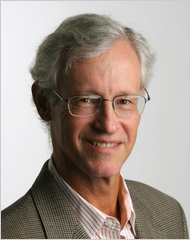
Arthur Brisbane
Across the paper’s many departments, though, so many share a kind of political and cultural progressivism—for lack of a better term—that this worldview virtually bleeds through the fabric of the Times.
Well, maybe we need a better term.
Brisbane provides two examples of this supposed progressive bleeding:
As a result, developments like the Occupy movement and gay marriage seem almost to erupt in the Times, overloved and undermanaged, more like causes than news subjects.
The Occupy Wall Street movement “seem[ed] almost to erupt in the Times“? Actually, when the occupation began, the Times, like other corporate news outlets, virtually ignored the story (Action Alert, 9/23/11):
The anti-corporate protests have been lightly covered in the hometown New York Times: One piece (9/18/11) largely about how the police blocked access to Wall Street, and one photo (9/22/11) with the caption “Wall Street Protest Whirls On.”
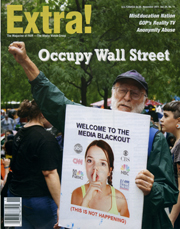
When U.S. media finally recognized that the OWS movement was a significant story that needed to be covered (Extra!, 11/11), the Times didn’t show any particular signs of overloving it:
Extra!, November 2011
A September 27 New York Times piece (FAIR Blog, 9/28/11) seemed to defend the police force’s brutal response, with reporter Joseph Goldstein depicting a police department concerned about “terrorism” and the “destruction and violence” that supposedly accompany “anti-capitalist demonstrations.” Such police worries, according to Goldstein, “came up against a perhaps milder reality on Saturday, when their efforts to maintain crowd control suddenly escalated”—an oddly passive way to describe police use of pepper spray and body slams against nonviolent demonstrators.
Goldstein wrote that the protesters “seem unorganized and, at times, uninformed.”… Condescension was a common thread in much of the coverage. In another New York Times piece (9/25/11), reporter Ginia Bellafante derided the “intellectual vacuum” of the protests, and their “apparent wish to pantomime progressivism rather than practice it.” She described one protester as a “half-naked woman…with a marked likeness to Joni Mitchell and a seemingly even stronger wish to burrow through the space-time continuum and hunker down in 1968.”
Even after OWS had been acknowledged across corporate media as a major story (Media Advisory, 10/18/11), Times writers just couldn’t help revealing how annoyed they were by the whole thing.
In the New York Times (10/17/11), former executive editor Bill Keller devoted a column about the “good news” happening around in the world—none of which has to do with the global movement against inequality: “Bored by the soggy sleep-ins and warmed-over anarchism of Occupy Wall Street?” Keller asks, before cheering Slovakia’s position on European Union bailout, which has done more “than the cumulative protests of Occupy Wall Street have done in a month of poster-waving.” A column by the Times‘ David Brooks (10/11/11) dismissed the protesters as “Milquetoast Radicals.”
A column by Andrew Ross Sorkin (10/4/11; FAIR Blog, 10/4/11) provides a better illustration of what Brisbane calls the “culture of like minds” that actually dominates the Paper of Record than the ombud’s fantasy of a leftie “hive on Eighth Avenue”:
I had gone down to Zuccotti Park to see the activist movement firsthand after getting a call from the chief executive of a major bank last week, before nearly 700 people were arrested over the weekend during a demonstration on the Brooklyn Bridge.
‘Is this Occupy Wall Street thing a big deal?” the CEO asked me. I didn’t have an answer. “We’re trying to figure out how much we should be worried about all of this,” he continued, clearly concerned. “Is this going to turn into a personal safety problem?”
As I wandered around the park, it was clear to me that most bankers probably don’t have to worry about being in imminent personal danger. This didn’t seem like a brutal group—at least not yet.
If you haven’t figured out that the New York Times is roughly 10,000 times more interested in producing news that’s of use to CEOs than it is in being helpful to anti-corporate activists, then your value as an analyst of the paper’s content is really quite limited.
P.S. They hire the kind of people they want to hire for this public editor job. Brisbane’s predecessor Daniel Okrent (5/25/04) wrote a similar goodbye column. Among the evidence he offered for the paper’s left-wing tilt:
The culture pages often feature forms of art, dance or theater that may pass for normal (or at least tolerable) in New York but might be pretty shocking in other places.



Washington Post blogger Erik Wemple (8/27/12), who also reviewed the New York Times‘ actual coverage of OWS, drew the appropriate conclusions about Arthur Brisbane’s approach to media criticism:
laughed at the last paragraph
“Liberal” is a useful appellation for the Times, as it allows it to piss on those truly challenging the power structure without the protofascist baggage of a Fox News or New York Post.
It legitimizes their jaundiced perspective among those who claim abhorrence toward those outlets … those who truly engage in “pantomime progressivism”.
I’ve alluded to this before, but I think it merits an encore performance:
http://www.metrolyrics.com/love-me-im-a-liberal-lyrics-ochs-phil.html
I just read the Okrent piece.
Wow. Just,…. just, wow!
I won’t go into the “Nixonland”-ian preoccupations that subtend the claims of Mr. Okrent’s apparent belief that the NYT is a Milhousian nightmare of urban and sophisticated “Franklins” spewing out their twisted (and seditious) morality disguised as cultural superiority, and then calling it news, as a just another species of mockery that the “liberal” media as a whole continues to hurl against the ceaselessly abused and delicate sensibilities of America’s “Orthogonians”.
Nope; I won’t do that.
But, it is rather hard to miss that Mr. Okrent’s got a “thing” about homosexuals…
Just sayin’.
Arthur Brisbane? Is that his real name or did he steal a pen name from the Mel Brooks movie ‘High Anxiety’ ? Sorry, but I just can’t take the NYT’s self-importance as seriously as they (and a lot of other people) do.
I always thought the Iraq War was to appease the left-wingers, and reading Okrent, it all makes sense – that must be why the New York Times moved Heaven, Earth and facts to help bring it about. (Snark). Funny how Okrent doesn’t mention Judith Miller’s campaign to sell W’s weapons of mass destruction propaganda in his assessment of the Times’ “liberal” bent.
Last night I watched “The Most Dangerous Man in America,” about Daniel Ellsberg and the Pentagon Papers, which included the NY Times’ vigorous defense of free speech and supporter of the press as the watchdog of government. It’s a different ballgame if you’re discussing the NY Times’ treatment of Ellsberg compared with Bradley Manning, even though their leaks were similar in many ways. Of course, comparing writers like Judith Miller to those such as David Halberstam and Neil Sheehan shows the change the newspaper has gone through, but it certainly hasn’t moved towards the left, just away from real journalism.
Thank you FAIR… With all their money the NYT can’t seem to find decent fact checkers… convenient for them and brain crushing for the rest of us. The New York times is not and never will be “left”.
If the police had spent as much time money and effort on Wall Street catching criminal bankers and financiers Occupy would never have happened.
You missed two astonishing Times stories, about which I wrote Brisbane and got no response. The first mentioned the smell of OWS demonstrators. I suggested that if an article ever mentioned the smell of RNC delegates, for example, there would be hell to pay. The paper also ran a staged news event in which a conversation was arranged between OWS and Wall Street. The latter was represented by a modestly successful broker living in Queens with wife and kids, the former by a barefoot man in multicolored tights. I thought even Fox would be embarrassed to run that story.
In general the business and arts sections treated OWS more respectfully than the news pages did.
I saw the occupy movement firsthand(was in NY then).At first I thought it was a bloody mess, that would soon codify into a serious attempt by a broad range of people to make some type of statement against “something”dealing with questions pertaining to wall street and the great division of wealth in this country.I waited for that moment when it would crystalize into some salient point of interest.Im still waiting.You are lucky the press did not hammer home some of the filth and idiocy on such prominent display.They at least tried to leave a door open so that at some point it may explain itself to the average Joe.I still don’t think the man on the street has a clue what it is all about.Basically i get it.You believe wall street has too much power and lives to well at the expense of others.Wish you would of all just bought a huge sign saying that ,and paid to hang it from the Brooklyn bridge.Now if you have had your say we all have to get back to work.Thanks for coming.Moving on
If it weren’t for Paul Krugman, (who wrote more accurate stories about OWS in his blog than the reporters did,) I wouldn’t bother to read it.
Here are some more reasons not to read the NY Times: Tom Friedman, David Brooks, Ross Douthat, Thomas Edsall (most of the time.)
The best part of the Times (online) other than Paul Krugman’s column and blogs, is the reader comments. Those show a liberal bias. The paper does not.
Jeff why is it good to show a liberal bias?
@ michael “Show me an Arab we can trust” e:
Because, as the saying goes, “reality itself has a Liberal Bias”. As a consequesnce, it will always offend the rich, the powerful, and the bigoted.
Hope that helps.