

CBS‘s Bob Schieffer revealed his greatest fear on yesterday’s Face the Nation (11/4/12):
Let me just say, David Gergen, I think the worst of all worlds would be if one of the candidates won the popular vote and other won the Electoral College.
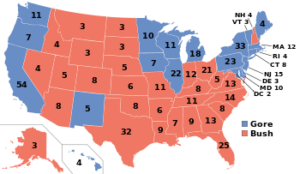
Bob Schieffer’s worst nightmare.
As the two made clear, they were talking about the possibility that Mitt Romney would win the popular vote and still not be president.
But it must be nice to know that the most terrible thing that could ever happen has already happened—as it did in 2000, when Al Gore won the popular vote by 300,000 votes and the Electoral College went for George W. Bush by five votes.
Funnily, though, Schieffer didn’t seem too upset by the prospect before the 2000 election (CBS Evening News, 11/2/00):
Well, Dan, you are right, this election is expected to be so close, one candidate could win the popular vote, but lose the vote that counts in the Electoral College. Remember now, the candidate who gets the most votes in each state gets that state’s electoral votes, which are allotted according to population….
It’s possible, for example, that Gore could carry California and New York, where he’s favored, and need only 14 additional states and the District of Columbia to win the presidency. If Bush carried the rest, he’d no doubt win the popular vote, but lose the election. That hasn’t happened since 1888, when Grover Cleveland got more votes than Benjamin Harrison, but lost the presidency as Harrison piled up a big lead in the Electoral College.
Then there’s the real nightmare. When it’s this close, an Electoral College tie is possible.
When it started becoming apparent that such a scenario was actually going to happen, no one at CBS (11/8/00) seemed very troubled by it:
SCHIEFFER: Well, I think you’ll see, and the Congress, people begin to call for eliminating the Electoral College. Now I don’t think that they in the end—they will do that. It’s very difficult to do. It would require a constitutional amendment, two-thirds of both houses of Congress would have to approve and then three-fifths of the state. That takes three or four or five years to get all that done. But I’m sure you’re gonna hear people call for doing that.
LESLEY STAHL: But I think that whoever is finally declared the winner, even if there’s a difference between the popular vote and the Electoral College, that the American people will accept the verdict of the Electoral College and we will move on, because that’s our system and it’s always worked and I believe it will work this time.
SCHIEFFER: Absolutely.
BRYANT GUMBEL: Amen.
Then, later, Schieffer (11/8/00) declared that the possibility of a candidate winning the presidency despite losing the popular vote was actually a good thing:
I, for one, am a fan of the Electoral College, because I think it makes the candidates campaign all across the country. If you do away with it, they’ll campaign in California and New York and Texas and Florida, and the rest of the country may not see them.
Yeah, without an undemocratic system that allows a tiny group to overturn the choice of a majority of voters, you might have a situation where presidential campaigns focused all their attention on a handful of states. And what a hellish world that would be to live in.



Schieffer’s ignorance is astounding.
Candidates campaign only in swing states because, due to the electoral college, every citizen’s vote is decidedly not equal.
The only citizen’s votes now courted are those that can potentially flip all of a state’s electoral college votes to one candidate. In 2000, only 543 citizen’s votes gave all of Florida’s 25 electoral college votes to Bush.
The Founding Fathers weren’t too big on justice in their Constitution. They counted non-voting slaves as 3/5 of a person toward the number of electoral college votes a state could submit to the national total, a distinct advantage to wealthy slave holder’s states. More slaves, more electoral college votes, but no votes for the slaves themselves.
From a crooked seedling grows a crooked tree.