

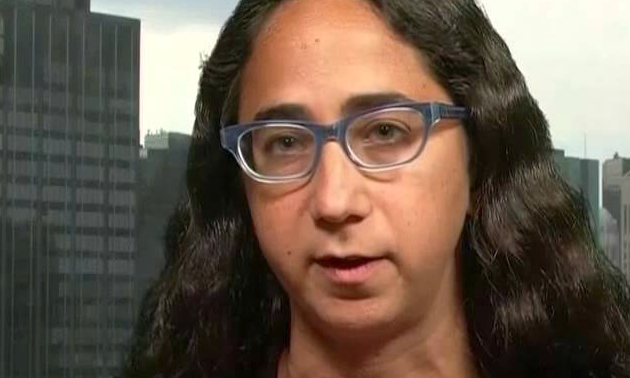
Janine Jackson interviewed Rachel Meeropol on Turkmen v. Ashcroft for the September 18 CounterSpin. This is a lightly edited transcript.
[mp3-jplayer tracks=”CounterSpin Rachel Meeropol @https://eadn-wc04-3257648.nxedge.io/audio/counterspin/CounterSpin091815-RachelMeeropol.mp3″]

Rachel Meeropol (RT)
Janine Jackson: Many remember too well the ugliness, hatred and violence unleashed after September 11, 2001, against Muslims, South Asians and Arab people. It wasn’t only mean-spirited individual bigots; the state itself, in the form of the FBI and INS, caught up hundreds of men and accused them of terrorism with no justification beyond their ethnicity or race, religion, or immigration status.
Not everyone accepts that the abrogation of human rights and the rule of law is just “stuff that happens” in the time of crisis, and people, including our next guest, have been fighting for justice for these men for years–calling to account not low-level rule-followers, but the rule-makers, including the former Attorney General John Ashcroft. Here to bring us up to date on the ongoing case known as Turkmen v. Ashcroft is Rachel Meeropol. She’s senior staff attorney at the Center for Constitutional Rights. Welcome to CounterSpin, Rachel Meeropol.
Rachel Meeropol : Thank you, it’s great to be here.
JJ: Listeners may not have heard very much at all about this case, so if you would, first tell us the basic grounds for it and for the selection of defendants.
RM: Absolutely. So the Center for Constitutional Rights filed Turkmen v. Ashcroft in 2002, when the 9/11 detentions were still ongoing. As most people may recall, shortly after 9/11, hundreds of Arab and Muslim men were swept up off the streets of New York and New Jersey. The FBI had opened up a tip line after 9/11, and hundreds and thousands of people called in with tips like, “My neighbor is Arab and he keeps strange hours, I think he must be a terrorist.” And on that level of information, the FBI and the INS would investigate the individual.
And if, in the course of that investigation, it became clear that the man was here in violation of the civil immigration law, maybe had overstayed his visa or was working without permission, he was arrested and held in connection to the terrorism investigation, treated as a suspected terrorist until cleared by the FBI and the CIA of any involvement in terrorism, and then deported.

Lead plaintiff Ibrahim Turkmen (image: CCR)
And many of the individuals arrested in this way were held in just outrageously restricted conditions of confinement in the Metropolitan Detention Center in Brooklyn. There they were abused by guards, they were held in solitary confinement, locked in their cells 23 to 24 hours a day, denied the ability to practice their religion, to communicate with the outside world. These detentions went on for months after 9/11, until eventually everyone was cleared and deported, and not a single detainee was found to have had any involvement with 9/11.
So the Center for Constitutional Rights brought the case to challenge the detentions, the religious profiling and racial profiling that led to the detentions, and the way these men were treated while they were detained. And we sought not just to go after the government officials who ran the Metropolitan Detention Center and the correctional officers who were individually responsible for beating our clients and the other detainees, and for treating them so terribly, but also the architects of the policy: former Attorney General John Ashcroft; former director of the FBI Robert Mueller; and the former commissioner of the INS, James Ziglar, who all formulated the plan to profile individuals, to arrest them in connection to the terrorist attacks, to hold them in these incredibly punitive conditions of confinement, in hope that this would lead to information about other potential terrorists.
JJ: So it may have meaning as an exemplar, but it’s not a symbolic case; these are real harms done to real people, and real people are responsible.
RM: That’s absolutely the case, and our clients have spent over a decade now fighting for their day in court, seeking compensation for the ways in which their lives were completely destroyed, in the hopes that that would allow them to sort of put their lives back together again, to get over what has happened. They don’t just care, though, about compensation for themselves; the clients and the former 9/11 detainees also really see this as a case to ensure that this kind of suspicionless, baseless religious and racial profiling doesn’t happen again. That it doesn’t go unpunished. If we cannot hold the high-level architects of discriminatory policy and abuse accountable, what is to keep it from happening again and again?
JJ: So what happened, then, in June at the Second Circuit appeals court? I think some folks may be surprised that the case has gotten as far as it has, but the appeals court’s ruling was interesting, and I guess encouraging; what happened there?
RM: That’s right; we’ve just had an amazing victory after so many years of struggling here. The Appellate Court reinstated our claims against the three high-level officials, and held that we should be allowed to move forward to discovery against these individuals, to find out the details of what actually happened, who ordered what. This came after the District Court had dismissed all of our claims against the three high-level officials.
So this was really a sea change in the way that the courts are looking at the ability of individual civil rights plaintiffs to hold the highest-level government officials accountable. While there has always been the theoretical possibility that an individual can sue a cabinet-level official for money damages for unconstitutional actions, it’s incredibly hard to actually move forward in a case like that. I don’t think it has ever, ever happened that civil rights plaintiffs have gotten discovery against cabinet-level officials. It just doesn’t happen, and that’s because it is so hard at the beginning of a case to have enough facts at your disposal to explain how these high-level people were actually involved in violating your individual rights. That’s not something civil rights plaintiffs generally have access to.
Because we’ve been involved in this case for so long, and because we were lucky enough to have some initial discovery against the United States about the 9/11 detentions, and also because those detentions were documented so thoroughly in two Office of the Inspector General reports, this is a rare situation where civil rights plaintiffs, pre-discovery, or before the completion of discovery anyway, have enough detail to get a court to say, “OK, you have plausible claims that these high-level officials violated your constitutional rights, let’s move forward.”

Former Attorney General John Ashcroft (cc photo: Gage Skidmore)
JJ: That seems to be where other cases have foundered; in Ashcroft v. Iqbal, they said he didn’t have enough details about the wrongs done to him–I guess it was really about the connection between John Ashcroft and the wrongs done to him. Was the problem just drawing that line all the way up?
RM: That’s absolutely right, and so in Turkmen we amended our complaint, after that Supreme Court ruling in Iqbal, to add the detail that the Supreme Court said was necessary to move forward against defendants of this nature, and so this is really the continuation of that battle.
JJ: The dissenter in that Circuit Court ruling, the dissenting judge said, “It’s difficult to imagine a public good more demanding of decisiveness, or more tolerant of reasonable even if mistaken judgements, than the protection of this nation or its people of further terrorist attacks.” I can see that echoing in the minds of many people; it certainly, though, begs the question that these were “reasonable judgements.” If a tall man commits a crime, we likely wouldn’t see a roundup of all the tall men in the area as reasonable, so it has something to do with who these people were.
RM: That’s absolutely right, and I think that’s the question at the heart of this case. Does the American public stand behind the idea that Muslims are suspicious because of their religion? Can we hold noncitizens to a different standard of justice than citizens? Does the fact that an individual is out of status mean they can be swept up and treated abusively in the hopes that maybe they might somehow have some information to share? Certainly white citizens in this country don’t face that kind of treatment. It’s our belief, and it’s our clients’ belief, that that kind of profiling cannot be the basis for rational law enforcement. It’s not simply that it doesn’t work, and it doesn’t, but it’s also that it’s completely amoral and unconstitutional.
JJ: We’ve been speaking with Rachel Meeropol of the Center for Constitutional Rights. You can learn more about this case and their work at CCRJustice.org. Thank you very much, Rachel Meeropol, for joining us today on CounterSpin.
RM: Thank you.



This has nothing to do with “protecting the public”
And everything to do with protecting power.
9/11, whether abetted, allowed, or simply taken advantage of, set the stage for the expanded “security” state, which the exploitocracy recognized as vital to its survival, as it proceeded to squeeze every drop of profit from those in its thrall.
We see the results in myriad manners, from quantum surveillance to the militarization of the police to immigrant detention to “ecoterrorist” prosecutions.
Fear makes folks do awful things
But this was coldly calculated to play upon those very failings of humanity.
In the United States Intelligence community the word ‘intelligence’ means a covert process to neutralize a target by threats, torture (physical & psychological), imprisonment or death.
https://www.academia.edu/16086427/Overthrow_Of_United_States_Government_By_fbi_cia
PS:
Vets beware: some very dangerous MDs work in VA hospitals and they may inappropriately seek to put you A W A Y, especially if you have experienced a terrifying or traumatic event in service, have called their phony hot line, or applied for PTS benefits.
http://portland.indymedia.org/en/2008/05/375399.shtml
Great beat ! I wish to pprentice att thhe same time
as you amend your site,how could i subscribe
for a blo web site? The account helped mme a appropriate deal.
I have been a little biit familiar of this your
broadcast offered bright clear concept