

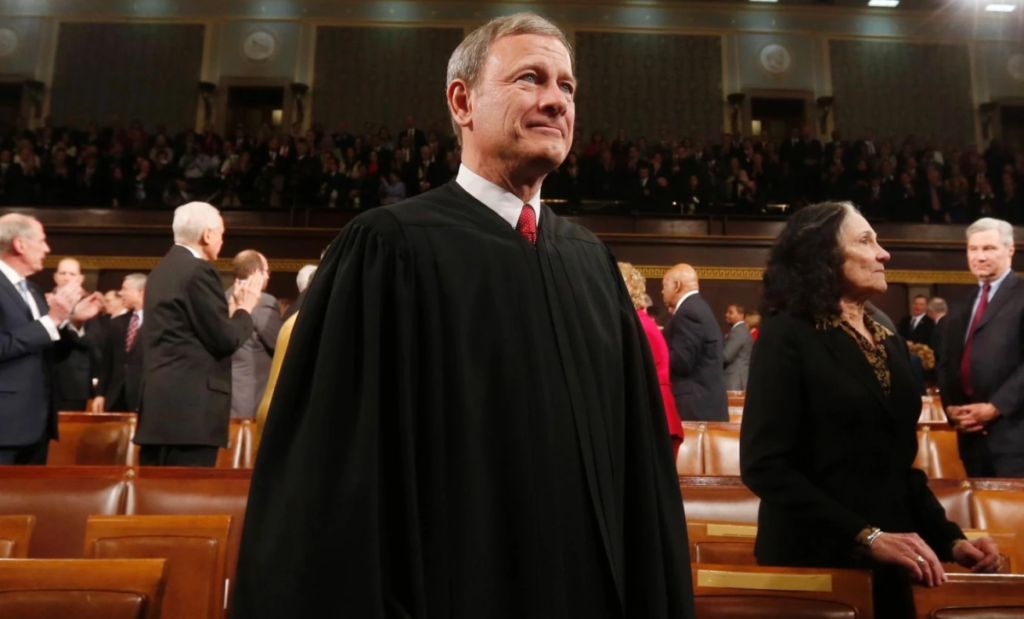

George Will’s Washington Post column was accompanied by a photo that correctly identified Chief Justice John Roberts. It went downhill from there. (photo: Larry Downing/Reuters)
Washington Post columnist George Will wrote a blistering attack on Chief Justice John Roberts’ recent ruling reaffirming the Affordable Care Act, King vs. Burwell, focusing on Roberts’ applying a judicial rule called the Chevron framework to the case. Let me quote at length from the version of Will’s column that appeared in the Investor’s Business Daily (6/25/15):
The most durable damage from Thursday’s decision…is the court’s embrace of a duty to ratify and even facilitate lawless discretion exercised by administrative agencies….
Rolling up the sleeves of his black robe and buckling down to the business of redrafting the ACA, Roberts cites a doctrine known as “Chevron deference.”
Named for a 1984 case, it is central to the way today’s regulatory state functions.
The doctrine is that agencies charged with administering statutes are entitled to deference when they interpret ambiguous statutory language.
As applied now by Roberts, Chevron deference obligates the court to ignore language that is not at all ambiguous but is inconvenient for the smooth operation of something Congress created. Exercising judicial discretion in the name of deference, Roberts enlarges executive discretion.
He does so by validating what the IRS did when it ignored the ACA’s text in order to disburse billions of dollars of subsidies through federal exchanges not established by the states.
Chevron deference does for executive agencies what the “rational basis” test, another judicial invention, does for legislative discretion.
I quote at such length because Roberts did not, in fact, apply Chevron to the ACA case. In fact, he explicitly said that Chevron wasn’t applicable to the case:
When analyzing an agency’s interpretation of a statute, we often apply the two-step framework announced in Chevron…. Under that framework, we ask whether the statute is ambiguous and, if so, whether the agency’s interpretation is reasonable…. This approach “is premised on the theory that a statute’s ambiguity constitutes an implicit delegation from Congress to the agency to fill in the statutory gaps.”…. “In extraordinary cases, however, there may be reason to hesitate before concluding that Congress has intended such an implicit delegation.”…
This is one of those cases. The tax credits are among the Act’s key reforms, involving billions of dollars in spending each year and affecting the price of health insurance for millions of people. Whether those credits are available on Federal Exchanges is thus a question of deep “economic and political significance” that is central to this statutory scheme; had Congress wished to assign that question to an agency, it surely would have done so expressly…. It is especially unlikely that Congress would have delegated this decision to the IRS, which has no expertise in crafting health insurance policy of this sort.
“It is instead our task to determine the correct reading” of the ACA passage at issue, Roberts concludes.
In case it needed spelling out, the Supreme Court’s summary of Roberts’ opinion does so: “Chevron does not provide the appropriate framework here.”
At some point, Will either noticed, or someone pointed out to him, that Roberts’ decision did the opposite of what Will’s column says it did: It did not defer to the executive branch’s interpretation of the ACA, but instead produced its own definitive interpretation of the law. This makes most of Will’s criticism–starting with the first paragraph, which denounces “decades of populist praise of judicial deference to the political branches”–irrelevant to the opinion Roberts actually wrote.
But that wasn’t going to make Will throw out a perfectly good column. Instead, by the time it appeared on its home base of the Washington Post (6/25/15), he had inserted a couple of minor changes: “Roberts cites a doctrine known as ‘Chevron deference'” became “Roberts invents a corollary to ‘Chevron deference,’” for instance. “As applied now by Roberts, Chevron deference obligates the court to ignore language….” morphed into “while purporting to not apply Chevron, Roberts expands it to empower all of the executive branch to ignore or rewrite congressional language.” Whereas the first version accused Roberts of “facilitat[ing] lawless discretion exercised by administrative agencies,” the revision changed that to “….administrative agencies and the executive branch generally.”
The Supreme Court performing its age-old task of interpreting laws, of course, does not invent any sort of corollary, or empower the executive branch to do anything to congressional law, or embrace a duty to ratify or facilitate any kind of discretion. It certainly isn’t “exercising judicial discretion in the name of deference,” since it expressly rejects deference as an appropriate standard. These are all complaints left over from the first version of Will’s column, when the pundit completely misunderstood what Roberts’ ruling said.
It’s actually a big deal that the Supreme Court settled what the ACA said rather than allowing the Obama administration to interpret it however it liked, as Salon‘s Jim Newell (6/25/15) pointed out:
Had the Court applied Chevron deference, whichever administration is in charge would be able to interpret the availability of subsidies on federal exchanges. For the ACA’s supporters and beneficiaries, that would have meant that the next Republican president would have had the authority to rewrite the rule to deny subsidies for people in 30-some states.

Emily Litella: a better pundit than George Will
By misreading the Roberts ruling, though, Will misses its actual significance. He comes across like Gilda Radner’s old Saturday Night Live character Emily Litella, ranting about “violins on television” or “conserving natural racehorses.” Although, unlike Emily, when it’s pointed out that he’s misunderstood the topic, Will doesn’t have the grace to say “never mind.”
Jim Naureckas is the editor of FAIR.org. Research assistance: Michael Tkaczevski.
Messages can be sent to the Washington Post at letters@washpost.com, or via Twitter @washingtonpost. Please remember that respectful communication is the most effective.



Kinda like when FAIR refuses to correct any of its articles even though there are material errors? as in when Jim Naureckas said the Times was ignoring Sanders even though the poll they published began before he was a candidate? or the blatant errors in the Venezuela columns? #doublestandards
It’s funny (as in “odd”) how FAIR articles always end with a little morality lesson, as if they’re afraid to let the substance of the article speak for itself.
Would it be going off subject to point out that George Will has also been assuring us for years that global warming a hoax?
Beyond obvious that Rooerts has decided, for whatever reasons, that he must support this lawless Administration and a President who thinks our Constitution is a joke. It’s not just that Roberts, a lifelong Conservative who has spoken out repeatedly in past about dangers of overreaching government, has twice now voted to support the most intrusive (and expensive) law Congress ever passed. But Roberts has gone through the most twisted legal distortions and convolutions to do so, even when the law and its implementation, are clearly either illegal, unconstitutional, or both. In fact, Roberts has both times essentially rewritten the ACA, so that he could vote for it.
So why would would an intelligent, dignified lifelong champion of conservative thought who knows full well how incompetent and dishonest this President is, go to great lengths in order to try justifying his support of the most damaging law ever passed?
Word among D.C. insiders is that Roberts has apparently been “reached” by the merry band of Chicago-type thugsters currently working for Obama. And these insiders also have a very good idea of how Roberts’ past makes him vulnerable to this blackmail.
Very sad for our country and its future indeed. It will take decades, if ever, for the country to recover from the effects of Obama and his destructive Administration.
Correction in last post: “Roberts”, in 1st sentence.
“But that was going to make…” Not. :-)
OC is oc the USA health-system’s coming of age, finally.
Word among D.C. insiders is that Roberts has apparently been “reached” by the merry band of Chicago-type thugsters currently working for Obama. And these insiders also have a very good idea of how Roberts’ past makes him vulnerable to this blackmail.
_____________________________________________________
[citation needed]