


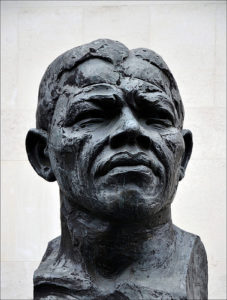
Statue of Nelson Mandela, London (cc photo: George Rex)
People who were closely watching the corporate media tributes to Nelson Mandela had to assume that certain aspects of Mandela’s life would be forgotten. Here’s one example, from CNN‘s Wolf Blitzer and Fareed Zakaria (12/5/13):
BLITZER: Fareed, we’re remembering Nelson Mandela, a world leader who made such, such a change, not only in South Africa, but, indeed, he inspired so many people around the world.
ZAKARIA: Absolutely, Wolf. I mean, you remember, this is a man born in 1918, born when the Sun never set on the British empire, and lived a long life, and was part of a kind of tradition of nonviolent resistance to colonial power and colonial oppression that was part of the Indian independence movement. He was greatly inspired by Gandhi, by the nonviolent struggle.
If you’re familiar with Mandela’s life story, you know this is misleading. Yes, Mandela initially pursued nonviolent resistance. But he led the armed wing of the African National Congress, a shift in strategy that Mandela and others believed would be more effective in their struggle against racist apartheid. It was that violent resistance that landed him in prison. In 1985, Mandela was offered a conditional release if he were to renounce violence; he refused.
Hours later on CNN, former Time editor Rick Stengel offered a more realistic assessment of Mandela’s views:
One of most interesting things he ever said to me was this idea of nonviolence. Remember, we compare him to Gandhi, we compare him to Martin Luther King. He said: “I was not like them. For them, nonviolence was a principle. For me, it was a tactic. And when the tactic wasn’t working, I reversed it and started”—that’s a very important difference.



…”had to assume that certain aspects of Mandela’s life would be forgotten.”
yes the armed resistance, as well as the neoliberal looting and crony disaster state
Oh how the mainstream loves non-violence when non-state resistance movements are the question, but how they love violence of the state.
Tactic or principle his actions in his later years indicate that he learned by reflecting on outcomes and modifying behavior. The journey to wisdom is sometimes very bumpy. See A Life Well Lived? http://eyesopeninginsearchofbeauty.wordpress.com/
non-violence works well when the threat of violence is waiting in the wings. remember the us gov was very concerned over the possibility of riots and civil war at the time MLK was making progress. he was the non-violent alternative.
Fareed Zakaria has to learn abut Gandhi from a non-Zionist objective source. Gandhi was as much supporter of non-violence as was Yitzhak Rabin. However, every colonial power has used Gandhi to lecture its victims.
Former New York Times executive editor Joseph Lelyveld in Gandhi’s biography ‘Great Soul: Mahatma Gandhi And His Struggle With India’ – has claimed Gandhi to be a sexual weirdo, a political incompetent and a fanatical faddist – one who was often downright cruel to those around him.
http://rehmat1.com/2011/03/29/gandhi%e2%80%99s-secret-love-for-jews/
“I do believe that, where there is only a choice between cowardice and violence, I would advise violence….I would rather have India resort to arms in order to defend her honour than that she should, in a cowardly manner, become or remain a helpless witness to her own dishonour.”
– Mahatma Gandhi
Tressco – In the following paragraph Ghandi also says “But I believe that nonviolence is infinitely superior to violence, forgiveness is more manly than punishment, forgiveness adorns a soldier.” The Doctrine of the Sword is not a simple document from which one line can be taken out of context. http://www.mkgandhi.org/nonviolence/Doctrine%20of%20the%20sword.htm
I would like to point out one thing. All the media point out the same non-violent tradition, that of Mandela, that of Martlin Luther King, and each is supposed to have its origin in Ghandi’s movement in India. OK, so where did Ghandi get his inspiration? Why, from Henry David Thereau, author of “On Walden Pond.” He also wrote a little essay entitled “Civil Disobedience.” Ghandi cites it as one of his sources. I wish this were brought out once in a while.
I confess to knowing very little about South Africa, apartheid, and the life of Mandela. Some people claim that because we in the US now have a black president, we therefore live in a “post-racial society.” When Mandela was president of South Africa, does that mean South African society became “post racial”? So my question is this, can it be said that an outcome of Mandela’s life is that there has been a redistribution of wealth and power in South Africa? Can we in the US claim a redistribution of wealth an power thanks to the life and times of MLK? I don’t wish to belittle the lives of these two men (King’s Riverside Church speech should be read by every school child), but I suspect the canonization of Mandela–the same canonization of King–really means that nothing or little has substantially changed.
Why’s it so difficult to spell “Gandhi” correctly? Just wondering.
He often said “I am not a saint”.And he was not.He was a man of principle.And his principles triumphed.Triumphed after he suffered mightily for them.Upon his death, we reflect that he gave over to his people some basic human rights, that were sorely lacking.He himself may of been violent…but he taught the world ( as Gandhi did)that you can accomplish much through peace.
Aww geez, I misspelled Thoreau’s last name as well. At least I caught that one now that Duncan has pointed out my error. I too am full of wonder how I could misspell these names.
One thing that we must remember is- he was given the chance many times to be released as long as he renounced terrorism.He would not.I was always glad that it seemed he did in fact renounce it.
Actually, mike, he refused the plea deal because it included no concessions from the government on their apartheid policies.
Reading is fun!
Good work. It’s good the media have the record set in facts as many people may not be as well informed or well read as some of us who are aware of the violent history . Ta-Nehisi Coates wrote a good piece that dug a bit deeper . http://www.theatlantic.com/politics/archive/2013/12/apartheids-useful-idiots/282114/
Janson of course it didnt.Why at that time would they of offered such a thing?They knew he was against that.As were a huge amount of south Africans both black and white.They would of released him understanding that.They simply asked him to renounce violence.Are you saying he stayed in jail on purpose…..because he did not like their policy?Sounds like he broke INTO jail.The records are not hidden.You can actually look up the release agreement.”and on his release shall promise to renounce violence…..”
No, the record is not hidden.
“Let Botha show that he is different to Malan, Strijdom and Verwoerd. Let him renounce violence. Let him say that he will dismantle apartheid. Let him unban the people’s organisation, the African National Congress. Let him free all who have been imprisoned, banished or exiled for their opposition to apartheid. Let him guarantee free political activity so that people may decide who will govern them.
I cherish my own freedom dearly, but I care even more for your freedom. Too many have died since I went to prison. Too many have suffered for the love of freedom. I owe it to their widows, to their orphans, to their mothers and to their fathers who have grieved and wept for them. Not only I have suffered during these long, lonely, wasted years. I am not less life-loving than you are. But I cannot sell my birthright, nor am I prepared to sell the birthright of the people to be free. I am in prison as the representative of the people and of your organisation, the African National Congress, which was banned.
What freedom am I being offered while the organisation of the people remains banned? What freedom am I being offered when I may be arrested on a pass offence? What freedom am I being offered to live my life as a family with my dear wife who remains in banishment in Brandfort? What freedom am I being offered when I must ask for permission to live in an urban area? What freedom am I being offered when I need a stamp in my pass to seek work? What freedom am I being offered when my very South African citizenship is not respected?
Only free men can negotiate. Prisoners cannot enter into contracts. Herman Toivo ja Toivo, when freed, never gave any undertaking, nor was he called upon to do so.
I cannot and will not give any undertaking at a time when I and you, the people, are not free.
Your freedom and mine cannot be separated. I will return.”
Now kindly STFU, mike.
Beautifully crafted words.I always loved his writings.I thought they rivaled any of our civil rights leaders.Then and now.Better yet is his seven pages written in “the cold days” on peaceful change.Is your point that when he was arrested after 17 months on the run and charged with planning armed action and conspiracy to help other nations invade South Africa,or when for years he was offered release conditions that it is all an oversimplification of those times?Agreed.You probably will not get some books I could recommend…how about this.Read a google bit entitled Opinion:Nelson Mendelas prison release speaks to complex legacy.
Did not know what STFU meant.I suppose i should of known.Come on now lets aim a bit higher in our discourse.Remember my point is that although Mendela was flawed and went through a time of violence…i always though his best days and accomplishments, were his gains achieved through peaceful methods.