

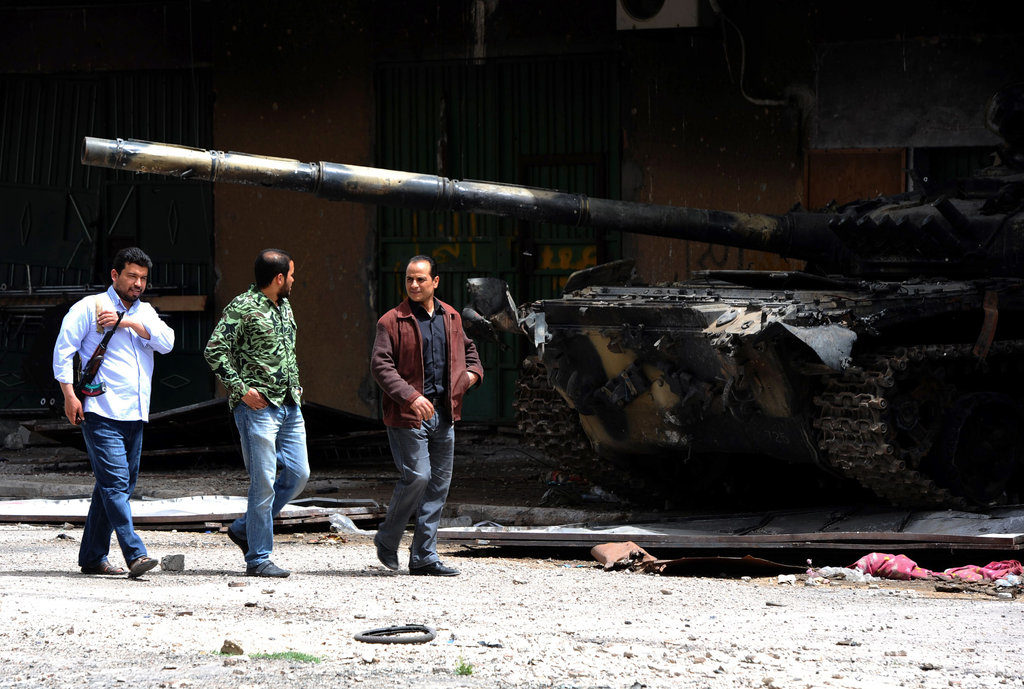
Today the New York Times describes the state of the war in Libya:
WASHINGTON — NATO plans to step up attacks on the palaces, headquarters and communications centers that Col. Muammar el-Qaddafi uses to maintain his grip on power in Libya, according to Obama administration and allied officials.
This “more energetic bombing campaign” included “a separate raid on Monday that temporarily knocked Libyan state television off the air.”
As the Times‘ Thom Shanker and David Sanger explain:
Officials in Europe and Washington said the strikes were meant to reduce the Libyan government’s ability to harm civilians by eliminating, link by link, the command-and-communications and supply chains that are required for military operations.
That is obviously the justification you’re going to hear from the people doing the bombing. Legally speaking, you are supposed to bomb targets that provide some military function—otherwise the attacks could be war crimes. Whether state television provides some concrete military advantage that would make journalists a legitimate target is a topic media outlets should discuss, for obvious reasons. But the Times seems willing to let the U.S./NATO explanations stand on their own.
But a more revealing admission comes later in the piece, when the Times talks about Kosovo and the lessons it teaches us about Libya:
Gen. John P. Jumper, who commanded United States Air Force units in Europe during the Kosovo campaign, recalled that allied “air power was getting its paper graded on the number of tanks killed”—even though taking out armored vehicles one by one was never going to halt “ethnic cleansing.”
So NATO began to hit high-profile institutional targets in Belgrade, the Serbian capital, instead of forces in the field. Although they were legitimate military targets, General Jumper said, destroying them also had the effect of undermining popular support for the Serbian leader, Slobodan Milosevic.
“It was when we went in and began to disturb important and symbolic sites in Belgrade, and began to bring to a halt the middle-class life in Belgrade, that Milosevic’s own people began to turn on him,” General Jumper said.
A military official is explaining that attacking certain civilian infrastructure can help to achieve a desired political outcome. That would seem to meet the conventional definition of terrorism, as violence directed against civilians for political ends. It’s not that is new information—NATO airstrikes in Belgrade were intended to harm civilians, and pundits cheered as this happened. But if the point is that the war in Libya is going to be more like Kosovo, this is disturbing.




It’s SOP for the corpress to speak of US war crimes in euphemisms – when they’re speaking of them at all.
But what’s always left out of the equation is what happens to the “good civilians” – such as those suffering in Misurata – when and if the West achieves its ends.
In this case, what will be the quid pro quo exacted for “humanitarian intervention” from the rebels should they defeat Gaddafi’s forces, or the country is partitioned?
It’s a safe bet that the goals of self-determination and true democracy held by so many in Libya will be subverted in the service of empire, isn’t it?
And what will all their sacrifice have been for?
Well said, Doug. War is unlikely to bring about peace, and militarism is unlikely to lead to democracy.
It’s okay to “kill your television” but you can’t kill everybody at the station. That’s a war crime.
When you speak of the “conventional definition of terrorism,” and then apply it to actions of NATO (or, for instance, the US), I think it is better to say “state terrorism” (with or without the quotes). But even so, it seems better yet not to use the term at all to refer to governmental or international-organizational actions, and save it for the violent actions of oppressed and relatively powerless groups within a given political environment. The actions of the US and NATO are better known as either “war crimes” or “crimes against humanity,” and therefore, we would like to think, at least theoretically prosecutable. I’m not aware that “state terrorism” could even theoretically lead to prosecution anywhere on earth.
@Daly Nicaragua v. United States is an example of “state terrorism” successfully prosecuted. Enforcing that judgement was another matter http://www.undemocracy.com/A-RES-41-31.pdf .
I am well acquainted with attitudes on these blogs. The unmitigated slack cut to all things liberal.It occurs to me that this “operation”happening in Libya with NATO forces- following US armed incursion would be seen in a far different light if BUSH were still the president. Here we are involved in regime change and nation building in another Arab/Muslim nation. Without any endgame, and very little explanation or even rational for what we are doing there. And it is almost as if there is a press blackout.Obama is not receiving the same level of attack and scrutiny from the left that i am sure Bush would be feeling.In fact almost nothing is being said. Astounding the hypocrisy.
Everything the left has been against – that led to the success in the Osama operation they now claim ownership of.Truly truly amazing.
I dont know from ‘endgames,’ Bush vs Obama or ‘regime change.’ ‘Nation building’ is hardly on the table at this point, so lets not get ahead of ourselves. (Why is ‘regime change’ a dirty word, or more correctly, phrase? Some regimes need to be changed and it is how it is accomplished and not that it is done that is the troubling question. If the population itself is willing to rise up against their own ‘regime,’ no matter the risk, why is it wrong to support that? The American colonists were willing to accept the ‘intervention’ of the French monarchy, even as they rebelled against their English king. Besides, MQ has had a much longer run than he deserved, more than time for him to take his looted billions and retire to Corfu)
I admit that at the time, with Mohmar’s announced intention of going “house to house and room by room’ to find and kill every rebel once his military forces had crushed the rebellion on the following day, I dreaded the coming specter of thousands of people being slaughtered while the world watched. Shades of Rwanda, Sudan.. But the next day, when I learned that forces, led by the US, had intervened to prevent that, I was relieved. Where it goes from here, I cannot guess. But for those people rising up to face down a miserable (and crazy) tyrant, with little more than their bare hands, I cannot help but be glad that a few of the world’s wealthy nations have bothered to provide some support. Not so for the Syrians, who are now shot down daily in their hundreds. Perhaps the Libyans will (provided they succeed) live to regret the involvement of the western nations in their struggle, but for now it is day to day and these concerns are necessarily down the road. No doubt the Europeans are thinking of their oil supplies, but then, what G20 nation does not? If that is the point of the assistance they are getting, then they are lucky to have that resource to bargain their survival with. If only Rwanda had had it…
And no, I dont think the US is or should be “the world’s policeman.” But honestly, the lunatic announced his intention to slaughter tens of thousands of his fellow citizens. What is the respondsibilty, if any, of the rest of the world? Personally, I like this better than the US in Iraq and Afghanistan. But then, I am a Pollyanna, and not admitting the wheels within wheels manuvering that is certainly going on that has nothing to do with the Libyans gaining control of their own country, the interests that will exploit the Libyans life and death struggle for more power, more money. Arms deals, multi-national takeovers of national resources, geopolitical strategic, blah, blah blah…
Nothing is clean and nobody plays it straight. I do know that.
NOTE: War Powers Resolution of 1973 (passed by the Congress over the veto pen of President Richard M. Nixon on November 7, 1973) conflicts with Article I, Section 8, Clause 11 of “this Constitution for the United States of America”, i.e., “The Congress shall have Power…To Declare War…”
As far as we can tell, the so called war powers “act” that President Obama and outgoing SECDEF Gates are said by Speaker Boehner to be violating (or “close” to violating) because of the Libya deployment of the U.S. Armed Forces, is the War Powers “Resolution”. Naturally, we conclude that such a “war powers” type resolution is unnecessary.
President Nixon thought so too, although for different reasons than we do (as far as we can tell). Mr. Nixon vetoed the WPR. Both the house and senate overrode his veto.
We further conclude that the (obvious) reason that the 1973 WPR has never really been necessary is because the 1788 Constitution already states that Congress has the sole power to “declare” war. In other words, the excessively complicated WPR isn’t needed or required, and never was. Congress was foolish to allow either President Kennedy or President Johnson to deploy the U.S. Armed Forces to Vietnam (which opened the door for President Nixon to subsequently carry the SE Asia counterinsurgency into Cambodia and Laos) during the 1960’s and early 1970’s – without first demanding that these three presidents “ask” for a “declaration” of war against Vietnam, Cambodia and Laos.
Demand you ask? Yes! Congress controls the constitutional purse strings for paying the cost of the U.S. Armed Forces…as well as for war. The Framers of the U.S. Constitution were not stupid! It’s just that members of congress have a real tendency to go through their macho/machona phases (even though the vast majority of them have never personally served in the uniform of our great nation in wartime in a war zone).
The constitutionality of the WPR has never been tested in the courts. If that were to happen, the WPR would certainly end up being “split-on” by Big Legal (the supreme Court). We flipped our ever present 50:50 coin on the WPR, and concluded that (if the WPR ever actually made it to the supreme Court), it would be end up being “split-on” 5-4, the WPR “winning out” over the Constitution. On the other hand (50:50 remember?), the supreme Court might actually do the right thing.
Frankly, we don’t see the point in a review by Big Legal. The Constitution simply could not be clearer. After all, the most disastrous war in the history of mankind got America’s attention with just a simple “Article I, Section 8, Clause 11”.
All that really needs to be done anytime the president deems it necessary to deploy the U.S. Armed Forces into combat against an offending entity is for him to “ask” congress to “declare” war on the offending entity, e.g., “the (formally recognized) government of (insert name of offending U.N. member country)”, e.g., Iraq, Libya, Serbia, Panama) OR “the (informally recognized) ‘government’ of (insert name of offending non-U.N. member entity)”, e.g., al Qaeda).
There is absolutely no reason in the world why al-Qaeda can’t be “declared war” on by congress.
After all, Israel has been at war with “Palestine” since 1948, and “Palestine” is not a U.N. member (although it briefly and fleetingly had U.N. recognition as a sovereign state in 1947). “Palestine” may soon become a sovereign Palestine again (after 64 years, the first 20 of which being occupied by Israel, Egypt & Jordan and the last 44 of which being completely occupied or controlled by Israel). Such sovereignty will be intriguing…not to mention being especially interesting to 1) the United States, which currently provides military financial (and other) support to Israel and to 2) Saudi Arabia & other members of the U.N. (to include the United States’ “Palestinian security assistance”), all of whom will suddenly find themselves providing support/assistance to a sovereign Palestine occupied by a sovereign Israel.
Incidentally, just because the president asks, should not be a guarantee that congress will say yes to a “declaration” of war. But then of course, there is always the macho (and even machona) heat-of-the-moment political factor, as when the resolution to invade Iraq was debated and voted on by congress just before the November 2002 congressional election. That is, the reelections of 100% of the House and 33% of the Senate were about to be determined by a voting electorate that hadn’t voted since the year prior to the al Qaeda attacks of September 11, 2001…and which voting electorate was (at the very least) being totally confused by Big Government (president & congress), Big Media, Big Business (military-industrial complex) & Big Politics (major political parties) as to the real nature of Saddam Hussein’s military (in)capabilities and (non)relationship with al Qaeda.
The last time the U.S. Constitution was complied with (as to a formal declaration of war) was during the presidency of Franklin D. Roosevelt (as to U.S. participation in World War II – 1941-45). Beginning in 1950, however, President Truman apparently “forgot” that there is an “Article I, Section 8, Clause 11”, and deployed the U.S. Armed Forces into combat in Korea based only on a U.N. Security Council resolution (that kind of thing, of course, never happening again since, as far as we know).
World War II’s “declarations” of war (joint congressional resolutions) were simple, direct and to the point.
Here is an example of how the “Article I, Section 8, Clause 11” process is supposed to work…this, after the president “asks” for a congressional “declaration”, to wit: President: “I ASK that the CONGRESS DECLARE that since the unprovoked and dastardly attack by Japan on Sunday, December 7, a state of WAR has existed between the United States and the Japanese Empire.” (EMPHASIS added):
Senate Joint Resolution 116 & House Joint Resolution 254 December 8, 1941: “Whereas the Imperial Government of Japan has committed unprovoked acts of war against the Government and the people of the United States of America: Therefore be it Resolved, etc., That the state of WAR between the United states and the Imperial government of JAPAN which has thus been thrust upon the United States is hereby formally DECLARED; and the President is hereby authorized and directed to employ the entire naval and military forces of the United States and the resources of the Government to carry on war against the Imperial Government of Japan; and to bring the conflict to a successful TERMINATION, all of the resources of the country are hereby pledged by the CONGRESS of the United states.” (EMPHASIS added).
Similar declarations were asked for by the president and made by congress as regards Germany and Italy, the other two members of the Axis Powers.
One of the most important phrases in the aforesaid formal congressional (constitutional) declaration of war is: “…to bring the conflict to a successful TERMINATION…”. (EMPHASIS added).
Unfortunately, counterinsurgencies conducted by foreign counterinsurgents never “terminate” until the departure of said counterinsurgents.
And even then, the underlying insurgencies themselves continue after that for “as long as it takes”, against the indigenous government that the foreign counterinsurgent power leaves behind…until said foreign power inevitably withdraws military financial support for said “puppet” government, e.g., 1) U.S. counterinsurgency in Vietnam 1963 (some say 1960) to 1973 (insurgency concludes in 1975 – with end of U.S. absentee congressional military financial support, the S. Vietnamese “puppet” government falling to a 30-year insurgency (some say 88-year insurgency against the French, Japanese and then Americans), capped by a N. Vietnamese invasion masterminded by the still revered and still alive General Vo Nguyen Giap, who is 99 years of age) 2) Soviet counterinsurgency in Afghanistan 1979-89 (insurgency concludes in 1992 – with end of Soviet absentee military financial support, the Afghan “puppet” government falling…and then various types of internal military conflicts continuing until 2001, when the United States enters the at least 160-year old Afghan fray looking for Osama bin Laden, and then foolishly gets involved in its own counterinsurgency…said counterinsurgency still ongoing even after the demise of Osama bin Laden in Pakistan in 2011). When (not if) the U.S. departs Afghanistan, it is inevitable that the government it leaves behind will eventually fall, the known history of counterinsurgencies yet once again prevailing.
And then, of course, there is the “Malayan Emergency” that diehard counterinsurgency buffs simply will not let go of. In that case, the British Commonwealth conducted a counterinsurgency in Malaya (now Malaysia) 1948-60, claimed victory and departed after a total of 189 years of British colonial intervention and control. However, the communist insurgency began anew in 1967, and didn’t end until 1989 [a total of 59 years against the 1) British 2) Japanese during World War II and the 3) British Commonwealth after World War II]…the “founding” Chinese communist insurgent, Chin Peng, still alive today in exile…almost 90 years old…and still claiming adherence to his communist ideals. OKJGp┞¢
OKJack┞¢Group┞¢
Middle and Working Class Disabled American Veterans┞¢
We Paid the Dues that Aren’t Required!┞¢