


New York Times photo of Navy pilots returning from bombing Iraq. (photo: Adam Ferguson/NYT)
Trying to wring some melodrama out of the not particularly dangerous lives of US bomber pilots, the New York Times‘ Helene Cooper starts off an article with an anecdote about two US Navy jets taking off from an aircraft carrier on a bombing mission in Iraq:
In one of the fighter jets was Navy Lt. Michael Smallwood, 28, call sign Bones, and in the other was his friend and roommate, Navy Lt. Nick Smith, also 28, call sign Yip Yip.
For a minute or two that day in May, the Hornets were right next to each other in the sky, but then Lieutenant Smith’s plane had engine trouble and began to lose altitude. Over the radio, Lieutenant Smallwood could hear his friend turn around, try to land back on the carrier and then eject into the Persian Gulf. The $60 million Hornet crashed into the sea.
Lieutenant Smallwood found himself fighting to keep his mind off the fate of his friend, but his orders were to continue climbing and fly on to Iraq.
Midway through the article—whose main point, according to the headline, is that “For US Pilots, the Real War on ISIS Is a Far Cry From Top Gun“—Cooper teases readers again:
As Lieutenant Smallwood’s plane flew toward Iraq in May after his friend had ejected from his own jet, he could hear from the chatter on the radio that a recovery effort was underway. But Lieutenant Smallwood knew better than to clog up the frequency asking if Lieutenant Smith and his weapons officer on the plane had been found alive.
Five more hours to go. Arriving in the skies over Iraq, Lieutenant Smallwood’s Super Hornet connected with a refueling tanker to get gas, then continued with the task at hand. But whenever there was a lull in the flight, “all I could think about was my roommate and his W.S.O.,” Lieutenant Smallwood said, using the military term for weapons officer.
At the end of the article, Cooper finally reveals the information withheld from her initial anecdote: Spoiler alert! The pilot who ejected was fine. She ends with a quote from his roommate:
“But I still had to run down to the room to see for myself,” Lieutenant Smallwood recalled. “First thing I did was hug him.”
This cozy ending to Cooper’s drawn-out tale was not altogether surprising, given the low casualty rate for US military personnel in what the Pentagon refers to as Operation Inherent Resolve: The Navy has lost only two people in a year of combat, both in non-combat related injuries, one of which involved falling off a balcony while on leave (Air Force Times, 8/24/15).
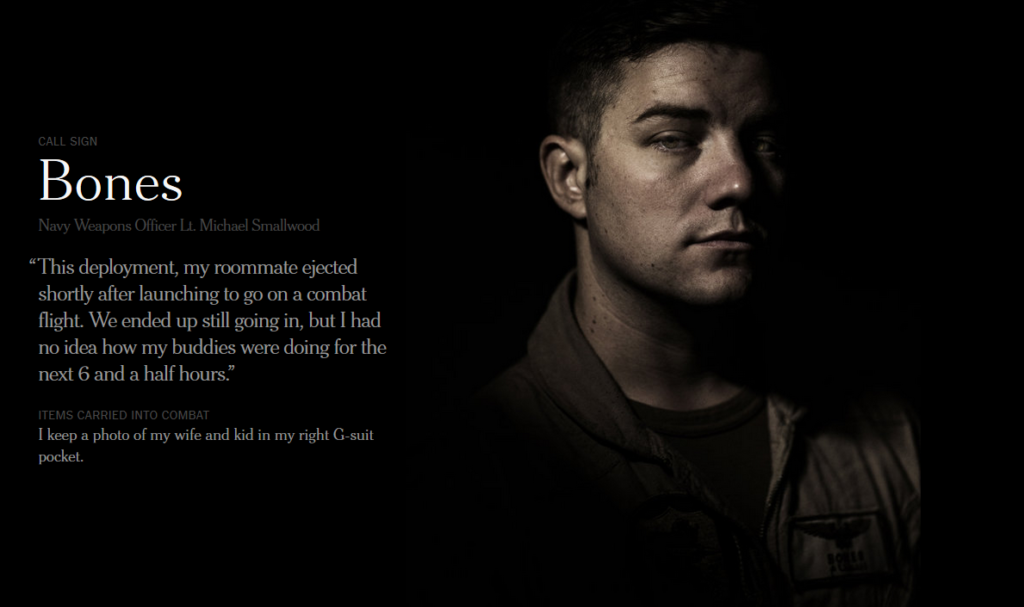
The Times article is accompanied by a photo gallery of bomber flyers, including Lt. Michael “Bones” Smallwood, whose tale of a time he was worried dominates the piece. (photo: Adam Ferguson/NYT)
Cooper does her best nevertheless to make the reader empathize with the risks faced by bomber pilots, despite a former flyer’s admission that “if you stay above 10,000 feet, you’re not going to be hit.” Though the mechanical difficulties faced by Yip Yip dominate the story, Cooper asserts that “engine troubles are not the only risk at 25,000 feet.” What else is there? Well, there’s acceleration: “The F/A-18s today require more G-forces than the planes of the Top Gun era, and pilots today pull nine Gs instead of four and five Gs”—so pilots have to make sure they are “not dehydrated or hungover from drinking and crooning the Righteous Brothers to Kelly McGillis at a bar the night before.”
For comparison purposes, riders on the Shock Wave roller coaster at Six Flags Over Texas experience six Gs—placing the amusement park-goers somewhere between Maverick and Bones on the toughness scale.
There’s one other risk “beyond that” that Cooper presents the bomber pilots as facing, though they’re not actually the ones facing it:
Despite the precautions the pilots say they take, there are civilian casualties from airstrikes, although the number is in deep dispute. Officials with United States Central Command, which oversees American military operations in the Middle East, recently said that they had received reports of 31 episodes involving civilian casualties since the airstrikes began, and had dismissed 17 as not credible, with six still under investigation. One report, investigated for more than six months, led Centcom officials to conclude that two children were probably killed by a coalition airstrike.
That paragraph is followed by a one-sentence paragraph: “Monitoring groups say the command’s figures are a gross understatement.” But that’s the last we hear from these monitoring groups; instead Cooper goes back to a Navy officer, who assures us that “in the war against the Islamic State, bombs hit their intended targets almost all of the time,” because “world opinion swings very violently against you when you start killing the wrong people.”
Cooper also tells us that flyers “spend a lot of their time in the air watching patterns of civilian life, to determine whether a movement on a road just outside of Ramadi is a truck full of Islamic State fighters or a pickup with civilians,” and that “they very often return to the Roosevelt [aircraft carrier] with all of their bombs still strapped to the planes.”
If she had talked to some of those monitoring groups, readers would have gotten a very different picture. The monitoring project Airwars, for example, says that at least 575 civilians have been killed in well-reported incidents connected to confirmed US or US-allied airstrikes from August 2014 through August 2015. With nearly 5,000 airstrikes conducted by the US and its allies in the first 11 months of the bombing campaign, this suggests that for every 10 air raids Yip Yip and Bones carry out, roughly one civilian is killed.
Cooper is right about one thing: That sure doesn’t sound like Top Gun.
Jim Naureckas is the editor of FAIR.org.
You can send a message to the New York Times at letters@nytimes.com, or write to public editor Margaret Sullivan at public@nytimes.com (Twitter:@NYTimes or @Sulliview). Please remember that respectful communication is the most effective.



Yeah, these ‘heroes’ bombing the Afghans, Iraqis, Syrians, and sundry really do have it rough… I understand the flak over Kabul is nearly as bad as that over MCAS Miramar.
“Death defying”
And death denying
I wish Cooper of the New York Times had asked them to comment on what it’s it’s like to now be navel aviators (meaning officers) in a war that Bush/Cheney started when they were still in highschool.
These young men have known an USA at war for much of their lives, would be nice to see if they have any idea why ISIS took over northern Iraq. They, if allowed to comment, would probably spout the Jeb Limbaugh lie that “It’s Obama to blame. Everything was peaceful and in 2008.”
As for just bombing ISIS and not killing non-ISIS types, how did that work when the USA tried to bomb the Ho Chi Minh trail in Cambodia? The Khmer Rouge don’t at all resemble ISIS. Not.
Articles like this NYT are just pedestrian propaganda for what is essentially terrorism by us, the US, by bombing. Calling a large explosion ‘pinpointed’ or similar terms is Orwellian nonsense to try to distract from the fact that explosions are a large-diameter event and — in a populated urban area — will always cause ‘collateral damage’, as in dead civilians (like children and women and other non-combatants). It’s always sickening to see these facile flag waving articles that ignore the other side of the equation — what it’s like to be underneath the falling bombs. But then, conversely, when someone bombs us (often in a futile, personal attempt at retaliation for US military actions abroad, ‘blowback’) it’s the crime of the millennia and world opinion just HAS to join us in vehemently, rabidly condemning and persecuting the attacker(s).
I wonder what they’ll write when the rest of the world catches up with our drone warfare and turns in on the US. Where are the Paul Tibbets of tomorrow going to come from when unmanned flying weaponry and cameras fill our skies? Whose indifference to civilian suffering will we then be able to celebrate?
Reminds me of Walter Cronkite’s coverage of US strategic bombing campaign early in the Vietnam war.
Something else to note is the relatively small amount of ordinance dropped in these bombing missions:
“In one of the fighter jets was Navy Lt. Michael Smallwood, …and in the other was his friend and roommate, Navy Lt. Nick Smith….”
…
“they very often return to the Roosevelt [aircraft carrier] with all of their bombs still strapped to the planes.”
The 6,000+ airstrikes by US and coalition forces is about 6-11 airstrikes per day and if its just 2 planes and if they often return without attacking ISIS this air campaign is all smoke and no fire.