


The New York Times wanted you to know that Aecio Neves was Brazil’s “pro-growth” candidate. (photo: Felipe Dana/AP)
The New York Times‘ James Stewart (10/24/14) made clear which side we should be rooting for in the Brazilian presidential elections: the side that lost yesterday.
“Rarely, if ever, has such a pro-growth, market-friendly candidate emerged as a serious presidential contender in a developing country,” wrote the business columnist, who writes under the modest heading “Common Sense.”
Stewart was referring to Aécio Neves, governor of the state of Minas Gerais and the favorite of “investors and business people in Brazil.” Neves ended up losing to incumbent President Dilma Rousseff, described by Stewart as “a former Marxist guerrilla who praises Mr. [Hugo] Chávez as ‘a great Latin American.'”
Neves had promised to name as his finance minister Arminio Fraga, a hedge fund manager and “an unabashed champion of market capitalism and pro-growth government policies.” “By any standard, we represent a pro-market, pro-growth approach,” Fraga told Stewart, promising that Neves’ policies would bring “renewed economic growth.”
So Brazilians voted to keep economic growth low? Well, even more than with most subjects in the news, international economics seems to be an area where reality is whatever journalists want to say it is. In Latin America in particular, “pro-growth” policies are not necessarily those that in the past have resulted in high growth (FAIR Blog, 1/16/14).
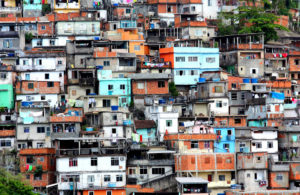
Investors may have the New York Times‘ ear, but they don’t have as many votes as the favelas, where extreme poverty has decreased by almost two-thirds in recent years. (cc photo: Dany13)
Mark Weisbrot, an economist who writes frequently about Latin America, wasn’t surprised that Brazilians chose Rousseff over Neves; in a pre-election Guardian column (10/2/14), he wrote:
Despite the slowdown of the past few years, and the 2009 world recession, Brazil’s GDP per person grew by an average of 2.5 percent annually from 2003 to 2014. This was more than three times the growth rate during the preceding two terms of President Fernando Henrique Cardoso, who implemented “Washington Consensus” policies and remains a much-preferred statesman in the US capital. Before Cardoso, there was a decade and a half of even worse economic failure, and income per person actually fell.
This return to growth, plus the government’s use of increased revenues to boost social spending, has reduced Brazil’s poverty rate by 55 percent and extreme poverty by 65 percent.
Cardoso belonged to the same party as Neves, the Brazilian Social Democratic Party, which despite its name takes a center-right line. This may explain why Neves’ “pro-growth” policies were not as convincing to Brazilian voters as they are to New York Times columnists.




Seriously Does the NYT even exist in this reality, or do they simply make up the world they want as they go along. To borrow from H2G2 by Douglas Adams ‘The NYT staff will be the first up against the wall when the revolution starts.’
padremelleryn, love your comments. “Pro-growth,” that’s capitalist slang for collective suicide. How much growth can one planet accommodate? Huge Chavez IS a great Latin American. Witness the outpouring of support from the Venezuelan people when George Bush the dunce tried to depose and murder him in 2002. “Minas Gerais [is] the favorite of ‘investors and business people in Brazil,’” which is to say the lowest scum of the already too ripe scum on the planet. Renewed economic growth? Who needs it? I have a better idea. How about perfect economic equality for all 7 billion on the planet; and survival for us all rather than a realization of the imminent extinction we’re all facing?