


Does this look like a “crisis”?
The PBS NewsHour (1/29/13) took a look at military spending cuts in advance of Chuck Hagel‘s confirmation hearings to be Barack Obama’s next secretary of Defense. The segment unfortunately presented a very narrow view of the issue, one that mimics the kind of coverage we see elsewhere in the corporate media.
Host Gwen Ifill set the stage by referring to the “Pentagon’s looming budget crisis.” Yes, there are plans to cut military spending–but calling that a “crisis” adopts the perspective of military contractors and Pentagon officials. Correspondent Kwame Holman followed up by reporting that “hundreds of thousands of the Pentagon’s civilian employees will face furloughs and reduced paychecks as early as April.”
To discuss the issue, Holman spoke to two sources: Gordon Adams, a Clinton-era military budget official, and Thomas Donnelly of the conservative American Enterprise Institute, who “worked on defense issues for Republican members of Congress. ” Donnelly is very critical of plans to cut military spending, and in fact thinks the size of the military forces is too small.
The problem with these discussions is that, as economist Dean Baker has pointed out, viewers are given no sense of what the cuts mean relative to the size of the military budget in total. As Ifill puts it in the top of the show, the sequester means that “the Defense Department may have to find $52 billion in savings this year and half a trillion dollars over the next decade.”
Those are, you know, really big numbers, right? But without knowing how big the Pentagon budget is, you have no way of knowing what those cuts actually mean.
The closest PBS got to explaining any of this was when Holman said this:
Historically, military spending rises during wartime and declines by about 30 percent once the war is over. So spending that went up nearly 70 percent in constant dollars since 2001 is on the way down, as the U.S. leaves Afghanistan and the Iraq war has ended.
That means even if Congress and the president reach a budget deal and avoid automatic spending cuts, the Pentagon’s budget still is going to be reduced significantly, says Adams.
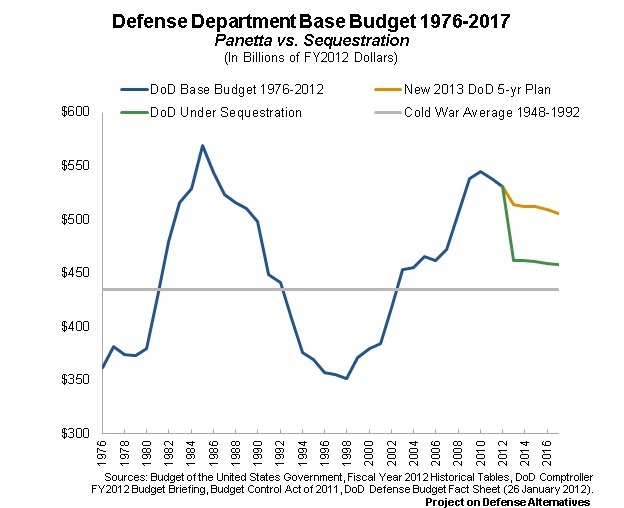
So we know military spending dramatically increased. So are these “crisis” cuts comparable to those increases? Not really. Ifill told viewers that the Pentagon might have to find $500 billion in cuts over the course of the decade. But what viewers should have known is that they’re planning on spending something like $8 trillion over the same time. So this massive, job killing fiscal “crisis” amounts to maybe 6 or 7 percent of their projected spending.
As the graph below shows, even if the cuts that are set to take effect and the sequestration cuts were to occur (the latter are very much up in the air), the Pentagon would be forced to get by on something like its 2004 or 2006 budget–still well above the Cold War average.
The NewsHour should have done a better job putting these numbers in context–though their history on this issue isn’t very encouraging. As we pointed out last year, one segment on the same issue included as experts Newt Gingrich, Mitt Romney and a Pentagon official. If you’re not willing to go and speak to sources outside elite politics, it’s going to be very hard to get a critical take on an issue like this. But that’s exactly what PBS is supposed to do.



So, once more, with feeling …
Public broadcasting as a concept should be defended.
Public broadcasting as a reality should be suspended.
Most of those who pontificate about “runaway government spending” and are literally salivating at the chance to slash or to eliminate social programs which we allegedly can no longer afford, have never explained why they think that subsidizing the Pentagon at or above the levels of the long gone Cold War until the end of time, is acceptable.
When the Own the Information, they can bend it all they want.
Thats why we’re waiting,
“budget crisis”, “sources outside of elite politics”, how entertaining would that be, we need contributors AND NOW donors and SPONSORS. We need Crises and Celebrities and occasionally slip in a Celebrity IN Crisis like a vacuous tabloid.
One more reason why I no longer own a TV. I thought I’d miss it, but I don’t. It was 150 channels of crap, and a tremendous waste of time.
This time let’s make sure that there is a real peace dividend!
O.K. so if PBS is a mouthpiece for the system, why does half the system always want to kill it? Is that just theater?
The only argument we should be having, is the same argument we should be having over woman in combat situations.7 words……Will these moves make our military stronger?If the answer is a definitive no,then we need to debate a few issues.#1.Can we afford to “not afford”a military that is par to none?#2 …has the deteriorating economic situation made sustaining our military might a foregone conclusion(much like Russia after their collapse)?And when will anyone in the government come clean on the true nuts and bolts nature of theses debates.
The American Enterprise Institute? Talk about a propaganda mill. Good god, what has PBS come to?
Many PBS programs are now “underwritten” (ie sponsored) by mega corporations and the Koch Brothers. Seen the lovely propaganda from Monsanto? This makes all their news programs and much of their other programming suspect, and is the very reason Republicans and others want to privatize it. Then it becomes just another way to sell junk and control the messages we see and hear. No mystery at all. I quit watching PBS News Hour the day I watched live streaming footage of Occupy Wall Street and then saw/heard the actual lies and distortions spouted by news anchors on PBS.