


In an earlier piece (FAIR.org, 3/3/21), we explored some country case study examples of how the press helps to manufacture consent for regime change and other US actions abroad among left-leaning audiences, a traditionally conflict-skeptical group.
Some level of buy-in, or at least a hesitancy to resist, among the United States’ more left-leaning half is necessary to ensure that US interventions are carried out with a minimum of domestic opposition. To this end, corporate media invoke the language of human rights and humanitarianism to convince those to the left of center to accept, if not support, US actions abroad—a treatment of sorts for the country’s 50-year-long Vietnam syndrome.
What follows are some of the common tropes used by establishment outlets to convince skeptical leftists that this time, things might be different, selling a progressive intervention everyone can get behind.
Think of the women!
The vast majority of the world was against the US attack on Afghanistan that followed the 9/11 attacks in 2001. However, the idea had overwhelming support from the US public, including from Democrats. In fact, when Gallup (Brookings, 1/9/20) asked about the occupation in 2019, there was slightly more support for maintaining troops there among Democrats than Republicans—38% vs. 34%—and slightly less support for withdrawing troops (21% vs. 23%).
Media coverage can partially explain this phenomenon, convincing some and at the least providing cover for those in power. This was not a war of aggression, they insisted. They were not simply there to capture Osama bin Laden (whom the Taliban actually offered to hand over); this was a fight to bring freedom to the oppressed women of the country. As First Lady Laura Bush said:
We respect our mothers, our sisters and daughters. Fighting brutality against women and children is not the expression of a specific culture; it is the acceptance of our common humanity—a commitment shared by people of goodwill on every continent…. The fight against terrorism is also a fight for the rights and dignity of women.
Wars are not fought to liberate women (FAIR.org, 7/26/17), and bombing people is never a feminist activity (FAIR.org, 6/28/20). But the New York Times was among the chief architects in constructing the belief in a phantom feminist war. Within weeks of the invasion (12/2/01), it reported on the “joyful return” of women to college campuses, profiling one student who
strode up the steps tentatively at first, her body covered from face to foot by blue cotton. As she neared the door, she flipped the cloth back over her head, revealing round cheeks, dark ringlets of hair and the searching brown eyes of a student.
The over-the-top symbolism was hard to miss: This was a country changed, and all thanks to the invasion.
Time magazine also played heavily on this angle. Six weeks after the invasion (11/26/01), it told readers that “the greatest pageant of mass liberation since the fight for suffrage” was occurring, as “female faces, shy and bright, emerged from the dark cellars,” casting off their veils and symbolically stomping on them. If the implication was not clear enough, it directly told readers “the sight of jubilation was a holiday gift, a reminder of reasons the war was worth fighting beyond those of basic self-defense.”
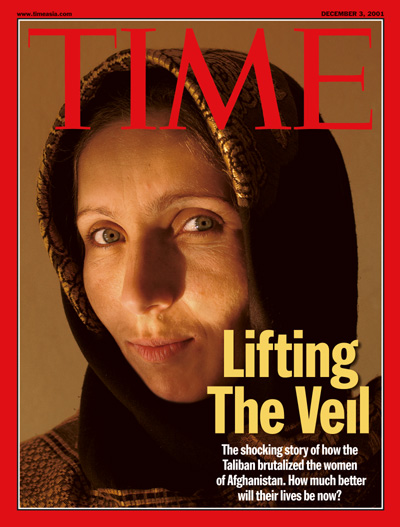
A few days later, Time‘s cover (12/3/01) featured a portrait of a blonde, light-skinned Afghan woman, with the words, “Lifting the Veil. The shocking story of how the Taliban brutalized the women of Afghanistan. How much better will their lives be now?”
This was representative of a much wider phenomenon. A study by Carol Stabile and Deepa Kumar published in Media, Culture & Society (9/1/05) found that, in 1999, there were 29 US newspaper articles and 37 broadcast TV reports about women’s rights in Afghanistan. Between 2000 and September 11, 2001, those figures were 15 and 33, respectively. However, in the 16 weeks between September 12 and January 1, 2002, Americans were inundated with stories on the subject, with 93 newspaper articles and 628 TV reports on the subject. Once the real objectives of the war were secure, those figures fell off a cliff.
Antiwar messages were largely absent from corporate news coverage. Indeed, as FAIR founder Jeff Cohen noted in his book Cable News Confidential, CNN executives instructed their staff to constantly counter any images of civilian casualties with pro-war messages, even if “it may start sounding rote.” This sort of coverage helped to push 75% of Democratic voters into supporting the ground war.
As reality set in, it became increasingly difficult to pretend women’s rights in Afghanistan were seriously improving. Women still face the same problems as they did before. As a female Afghan member of parliament told Phyllis Bennis of the Institute for Policy Studies (CounterSpin, 2/17/21), women in Afghanistan have three principal enemies:
One is the Taliban. Two is this group of warlords, disguised as a government, that the US supports. And the third is the US occupation…. If you in the West could get the US occupation out, we’d only have two.
However, Time managed to find a way to tug on the heartstrings of left-leaning audiences to support continued occupation. Featuring a shocking image of an 18-year-old local woman who had her ear and nose cut off, a 2010 cover story (8/9/10) asked readers to wonder “what happens if we leave Afghanistan,” the clear implication being the US must stay to prevent further brutality—despite the fact that the woman’s mutilation occurred after eight years of US occupation (Extra!, 10/10).

Vox (3/4/21) asserted that the US occupation of Afghanistan has meant “better rights for women and children” without offering evidence that that is the case.
The trick is still being used to this day. In March, Vox (3/4/21) credulously reported that Joint Chiefs of Staff chair Gen. Mark Milley made an emotional plea to Biden that he must stay in Afghanistan, otherwise women’s rights “will go back to the Stone Age.” It’s so good to know the upper echelons of the military industrial complex are filled with such passionate feminists.
In reality, nearly 20 years of occupation has only led to a situation where zero percent of Afghans considered themselves to be “thriving” while 85% are “suffering,” according to a Gallup poll. Only one in three girls goes to school, let alone university.
And all of this ignores the fact that the US supported radical Islamist groups and their takeover of the country in the first place, a move that drastically reduced women’s rights. Pre-Taliban, half of university students were women, as were 40% of the country’s doctors, 70% of its teachers and 30% of its civil servants—reflecting the reforms of the Soviet-backed government that the US dedicated massive resources to destroying.
Today, in half of the country’s provinces, fewer than 20% of teachers are female (and in many, fewer than 10% are). Only 37% of adolescent girls can read (compared to 66% of boys). Meanwhile, being a female gynecologist is now considered “one of the most dangerous jobs in the world” (New Statesman, 9/24/14). So much for a new golden age.
The “think of the women” trope is far from unique to Afghanistan. In fact, 19th century British imperial propagandists used the plight of Hindu women in India and Muslim women in Egypt as a pretext to invade and conquer those countries. The tactic’s longevity is perhaps testament to its effectiveness.
He’s attacking his own people!
One of the many justifications used to engineer public consent for the disastrous Iraq War was that Saddam Hussein was a monster who was a danger to his own country. ‘There’s no question that the leader of Iraq is an evil man. After all, he gassed his own people. And we know he’s been working on weapons of mass destruction,” President George W. Bush frequently said, with the media parroting his every word.
In the run up to the Iraq War, the New York Times suddenly became extremely concerned with Hussein’s crimes against civilians. Foreign correspondent John F. Burns (1/26/03), for example, compared him to Stalin and denounced him for plunging Iraq into a “bloodbath of medieval proportions.” The cornerstone of Burns’ pro-regime change argument was, ironically, the treatment of prisoners at Abu Ghraib prison. How did that one work out?

The evidence McClatchy (2/21/11) offered that Gadhafi had been charged with “genocide” was a single interview on Al Jazeera.
At the same time NATO was deciding to intervene in Libya to overthrow Moammar Gadhafi, corporate media were filled with passionate denunciations of his regime, most telling readers that he had attacked “his own people” (e.g., McClatchy, 2/21/11; Washington Post, 3/11/11; New York Times, 3/15/11).
The Washington Post (4/1/11), approving of the intervention, reported that “a massacre of civilians, amounting to crimes against humanity,” would likely have transpired absent NATO’s intercession. It compared the supposed imminent slaughter to the Holocaust, implying that the United States’ actions “followed reflection in the international community about the failures to prevent genocide in the 1990s.” New York Times columnist Ross Douthat (3/21/11) also praised the attack as “the beau ideal of a liberal internationalist intervention,” claiming its “humanitarian purpose” was plain for all to see.
The phrase “killing his own people” (or “gassing” them) became commonplace in media accounts of enemy wrongdoings, as it directly fed into the new Responsibility to Protect doctrine, a legal framework that allowed military intervention in other countries under humanitarian auspices. In practice, however, it was generally invoked to overthrow adversarial states. Data from Google Trends shows only minor interest in Libyan human rights until early 2011, reaching a massive spike in March (the date of the NATO intervention) before quickly dropping down to negligible levels and staying there ever since. A majority of Democratic voters supported the intervention, almost on a par with Republicans.
The fact that talk of human rights in Libya has reduced to a trickle suggests either that the situation has drastically improved there, or that there were ulterior motives for all this human rights talk in the first place. It is clearly not the former (FAIR.org, 11/28/17). That media lost interest in the human rights situation just after a successful military intervention strongly suggests their newfound passion was not genuine, and was a tool to sell war all along.
As with Libya, peak discussion of human rights in Syria coincided with the US bombing of the country in April 2017. It stayed high throughout the early period of the civil war, although it has petered out in recent years, as a victory by the government of Bashar al-Assad becomes ever more certain. To corporate media, Assad is a dictator who is “gassing his own people” (e.g., Vox, 4/4/17; Bloomberg, 12/4/18; New York Times, 6/25/18; Economist 6/18/20) and so, the implication is, something must be done—that something likely involving military jets. (In a 2019 survey, far more Democrats opposed withdrawing US troops from Syria than Republicans: 66% vs. 23%—Brookings, 1/9/20.)
A prime liberal interventionist argument can be found in the Huffington Post (8/26/13), where lawyer Josh Scheinert argued that “Syria’s civilians have paid the highest price” for Obama’s hesitancy, and demanded that “that…must change.” Scheinert wrote that he wanted to “believe that as a global community, when it came to the worst atrocities, not just the really bad ones, we might have moved on from our dark history of failures.” By failures, he did not mean active US participation or leadership in coups, wars and genocides in Latin America and Southeast Asia (to name but a few), but the times when the US military did not intervene.

The Guardian‘s Natalie Nougayrède (3/1/19) presented the arrest of Bashar al-Assad as a matter of legal spadework rather than military invasion.
Guardian columnist Natalie Nougayrède (3/1/19) made a similar argument, maintaining that “Assad Can Still Be Brought to Justice—and Europe’s Role Is Crucial.” “Massive human rights violations must not be left unpunished,” she argued, claiming his arrest would “act as a deterrent against further slaughter.” Of course, the only realistic way to arrest Assad, as she surely understood, would be to send an invasion force into the country to overthrow the government and kidnap him. Thus, she effectively managed to couch what would be an all-out military assault on the scale of Iraq as a narrow legal response aimed at preventing human rights violations.
Sometimes atrocities will simply be made up out of whole cloth, such as Gadhafi’s Viagra-fueled rape squads, Saddam’s soldiers killing babies in incubators, or the “Gay Girl in Damascus” hoax. President Lyndon Johnson used the imaginary “open aggression on the high seas” known as the Gulf of Tonkin incident to convince Congress to authorize the Vietnam War (FAIR.org, 8/5/17).
Going further back, incidents like the USS Maine explosion—the impetus for US intervention in the Cuban war of independence—and British World War I propaganda about Germans bayoneting babies, crucifying prisoners and cutting the heads of children helped whip a skeptical, pacifist public into a bloodthirsty fervor.
We have to save democracy!
This trope has been used extensively against Venezuela, as the Washington Post illustrates. The paper’s editorial board has published editorial after editorial demanding a coup (or more) in order to supposedly save democracy.

Rather than “stand[ing] by as Venezuela veers toward civil war,” the Washington Post (6/30/17) appears to want the US to actively intervene to make civil war more likely.
The Post (6/30/17) strongly supported a wave of opposition violence in 2017 that killed at least 163 people, including an incident where an opposition leader stole a military helicopter and used it to bomb the Supreme Court and Interior Ministry. The Post strongly (and falsely) implied that it was an inside job by the Maduro “regime,” who were resorting to increasingly “far-fetched” and “brutal” repression of demonstrations that have the “support of the vast majority of Venezuelans.”
In fact, this “vast majority” turned out to be less than 3% of the country, as a poll taken that week by an opposition-linked firm showed. Eighty-five percent opposed the movement’s tactics, with 56% against any form of opposition action whatsoever, even if it were entirely peaceful. This continued a long trend of media invisibilizing the majority of Venezuelans, with only those agreeing with Washington’s ambitions worthy of being labeled “the Venezuelan people” (FAIR.org, 1/31/19).
The same editorial made a number of inflammatory predictions that if the US did not act, Maduro would “eliminate the opposition-controlled National Assembly” and “convert Venezuela into a regime modeled after Cuba’s.” None of this has proven to be true. The Post appeared bewildered by the lack of appetite for a US coup from Venezuela’s neighbors, explaining this by telling readers that they had been “bribed by Caracas with discounted oil.”
One month later, the Post’s editorial board (7/27/17) was still informing us that the violent US-backed coup attempt was actually a peaceful demonstration supported by the “vast majority of its own people,” and that “Venezuela’s lawless regime” was itself the one conducting a coup against democracy. We must act now was the message, as Maduro was about to “abolish” the National Assembly and “cancel future elections”— again, none of which actually happened.
“The response of the United States and other democracies [to Venezuela] has been consistently inadequate,” the board lamented. Given that the US was doing everything short of active military intervention in the country, the implication of what should be done was clear.
In case that was not obvious enough, however, the Post (11/15/17) also ran a column headlined “The Odds of a Military Coup in Venezuela Are Going Up. But Coups Can Sometimes Lead to Democracy.” The piece claimed that Maduro had “cracked down on dissidents by force and run roughshod over the country’s democratic institutions.” The military, it noted, will “play a key role in determining whether a country will move to real democracy.”

“Ortega first ruled Nicaragua for 11 years after the 1979 revolution, until his ouster in the country’s first genuinely democratic election,” wrote the Washington Post (8/12/16)—ignoring the 1984 elections, because to the Post, elections are only democratic if they US-favored candidate wins.
The Washington Post (8/12/16) has also claimed that action against Nicaragua was necessary to save democracy. Leftist President Daniel Ortega, the board told readers, has been “astonishingly contemptuous of democratic norms,” including overseeing “a bogus repeal of constitutional term limits, electoral fraud, intimidation of the opposition and control of major media.” How can the United States, which the Post claimed “spent so much money and political capital to promote democracy in Nicaragua during the 1980s,” sit by and offer “nothing but mild verbal opposition?”
The level of contempt displayed here for basic historical truth is staggering. In reality, the US government in the 1980s trained, armed and funded far-right death squads that wrought havoc in Nicaragua and the rest of the region, killing hundreds of thousands in genocides the area will never recover from. Quite apart from its architects being found guilty in US courts, the Reagan administration was tried and convicted by the International Court of Justice on 15 counts centering on the illegal use of force. It is these actions, presumably, that the Post described to readers as “promoting democracy,” thereby using a mythical past to convince left-leaning audiences that further “democracy promotion” is necessary today.
The US has for years been supporting a domestic protest movement aimed at toppling Ortega. However, it has failed to get very far, primarily due to his widespread public support and the opposition’s own unpopularity.
Corporate media chided the United States, but generally only for not doing enough to ensure a change in government. “What America Must Do to Help Nicaragua Restore Democracy,” ran the Hill’s headline (1/30/20). The article advised that the US must “diversify its strategy and increase sanctions on regime insiders complicit in carrying out human rights abuses.” “Two years After Nicaragua’s Mass Uprising Started, Why Is Daniel Ortega Still in Power?” grumbled a Washington Post headline (1/5/20), disappointed that democracy™ had not been restored yet.
Unfortunately, even much of the US left media has aligned with the corporate press in condemning progressive Latin American administrations, thereby greasing the skids for US-supported attempts at regime change (FAIR.org, 10/12/19, 1/22/20).
Who gets to talk on human rights
Sourcing is a key component of journalism; who the sources are will shape the tone and the argument of anything a news organization produces (Extra!, 1–2/06). However, there are myriad potentially suitable individuals or organizations to go to, and journalists themselves are largely in control of who they select. Media can therefore effectively decide which arguments get heard and which do not, simply by going to the people who reflect the views they wish to push.
At the beginning of the Iraq invasion, corporate media was saturated with pro-war voices, while dissent was largely squelched. A FAIR study (5/1/03) of TV news in early 2003 found that 64% of all sources favored an attack, while only one in ten voiced any opposition to the idea. As a result, viewers were effectively blitzed by voices arguing for an intervention.
Moving to the present, a search for pro-peace think tanks such as the Institute for Policy Studies and the Center for Economic and Policy Research elicits 86 and 53 results, respectively, in the New York Times over the past five years, going back to the beginning of 2016. Hawkish organizations are referenced far more frequently; the Center for American Progress, whose executive director Neera Tanden has called for “oil-rich countries” to pay the US for the privilege of being bombed (FAIR.org, 3/3/21), has featured in 432 Times articles since 2016, while conservative think tank the Heritage Foundation appears in 529 over the same period, suggesting that what we saw during the Iraq invasion is the rule rather than the exception.
If well-paid US columnists start becoming preoccupied with human rights in your country, it is a pretty good sign that you are about to get bombed. It is also remarkable how quickly those same pundits will lose their acute interest in human rights in a nation after a US intervention. Therefore, the next time you hear freedom, human rights and democracy in another country being endlessly discussed, be on your guard for ulterior motives; these cold-blooded media figures may just be crying crocodile tears in the service of empire.



A most timely and revealing article.
I have to ask ”What about tropes about China?” Here in Australia, we are inundated with media stories on how bad China is. In the first place, – China’appears to want control of the South China sea, and doesn’t like American warships being there ? Is that so terrible? America surely wants control of waterways near its mainland.
Perhaps more importantly, we hear constantly about the torture, genocide, of the Uigher people. It does seem that this Moslem minority populatio is indeed being treated unfairly in China. But how bad is this – is it as bad as the story that is pitched to us? Is it a reason for war against China?
The oppressed Palestinians in Gaza need to hang up big signs calling themselves the “Uigher Republic of Gaza”. The Egyptians oppressed by Sisi need to march in the streets with signs saying “We are the oppressed Muslim Brotherhood of Uighers”. Bashar al-Assad needs to rename his country as the “Uigher Republic of Syria”. Iran needs to rename itself as the “Uigher Republic of Iran”. If a muslim cannot be considered to be a human being by the Empire unless they are Uighers, then they need to ALL claim, all 1 billion of them, to be Uighers. Maybe that will get the NYT and Wash Post to stop constantly trying to kill them.
Steve, China controlling the South China seas is not what Vietnam, Malaysia or Japan want. And it’s not what Polynesia wants either. (I’m Polynesian)
The new belt road initiative is in competitionwith India in terms of trade along the east coast of Australia, through Polynesia, along the top of New Zealand to South America. There’s actually a lot going on through the Pacific and the South China seas.
‘It’s for the children’ -Gag.
Depressing, I knew that Conservatives were imbeciles, it’s depressing to be reminded that the anti-War left is gone. All points well taken but the one on Venezuela was the final straw for me, not because it was the worst but because it was so gratuitous.
Here is a country that does not threaten our security at all and our complaint against them is that we were not satisfied with the conduct of their election because they didn’t have enough candidates on the ballot. Good grief. There are so many countries we are on good terms with that don’t even have elections or have dodgy elections and we are giving them the death penalty over nothing.
This one proves to me that we should not intervene anywhere because we are hopelessly evil and/or clueless.
Interesting that Americans, who murdered 5 1/2 million Vietnamese in Vietnam, not one of whom ever harmed one hair on the head of any American in America, murders hundreds of thousands of Syrians, Venezuelans, and Iranians with sanctions that make it impossible for them to buy food, medicines, and equipment accuses another country of disrespect for human rights, and the corporate media obediently vomit the US government lies and propaganda.
Historian Peter Kuznick cites Robert McNamara as accepting that the US killed 3.8 million Vietnames and another million Laotian Cambodians.
https://theanalysis.news/interviews/the-most-dangerous-man-turns-90-peter-kuznick-on-daniel-ellsberg/
Here you reveal that you have been propagandized in a significant way–because you use the word “we” for what the US military machine does. It does not ask for our consent–we are NEVER allowed to vote on these invasions or sanctions–although public opinion needs to be kept confused as demonstrated in this article. But this tiny word is very important, because to say “we” is to imply that the US public has endorsed all this. If we cultivate the idea that all this aggression is something our out-of-control Pentagon does, against the will of the public paying for it, we are in a better position to put a stop to it.
Conservatives and Liberals are both imbeciles, and are in it together.
I am old enough to remember when the Soviet Union was the U.S left’s shining beacon on the hill, and the scourge of the right. Now, they both hate Russia and blame them for every ill in the world. Also, I remember the late 70s when we were told we had to recognize China and de- recognize Taiwan, or we were sitting on a “ticking time bomb.” Now, both try to out hate China each other. It just proves that both left and right are tools of the MIC.
The Washington Post shows appalling cheek to accuse another government of “control of major media!”
This is a fantastic article, Mr. MacLeod.
Excellent rundown of some of the propaganda techniques currently in-use by the US and its minions. One of the several aggravating aspects of this is that we now live in a media-saturated environment, but yet too much of the voting public seems to be no-more sophisticated in their analysis and voting than was the case back in the 1800’s before the advent of electronic media.
Thanks for the article. It provides good examples of how internal consent within the United States is — in the 21st century — manufactured by a complaisant mass media to support our interventions in other countries, in our continual drive for international dominance, aka “Pax Americana”.
Going back in history you might add the 3 million Koreans dying in the Western effort to keep Korea from becoming totally communist.
Going back further is the hiring of Adolf Hitler by the German elite circa 1920 as a low level spy to infiltrate and disrupt communist groups in Germany, with incredibly consequential results.
At about the same time, European elites (including Europeans in the Americas) colluded in an effort to suppress a communist revolution in Russia, by supplying weapons and other support to the White Russians, that no doubt engendered a “fortress” mentality among the Soviets, quite possibly creating an atmosphere permitting the emergence of the monstrous dictator Stalin, and the “Cold War”.
That’s a great comment. Do you have any sources for the last paragraph? I am actively involved in a debate right now with capitalist/NATO boot lickers and I’d love some suggestions on reading material that might help me draw the line between the totalitarian nature of Stalin’s USSR and the preceding western interference in the region to suppress communism. Thanks in advance.
That interpretation of Hitler’s rise is different frome anything I have ever heard. Given the consensus manufactured by Western media that does not mean it can’t be true. But I stll find it extremely unlikely. There were lots of established communist groups and parties, but the miniscule NSDAP was not one of them. He was a failed artist, WW1 private in Munich, hard to imagine that the “elites” knew of him. Of course once his rabble rousing capacities became clear, many bourgeoise petit and grand saw and supported him has a battering ram against the left.
Neoliberal Dems are just about the same as, what? Kindly Nazis? Mike Liston
This is a really good piece that needs to be spread far more widely.
Thank you for the excellent article. In the same vein of historical reportage, I recommend William Blum’s “Killing Hope” and “America’s Deadliest Import: Democracy.” Also the superb, recently published “The Jakarta Method: Washington’s Anticommunist Crusade and the Mass Murder Program that Shaped Our World” by Vincent Bevins.
“The Jakarta Method: Washington’s Anticommunist Crusade and the Mass Murder Program that Shaped Our World” was a great cover story for one of the greatest resource grabs ever.
At the same time as the slaughter in Indonesia, arrangements were being made to secure vast resource wealth in West Papua. Decades later, West Papua still hosts the world’s biggest gold mine. Radiating outwards, hundreds of billions more in other minerals, forests, oil and gas.
Half a million indigenous deaths documented. A gap with neighbouring Papua New Guinea of six million people – sixty years ago both populations were about equal. And they call it a “slow” genocide.
On a global scale though, like this article shows, the scale of the slaughter from resource grabbing becomes more blatant.
Virtually every western administration has featured appointments from the same global corporations extracting $1.5 trillion in resources annually, from the ‘third’ world to the ‘first’ world. In return for about a quarter of a trillion in aid and ‘free’ trade and ‘democracy’.
Meantime, about a trillion disappears into tax havens, each year.
Follow the money?
It will be interesting to see what comes from a new US law ending secrecy around true owners of all companies. Will Justice be given sufficient resources to enforce the new laws exposing ‘ultimate beneficiaries’ and holding them to, erm, account? Or just another data point joining myriad other policy failures to end systemic corruption.
“Love the tropes” captures all that sort of thing beautifully. Someone stop me before I start quoting Smedley Butler.
The corporate mainstream media are the biggest obstacle to peace. They are fostering a pro-war mentality within the population.
Beautiful statement about the state-merged “press” in the United States and it’s “western” ally (vassal) states.
Well done!
The media are revealed here for what they are: collaborators in the government smoke-and-mirrors practise of hiding the fact that the U.S., along with other “democracies” are war profiteers through their military-industrial economies.
Excellent article. The language today has been amped up to Iraq invasion level. Even with issues like the border, where headlines such as “Biden signs international deal” to soften the fact that the deal was to increase police south of the border. And now we have the left (of which I once indentefied) calling non supporters of Syrian involvement “Assad Apologists” and worse “Fascists”. Of course, this is language of people influenced by msm media. Imagine that, people who don’t support war are now Fascists.
I really appreciate this article. Would love a deep analysis of media language today.
Michael Gerson must have read this article – his column today decrying Biden’s proposal to withdraw from Afghanistan ticks all the trope boxes!