

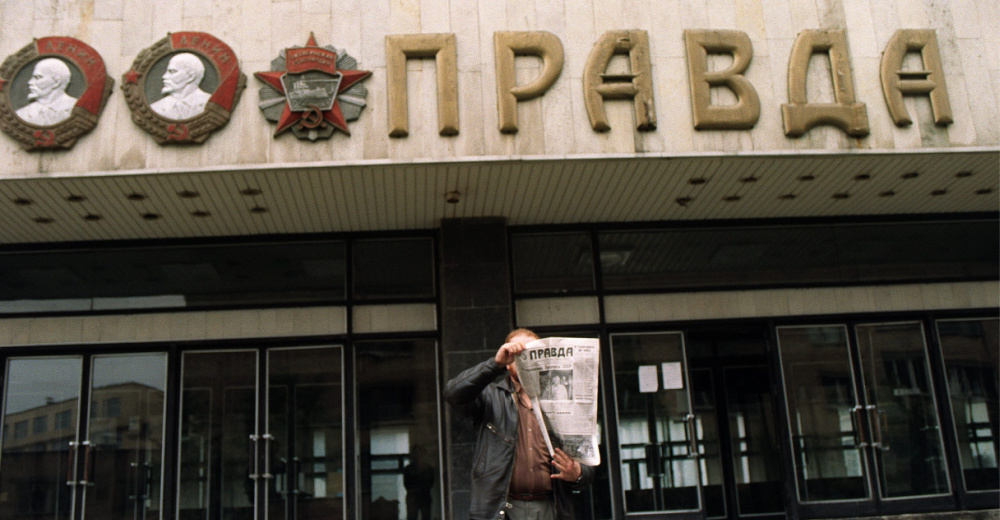
Ari Paul (FAIR.org, 4/25/25): “Going after public broadcasters is…part of the neo-fascist playbook authoritarian leaders around the world are using to clamp down on dissent and keep the public in the dark.”
The death of former 1960s radical turned right-wing provocateur David Horowitz brought to mind the time he called me “stupid” (Michigan Daily, 9/8/03) because he disliked a column (Michigan Daily, 9/2/03) I wrote about neoconservatism.
I was reminded of that again just days later when Matt Taibbi (Racket News, 5/4/25), a journalist who left Occupy Wall Street populism for ruling class sycophancy, attacked my recent article, “Cuts to PBS, NPR Part of Authoritarian Playbook” (FAIR.org, 4/25/25). In his response, titled, “No, State Media and Democracy Don’t Go ‘Hand in Hand.’ Just the Opposite,” Taibbi asked, “How nuts do you have to be to think ‘strong state media’ doesn’t have a dark side?”
It’s a straw man argument, with a heavy dose of McCarthyism thrown in to boot. I’d encourage everyone to read both pieces in full, but here I’ll break down the main problems with Taibbi’s piece.
Public vs. state media
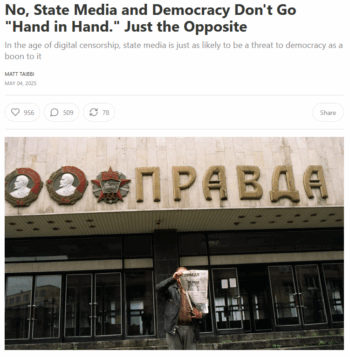
Matt Taibbi (Racket News, 5/4/25): “The above is either satire or written by someone consciously ignoring the history of state media.”
Taibbi’s main trick is to pretend that “state media” and “public media” are interchangeable. They’re not. State media consists of government propaganda outlets that answer directly to executive authority, rather than independent editors. Public media are independent outlets that receive taxpayer subsidies. As I wrote in my piece, NPR “only gets 1% of its funding directly from the CPB,” the Corporation for Public Broadcasting.
Obviously, if NPR and PBS were “state media,” Trump wouldn’t need to try to shut them down; he would already control them editorially. That’s not to say that they’re perfectly independent. FAIR writers, including myself (11/26/20), have for decades been critical of NPR and PBS political coverage. FAIR (e.g., 6/1/99, 9/17/04, 5/11/24, 10/24/24) has pointed out again and again that right-wing complaints about supposed left-wing bias in public broadcasting have repeatedly resulted in compromised coverage. (I noted in the very piece Taibbi purports to critique that Republican critics of public broadcasting “use their leverage over CPB funding to push NPR and PBS political programming to the right.”)
FAIR’s Julie Hollar (FAIR.org, 5/2/25) wrote just days before Taibbi’s post that NPR had downplayed the Trump administration’s attack on free speech, taking a false “both sides” approach to the issue. So, yes, FAIR is outspoken about the “dark side” of NPR and PBS, and Taibbi surely knows it. But he doesn’t seem interested in an honest argument.
His words, not mine
Taibbi used quotation marks around “strong state media” twice, when those aren’t the words I used—they’re his. He claimed that I was “consciously ignoring the history of state media,” though much of my piece concerned state efforts to force conformity on public outlets. While failing to engage with the rest of my article, he took the reader to Russia in the 1990s, when independent journalists (like himself) were working:
That period, like the lives of many of those folks, didn’t last long. Vladimir Putin sent masked police into the last independent TV station on May 11, 2000, capping less than ten years of quasi-free speech. “Strong state media” remained, but actual journalism vanished.
I’m very open about my opposition to the tyranny of autocrats shutting down and raiding journalistic institutions (FAIR.org, 5/19/21, 6/8/23, 8/14/23, 10/22/24). And my article noted that other wannabe autocrats are attacking public broadcasters, notably in Italy, Israel and Argentina, a fact that does not undermine but rather supports the idea that there’s a correlation between public broadcasting and democracy.
If Taibbi were truly worried about “state media,” he wouldn’t be mad at a meager government subsidy to NPR or PBS, but instead would show more concern for something like the Trump administration’s White House Wire, “a news-style website that publishes exclusively positive coverage of the president on official White House servers” (Guardian, 5/1/25). And mentioning Putin’s attacks on “independent TV” is certainly a better argument against Trump’s FCC investigations into private US outlets like ABC and CBS than it is against the existence of NPR or PBS.
Taibbi’s invocation of “Putin” and “Russia” as a reason why we should not be concerned about Trump’s attacks on public broadcasting is such an illogical non sequitur, it makes more sense to interpret it as standard-issue McCarthyism. This is bolstered by Taibbi’s invocation of more paranoia about any state subsidy for media:
Yes, Car Talk and the MacNeil/Lehrer Report were cool, but outlets like Neues Deutschland, Télé Zaïre and Tung Padewat more often went “hand in hand” with fingernail factories or firing squads than democracy.
He seemed to be trying to scare the reader into thinking that we are just one episode of Wait, Wait…Don’t Tell Me! away from the Cambodian genocide.
The neo–Cold War trick is to just say “Putin” enough times in hopes that the reader will eventually realize that the US government funding anything is a sign of impending tyranny. It’s an old joke to accuse greying reactionaries of hating publicly funded snowplows because “that’s socialism,” but that appears to be where Taibbi is these days.
A sloppy attack

Timothy Neff and Victor Pickard (International Journal of Press/Politics, 7/24): “High levels of secure funding for public media systems and strong structural protections for the political and economic independence of those systems are consistently and positively correlated with healthy democracies.”
Taibbi pretended to refute my claim that “strong public media systems and open democracy go hand in hand,” but in his article’s large block quotation, he omitted two embedded citations to scholarly studies that support this assertion. One of those was from Political Quarterly (3/28/24), the other was an Annenberg School study (3/16/22) whose co-author, Annenberg’s Victor Pickard, has also written about the importance of public media for The Nation (4/15/25).
Taibbi could have challenged those studies if he wanted, and good-faith disagreement is welcome. Omitting them from the quotation, though, leaves out the critical part of my statement.
Taibbi continued:
People who grew up reading the BBC or AFP may imagine a correlation between a state media and democracy, but a more dependable indicator of a free society is whether or not obnoxious private journalism (like the Russian Top Secret, whose editor Artyom Borovik died in a mysterious plane crash) is allowed to proliferate.
I’ve written at length about that dangers that the Trump administration poses when it comes to censorship, intimidating journalists, lawfare against media and using the power of the state to chill speech (FAIR.org, 12/16/24, 1/23/25, 2/18/25, 2/26/25, 3/28/25, 4/29/25). Taibbi ignored this part of my record, which is referenced in part in the very article to which he’s responding. This is crucial, because my defense of PBS and NPR in this instance is part of a general belief that the government should not attack media organizations, public or private.
As someone who read Taibbi enthusiastically when he was a Rolling Stone and New York Press writer, it’s sad to see someone I once admired so sloppily attack FAIR’s defense of press freedom against anti-democratic state power. But on the bright side, his outburst acts as an inspiration for a place like FAIR to continue defending free speech and a free press, while mercilessly calling out state propagandists who disguise themselves as journalists.





Why is FAIR using a meaningless statistic on NPR funding? There is really only one important word in the assertion NPR “only gets 1% of its funding directly from the CPB”–“directly.” The CPB funds local stations, these local stations buy NPR programming in part using CPB funds. That 1% statistic obviously obfuscates the real extent that CPB funds go to NPR.
Why is Taibbi fanboi admitting they didn’t even read the article or learn the difference between PUBLIC media and STATE media?
Because when corporations run the STATE and they fund the public medal, the public media now becomes STATE media. Like the BBC. 6 corporations own 95% of the media. And yet it’s considered a free press.
I’m not really interested in what Taibbi’s been doing since leaving Russia, and my criticism has really nothing to do with Taibbi. I’m just annoyed that FAIR is using meaningless statistics in writing about NPR. NPR likes to make that 1% number prominent on annual reports and financial disclosure webpages as it seems to insulate the company from criticism about public monies going to a media company with a perceived political bias. I’m sympathetic to NPR—why wouldn’t they use it? But why would FAIR repeat it
What’s your point?
Taibbi has become seriously weird.
“As someone who read Taibbi enthusiastically when he was a Rolling Stone and New York Press writer…” and author of such books as “I Can’t Breathe” (conveniently removed from his Substack byline a number of years (and rightwing subscribers) ago, “The Divide” and “Griftopia”.
Same here, Ari. Matt has gone where the $$ has led him. He figured out at some point that (almost always justified) criticism of Democrats and their relationship with media wasn’t as lucrative as simply joining the MAGA train while pretending to be objective. He never criticizes Trump now that Trump is in office, never criticizes crackdowns on student free speech, and never dares to touch the Israeli genocide ongoing in Gaza. His comment section is a den of cynical, right-wing ghouls and sock puppeteering. But they all pay $10/month (it keeps going up!) for the privilege.
Glenn Greenwald has never wavered; despite angering liberals because he dared to take on Democrats when they were in power, he’s been consistent in his criticism of the ties between media, government and Zionist interests – and this holds true today. But Taibbi is a chameleon.
IMO this is when it began: https://www.nefariousrussians.com/p/matt-taibbi-is-a-cancel-culture-hypocrite-b78
And speaking of Yasha Levine, he and Mark Ames (both former The eXile colleagues with Taibbi) take Matt down a few notches here: https://www.nefariousrussians.com/p/on-radio-war-nerd-talking-about-twittergarchs
Taibbi knows who butters his bread now, and his journalistic instincts and ethics had to be abandoned, selectively, to keep his new subscriber base happy. When Tucker Carlson and Candace Owens are both better sources on any of the aforementioned topics, any real journalist or honest analyst might check himself. Taibbi doubled down and did the opposite.
Yes
Now I am a fan of Ames and Levine and John Dolan.
But maybe you should read up on Ames and Levine’s criticisms of Greenwald, not just Taibbi. They’ve had public spats for 15 years. Probably published at NSFWCorp or Pando—wherever Ames and Levine could get published in the 2000s-2010s.
(That said, I think all of these men were in agreement that “Russiagate” from 2016-2020 was insane)
Taibbi did some good reporting on the financial crash of 2008, I’ll give that to him. Since then he’s drifted right and I don’t know if he simply wants to cash in, like so many right wing grifters, or he’s truly become a MAGA believer, but his reputation will likely never recover.
His shameless and vapid “Twitter files” farce with King Grifter Elon proved he’s finally lost all credibility.
The BBC, NPR, and PBS have all become such useless, power-worshiping sycophants that they are actually a point against Paul’s arguments. He seems to have something that gets in his craw about Taibbi but Taibbi has been consistent with his values for decades now. It is the CIA-loving Democrats who have changed.
I agree. Taibbi comes across as a monotone troubleshooter for the duplicitous, mendacious DP, but that doesn’t make him wrong. What I think is unfortunate is FAIR, in going after Taibbi, who does coddle the right, has given cover for “public” media that are virtually indistinguishable from commercial MSM.
You make a good point. NPR, PBS, they are MSM. They have enough redeeming programming to be immune from the Orange Tyrant’s budget cuts, especially in light of military spending, or unpunished white collar crime. Fer rice cakes PBS has had the evening news hour reported by the wife of Ayn Rand-devotee Alan Greenspan, for what? Two decades? Sponsored by Chevron and Lockheed Martin.
Andrea Mitchell has never reported for PBS. Are you thinking of Judy Woodruff?
While the article doesn’t solely focus on Taibbi’s conversion, but on his incompetency and prejudice, I’d like to point out that Taibbi is persona-non-Grata for the entire planet. Nobody really cares what he has to say (this aside) and his suck-up to the worst of our species is unacceptable. If I had a terrminal disease, he would be among those shot as collaborators. In other words, he’s scum.
By the way, I’ve been a fan of FAIR forever, and I’m glad to see you on the ball in even this article mentioning NPRs cowardly acqiescence to pressures on the right. I can’t even listen to their news anymore. But the public can help NPR reclaim its spine if it continues to support FAIR and other organizations fighting back against the constant rightwing attacks on truth, which Trump is invigorating.
Your article contained a bit of good news: namely that David Horowitz is dead. Someone should write an obituary that doubles as slander. Horowitz ran an army of student snitches who terrorized progressive professors, and probably made a killing. I witnessed, while recording Noam Chomsky at Brandeis University, that his little rats distributed pamphlets that were an open invitation to assassinate Chomsky as the cover morphed Chomsky into Bin Laden (and the talk was not very long after 9/11.
I have to agree that Matt Taibbi has evolved negatively. I was a Racket subscriber and YouTube subscriber of Useful Idiots (which has continued quite nicely with Taibbi replacement Aaron Mate), but let my Racket subscription lapse as I noticed Matt change. I attribute this to the pernicious influence of Walter Kern whom Matt obviously looks up to like a puppy dog.
Because when corporations run the STATE and they fund the public medal, the public media now becomes STATE media. Like the BBC. 6 corporations own 95% of the media. And yet it’s considered a free press.
Been watching Taibbi drift to the right for a few years now. Another one bites the dust.
I agree that Matt Taibbi ha really changed his perspective, much like Glenn Greenwald a founder of the Intercept. They once seemed to understand who the real enemies are and now they seem confused.
Disagree on Greenwald. He’s been consistent through his career. Criticizes media overreach/dishonesty/hypocrisy no matter which party, politician or country (cough…Israel) they’re supporting.
Thank you for this. I think he’s just cashing in on the maga gullibility machine… which is actually more dishonest. I used to love reading his stuff and even had paid subscriptions but he’s so slimy now.
Nobody ever went broke over-estimating the gullibility of the American Patriot!! (to paraphrase)
I used to read Taibbi in Rolling Stone religiously too. And several of his book. One of his books, I think it was Griftopia, taught me more about the 2008 financial crash than anyone or anything else, with humor and grand scholarship. Some time after that I heard Taibbi announce proudly on Useful Idiots that “I’m a capitalist.” But. Any respect I had for Taibbi largely disappeared then. I don’t know that I’m a socialist, but above all I’m not a capitalist. My break became complete with Taibbi’s testimony before the Senate. My sense, and I”m probably wrong, was that Taibbi was testifying as a friend of the court, so to speak, rather than having been compelled to. He also drifted away from holding Wall Street to account. I missed him briefly when he left Useful Idiots. My intuition indicated Taibbi left Useful Idiots because Katie Halper wasn’t the talent he is. Although this dynamic probably doesn’t apply, I’ve since come to believe it was the other way around. Halper didn’t think Taibbi was equal to her talent. All the best to Mr. Taibbi, except what he can buy with capitalist dollars. Aaron Mate serves as a better host. At least at this late date.
“State media consists of government propaganda outlets that answer directly to executive authority, rather than independent editors. Public media are independent outlets that receive taxpayer subsidies.“ This is a very useful distinction. One must, however, always guard against the potential of supposedly innocent public funding to work the same effects as direct state control of media even if those effects are harder to see, even if direct state control beyond public funding is worse. The hand that gives rules, after all.
Paul is on solider ground here than he was in his article on Eoin Higgins’ book on Taibbi and Greenwald a short while ago. Taibbi (and Walter Kirn, Taibbi’s podcast companion) recently has conspicuously ignored, without explanation, the threat that Trump poses, more frequently than ever. Paul himself, however, has not in this piece, or elsewhere as far as I know, addressed Taibbi’s chief criticism of NPR, which is that it has become unlistenable because it has descended wholesale into the toilet of shitlibbery and identity politics, fingering racism and sexism, and all the other isms, where the suggestion that they are skulking is egregious and absurd. The outlet has become a public scold par excellence, and has provided a superabundance of cultural ammunition for Trump’s ascendancy by bearing false witness to society’s real ills. Answering these charges may be beyond the scope of this particular article, but if Paul (or FAIR) would accuse others of ignoring arguments, he’ll also have to examine his own omissions which transcend this response.
I disagree with the comments here on Greenwald. I originally defended him, as I did Taibbi, as the target of shitlibs who couldn’t stand his criticisms of the Democratic party and his unapologetic contempt for their sacred cows, e.g., Russiagate. I began stroking my chin, however, after the Supreme Court decision in Trump v. United States, which he proclaimed was not alarming, a take too obtuse for someone whom I thought was more alert. Then he purported to debunk, without elaboration, Chris Hedges’ longstanding analysis of the disenfranchised lumpenproletarian population which has provided Trump with a good chunk of his base. Then he downplayed the significance of the arrest of judge Dugan in Wisconsin on the ground that she could technically be guilty as charged. This is a pattern, and it is inexplicable for a genuine civil libertarian.
Nonetheless, I will not cancel my subscription to either Greenwald or Taibbi, whose work I still believe is and has been nonpareil in its importance and remains a potent model of what independent journalism should be in what is otherwise a sewer of propaganda and “universal deceit”. For whatever it is I disagree with the two of them about, which is not everything, I still think they can and should try to be reached with criticism.
Taibbi’s piece, in which he accurately quoted Ari Paul about “strong public media”, repeated it two paragraphs later, then misquoted and took Paul to task for promoting “strong state media” – even using the misquote to title the piece no less – was exceedingly, uncharacteristically lame journalism. So lame I suspect it is connected to some other uncharacteristically lame journalism, Paul’s previous piece, which he ludicrously claims by hyperlink above shows Taibbi’s move from populism to “ruling class sycophancy”. Regrettably he supported no such conclusion in his piece. Case of bad karma here. Crappy journalism begets crappy journalism. Stop the cycle, both of you.