

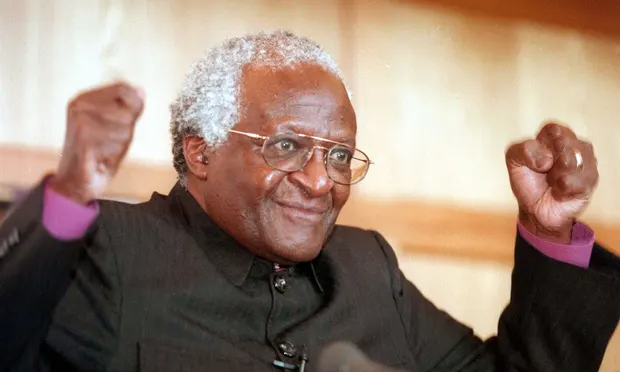

AP (12/26/21) noted that Desmond Tutu “campaigned internationally for human rights”—but didn’t mention Israel/Palestine.
Obituaries in the corporate and establishment press for South African Archbishop Desmond Tutu rightly celebrated him not only as one of the key leaders of the struggle against apartheid in his own country, but as a global advocate against oppression, including being a fierce Christian voice against homophobia.
These obituaries often underplayed or ignored, however, that Tutu, as a South African crusader against apartheid, helped to normalize the idea that Palestinians suffered under a similar apartheid system. Likewise marginalized was the enormous amount of hate he received for his advocacy for Palestinians and his criticism of the Israeli government.
The New York Times (12/26/21) obituary reduced his Palestine advocacy to one incident in 2010 when “he unsuccessfully urged a touring Cape Town opera company” to not perform in the country, quoting his urging the company to postpone its production of Porgy and Bess “until both Israeli and Palestinian opera lovers of the region have equal opportunity and unfettered access to attend performances.”
The AP obituary (12/26/21) ignored this issue entirely, as did obituaries in USA Today (12/26/21), the BBC (12/26/21) and NPR (12/26/21). The Washington Post (12/26/21) did the issue some justice, saying that Tutu “repeatedly compared Israel’s treatment of Palestinians in the West Bank and Gaza to South Africa during the apartheid regime.” While CNN‘s initial obituary (12/26/21) devoted only part of a sentence to his call for a boycott of Israel in 2014, a follow-up piece explored his broad range of activism: “As South Africa Mourns Desmond Tutu, So Do LGBTQ Groups, Palestinians and Climate Activists” (11/27/21).
Guardian petition

Critics complained that the Guardian‘s obituary (12/26/21) contained all of four words on Desmond Tutu’s criticism of Israel. The paper later printed an op-ed (12/30/21) on his advocacy for Palestinians.
As of this writing, more than 3,000 people had signed a petition demanding a correction to the Guardian’s obituary (12/26/21). Petitioners complained that while the obit
documents the archbishop’s tireless struggle against oppression and racism of all kinds…Tutu’s repeated criticism of Israeli apartheid policies, and his commitment to the cause of the Palestinian people, are all simply omitted.
The article’s lone mention of Israel cited Tutu’s blasting “the US for supporting the Contras in Nicaragua and Israel for bombing Beirut.” The petition said that the article “exemplifies the Guardian’s consistent pro-Israel bias,” a trend FAIR has previously documented (2/22/21). According to the Palestine Solidarity Campaign (12/30/21), activists were concerned with the Guardian’s “deletion of a large number of comments in response to the obituary which all highlighted Tutu’s condemnation of Israeli apartheid.” The comments were restored upon pressure, the group said, but the original deletion, the group said, still inspired unease.
The Guardian (12/30/21) did eventually publish a piece on Tutu’s Palestine activism, in an apparent response to the media activism.
As the Middle East Eye (12/26/21) reported, Tutu likened Palestinians’ political conditions to those of Black South Africans under apartheid. He supported the boycott, divestment and sanctions (BDS) campaign as a form of peaceful pressure, and often spoke of Israel’s policies as being contrary to the teachings of Jewish and Christian values.
Upon his death, the Israeli newspaper Ha’aretz (12/26/21) quoted Tutu’s defense of boycotting Israel, saying those who continue to do business with Israel “are contributing to the perpetuation of a profoundly unjust status quo.” “Those who contribute to Israel’s temporary isolation,” meanwhile, “are saying that Israelis and Palestinians are equally entitled to dignity and peace.”
Reactionary pushback

Alan Dershowitz on Fox News (12/27/21): “Let’s make sure that history remembers both the goods he did and the awful, awful bads that he did as well.”
Skating over Tutu’s outspokenness about Palestinian rights in his official obituaries does a disservice to Tutu’s life, as his intense advocacy for Palestinians was a major part of his devotion to social justice, and like all campaigns for social justice, it inspired reactionary pushback from defenders of the status quo.
The pro-Israel Anti-Defamation League (5/3/12) said that he “veered into classical religion-based antisemitism” with his condemnation of Israel’s treatment of Palestinians. AP (10/4/07) reported that Tutu had even been disinvited from speaking at a university because the administration “worried his views on the Israeli/Palestinian conflict would offend the Jewish community.”
The London Times (1/13/11) reported that a petition “signed by three well-known members of Cape Town’s Jewish community” accused Tutu of being a “bigot, dishonest, and a defamer of Israel and the Jewish community.” “Over the years,” they said, “Archbishop Tutu has been guilty of numerous antisemitic and anti-Israel statements.”
Alan Dershowitz—lawyer for Donald Trump, Harvey Weinstein and Jeffrey Epstein—even took to Fox News (12/27/21; Crooks & Liars, 12/28/21) to dance on Tutu’s grave: “Can I remind the world that…the man was a rampant antisemite and bigot?”
This backlash is rooted in the idea that advocacy for the Palestinians must be antisemitic because Israel is an officially Jewish state—an idea that borrows from the now-ridiculous notion that fighting apartheid in South Africa was somehow anti-white. The Jewish Telegraphic Agency‘s obituary (12/26/21) highlighted this absurdity, saying Tutu “identified closely with the historical suffering of the Jewish people in his forceful advocacy against apartheid in South Africa.”
A lasting legacy
Underplaying this aspect of Tutu’s life also understates his impact, because it was Tutu, as a hero of South African liberation struggle, who gave major legitimacy to both the movement to boycott Israel and to critics who labeled Israel’s occupation as apartheid. Tutu’s early recognition that Israel’s anti-Palestinian policies mirrored what he had campaigned against in South Africa laid the groundwork for human rights groups like Human Rights Watch (New York Times, 4/27/21) and B’Tselem (NBC, 1/12/21) to recognize Israel’s occupation as a form of apartheid.
The omission or underplaying of this facet of Tutu’s life is a reminder of how scared many corporate media institutions are of touching what is often called the third rail of politics. That the AP‘s obituary, for example, can highlight Tutu’s heroic commitment against homophobia but not his views on the Israel/Palestine conflict, or the backlash he faced as a result, underscores the limits of intersectional social justice in the establishment press.




At the risk of being labeled “antisemitic”, may I introduce historic fact into this discussion? It is history which people (in the minority) in the Knesset and their supporters in Israeli society draw upon when they criticize the Apartheid-like policies of their government. Their line of reasoning, always ignored by The Guardian, New York Times, and other respected western news outlets, includes the following:
In the early 1900s, The Union of South Africa, then controlled by the English-speaking United Party, was one of the first nations to sign the Balfour Declaration, supporting formation of a State of Israel. The bind between Israel and South Africa was cemented early on when Israel became a nation in 1947.
In 1948, the Africaaner Nationalist Party gained control of the all white South African Parliament. Under the Nationalist Party, the system of Apartheid was established. The historic hatred and suspicion between Africaaner and English-speaking whites, which resulted in South Africa’s Boer Wars of the early 1900s, were not unlike the U.S. Civil War. Afrikaaner resentment over their defeat took on an international twist in the 1920s and 30s, when the Nationalist Party supported Nazi Germany. Luckily for Allied forces, they did not gain control of South African Parliament until World War Two was over.
The obvious question left on the table: How could the State of Israel climb into bed with a government, whose leaders supported Hitler? . . . Apartheid did not go to the extremes of Nazi Germany, but the system did create “homelands” for all black people in the country. They were at the lowest rung of a ladder in a caste system affecting “Indian” and “Colored” people as well. When the government started its dealings with Taiwan, a special designation was made for Taiwanese for their economic significance; all of this in an effort to circumvent world wide sanctions and negative public opinion abroad.
When minority party voices in the Knesset speak about modern day Apartheid, who outside of Israel hears them? Decades ago after he left the White House, Jimmy Carter made Israeli Apartheid comments, but no one on the national stage seemed to care. During the days of South African Apartheid it was acceptable to shine some light on the system in the U.S. Press. But now the word Apartheid is treated as nothing but a bad memory.
The history of Israeli – South African entanglement, which includes the September 22, 1979 nuclear bomb test on Prince Edward Island off the coast of South Africa, is somehow lost on well-read scholars and “seasoned” journalists in this country.
“Somehow lost?” Follow the money.
This is an important story in telling the truth to counter myths.
(Mondoweiss also ran a good story, republished in Common Dreams).
A similar story could be written about Canadian media. The Toronto Star,
considered the most ‘liberal’ (and Liberal) paper in the country,
devoted not a word about Israel in a full page eulogizing the
‘lifelong opponent of apartheid’ — but not the modern variant.
P.S. Prince Edward Islands (two) are off the coast of South Africa,
but Prince Edward Island (one) is off the coast of New Brunswick, Canada.
Israel has been an apartheid state since 1948—although 1948 is truly known as NAKBA—-when the zionists began attacking and killing the Palestinians, and then stealing Palestinian land. This has never stopped.
Although, nothing happened to Israel re: the bombing of America’s USS Liberty in the 1960s either. Nor did America seem to care as LBJ had no response. America didn’t seem to care when Rachel Corrie was murdered by bulldozer —and Americans were murdered in international waters as they sailed to protest Israel.
I give up on Israel , but as
taxpayers, we have given Israel trillions of dollars in aid. America’s aid is killing the Palestinians . Such a legacy, a sad , and illogical legacy. But for American newspapers to neglect Desmond Tutu’s words on Israeli actions—-NEWS often seems to have become a useless oxymoron.
Is it downplaying or is it just a reflection of what the man was known for?
Houdini was one of the first people ever to pilot a plane in Australia, but it’s not his claim to fame.
LOL. Yes it’s downplaying it. Pro-Palestinians was one of Tutu’s major themes especially after the end of apartheid in South Africa. Come on.
Says you. How do you prove that?jo
Were you hiding under a rock? It was common knowledge. Again, SA apartheid ended in the 90s. Virtually every speech Tutu gave after that point included the Palestinian’s struggle and Israeli apartheid.
https://thejerusalemfund.org/2022/01/archbishop-desmond-tutu-tireless-advocate-for-peace-justice-and-equality-in-palestine/
I’m not disputing that. I’m disputing the assertion that it’s not included, or glossed-over, in his obituary because of suppression of the story.
The guy did a lot in his long life and the success story is gonna be South Africa and not Palestine. Emphasizing South Africa and not Palestine could be a reflection of that instead of some effort at suppressing the Palestine part of the story.
It’s not an “assertion” that it’s being glossed over or left out entirely. It’s the reality of the situation, easily verifiable by Googling Tutu’s various eulogies.
It is fact that the corporate MSM routinely handles Israel (and to a lesser extent other “staunch allies”) with kid gloves at the same time as they miss no opportunity to crap on the Palestinians or ignore them as humans with rights altogether.
According to the same pattern, the corporate MSM has omitted Tutu’s 25+ years of pro-Palestinian advocacy. Again, after apartheid ended in South Africa, and moreso during the aughts and twenty-teens, his speeches and writing MOSTLY was about the Israeli settler colonial apartheid state’s treatment of the native Palestinians.
https://youtu.be/8emlgFPcX5o
I lost a longtime Jewish friend who labeled Tutu and anti-Semite.
I am deeply offended… and prompted to laughter by that comment.
Dershowitz will scream at you that when you criticize just Israel that’s bigotry because you should also criticize others. And when you criticize another government, that’s also bigotry. Gee whiz I guess all criticism of Israel is bigotry.
Dershowitz is a jerk and a child predator. He must have something really good on a lot of people – above and beyond his litigious threats – or the Epstein/Maxwell affair would have exposed him for his crimes.
Considering he’d been irrelevant outside of the Far-Left bubble for decades and a fading icon from a failed nation for a long time before he died, he got about as nice a set of tributes as he could have asked for.
It’s not everyone else’s job to do PR for faux-progressivism. You can do that on your own sorry websites.