

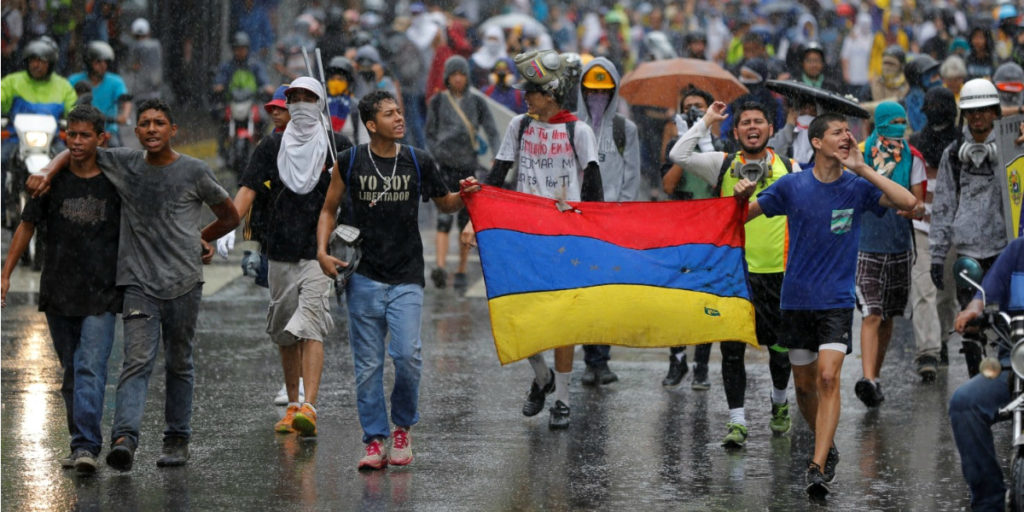
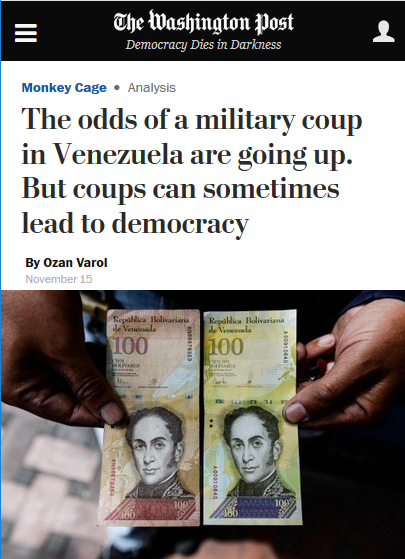
A Washington Post op-ed (11/15/17) argues that “where the military sides with the people, democracy becomes a real possibility.”
The only voices allowed in the Washington Post on the subject of Venezuela over the past year have been those calling for the overthrow or sanction of its government. A review of 15 opinion pieces featured in the Post shows voices even remotely sympathetic to the government of President Nicolás Maduro are omitted entirely. For the capitol’s paper of record, Venezuela joins the status of Adolf Hitler or ISIS: a settled evil without any nuance.
Columns and editorials in the Post are uniformly pro–regime change, pro-intervention, pro-sanctions or outright pro-coup. Meanwhile, nations with deplorable human rights records that are in good standing with the US government, such as Saudi Arabia and Israel, are routinely given puff piece op-eds (7/14/15), softball Q & A’s (8/7/17) and framed over and over again as “reformers” of their own abuses (FAIR.org, 4/27/17). The opinion pieces on the topic of Venezuela, however, range from pro-sanction to pro-invasion:
- “Venezuela Is Lurching Closer and Closer to Chaos” (Editorial, 12/26/16)
- “In Venezuela, We Couldn’t Stop Chávez. Don’t Make the Same Mistakes We Did” (Andrés Miguel Rondón, 1/27/17)
- “The Organization of American States Decides to Have a Serious Talk With Caracas” (Francisco Toro, 3/29/17)
- “What It’ll Take for Venuezela’s [sic] Protests to Work, According to an Opposition Expert” (Amanda Erickson, 4/26/17)
- “Analysis: In Venezuela and Turkey, Strongmen Fear the Limits of Their Power” (Ishaan Tharoor, 4/27/17)
- “Beware Maikel Moreno, the Hatchet Man Who Runs Venezuela’s Supreme Court” (Francisco Toro and Pedro Rosas, 4/28/17)
- “Venezuela Is Heading Toward Cataclysm” (Editorial, 5/3/17)
- “Goldman Sachs Makes an Irresponsible Deal With the Corrupt Venezuela Regime” (Editorial, 6/4/17)
- “The Region Cannot Just Stand By as Venezuela Veers Toward Civil War” (Editorial, 6/30/17)
- “Why One Man’s Bizarre Attack on the Government Is Reverberating in Caracas” (Daniel Lansberg-Rodríguez, 6/30/17)
- “Venezuela’s Lawless Regime Staggers Toward a Coup” (Editorial, 7/27/17)
- “Venezuela Is Imploding. These Citizens Were Desperate to Escape” (Tamara Taraciuk Broner, 8/2/17)
- “The Specter of Civil War in Venezuela” (Editorial, 8/13/17)
- “Venezuela’s Warning to America: Beware the Populist-Turned-Dictator” (Federico Finchelstein, 9/18/17)
- “The Odds of a Military Coup in Venezuela Are Going Up. But Coups Can Sometimes Lead to Democracy” (Ozan Varol, 11/15/17)
The last contribution on the list, from law professor and PR consultant Ozan Varol, suggests a coup could bring about “democracy,” despite Maduro winning in 2013 by roughly 1.5 percentage points (not exactly dictatorial numbers), in an election overseen and sanctioned by international election monitors—including the US-based Carter Center. While one can debate the democratic properties of measures taken since, few doubt Maduro won the election held in April 2013 after President Hugo Chávez’s death, nor can one easily explain how, if the elections were rigged, Maduro’s party overwhelmingly lost the Assembly election two years later. Maduro will face voters again in less than a year, in October 2018.
Since a CIA-backed coup in 2002 temporarily removed Chávez from office (a coup both the Post —4/14/02—and the New York Times—4/13/02—cheered on), every election has been contested by the opposition as unfair. Perhaps this is sometimes true, perhaps it’s not. But for the Post, it’s never discussed. It’s simply taken for granted Maduro is a cartoon dictator; the only question dissected is how best to kick him out—regardless of what voters may think. When it comes to Venezuela, the paper’s self-aggrandizing, Trump-era motto, “Democracy Dies in Darkness,” reads less like a warning and more like advice.
The Post’s editorial board was no less bellicose than the op-eds—though it did stop short of outright calling for a military coup. In six editorials over the past year, the board routinely used the delegitimizing label “regime,” echoed the Trump administration’s arbitrary use of human rights language, and called, again and again, for “tougher” sanctions on both the Maduro government and its allies.
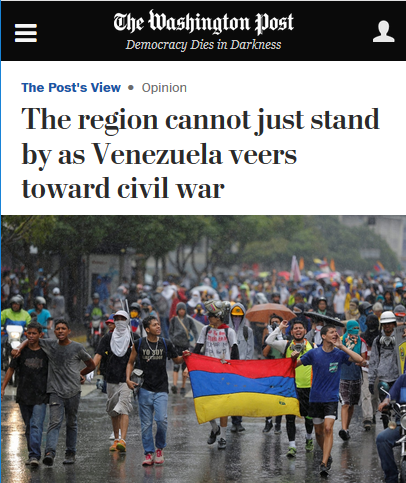
Suggesting without any evidence that the government secretly stages violent attacks to promote a political agenda (Washington Post, 6/30/17) is generally seen as irresponsible–unless, of course, the government is an official enemy.
One editorial (6/30/17), mimicking Alex Jones, casually advanced a conspiracy theory that Maduro had assaulted his own government in a false-flag attack. (“Opposition leaders understandably wondered whether the incident was orchestrated by Mr. Maduro. If so, it wouldn’t be surprising.”)
The Post, always alarmed and morally superior in tone, constantly implored the United States government to “do something”—as, of course, has been Washington’s wont in Latin America for more than a century.
Without any clear criteria, the Post has decided the subject of political repression in Venezuela is a settled question, beyond debate; the Maduro “regime” is categorically evil and must go. Any assessment as to how US sanctions or Trump’s surly rhetoric or street violence by opposition extremists (including lighting black Chavistas on fire) or food-hoarding by wealthy industries may contribute to the unrest is never broached, much less discussed.
Essentially, the Post is curating a media conversation in which Venezuela is in the same moral category as Hitler or ISIS—unworthy of any defense. The paper presents only one side of that nation’s crisis—one in which a sizable percentage of the people, disproportionately the poor and indigenous, remain supportive of Maduro. Dozens of other controversial governments receive “both sides” coverage in the Post’s opinion pages—including the Trump administration, which has its own in-house PR rep on the Post’s staff. The only discernible criteria for why Venezuela doesn’t is that its government is out of favor with the US State Department.
* The Washington Post has a vertical called “Analysis”; when this “analysis” veered into editorializing the moral properties of the government, it was listed as opinion for the purposes of the list.
Messages can be sent to the Washington Post at letters@washpost.com, or via Twitter @washingtonpost. Please remember that respectful communication is the most effective.




Adam you look like a cross between Jack Black and Christ Pratt, but you are honestly one of the best living media critics. Thanks.
A coup throwing out the editorial staff at the Washington Post and New York Times might lead to democracy in those organizations.
When the “sizable percentage of the people, disproportionately the poor and indigenous, remain supportive of Maduro” fell far below 50 and not only did the government did not change, but the dictatorship doubled down with a series of actions intended to maintain power collegial relations with the United States ended. Only damage control remains.
It is important to note bullying by the media. But it is also important that independent media form an independent perspective on countries like Venezuela, instead of getting defensive in response. (not necessarily FAIRs role
From what i have seen/read, Independent media has done pretty well infact. Though, i don’t know how well i can tell. For instance The Nation link(https://www.thenation.com/article/why-is-venezuela-in-crisis/) provided in this article. To be frank, the image of left wing media being uncritical or making excuses for Venezuela seems just plainly false to me.
Another example of left-wing outlets not beating around the bush; https://jacobinmag.com/2017/07/venezuela-maduro-helicopter-attack-psuv-extractivism-oil
American liberal bootlicking press, because a private school with minimum black people in D.C costs 40000$ a year…
Thanks for this. Another story that I doubt WaPo and NYT have covered is an opposition admission that its strategy has been to encourage insurrection. The former executive secretary of the opposition Democratic Unity Roundtable, MUD, Jesus ‘Chuo’ Torrealba said (https://venezuelanalysis.com/analysis/13452):
“[MUD] failed in their proposal for insurrection – what do I mean when I say insurrection well you remember the speech on the 3rd of July in Chacao. The four key phrases used then were – national uprising, upsurging rebellion, zero hour and general strike. That’s a proposal for insurrection. The insurrection failed, they failed at [this] past election and on top of that they don’t like dialogue.”
On election results:
https://www.investigaction.net/en/venezuela-regional-elections-chavismo-in-triumph-opposition-in-disarray-and-media-in-denial/
P.S. Too bad my several attempts to receive your newsletter (which I got until about a year ago) have come to naught.
I have written to Washington Post:The Editor – Let’s see if thy have the depth of reality and have the care to respond…
On 4 December 2017, FAIR, the national media watch group (since 1986), published a realistic scrutiny of the last 12-months of Washington Posts articles on Venezuela (WaPo’s One-Sided Cheerleading for Coup and Intervention in Venezuela), which catalogued your papers very obvious bias with the democratically elected president of this nation.
A credible response is required by your editor-in-chief, where they explain their position of only presenting an extremely unbalanced viewpoint that can be described as obviously comprehensively biased, reflecting US government desires. If these articles and this stance is not journalistically criticised, then it is as if the nation is transcending through over-dosing on Hollywood movie opioids over many decades, where stories of wars and politics have reshaped minds. What is described by the WP is lacking in wholesome detail and cannot be digested by those of us viewing America, as anywhere near the truth of this Venezuelan matter.
Surely, credible newspaper journalism can only have a life of longevity when its written and spoken expressions employ truth, the whole truth and nothing but the truth, that is balanced reporting, regardless of Washington’s political demands and whimsical preferences, but instead what used to constitute investigative journalism. All newspaper proprietors, who mostly have money and power comes responsibility, and in our later years in life we all have to reflect on what we ‘actually left behind’ through choices taken during our brief existence.
Sincerely,
Andrew Charnley