


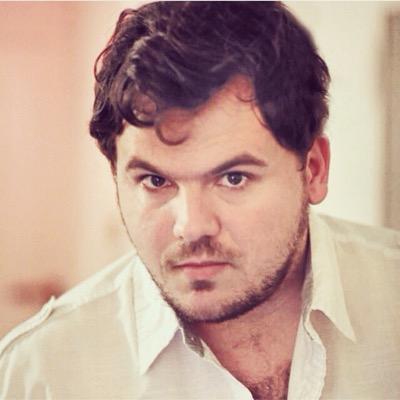
The New York Times‘ Real Estate section depicts “pioneer” Michael Trebek “in front of his multi-family brownstone in Harlem.” (photo: Jacqueline Mia Foster/NYT)
The New York Times Real Estate section is written for the rich by writers who are either themselves rich or very good at faking it. The tone is one of “oh, what inequality?” matter-of-factness, where $2 million loft purchases are thrown around like Seamless thai food orders. It’s a style of journalism where the writer uncritically adopts the class and corporate tone and verbiage of those they cover: the affluent and the cottage industries that emerge to suit their whims.
This is to be expected. Real Estate sections are a significant source of revenue for a news business increasingly desperate for it, and those reading Real Estate sections on a quiet Saturday morning aren’t expecting in-depth investigations. But the uncritical adoption of industry language has the paper of record either repeating or allowing others to repeat rather tone-deaf colonial language and tropes.
Take, for example, Friday’s whimsical New York Times piece (5/1/16) on young rich people buying multi-family homes and becoming “accidental landlords.” After writing glowing recaps of a handful of white millionaires buying up property in neighborhoods historically associated with African-Americans or other communities of color, the piece allowed a real estate agent to describe Harlem thusly:
Any area of the city can suddenly become the next housing hot spot, and young people have always been the pioneers, because often they can’t afford anywhere else.
A “pioneer,” according to Merriam Webster, is “someone who is one of the first people to move to and live in a new area.” Which raises the question: If these “young people” are the “first people to move to” Harlem—who was there before?
The author went on to refer to one of the wealthy brownstone-seekers, Matthew Trebek (son of Jeopardy host Alex Trebek, naturally), as engaging in “explorations” of Harlem, as if it were an undiscovered wilderness.
It may seem like PC parsing, but this type of language helps normalize a racist mindset in an already racist industry. A 2012 report by the US Department of Housing and Urban Development found that discrimination and redlining, while more subtle than in decades past, is still rampant in the real estate business. Racially loaded terms like “pioneer” and “exploration” help reinforce the notion that long-existing communities of color are untamed frontiers needing to be settled.
The New York Times has previously allowed this type of colonial language. In 2014 it referred to a friend of actor Michael Shannon as a Red Hook “pioneer” (6/22/14). In 2013, one resident described themselves as a DUMBO “pioneer” (9/1/13), and in 2012 the Times uncritically quoted a real estate agent talking about “urban pioneers” (12/19/12).
Other problematic tropes include the ubiquitous “up-and-coming neighborhood,” which implies that the neighborhood’s previous status was down. Its use in a 2015 story (11/8/15) about a white millionaire moving to Harlem dripped with racial insensitivity:
[One apartment-seeker’s] measure of a place that would increase in value? A nearby Starbucks. So he made good use of Google Maps, checking locations. “I think Starbucks is a harbinger of an up-and-coming neighborhood,” he said. “They do a lot more research than I could.”
In 2014, Aaron Cantu reported for FAIR on the media’s use of the euphemistic “melting pot” to gloss over the influx of white New Yorkers into neighborhoods of color.
The use of colonial language to describe gentrification isn’t new. Indeed, one wealthy highrise in 2014 in Brooklyn’s Bushwick neighborhood took this thinking to its logical ends, naming its lofts “Colony 1209” with its marketing materials reading:
Here you’ll find a group of like-minded settlers, mixing the customs of their original homeland with those of one of NYC’s most historic neighborhoods to create art, community and a new lifestyle. Let’s Homestead, Bushwick-style.
This is obviously on the more extreme (and oblivious) end of the spectrum, but it’s the context in which the New York Times operates. While improvements have been made (one 1986 article refers to those venturing above 96th street as “settlers”), terms like “pioneer” and references to “explorations” should be dropped altogether, especially when casually discussing millionaire white people gentrifying a neighborhood synonymous with African-American culture and history.
Adam Johnson is a contributing analyst for FAIR.org. Follow him on Twitter at @AdamJohnsonNYC.
You can send a message to the New York Times at letters@nytimes.com (Twitter:@NYTimes). Please remember that respectful communication is the most effective.


And the “indigenous”, as always, are disappeared, figuratively and literally
No one ever notices that when people refer to a ‘nice area’ or a ‘rough area’ they are almost always referring to race — are there upscale whites or not?
People certainly notice. Talk of “bad neighborhoods” is a euphemism for neighborhoods of color, at least in NYC. It’s a subtly veiled way of talking about race without actually talking about it.
Shows what you know, Hell’s Kitchen was a bad neighborhood for decades, hardly one of colour.
Howard Beach, or various parts of South Brooklyn, all very white, sure can be a bad neighborhood, if you’re black, or brown.
What everyone should know is the New York Times literally eliminated Hell’s Kitchen, crafting the appellation “Clinton” to enhance property value and price out the working class. It’s a long standing mission, just glaringly explicit in the real estate section; all the news that’s in business’ interest to print.
I can affirm that “bad neighborhood” = “black neighborhood” is well-established in metro Cleveland as well. For example, I’ve had people tell me I live in a “bad neighborhood”, because the municipality I’m in is roughly 55% black, even though crime is fairly low (especially compared to neighboring areas), homes are well-maintained, retailers are doing just fine, etc. It doesn’t matter that the vast majority of what I see from my black neighbors is engaging in such degenerate activities as mowing the lawn, buying groceries, catching a bus to work, taking their kids to school, or tossing a football around.
On the upside, that means homes in the area are relatively cheap to buy or rent.
I moved out of NYC 6 years ago. Can someone tell me: Is the bar in Bed-Stuy on Fulton, charmingly and at that time “appropriately” called, Outpost still in business?
Or, has it renamed itself to more accurately reflect its status as not the only overly hoppy craft suds-serving (heirloom pickle & pork belly slider Wednesdays!), interiorly designed with reclaimed wood, whites only bar in the ‘hood?
I mean, Outpost!
Yes, it is still there. The name outpost was always horrific and it still is!
The only thing you’re wrong about is that that area is not considered bedstuy… thats definiteely clinton hill or even – gasp – fort greene border.
While “Outpost” might be an insensitive name, I believe it was supposed to be a play on the cafe’s status as an LBGT safe space and hangout. Emphasis on “Out” I guess.
I hear you. Not to cast blame or point fingers, but it’s worth looking into/thinking about the role and responsibility of those in the LBGTQ community/communities in gentrification and economic ethnic cleansing, historically. (I’m looking your way, Park Slope! Bernal Heights in SF, etc). It’s possible to be sensitive to the needs of one community (LBGTQ), while being highly insensitive and dangerous to another (the historically working class African American community around “Outpost”). “Outpost” can be a safe space for affluent LBGTQ “settlers” and at the same time function as a harbinger of gentrification.
Very interesting interview with College of Staten Island prof. and NYU fellow Sarah Schulman on gentrification and the gay community: https://kpfa.org/episode/against-the-grain-june-8-2015/
All fairly affluent and educated young people (gay/straight/whatever) are being pulled into “edgy” ‘hoods in cities across the country with the promise of exciting bohemian lives slumming it and with the lure of cheap rent. They are being used by capital and real estate to cleanse these ‘hoods for “renewal.” They will eventually be priced out themselves unless they take soul-destroying jobs that pay well but engage in class warfare. (PR, adverts, real estate, marketing, corp lawyering, tech, finance, etc. etc.)
Where are the safe spaces for poor and working class communities of color from the predatory machinations capital and real estate?
What a PC douch.
PC? I’m sure he appreciates the compliment.
Douche has an at the end of the word.
PC seems to mean civilized progress. The Real Estate section bought out all their interesting writers who wrote on the history on neighborhoods and buildings of the city. MAking it exclusively for rich readers.
Which writers were those? –Christopher Gray
Christopher Gray comes to mind, Christopher Gray. ^_^
Wholeheartedly agree. However, the example of DUMBO does fit the “pioneer” metaphor rather well as it was never a residential area before its transformation to condo land. It had been home to industrial spaces and warehouses (then later artist lofts not zoned for living) before it was a wealthy area.
I have read the Times for over 40 years and the one constant has been the howlers that they come up with when trying to explain the non-white world of NYC to their white readers. More often than not it reads like an expedition out of National Geographic
Could you give an example of this “constant”? Christopher gray
there are many examples in the article above
I’ve had intimate personal experience with this issue. I live in the rapidly gentrifying neighborhood of Logan Square in Chicago. When HUD first subsidized my housing in 2004, me being a bi-polar looney tune, the neighborhood was staid, my building more than comfortable, indeed, quiet, quite the rarity for the city. There was a strong representation in the community, such as it is, of Hispanic, which remains true, and an equally absent representation of the truly cultured and spiritual, which is to say, black people, which also remains true today. Still, the Caucasionness of the gentrification is frightening. Chicago remains one of the most racially segregated cities in the United States, to the equal disenchantment of all concerned. I was in a bar recently, all white, along with me, all yuppie, unlike me at 57, all equally battening down Jimmy Buffet’s hatches, whether they knew it or not. And I complained aloud of the gentrification. One whitey, amongst the throng proclaimed, ‘it’s working out for me just fine thank you.” This was quasi-concomitant with the moment I went into another liberal bastion, Stanley’s Donuts, a sponsor of the final Grateful Dead concerts in Chicago last July, because they have a vegan donut. And I’m a vegan, or at least I try to be. This was only last Saturday. This, to remind you, is a swank donut shop in the very rapidly gentrifying areas of Logan Square in Chicago. It was a long line to buy the sugared flour. I’m not one to wait in lines as a rule. But of all we Caucausions in the place, about 70, there wasn’t a single black face in the crowd. More alarming still, we whiteys didn’t have much concern for the fact; at least not as much for plastering a frown on our faces. Funk that. I left. My favorite television show is Kung Fu. Either that or a close second to All in the Family. Not a black face in the crowd. And whitey was neither the slightest bit amused, nor the slightest bit alarmed. Oh, that’s right, only two doors down, right next to the violent rumblings of the el train, there were two beggars, and at last count one of them was black. I was trying to get at this point: For the 11 years I’ve lived here, there has been the same group of about 7 or 9 of the kindest black people – and ain’t they all? – you could ever want to meet, hanging out homeless on the very busy corner of Western/Armitage/Milwaukee. They are neglected, abandoned to their poverty, shunned, and metaphorically spit on for being the victims of a system rotten and worm-eaten through and through. Why don’t the brothers and sisters have HUD housing? And this is the kick in the ass. The Chicago Housing Authority is currently running a half billion dollar surplus. It’s the profound matter of the right color skin. I have it: pink. They have merely culture and spirituality. And black skin. Jaime Dimon ought be banned from this site. Let the capitalist pig roll in the sty with his several colleagues.
In Portland, the term “sketchy” often means “racially mixed” or “poor”. I am getting really wary of the term and when people use it I tend to assume they are jerks. Maybe unfair, but oh well.
Greetings my brother,
A sensitive remark to an ongoing trend is courageous. Marcus Garvey, Dr King, Malcolm X, our stories, his-story, shows us… That the good we welcome IS always here. The good we ask for IS always here. The good that IS good never change, even when eyes fail to see good.
The good news is, you ARE a representive of that GOOD.
More strength.