

There’s plenty of chatter about the upcoming midterm elections out there—though, as the right-wing Media Research Center (10/22/14) recently reported, not very much on the high-profile network evening newscasts. But there’s one common election-year observation that, while true, misses the point.
Peter Baker of the New York Times (10/21/14) observed recently that the Republicans “will ride dissatisfaction with Mr. Obama” in order to win. Yet, he wrote:
There is a paradox in that, because no matter who wins the upper chamber, voters seem poised to return more than 90 percent of incumbents in both parties to a Congress they say they loathe. Expressing disapproval is fashionable, but Americans still rely on the institutions they disapprove of.
PBS NewsHour anchor Judy Woodruff (10/27/14) likewise noted:
We hear so much about how Americans are disgusted with Washington, they don’t like the people who are serving here in the Congress, they don’t like what’s going on at the White House, the media focusing on all these close races.
But, Amy, when it comes right down to it, we looked at it again today, 90 percent of the members of the House and the Senate are coming back and don’t even have a serious opponent.
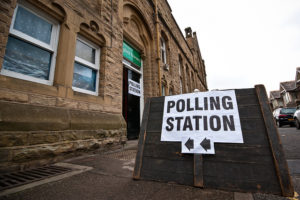
(cc photo: Greg McMullin)
This is true enough: People don’t like Congress, and yet most members of Congress get to keep their jobs. Is it really because the public’s “disapproval is fashionable”? Or that we’re not really as disgusted as we say we are?
When you hear this kind of election analysis, remember that it doesn’t apply to the actual public. Just 36 percent of eligible voters participated in the 2006 midterms; it was 37 percent in 2010. So the majority of the public doesn’t even vote in these contests; presidential races, meanwhile, tend to attract a bit more than half of the voting population.
Could there be any clearer expression of voter disgust with the political system than the decision to not vote at all? All the exhortations to get out and make your voice heard apparently fail to motivate people to go ahead and do so. But too often the nonparticipants are written out of election coverage—even though, if one takes all that stuff about the consent of the governed seriously, they are the clear majority, and will continue to be affected by government policy.
 During the 2012 election season, USA Today partnered with Suffolk University to poll unlikely voters. It’s an interesting snapshot of what could be something like half the adult population. They don’t espouse a coherent ideology, but, Susan Page (8/15/12) wrote, they “lean toward the Democratic candidate in most though not all election years.”
And as the chart to the left shows, a majority of them would like to see more than two parties, think that politics is corrupt and full of empty promises. Many think there isn’t much difference between the two parties.
If you care about democracy, then you should have some interest in the citizens who aren’t exercising their right to vote. But in horse race-dominated politics, the campaigns know that the best way to win is to turn out the sliver of the population most likely to vote for your candidate—which can often mean focusing on issues that aren’t all that relevant to most people. And then journalists covering the campaigns will focus most of their attention on those messages—thereby making the whole process all the more alienating to these unlikely voters.
So when they say they don’t think the political process feels all that relevant to their lives, they’ve got a point.
It’s not in the interests of political candidates to expand the discussion; if a Republican thinks he can win by hammering home messages about how Obama is weak on Ebola, he’s going to do that. That would seem to mean that, absent an influx of independent parties, journalism is the one institution that could serve to expand the discussion of real issues that matter to people.
If history is any guide, that’s pretty unlikely.




I do vote, acutely aware of the hollow exercise in democracy it almost always is
But I’ll be damned if I’ll berate someone for not doing so, who in good conscience can’t bring themselves to choose between a piece of shit
And a pile of it.
But, while we may Hem and Hew and sputter about it, the base line is that the people who don’t vote get what they ask for. If they are going to let the two parties tell them there is no choice, then they simply doing what they are told, not making a choice.
I have said this for many years; if everyone who can vote did, and they voted just twice in a row for someone not of the “Two parties” this nonsense would be over in a year. The first time the two parties didn’t get enough votes they would go into a panic, the second time they would all expire from heart attacks.
But, while non-voters are people too, The system is ‘Only those who vote count on the ballot. Until that is changed, nothing else will either. Not voting says to the Politico’s “They like what we are doing”.
The elephant in the room that no one ever discusses – how small our Congress is in comparison to our population. If our Congress had kept growing as it was designed by our Founders to grow, we would have a much more representative House of Representatives. As it is we have a House of Special Interests and most of it does not apply to the reality of life in America.
The fact that we are allowed to choose our dictators doesn’t make us any freer. It merely gives voters the feeling of power and the illusion of control. All the while they are being manipulated into supporting a government that implements policies detrimental to their well being.
What better way is there to get people to follow the law and pay taxes than to convince them that these things are their will? What better way is there to get people to tolerate the government’s evils than by convincing them that the situation is temporary and that they can change the government at the next election? What better way is there to get people to respect elected officials than to convince them that they, the people, chose these scoundrels to represent them? (A mandate, it’s called.) None of these things are true, but the fraud works. Democracy is held to be the best form of government yet devised. The question is best for whom? Certainly not the people.
It does work best for the ruling elites who can hide their evil plans behind a smiling democratic facade. The formula is to give people just enough freedom to feel free but not so much that the government loses control of them. To assure that the people will put up with their laws, antics, and taxes the ruling class must keep the citizens involved.
Ain’t that schweet? Corporate news already knows that “ 90 percent of the members of the House and the Senate are coming back and don’t even have a serious opponent.” Don’t Ms. Woodruff mention the word gerrymandering. And certainly don’t, being an alternative voice in public broadcasting that otherwise wouldn’t be heard, mention corporate control of elections. After all, your funding comes from BNSF railroad. Your making such mention would be a conflict of interest wouldn’t it? Gore Vidal made it so clear relatively many years ago when he said that US political candidates are vetted in corporate boardrooms before they ever make the ballot. And then the electorate is allowed to ratify one or the other of their choices at the polls every two or four years, in the sham that is the US electoral process. Barbara Mullin, Obama isn’t the very representation of the wider Democratic party. He’s pro-war; pro-Wall Street, and anti-everything else. How does that make the Democratic base anti-war? Due respect, Padremellyrn, you’re full of s***. I became an eligible voter in 1980. I voted for Ed Clark, Libertarian that year. I’ve never voted for any of the two corporate parties for president, and things remain the same, only worse. I voted for Nader I think, every time he ran for president; and a real public servant couldn’t even pull 5% of the vote to achieve for the Green Party federal matching grants. I lived in Kentucky in 2000, and voted for Nader, because it was a safe state that the intellectual midget was going to carry by double-digits. Had it been close in Kentucky, I would seriously have considered voting for Gore because I knew how catastrophically bad Georgie was going to be. Which leads me to my point. The electoral college is a farce. Gore won the election in 2000. He won the popular vote; he won Florida, and it was stolen from him by the Secretary of State, Katherine Harris, who as Florida’s secretary of state was the head of the intellectual midget’s campaign. That’s not a conflict of interest?
I didn’t vote at all in 2012, because I volunteered to collect signatures to get Uncle Ralph on the ballot in Illinois, which we did; as well as in 44 other states. As election day approached, Nader was polling a grand total of a third of a percent in Illinois, a state which Obama was going to carry by double-digits. I was so disgusted by the whole process, that was the first time I didn’t vote. The novelty had worn off.
The reasons for not voting – the system is corrupt and the choices seem always to be between Tweedle Dum and Tweedle Dummer – have some weight to them. But we are still enough of a democracy that we should be organizing and protesting in other ways to change it for the better. I think laziness and a lack of what Arisotle called civic virtue allow most people to beg off their duty to be engaged.
@Potshot – I have done much the same, and have for years advocated the same, Vote anything but. The key is that you have to convince enough people to do the same. But Wrong, tell me, if enough voters didn’t vote for only one of the two parties, you saying that the third parties wouldn’t win and things wouldn’t Change? Then explain why we have Democrats and Republicans when we didn’t start with them? We had Whigs and Tories and Federalists, and all kinds of other parties that were the ‘two’ parties long before this.
So the proof is there, it can be done. Is it going to be easy? Hell NO! We have to fight the apathy and the corporate press and lots of other things. But even the New Deal didn’t have happen over night, and we are not going to change things overnight.
But tell me honestly, do you really think that if two elections in a row, neither party won, they would just keep doing the same?