


The New York Times depicts Barack Obama engaging in problematic middle-class populism. (photo: Doug Mills/NYT)
The last thing that the wealthy want is for the rest of the populace to unite against them politically. Luckily for them, the New York Times–whose largest stockholder coincidentally happens to be the third-richest person on the planet–seems determined not to let that happen.
Here’s how Thomas Edsall, who covers “American politics, inequality, campaign strategy and demographics” for the Times (2/4/15) responded to President Barack Obama’s promotion of “middle-class economics”:
Middle-class populism, however, raises a host of problems for the Democratic Party. When the middle-class populist message is turned into actual legislative proposals, the costs, in the form of higher taxes, will be imposed on the affluent. Such a shift in the allocation of government resources threatens the loyalty of a crucial Democratic constituency: well-off socially liberal voters.
The question, though, is what is “middle-class” and what is “affluent”? Edsall takes a crack at defining it:
In 1992, voters from households making from $15,000 to $75,000 a year-–a very rough estimate of the working and middle class–made up 74 percent of the electorate. By 2012, voters from households making $30,000 to $100,000 (again, a rough estimate of the working and middle class) made up 52 percent of the electorate. By 2012, nearly three of every 10 voters, 28 percent, came from households making in excess of $100,000, the upper middle class and beyond.
In other words, the size of the target constituency for a political strategy emphasizing middle-class populism has grown substantially smaller, while the size of the affluent voting population that would bear many of the costs of financing the new populism has grown larger.
One problem here is that these numbers are not adjusted for inflation. An income of $75,000 in 1992 is equivalent to an income of $122,733 in 2012, according to the Bureau of Labor Statistics’ Inflation Calculator; $100,000 in 2012 bought as much as $61,108 in 1992. Has the target constituency for “middle-class populism” really grown smaller, or the affluent voting population gotten larger? You can’t prove it by these numbers. And given the continuing increase in inequality, the premise that a growing share of the electorate perceives themselves to be affluent is far-fetched on its face.
The obvious target for an appeal to middle-class populism are people who think of themselves as middle class–which includes not just people who make $75,000 or $100,000 but people who make much more, as Edsall acknowledges:
Many of those in households making from $100,000 to $250,000 do not, in fact, believe they are affluent and consider themselves merely middle class.
Apparently we are to assume that those people are deluded for thinking that they’re part of the middle class–even though Edsall himself describes people making $100,000 or more as being “the upper middle class and beyond,” with the upper middle class by definition being a subset of the middle class.
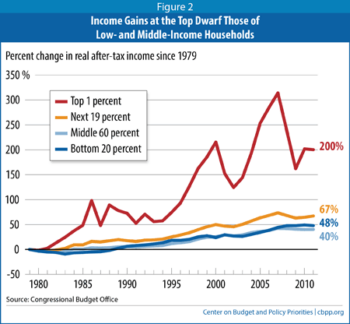
The rich are different from us, as this Center on Budget and Policy Priorities graph shows–they have more income gains.
The most prominent recent political movement against economic inequality, Occupy Wall Street, famously defined the economic elite as “the 1 Percent.” These are households who make at least $385,000, with an average income of $1.3 million. While it’s true that the upper middle class has done better than the rest of us over the past several decades, showing some degree of income growth while most incomes have stagnated, it’s also true that the top 1 percent have benefited far more: Between 1979 and 2007, as the Economic Policy Institute (1/26/15) has noted, 54 percent of all income gains went to the top 1 percent; from 2009 to 2012, “the top 1 percent captured 95 percent of total income growth.”
Given this lopsided distribution of income gains, it’s not irrational for people who make quite a bit more than the median income to identify with the middle class and applaud policies that are aimed at curbing the accumulation of wealth by the super-wealthy. But Edsall’s argument for the failure of middle-class populism depends on better-off voters who think of themselves as middle class not really being middle class–and knowing somehow that when politicians talk about the “middle-class,” they aren’t talking about them.
Let’s hope, for the sake of the truly wealthy, that people like that read the New York Times.


Middle class dismissed
Sounds like, among a certain class of people, claiming to be middle class is a form of whining.
It’s time for people to identify with “working class” instead of “middle class” and insulting terms. People who have to work for a living have more in common with each other than they do with those who don’t. The term, “middle class” is divisive and mostly worthless. No one should be forced to live in a way that’s worse than what we expect “middle class” to mean. Just how much someone who earns $350,000 has in common with a burger flipper is easier to see when you examine the real differences in wealth between them and someone like Bill Gates, http://www.lcurve.org/
This whole bit about the middle class is garbage and has been my entire 67 years on this planet.
If you work for an hourly wage, you are working class. I always was and am very proud of that fact. My Dad was as well and he was never ashamed of that fact either. The sad thing about this US of A is that the working class has been kept divided by artificial means, abortion, guns, religion, and of course skin color. They are false divisions and the working class needs to see this truth and come together as a group. The working class has more in common with each other than they will ever have with the rich, regardless of religions, skin color, or any other false divisions they like to use to keep the workers down. Yeah, old Karl Marx was a wimp. The older I get, the more radical I get. This middle class crap just gets me really worked up. Workers of the world, unite, you have nothing to lose except the chains your oppressors have bound you with.
As to that top 1%, a question for them all, how much is ever enough? Can they ever have enough? I doubt they will ever be satisfied, even if they owned everything there is, they’d still want more. Greedy bastards.
Nearly every discussion of the so-called “middle class” focuses on income — but ignores another crucial aspect of class: basically, power. We all recognize that at the very, very top of the income/wealth ladder, the folks there have far too much power. And we know where their power and wealth comes from; the majority of their income comes from investments, dividends, capital gains, etc., in other words, from their ownership of property — *not* from the work they do. Their ownership of property gives them common interests, thus binding them into a class. Sometimes we call them the capitalist class, or the 1%, or the ownership class, or the ruling class. But a class, they are.
What about the working class? What binds them together to have common interests? Well, they get nearly 100% of their income from the work that they do. That’s one aspect. But what about the actual day-to-day conditions of their work? How much power do they derive from the work that they actually do? We all know the answer. Do fast food workers, secretaries, factory workers, retail employees and millions of others have any control over their working circumstances? No. Their job is basically to follow orders. The work is boring, repetitive, mundane, soul-crushing.
Ok, so that’s two classes so far: the working class, about 80-85% of the population, and the owning class, about 1% of the population. So who are these “middle” folks, the remaining 15-20%? Well, what about managers, doctors, lawyers, engineers and so on? This is where income doesn’t help — they, like workers, also get a huge chunk of their income from the work that they do. (Although many also get a relatively small portion of their income from investments, too.) Yet all working people know that managers and workers are different. In fact, the relationship is almost always antagonistic, if not downright hostile. It’s managers, not owners, that workers hate the most. Really, the owners are so far removed from the workplace that we never even see them. It’s managers, that call the shots and give the orders. It’s managers and professionals that say how the job is done, what tools get used, what the company’s strategy is, how much work is going to be done, and so on. In short — they have the power to define and coordinate the working conditions of the people “below” them, while also enjoying much control over their own working conditions, and often plenty of perks. And because they enjoy such power, creativity, control, and want to maintain these circumstances, they are bound together — thus another class: the so-called “middle class”, which is really at the top, just below the owners (who, ultimately, they serve). Better called the professional-managerial class, or the coordinator class, I think. Clears things up quite a bit.
So I’d suggest that, while income is often a clue of class status, that we would make a major mistake by lumping workers and managers/coordinators into the same group, against owners. All three are quite different groups, with very different interests. (And, historically, the coordinators have sometimes ridden the wave of revolution to replace the owners as a new ruling class, themselves. There’s a good case to make that that’s what the USSR was, a coordinator-class economy.)