

[mp3-jplayer tracks=”CounterSpin Alice O’Connor Full Show @https://eadn-wc04-3257648.nxedge.io/audio/counterspin/CounterSpin160930.mp3″]

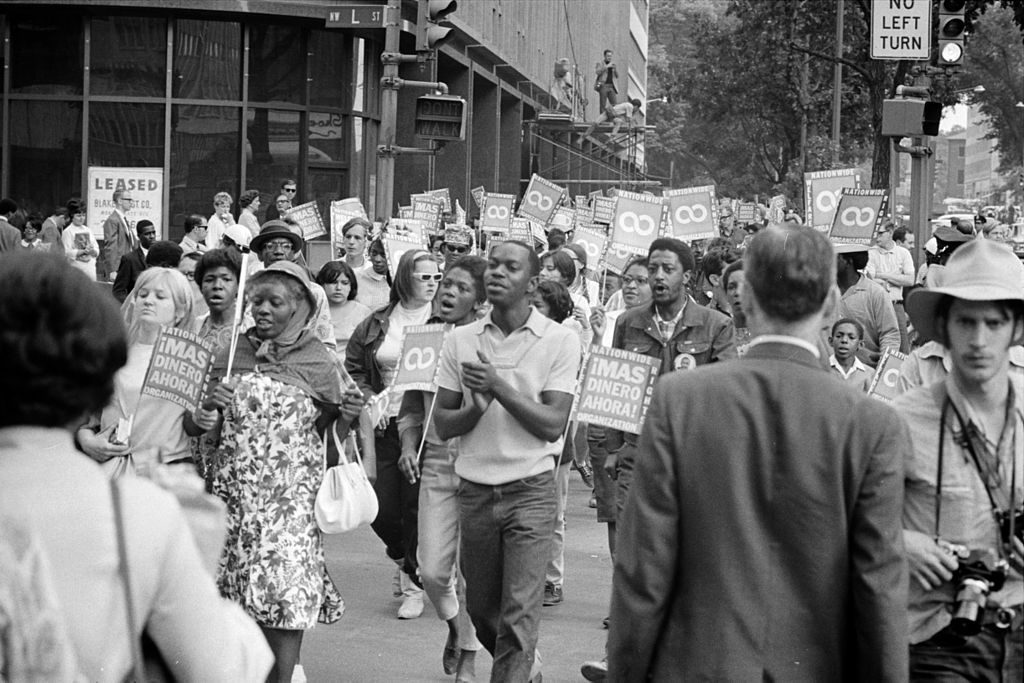
Poor People’s March, 1968 (photo: Warren K. Leffler, US News & World Report)
This week on CounterSpin: New data showing a drop in the percentage of Americans living below the poverty line is being rightly celebrated. But if eliminating poverty is really our goal, wouldn’t there be keener interest in asking exactly why the number went down—or what it means that it didn’t go down for everyone? For that matter, is monitoring the ups and downs in the poverty rate really the most useful way to think about the problem of persistent social inequity and hardship—or the best measure of the adequacy of the responses we’ve developed?
We talk about the limits of how we talk about poverty with Alice O’Connor. She’s a professor of history at the University of California/Santa Barbara and author of Poverty Knowledge: Social Science, Social Policy and the Poor in 20th Century US History.
Transcript: ‘Poverty Is a Product of the Institutions We Have in Society’
[mp3-jplayer tracks=”CounterSpin Alice O’Connor Interview @https://eadn-wc04-3257648.nxedge.io/audio/counterspin/CounterSpin160930OConnor.mp3″]
First, as usual, we take a look back at recent press, including Charlotte’s “outside agitators,” a Brazilian coup confession and an update on the national prison strike.
[mp3-jplayer tracks=”CounterSpin Banter @https://eadn-wc04-3257648.nxedge.io/audio/counterspin/CounterSpin160930Banter.mp3″]



MY LABORING-CLASS — SLOW AND CAREFUL THINKERS
75% of wealth — 25% most wealthy, rich ruling-class
25% of wealth — 25% middle-class, college educated
00% of wealth — 50% lower-half of society, laboring-class
So, all of the wealth that should be owned by the impoverished lower-half is owned by the top 25%, a system of economical slavery. A system of brutal imperialism that could not function without a brutal and terrorizing police state being imposed upon the Native-Americans, Afro-Americans, Latino-Americans and white laboring-class Americans.
Call if a class war, a race war or Civil War, surely it is all the same thing.
Excellent report, and excellent interviewing by Janine, as usual and inevitable.
I just write to note that the NPR “Poverty Tour” series just begun by On the Media’s Brooke Gladstone and referenced in the Alice O’Connor interview is not without its good points. Okay, good points given that it’s an NPR production. Still the good points are there. For example, the episode emphasizes that US poverty only gets worth despite occasional exposure in the mainstream media (referencing an old Peter Jennings piece). And the star of the piece, an Ohio welfare dept. director (or retired director, I forget), boils poverty down to the simple formula that people are poor “because WE won’t share.” True, he doesn’t say poverty exists because workers don’t control the means of production or anything like that, but I think the formulation “because we won’t share” puts the onus on the rest of us, not on the poor. Not too bad, for NPR.