

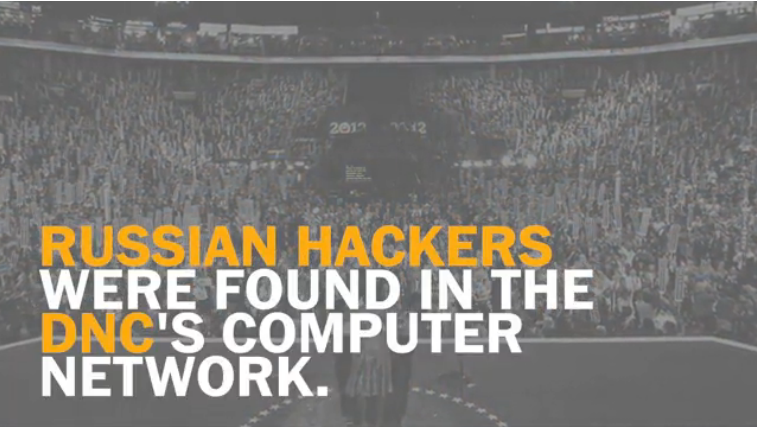
A Washington Post video turned a computer security firm’s allegations about a DNC hack into a series of unsourced factoids.
The Washington Post reported on Tuesday (6/14/16) that Russian intelligence had hacked the DNC servers to steal opposition research on Donald Trump:
Russian Government Hackers Penetrated DNC, Stole Opposition Research on Trump
While the Post story by Ellen Nakashima was sourced to “committee officials and security experts who responded to the breach”—i.e., CrowdStrike, the security firm hired by the DNC—that attribution dropped out of the headline, presenting Russian government culpability as an unquestioned fact. This framing was echoed by dozens of media outlets who picked up on the story and uncritically presented Russian guilt in their headlines without qualification:
- Russian Government Hackers Broke Into DNC Servers, Stole Trump Oppo (Politico, 6/14/16)
- Russia Hacked DNC Network, Accessed Trump Research (MSNBC, 6/14/16)
- Russians Steal Research on Trump in Hack of US Democratic Party (Reuters, 6/14/16)
- Russian Government-Affiliated Hackers Breach DNC, Take Research on Donald Trump (Fox, 6/14/16)
- Russia Hacks Democratic National Committee, Trump Info Compromised (USA Today, 6/14/16)
- Russian government hackers steal DNC files on Donald Trump (The Guardian, 6/14/16)
- Russians Hacked DNC Computers to Steal Opposition Research on Trump (Talking Points Memo, 6/14/16)
- Russian Spies Hacked Into the DNC’s Donald Trump Files (Slate, 6/14/16)
- What Russia’s DNC Hack Tells Us About Hillary Clinton’s Private Email Server (Forbes, 6/15/16)
Then something strange happened. Wednesday afternoon, a person or persons using the name “Guccifer 2.0” (referencing a hacker who infamously got into the Bush family emails) published online what appears to be detailed information derived from the hack. In the post, Guccifer 2.0 claimed the hack wasn’t nearly as sophisticated as CrowdStrike claimed, and wasn’t the work of hackers working for Russian intelligence.
While it’s definitely conceivable that Guccifer 2.0 could turn out to be a front for Russian intelligence, as CrowdStrike alleges, it certainly raises doubts as to the airtight case against Russia. Tech website Vocativ (6/16/16) concluded with a note of skepticism from Jeffrey Carr, CEO of a competing cybersecurity firm, who observed that while “it’s not unusual for any intelligence service to cover its tracks,”
I’m skeptical almost all the time when it comes to attribution…. I think the entire historical assignment of [government-affiliated] actors…was just wrong. That they were never part of an intelligence service or military service in the Russian government, that they were always independent hackers, and we don’t really know who they are.
In the wake of the Guccifer 2.0 development, some media outlets began to hedge their bets. Notice the shift in framing from Wired’s Andy Greenberg:
Russia’s Breach of the DNC Is About More Than Trump’s Dirt (6/14/16)
Thirty-six hours later—after the Guccifer revelation:
A Chaotic Whodunnit Follows the DNC’s Trump Research Hack (6/15/16)
They were 100 percent certain the hack was Russian, and now it’s a “Whodunnit”? International Business Times also shifted from a “Russia did it” to a “it’s a mystery” framing:
- Russian Hackers Infiltrated Democratic Party Computers to Steal Research on Donald Trump (6/14/16)
- DNC Hack: Security Firm CrowdStrike Stands by Research as Russia Strongly Denies Involvement (6/16/16)
Suddenly things aren’t so certain. Which is good—journalists should update stories as they evolve—but this raises an essential question: Why was everyone so willing and ready to take CrowdStrike’s word for it, without an ounce of skepticism, in the first place?

CrowdStrike’s Dmitri Alperovitch (left) says spying by Vladimir Putin’s Russia has increased “a thousand-fold” in the past two years. (images: YouTube, Global Panorama)
From the initial report, there were some red flags. Dmitri Alperovitch—CTO, co-founder and spokesperson for CrowdStrike—isn’t without a flair for the dramatic. In the Washington Post article, Alperovitch made a startlingly hyperbolic claim:
Russia has always been a formidable foe in cyberspace, but in the past two years, “there’s been a thousand-fold increase in its espionage campaign against the West,” said Alperovitch, who is also a senior fellow at the Atlantic Council. “They feel under siege.”
Russian espionage against “the West” has increased 100,000 percent? That would certainly add urgency to the Russian menace. A request by FAIR to the Washington Post to explain how they verified this figure remains unanswered.
The Post also did not respond to inquires by FAIR on how or whether they attempted to independently verify CrowdStrike’s claims of Russian intelligence’s culpability.
CSO Online (6/15/16), a straightforward cybersecurity blog, noted in its recap of the back and forth that “overall, the Washington Post story actually read more like a promotion for CrowdStrike’s incident response offerings than actual security news.”
Alperovitch, as the Post notes, also works for the Atlantic Council—a reliably anti-Putin think tank that publishes articles such as “Two Cheers for Cold War!” and policy papers like “Distract Deceive Destroy: Putin at War in Syria” and Hiding in Plain Sight: Putin’s War in Ukraine.” The Atlantic Council is funded by the US State Department, US allies (Norway, Sweden, Finland, NATO) and a consortium of Western corporations (Qualcomm, Coca-Cola, The Blackstone Group), including weapons manufacturers (Lockheed Martin, Raytheon, Northrop Grumman) and oil companies (ExxonMobil, Shell, Chevron, BP).
CrowdStrike currently has a $150,000 / year, no-bid contract with the FBI for “systems analysis.”
In January 2014 (back when, according to Alperovitch, Russian espionage was 0.1 percent as intense as it is today), CrowdStrike again was the sole accuser of Russian cyberattacks. Just as in the DNC case, the Washington Post’s Nakashima was on it–although in the earlier report, the qualifications made it into the headline: “Researchers Say They See Russian Hackers’ Hands in Cyber Espionage Against Western Energy Interests.”
The story was also reported in Reuters (1/22/14), Mashable (1/22/14) and several others. According to the Post, Alperovitch “did not have definitive proof” to implicate Russia. It seems the standards for “definitive proof” have weakened since then.
As NATO and Russian tensions build to Cold War levels, wouldn’t it be prudent for editors, at the very least, to throw in an “allegedly” or two? Instead, what we have is lockstep condemnation from a press eager to demonize the Russian menace. Just because those in power are preparing for a “new Cold War” doesn’t mean the media need to play along.
CORRECTION: An earlier version of this piece misidentified Sweden and Finland as NATO members.
Adam Johnson is a contributing analyst for FAIR.org. Follow him on Twitter at @AdamJohnsonNYC.
Messages can be sent to the Washington Post at letters@washpost.com, or via Twitter @washingtonpost. Please remember that respectful communication is the most effective.





Russia to judgment
Funny :-)
Much obliged, Steven
If only the subject were innocuously humorous.
All this sewage talk is repulsive – and concerning. Adam Johnson is the messenger from the man-hole – I’m not liking his message.
It reminds me of redundant world war and spy games of 30s 40s 50s 60s projected into the modern world post-Internet.
DNC, Hillary Clinton, NSA, little Sara at school texting pictures, uncle on porn, me walking-talking-posting – we have no place to hide in the same way as we are evolving to have nothing to hide.
It’s a new and open playing field.
It seems humanity is destined to achieving the goals of transparency – a “naked liberation” movement where hacking is a bizzar notion.
But in the meantime we have stogy oldworld bigots and ignoramuses floating around in every government, at every agency and every level, every media network and in every corporation and organization throughout the planet like bits of stool in waterways that are painfully recovering from centuries of crap.
While the members of the global $$-oligarchy, weapons and nuclear manufacture persist and constitute “stuff-to-hide”, the transition to an economy, security and culture of sustainability, transparency and non-violence is going to be unnecessarily rocky and probably hopeless.
When the WPost and MSM media are prepared to tackle such news and reports with full disclosure then let me know. In the meantime boycott them, expose them and take up the real conversations independently elsewhere : The agenda of sustainability and all it’s connected dots.
We live in the age of the Internet not WWII.
Another excellent piece, Adam. Thank you. I have only one bone to pick. At the end you say, “Just because those in power are preparing for a ‘new Cold War’ doesn’t mean the media need to play along.”
I would argue the media is fulfilling its intended purpose of doing exactly what ‘those in power’ have directed them to do.
Few have asked the obvious questions of how the Russians knew a year ago that Trump would be the nominee, and why the DNC thought matters of common knowledge wouldn’t be enough to use against him.
Of course Russia did it! Putin’s behind everything from the Syrian refugees to the Zika virus!
… and the bad weather. That is well-known.
Correction: Sweden is not a NATO member; in fact, it’s ostensibly neutral.
The error is understandable, though, since the Swedish government has been very eager to co-operate with NATO and the US in getting the new cold war underway.
I dont have anything against russia, and would like to see cooperation and peace between the G8 members.
However, working in the info tech sector, most bots and hackers come from china and russia. :p
Article asks: “…this raises an essential question: Why was everyone so willing and ready to take CrowdStrike’s word for it, without an ounce of skepticism, in the first place?”
Didn’t the DNCLeaks (their content) already provide an answer to this question? They shill for Clinton, both during the primaries and now. The DNC (aka Clinton) influences, if not controls, the mass media.
The way mass media is covering the DNCLeaks is explained by DNCLeaks
Here we are nine months later and there’s still no proof that “Russians” hacked the DNC. Russophobia, though, is in full force – and based elements that bring to mind carnival legerdemain or a penny stock promotion. Smoke and mirrors.
CrowdStrike claimed a DNC document was modified “by a user named Феликс Эдмундович (Felix Dzerzhinsky), a code name referring to the founder of the Soviet Secret Police.” That appears akin to US intel forces hacking foreign actors and leaving behind a e-calling card citing Sidney Souers, Allan Pinkerton or J. Edgar Hoover. See other details in “The New Red Scare: Reviving the art of threat inflation” in Harper’s @ http://harpers.org/archive/2016/12/the-new-red-scare
Questions raised about CrowdStrike’s work are noted in such DNC scenario analyses as “Did the Russians Really Hack the DNC?” @ http://www.counterpunch.org/2017/01/13/did-the-russians-really-hack-the-dnc
– which also raises questions about the work of such firms as FireEye backstopping CrowdStrike’s efforts:
“Security Alliance regards security firm FireEye’s analysis that tied APT28 to the Russian government as based ‘largely on circumstantial evidence.’ FireEye’s report ‘explicitly disregards targets that do not seem to indicate sponsorship by a nation-state,’ having excluded various targets because they are ‘not particularly indicative of a specific sponsor’s interests.’ [5] FireEye reported that the APT28 ‘victim set is narrow,’ which helped lead it to the conclusion that it is a Russian operation. Cybersecurity consultant Jeffrey Carr reacts with scorn: ‘The victim set is narrow because the report’s authors make it narrow! In fact, it wasn’t narrowly targeted at all if you take into account the targets mentioned by other cybersecurity companies, not to mention those that FireEye deliberately excluded for being ‘not particularly indicative of a specific sponsor’s interests’.” [6]
And more from cybersecurity expert Jeffrey Carr: “FBI/DHS Joint Analysis Report: A Fatally Flawed Effort” @ https://medium.com/@jeffreycarr/fbi-dhs-joint-analysis-report-a-fatally-flawed-effort-b6a98fafe2fa#.fgvddrl79
Further, Carr excoriates CrowdStrike in “The GRU-Ukraine Artillery Hack That May Never Have Happened” @ https://medium.com/@jeffreycarr/crowdstrike-needs-to-address-the-harm-it-caused-ukraine-742d0e2468f9#.k92btxccy eg. “Conclusion
Part of the evidence supporting Russian government involvement in the DNC and related hacks (including the German Bundestag and France’s TV5 Monde) stemmed from the assumption that X-Agent malware was exclusively developed and used by Fancy Bear. We now know that’s false, and that the source code has been obtained by others outside of Russia…
With the release of its Danger Close report, Crowdstrike has acted as irresponsibly as the Washington Post did when the paper ran a story claiming that Russian hackers had breached a Vermont utility. Instead, it was only one laptop. In the case of Danger Close, Crowdstrike invented a “devastating” cyber attack out of thin air and called it DNA evidence of Russian government involvement.”
And in “Crowdstrike Needs To Address The Harm It Caused Ukraine” @ https://medium.com/@jeffreycarr/crowdstrike-needs-to-address-the-harm-it-caused-ukraine-742d0e2468f9#.k92btxccy which begins: “Crowdstrike’s Danger Close intelligence report is an analytic failure of epic proportions, but more importantly, it has harmed the morale of the people of Ukraine as well as cast doubt in the minds of the Ukrainian soldiers who relied upon the app.”
Additionally raising questions as to its character, CrowdStrike appears to be trying to silence NSS Labs, an independent testing company, which has found the company’s “endpoint” security products to be sub-par:
+ “NSS Labs releases scathing response to CrowdStrike endpoint security accusations, questions customer security”
http://www.channelnomics.com/channelnomics-us/news/3005897/nss-labs-releases-scathing-response-to-crowdstrike-endpoint-security-accusations-questions-customer-security
+ “NSS Labs rated 13 advanced endpoint security products, flagged 2 with caution rating” @ http://www.networkworld.com/article/3170114/security/nss-labs-rated-13-advanced-endpoint-security-products-flagged-2-with-caution-rating.html
+ “$667 million startup Crowdstrike just lost an ugly public spat with a company that tests software” @ http://www.businessinsider.com/crowdstrike-loses-an-ugly-public-spat-with-testing-company-2017-2
+ “Security Firm Loses Bid to Suppress Unflattering Test Results” @ http://www.pcmag.com/news/351774/security-firm-loses-bid-to-suppress-unflattering-test-result
+ “NSS Labs CEO denies calling on reseller to obtain CrowdStrike product: Exec tells Channelnomics CrowdStrike ULA provisions are ‘un-American’ “ @ http://www.channelnomics.com/channelnomics-us/news/3005995/nss-labs-ceo-denies-calling-on-reseller-to-obtain-crowdstrike-product
and on…