

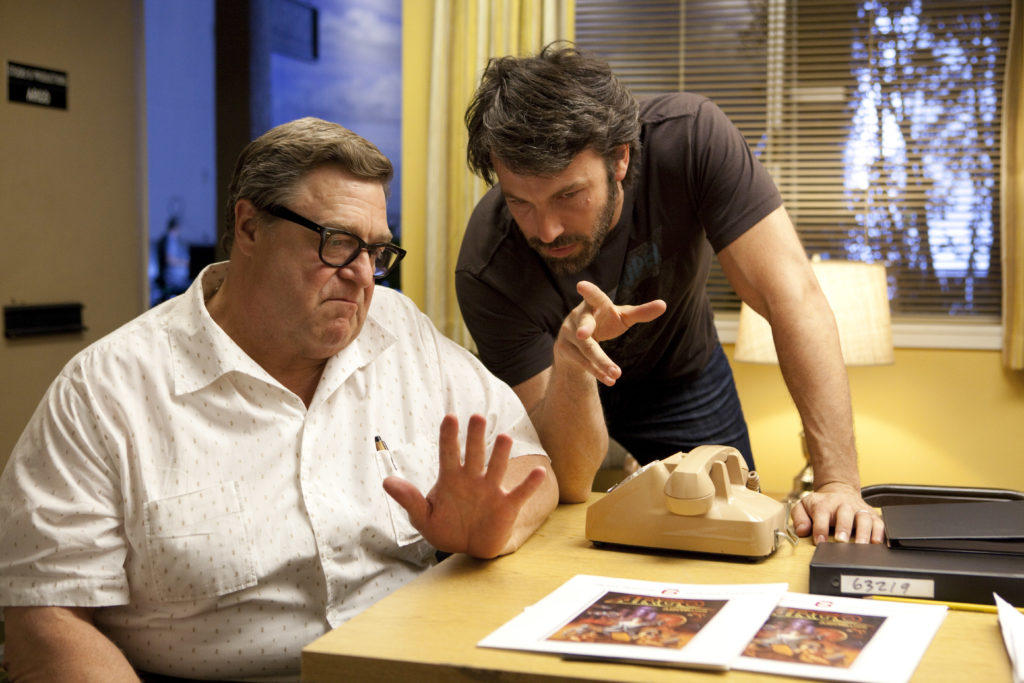

John Goodman played a moviemaker working with CIA agent Ben Affleck to produce a fake film in the Oscar-winning Argo. It turns out there were real CIA agents working with the real movie-makers to make the actual film Argo.
Vice’s Jason Leopold (4/6/16) has uncovered documents showing the CIA had a role in producing up to 22 entertainment “projects,” including History Channel documentary Air America: The CIA’s Secret Airline, Bravo‘s Top Chef: Covert Cuisine, the USA Network series Covert Affairs and the BBC documentary The Secret War on Terror—along with two fictional feature films about the CIA that both came out in 2012.
The CIA’s involvement in the production of Zero Dark Thirty (effectively exchanging “insider” access for a two-hour-long torture commercial) has already been well-established, but the agency’s role in the production of Argo—which won the Best Picture Oscar for 2012—was heretofore unknown. The extent of the CIA’s involvement in the projects is still largely classified, as Leopold notes, quoting an Agency audit report:
However, because of the lack of adequate records, we were unable to determine the extent of the CIA’s support to the eight projects, the extent to which foreign nationals participated in CIA-sponsored activities, and whether the Director/OPA approved the activities and participation of foreign nationals…. Failure on the part of CIA officers to adhere to the regulatory requirements could result in unauthorized disclosures, inappropriate actions and negative consequences for the CIA.
The CIA’s history of producing or helping to produce films goes back decades. The Agency, for example, secretly bought the rights to Animal Farm after Orwell’s death in 1950 and produce an animated adaptation centered on demonizing the Soviet Union rather than capturing Orwell’s broader critiques of power.
And as the CIA got involved in film production, Hollywood players have likewise taken part in covert operations. For years, legendary film producer Arnon Milchan (Pretty Woman, Fight Club, back-to-back Oscar winner for Best Picture in 2014 and 2015) worked for Israeli intelligence to deal arms and obtain technologies Israel needed to make nuclear weapons. “At the peak of his activities,” according to the Guardian, he was “operating 30 companies in 17 countries and brokering deals worth hundreds of millions of dollars,” an arrangement that, Milchan told the BBC (11/26/13), involved Sydney Pollack—director of Sabrina, Tootsie and, ironically enough, Three Days of the Condor.
In such revelations, an important point is often overlooked: The CIA assisting or posing as filmmakers, journalists and other creative roles—a practice the Agency reserves the right to partake in to this day—puts actual filmmakers, journalists and other creators at risk overseas. It’s an important piece of context that’s rarely addressed by a pundit class who is (rightfully) outraged at American journalists and filmmakers being detained as spies overseas, but responds with praise or amusement when CIA takes on such roles as cover.
The amnesia at work is impressive. Jon Stewart’s film Rosewater, about Iran detaining Iranian-Canadian journalist and filmmaker Maziar Bahari in 2009 on charges of spying, came out a mere 18 months after Argo won Best Picture for depicting the CIA using phony filmmakers to do just that. We praise the latter without acknowledging the glaring fact that it helps set the stage for the former.

In Rosewater, Gael Garcia Bernal plays Maziar Bahari, a Western journalist held by Iran as a spy after he reports on violence against protesters.
This isn’t to suggest Iran doesn’t detain legitimate journalists and filmmakers for simply publishing uncomfortable truths—as it did in the case of Bahari and Washington Post’s Jason Rezaian in 2014—but American media’s cozy relationship with the CIA and other intelligence agencies makes the possibility of overcompensation by Iran and other unfriendly governments that much more likely, and makes the pretense that legitimate journalists are suspected of espionage that much more plausible.
Indeed, this is a position advanced by Associated Press reporter Terry Anderson, who spent six years detained by Hezbollah and now lobbies aggressively against these suspect practices. As Martha Bayles and Jeffrey Gedmin wrote in a Boston Globe op-ed last year (1/4/15):
First, such practices make honest journalism more dangerous. Ask Terry Anderson, the Associated Press reporter who in 1985 was taken captive by Hezbollah, which accused him of being a CIA agent. After being released in 1991, Anderson became an eloquent voice arguing against blurring the distinction between newsgathering and espionage.
This is not to suggest that if the CIA’s policy were less murky and problematic, the Taliban would not have murdered Wall Street Journal reporter Daniel Pearl, or the Azerbaijan ruling party would not be trying to discredit Khadija Ismayilova. But when it comes to managing risk, a definite ban on the recruitment of journalists would constitute a positive step. Not only that, but the lack of such a ban erodes the trust of America’s allies and provides fuel to its adversaries.
The same is true for filmmakers. While it appears the CIA’s involvement in the entertainment “products” revealed by Vice was to provide access in exchange for steering the message (as opposed to using the filmmakers for intelligence-gathering), the spectacle of Hollywood teaming up with US intelligence agencies to make propaganda—especially given the dodgy historical context—no doubt stokes the fears of countries already hostile to Americans within their borders.
This isn’t to say that if the CIA bans the practice of recruiting journalists and assisting the production of films, other countries still won’t be paranoid (justifiably or not), or that such a restriction would even be respected. But when the CIA blurs the lines between covert intelligence gathering and legitimate media, the reaction of media people shouldn’t be amusement, much less awards. Every time this type of behavior is normalized, or shrugged off, or made sexy, real journalists and real filmmakers overseas are put further at risk.
Adam Johnson is a contributing analyst for FAIR.org. Follow him on Twitter at @AdamJohnsonNYC.




How ironic in the case of Argo… since the movie is a piece of bullshit fiction that almost completely discounts the told of Ken Taylor and the other Canadians in the Tehran embassy.
How ironic in the case of Argo… since the movie is a piece of bullshit fiction that almost completely discounts the travails of Ken Taylor and the other Canadians in the Tehran embassy.
1) Argo was filmed at Langley, as you can see by just watching the film. We have known for four years that the CIA were involved in that film.
2) This report was originally released to Judicial Watch, not Vice and Jason Leopold.
So much for ‘accuracy in reporting’…
Nearly every “report” FAIR produces has outright errors or manipulates facts to fit Naureckas’s worldview, not to mention the cherry picking of which issues they address (have you seen a single article critical of Bernie Sanders?). Nobody takes this group seriously anymore.
“A version of the 20-page audit was released last September to the conservative group Judicial Watch and later to the National Security Archive in response to their open records requests. But the eight entertainment projects the CIA worked on were redacted, as were footnotes that stated the specific regulations for dealing with the media that CIA officials violated when working on at least one of the projects. That portion of the audit, however, was unredacted in the version turned over to VICE News this week.” https://news.vice.com/article/cia-helped-produce-top-chef-covert-affairs
Pretty Woman was released in 1990 and The Fight Club in 1999.
I can see how that would be confusing the way it was written. He should have added “for the films 12 Years a Slave and Revenant” after “back-to-back Oscar winner for Best Picture in 2014 and 2015.”
Mr. Johnson makes excellent points yet somehow manages to repeat Western propaganda about Jason Rezaian. This makes his intentions behind this piece questionable. Rezaian was behind the 2009 failed attempts at a color revolution in Iran. The allegations of lies, fraud, came from Tehran Bureau – the domain TehranBureau.com was by Jason Rezaian. Even more curiously, that domain name was created on June 12, 2008 – exactly one year to the day before Iran’s presidential election. Rezaian was all behind the unrest and lies and failed revolution. I found it very disturbing that the Iranian government released him without ever talking about his role in all this. For some intelligent reading on Jason Rezain who is defended in this article, I suggest reading a truly terrific piece http://www.foreignpolicyjournal.com/2009/07/21/the-case-of-the-‘fatwa’-to-rig-iran’s-election/view-all/
Great reporting! Simply love when truthful reporting skimps on the ponderous and is breezy in style. And Ben Affleck is behind that? I didn’t like Argo because the critique going in was that it skirted the history of Iran, especially the US deposing of the Shah in 1953. In hindsight however, I had to admit it did treat of that history. This is truly alarming. I thought Ben Affleck was a devotee of Noam Chomsky? Tom you’re such a standout devotee of the truth. How do you do it? What is your secret? Can we mere mortals have a peak at greatness? I was thrown by that too Bonnie. Apparently we have to consult Wikipedia for those titles, small flaw in otherwise splendid reporting
The US (and UK) didn’t depose the Shah in 1953. They INSTALLED the Shah in 1953.
Wag The Dog told us everything we need to know. Unfortunately no one paid attention.