

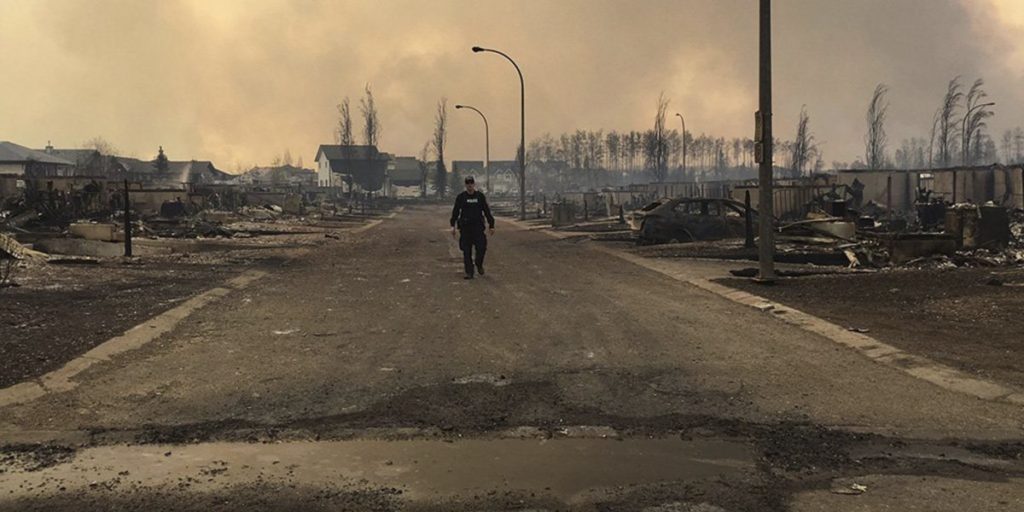

A Mountie examines fire damage in Fort McMurray, Alberta, in a photo featured on CBS‘s website. (photo: RCMP)
As fast and furious as trailers for a Hollywood disaster movie, network news coverage of the massive fires ripping through Canada’s tar sands hub has missed opportunities to provide real information about the heavily polluting tar sands industry and global warming’s role in adding fuel to the flames.
As of May 10, the fires have burned nearly 800 square miles in the province of Alberta and hit about 2,400 homes, businesses and other structures. In all, nearly 90,000 people in the Fort McMurray area have been forced to flee their homes. (If you’d like to contribute to help the fire’s victims, the Canadian government is matching all donations to the Red Cross Alberta Fires fund.)
From May 2 to May 9, CBS News mentioned Canada’s wildfires 11 times, ABC News ten times and NBC News four times. None of the stories mentioned global warming’s role in contributing to the hot, dry conditions that make forests ripe for wildfires.
Fires Hit Heart of Canada’s Tar Sands Industry

Damage from tar sand mining in Alberta, Canada (cc photo: Dru Oja Jay / Dominion)
Fort McMurray, a city of some 60,000 people, was a frontier outpost until tar sands production began in earnest in the 1960s, with a spike in oil prices in the mid-2000s fueling a secondary boom that nearly doubled the city’s population in the decade since. Just one network, CBS, mentioned why Fort McMurray had suddenly sprung up in the middle of an old-growth forest. Even that mention was itself telling: CBS used the Canadian oil industry’s preferred term, “oil sands,” instead of the more accurate “tar sands” to describe the sandy, sticky clumps that are turned into fuel through an expensive, polluting and energy-intensive process.
Tar sands oil is one of the dirtiest, costliest and most destructive fuels in the world. Unlike conventional crude oil, unrefined tar sands oil is hard to extract, and in order to mine this resource, oil companies are digging up tens of thousands of acres of pristine forest in Alberta and leaving behind a toxic wasteland. Because of this arduous process, tar sands oil’s life-cycle climate pollution is significantly higher than fuels made from conventional oil.
Climate Change Fueling More & Stronger Wildfires
There’s a long scientific track record connecting global warming with increasing and more intense wildfires. Warming temperatures are leading to longer fire seasons, drier conditions and more lightning to spark fires, according to the National Wildlife Federation.
Asking if any one fire is caused by climate change is the wrong question, like asking for proof any one smoker’s cancer was definitively caused by cigarettes. The correlation comes when we look at trends, which are clear.
“This is an example of what we expect — and consistent with what we expect for climate change,” University of Alberta Wildland Fire Professor Mike Flannigan told CNN.com’s John Sutter (5/7/16). “This fire is unprecedented [locally].”
Here in the United States, the overall area burned across 11 Western states is projected to double by late this century if the average summertime temperature increases 2.9 degrees Fahrenheit, with Montana, Wyoming, New Mexico and Utah hit particularly hard.
Ignoring Clear Climate Links
Print coverage linked the fires to global warming more often, mentioning climate change 32 times in 489 articles. But as has become standard practice in the industry, it relegated climate change to sidebar or follow-up stories, rarely mentioning it in the main news coverage.
Broadcast coverage rarely delved into the causes of the fires at all, and when it did, global warming’s contributions were never mentioned.
“Lightning and drought thought to be the causes,” said Scott Pelley on the May 5 edition of CBS Evening News. “This massive inferno is feeding on dry forest,” reported Miguel Almaguer on the May 4 NBC Nightly News, not elaborating on why tinder-dry forests are becoming more common.
Disaster-Themed Coverage

Parts of Alberta were “literally hell on Earth,” according to CBS News. (image: Jason Edmondson/You Tube via the Sun)
All networks focused almost exclusively on harrowing wildfire video, but perhaps no newscast was more over-the-top in its rhetoric than the May 5 edition of CBS Evening News. “Embers rain on Canada,” blared anchor Scott Pelley in the show’s introduction. “Wildfires rage and 90,000 people run for their lives.” Not to be outdone, reporter Ben Tracy added, “Parts of Alberta are literally hell on earth.”
One resident who seemed to particularly meet the networks’ desire for first-person wildfire video combined with disaster commentary, YouTuber Jason Edmondson, was featured on all three networks . “I can feel the heat here. This is insane!” he was shown saying. As the Sun (5/6/16) reported, Edmonson continued: “Holly f***! Boy you can feel the heat. Holy s***, this is f****** crazy.” The networks edited that part out.
Newscasters seemed unable to grasp the size of the fire without using New York City as their yardstick. “It’s already devoured an area bigger than Manhattan,” Lester Holt said on the May 4 edition of NBC Nightly News. “Tonight a monster inferno raging through the Canadian province of Alberta has exploded to a size bigger than New York City,” Holt told viewers the next night. And on May 6, ABC’s Neal Karlinsky told viewers the fire was “10 times the size of Manhattan.”
Man vs. Nature
The theme that most often emerged from the coverage was a battle of man versus nature, with man as the protagonist and nature as the villain to be beaten back. “Tonight the fight continues, a tough battle waged on the front lines where they’re still losing ground every day,” said Miguel Almaguer on the May 5 NBC Nightly News.
The evacuees are certainly the victims of this disaster (along with Canada’s forest wildlife and ecosystems), and firefighters deserve every bit of heroic praise.
Factoring in the contributions of global warming and tar sands production would complicate the networks’ effort to tell a simple, black-and-white story. What if our addiction to cheap, dirty energy helped create these monstrous fires?
Finally, there’s the lingering question of whether that’s even a path the networks have any interest in going down. As Media Matters reported in April, CNN viewers are five times more likely to see oil industry ads than climate science coverage.
Miles Grant is a progressive blogger and environmental communicator in Fairhaven, Massachusetts. He’s director of communications for the National Wildlife Federation (though his thoughts here are his own). Read more at The Green Miles and follow him on Twitter.




The next step is for other news providers including news coverage sites like FAIR to provide clarity on the reason(s) editors are not providing linkage of events such as the Fort McMurray Fire to Climate Changes caused by Global Warming.
That would require journalists to understand probability and statistics. No individual weather event is positively attributable to manmade global warming, but it contributes to ALL of them. Most enviro activists can’t explain how that is possible. Even fewer journalists can do it. I’ve met mathematicians who don’t understand it. With self-appointed explainers like Al Gore and Bill Nye, it’s not getting any better. Those guys need to stand aside and hand the scientists the mike.
The subject of climate change and the Fort McMurray fire was brought up in the Canadian press–but mostly to discuss whether it was polite to do so:
http://www.cbc.ca/news/politics/elizabeth-may-fort-mcmurray-climate-change-1.3566126
This follows a theme of Canadian corporate media: focus on the emergency (which is apolitical) and leave climate change (which the press sees as a political issue) until the emergency has subsided. Needless to say, the press–and their readers–loses interest in the subject once the emergency has, indeed, subsided.
Fanning the flames
Smothering the spark
Correction: Dru Oja Jay works with the Dominion publication, not the Domion.
Despite the claims of this nutty dimwit, there is no proof that so-called “global warming” et. al. has anything to do with the wildfires.
Despite the claims of this nutty dimwit, there is no proof that so-called “global warming” et. al. has anything to do with the wildfires. These are wild claims of radical believers in the global warming hoax.
@qpro4inc: It’s about time somebody took a firm stand against global warming. Now how about your opinion of the solar-system? Anyone can look out the window and see that the earth is flat.
We await you wisdom, oh, learned one.
Mass media and progressive activists seem completely unable to tell this story with scientific accuracy. No SINGLE weather event or wildfire can be attributed to manmade global warming (AGW). But, and here is the point almost everyone is missing, that does not mean these events are unrelated to AGW. Climate is about averages over several decades. Roll a die once. You will get one of six numbers. That’s weather. Roll it ten thousand times and the AVERAGE is predictable. That’s climate. You can’t tell whether the die is loaded from one roll, but it’s obvious after ten thousand. This concept seems to be far beyond the grasp of the typical journalist, and the climate deniers rush in to exploit their failure.
Thank you for this important news survey. The description that the climate change side of this story has been relegated to secondary status in U.S. media also applies to mainstream news media in Canada. Many newspaper columnists in Canada are arguing that due to sensitivities surrounding the personal hardships of those who fled the fire, “now is not the time” to discuss the climate change origins or implications of the fire. Canadian mainstream news has focused on stories of heroism and survival, out of proportion to the important story of the fire’s origins and implications.
Yesterday, Alberta Premier Rachel Notley stood with the titans of the tar sands industry at a press conference in Edmonton to say that now that the fire danger to Fort McMurray has receded, the most important thing that needs to be done is to restart the tar sands operations that were closed out of fire precaution or due to the fleeing southward of operations’ personnel.
One small factual correction–tar sands production in Alberta did not “begin in earnest” in the 1960s. The big spurt has come during the past two decades, prompting, in turn, the rapid growth of Fort McMurray and its urban sprawl into the surrounding boreal forest.
I was involved in advocacy for Haiti before and after the January 2010 earthquake. I traveled to there in June 2011. There, some 60,000 to 70,000 people died (not the “300,000” figure carelessly used by UN and other international agencies, though that is another story). Now THAT was and remains a huge tragedy. Much of the lives lost and material damage from the earthquake was human-induced–by several centuries of rapacious U.S. and European imperialism which continue to this day. All the tears and promises of change and improvement for Haiti made by leaders of the U.S., Canada and Europe has come to naught. Haiti continues to be punished for the ‘crime’ of daring to rise up against slavery in 1791 and ultimately defeating the largest empire of the day, France, in 1803. Haiti declared its independence on January 1, 1804.
Roger Annis
Vancouver, Canada