

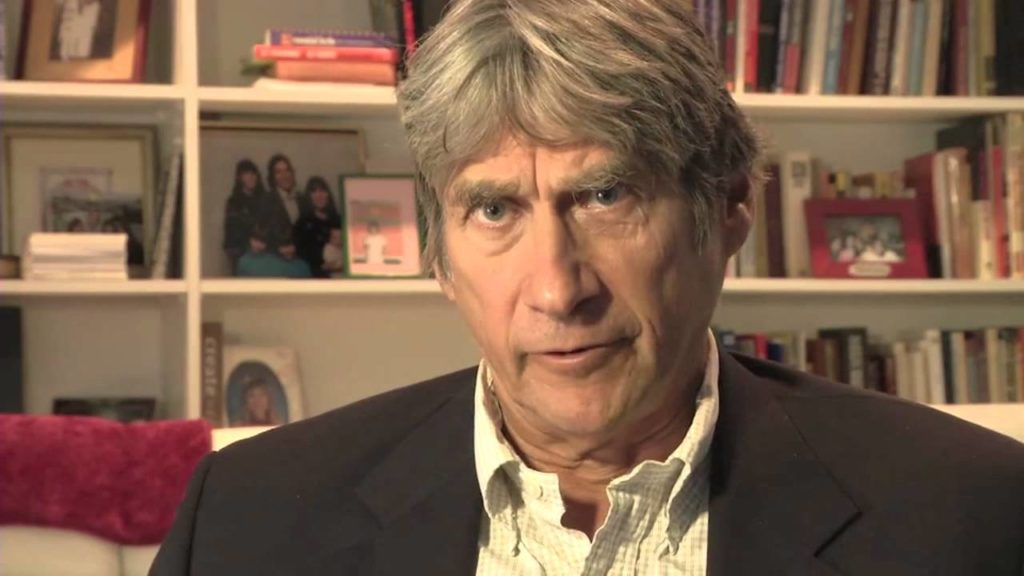
Janine Jackson interviewed Harvey Wasserman about renewables and nuclear power for the July 29, 2016, episode of CounterSpin. This is a lightly edited transcript.

Harvey Wasserman: “These guys running around defending nuclear power aren’t just defending nuclear power. What they’re really about is protecting the grid, which is corporate-owned and corporate-controlled.” (image: Ecological Options Network)
[mp3-jplayer tracks=”CounterSpin Harvey Wasserman Interview @https://eadn-wc04-3257648.nxedge.io/audio/counterspin/CounterSpin160729Wasserman.mp3″]
Janine Jackson: When you think of impediments to fighting climate change, you might think of the power of the fossil fuel industry, or corporate globalization running roughshod over people’s effort to tend to their environments as they have, in some cases, for millennia. A recent New York Times article finds a different villain: renewable energy, or, in Times reporter Eduardo Porter’s words, “the United States’ infatuation with renewable energy.” It’s a puzzling assertion, even before you get to what Porter says is the most worrisome development—that renewables are pushing out nuclear power, which he describes repeatedly as producing “zero carbon” electricity.
What’s going on here? To help us sort through it, we’re joined by activist and journalist Harvey Wasserman, author of, among other titles, Solartopia: Our Green-Powered Earth. Welcome back to CounterSpin, Harvey Wasserman.
Harvey Wasserman: It’s great to be with you, Janine. Thank you.
JJ: Well, in this July 19 piece, Eduardo Porter says, “The United States and indeed the world would do well to reconsider the promise and the limitations of its infatuation with renewable energy”—though there isn’t actually anything in it to hint at the “promise” part. Besides the article’s undercurrent about people being too stupid to know what’s good for them, which is irritating, what’s wrong with the picture that the Times is presenting here?
HW: Well, the question is what’s right with it. I mean, this guy had really dug deep to come up with arguments against renewable energy, none of which make any sense unless you’re working for the fossil fuel and nuclear power industries, or what I call King CONG—coal, oil, nukes and gas. The Times has been a cheerleader for nuclear power right since Hiroshima; they’re not letting up. And in this article, Eduardo Porter—I don’t know what drugs these guys take, but he’s basically saying that renewable energy is harming the fight against climate change because it’s bankrupting nuclear power. I mean…
And then he goes to these great lengths to say things that are absolutely false about nuclear power, the idea that it’s cheap, that it’s clean, and that it gives us base-load power, completely ignoring the fact that the grid on which nuclear power sends its electricity is completely obsolete, outmoded, and that we are moving to an energy economy that’s based on decentralized and distributed generation rather than central generation. It’s like this guy is arguing against cell phones because they’re putting out land lines. That’s basically the argument he’s making, and it’s utterly insane.
JJ: Just on a point of fact, because it’s something that not just Porter and not just the Times, but it’s a thing that we see repeatedly, the idea that nuclear is zero carbon. Real quick, how is that justified? Nuclear power is not zero carbon.
HW: Yeah, well, first of all, just for a slight detail, all nuclear power plants emit carbon 14. Now, it’s small quantities, but it is there. Just like they said there was zero odds on a nuclear power plant blowing up, and now five of them have exploded.
And secondly and most importantly, nuclear power plants operate on uranium fuel pellets, which cause a tremendous amount of pollution in their production, both in the mining and the milling process, especially in the enrichment process. There’s tremendous amounts of carbon emissions invested in every fuel pellet that’s inside the core of a nuclear plant. It’s simply a false argument.
And it’s annoying, and it’s totally corporate-driven by an industry that’s desperate to preserve its investments in coal, oil, nukes and gas, and are being driven out of business by solar energy. And it’s astounding to see the so-called journal of record writing Orwellian articles that completely ignore reality and that are pushing an obsolete paradigm as well as some really dangerous fallacies.
JJ: Well, what Porter seems to be saying is — I mean, what he says in the piece is that, well, renewables produce temporary gluts in power, and that drives out other sources. And he talks about how there are spikes in prices when the wind isn’t blowing or when the sun isn’t shining. I mean, the substance of the argument is, well, it might sound good, but it’s not working. How do you get at that?
HW: Well, there’s a little word that was invented by Benjamin Franklin that he has omitted from this article, which is “battery.” Everybody knows that battery technology is now being advanced, there’s a billion-dollar gigafactory being built in Nevada. All across the world, the battery industry is gearing up, and nobody who follows this technology doubts that within five years, there will be a major revolution in battery technology, which will go into houses and factories and automobiles and machinery, that will carry us over the so-called intermittent problem with renewable energy. I mean, this is no mystery.
This article also does not mention the words “rooftop solar.” The real revolution in renewables is photovoltaic cells on rooftops of all the homes and all the factories and all the businesses in the world that will get rid of the grid. The grid is obsolete, it’s 20th century technology, it really came in in the 1880s, when Edison invented the utility industry, and it’s on its way out. And this article, really, by Porter, and so much other hype that we see around the industry’s PR machine, completely ignores the obvious transformation that’s happening in the energy business. It’s astonishing.
JJ: I think you’re touching something that is going to be not necessarily what listeners have heard about. We feel like we’re in a thing where fossil fuels, we’re trying to change them to renewables. But you put your finger on a deeper shift which is not so obvious, and that is, just what you’re saying, from this centralized, grid-based, corporate control to decentralized, citizen-based, community control. And when you say it like that, it gets a little easier to understand why there would be pushback.
HW: Well, I did a very elaborate article on EcoWatch.com, which people might want to look at, dissecting this piece. Because it was so twisted, and it really requires that you go just one step below. These guys running around defending nuclear power aren’t just defending nuclear power. What they’re really about is protecting the grid, which is corporate-owned and corporate-controlled, and the real battle here in the energy world is who’s going to own the energy supply. Is it going to be the corporations with their centralized grid and these coal, oil, nuke and gas burners, or is it going to be the public with a decentralized post-grid reality that’s based on solar panels and, to a certain extent, wind and biofuels and all the other stuff that you can do on a decentralized basis?
And that’s really what the bigger battle is about. And, of course, the grid and the fossil nuclear industry are not ecologically sustainable, and they do mean the end of the Earth. Whereas the decentralized grid, we can balance it in harmony with Mother Nature, and build technologies or use technologies that work in harmony with the planet, and maybe we can actually survive.
JJ: That sounds like a good idea!
Let me just say, finally, we can see, then, where the fear is coming from, and there clearly is a campaign at work, because Porter’s done this before, the Times has done this before. We just saw the Wall Street Journal a few weeks back claiming that the big environmental groups are now changing their stance and embracing nuclear. There’s clearly an effort to change people’s minds about this. So for those who might think, well, everyone gets that renewables are better and it’s just going to happen—there still is a fight on, is there not?
HW: Well, it’s worse than that, because ALEC, the Koch brothers’ front group, the American Legislative Exchange Council, is going state-by-state and passing laws that limit and even roll back the progress of the renewable energy industry. They’ve imposed, for example, statewide limits on how much renewables can be put into the grid. Southern California, Los Angeles, should become the world’s first solartopian megalopolis, where the whole city should be on solar, and there are actually legal limits as to how much solar generation you can do on your own house. They will not allow solar installers, who are licensed to put solar panels on your house, that will generate more power than you actually use. It’s ridiculous.
And this is all part of the corporate attempt, the fossil-nuclear industry’s attempt to stop the revolution in renewables. Because everybody knows, including the utility industry, that the solar revolution, the solartopian transition, means the end of the centralized utility industry, and that’s what they’re fighting to preserve. And unfortunately, it’s at the expense of our public health and the survivability of the planet.
JJ: We’ve been speaking with Harvey Wasserman. You can find his book Solartopia online at Solartopia.org, along with, soon, the forthcoming America at the Brink of Rebirth: The Organic Spiral of US History. Thank you very much, Harvey Wasserman, for joining us this week on CounterSpin.
HW: Well, thank you, Janine. Anytime.




Remember this the next time you hear some energy megacorp pimp its “commitment to clean energy”.
There’s nothing clean that’s touched by their filthy fingers.
I remember fellow solar advocates in 1980 fighting for sane energy in Austin he capital of Texas. The centralized power energy players are still in control. Really, solar didn’t have a chance.
I’m disappointed in the lack of journalistic integrity displayed by both the reporter and guest here.
I’ll outline just a few of the outright lies that were said…
-“Nuclear is not low carbon:” Yes it is. In fact it is 2-4X less carbon intensive than even solar according to IPCC. It’s on par with wind energy.
-“The New York Times is a Cheerleader for Nuclear”: Not true– on June 27th their editorial board called for New York to take example from California and close their nuclear fleet.
-“this is all part of the corporate attempt, the fossil-nuclear industry’s attempt to stop the revolution in renewables. ” Lie.
There have been only a few places in the world where they have actually been able to stop burning things for energy (France, Sweden, Ontario) — how’d they do it? Nuclear. Renewables are completely dependent on fossil fuels for backup when the sun goes down or wind stops blowing. The Pro-nuclear activists such as myself that were in New York for the PSC meeting, and that Marched for 5 days to save nuclear in California are organized by Environmental Progress and Mothers for Nuclear– organizations that have not accepted a dime from any energy interest.
We need renewables. We need efficiency. We need nuclear. We don’t have time to pick and choose low carbon sources.
If anyone else out there is sick of the dogmatic nonsense of aging activists and simply wants the most scientifically credible way to decarbonize as fast as possible– please go here: http://www.environmentalprogress.org/key-questions/
OK. Now talk about un-insurablility and nuclear waste. Then the Trojan plant. Then Fukushima.
Un-insurability: Nuclear plants are insured. The Price-Anderson Act requires nuclear utilities to buy private insurance of about $375 million per plant. If there is an accident, they are required to contribute to a collective industry fund of about $13 billion to pay liability claims. Anti-nuclear advocates call these limits a “subsidy” but taxpayers have never paid anything to industry for those limits.
Nuclear waste?
One of the great advantages of nuclear is that it produces very small amounts of highly manageable, and easy-to-store, waste. The volume of long-term radioactive waste generated from American nuclear plants is so small if it were all stored in the same place it would fit on a single football field stacked about 20 feet high. And later this century, nuclear “waste” — which contains over 98 percent of the energy in the original fuel — will likely be recycled by next-generation nuclear plants.
Trojan Nuclear Power Plant?
It’s too bad it’s not still running today, a lot of unnecessary deaths from fossil fuel use would have been avoided. Nuclear has saved 1.8 million lives so far from fossil fuel pollution avoided according to James Hansen, who sits on the board of our organization.
Fukushima?
The authoritative study of the Fukushima accident by the UN Scientific Committee on the Effects of Atomic Radiation concluded that “no discernible increased incidence of radiation –related health effects are expected among exposed members of the public or their descendants.”
Those mutant daisies are in fact something called “fasciation” that is a mutation not caused by radiation. There is no elevated cancer in Fukushima. The oceans are fine. And the million deaths myths about Chernobyl is not only pseudo-science, it is psychologically damaging to people who live in the region.
Thanks for the questions Cass– It’s important that we still listen and participate in the exchange of ideas, even though it feels like Pro-Nuclear and Anti-Nuclear folk need to be at odds. We’re all interested in the future of humanity. This is certain. Let’s remember that.
I took chunks of my responses from the website I linked to you above– I hope you get a chance to read it, it’ll give you a lot of hope for humanity.
Not only does the industry pay for its own insurance collectively up to 13 billion, but Congress then decides how they recover anything over $13 billion from the industry. So, the idea that the Price-Anderson Act is a free insurance is a huge lie. It’s just that anti-nukes repeat it so often a lot of people believe it, but it only takes a read of the law to see that it isn’t, and as you said, a subsidy that hasn’t paid a dime isn’t a subsidy.
And about Fukushima, it is just evidence that in the worst possible catastrophic accident, nuclear kills no one. There is a reason why Lancett, the most credible source for health has pointed out that nuclear is by far the safest form of energy generation available.
The latest “World Nuclear Industry Status Report” details the numerous nuclear power plants that have been or in a short time will be shut down. Financing problems, aging plants, and technical breakdowns are a big part of the reason; but competition from renewable energy sources is becoming the most important factor. The future energy picture is captured in this notation: “Globally, wind power output grew by 17 percent, solar by 33 percent, nuclear by 1.3 percent” in the past year, and “Brazil, China, India, Japan and the Netherlands now all generate more electricity from wind turbines alone than from nuclear power plants.”
Credit for the above- thank you, Mel Gurtov.
Eric Meyer is correct that we need nuclear energy, but fossil fuels are now on a fast track to exterminate mankind simply because after more than two centuries of attempting it, the oil industry has finally usurped the American democracy.
The only hope we have to improve our totally corrupt Congress is to repeal Citizen’s United, an unbelievably bad Supreme Court decision that enabled unlimited, anonymous contributions to politicians by anyone on earth, including foreign powers. Yet with all our federal regulatory agencies now hopelessly dysfunctional, none of our pundits want to talk about it.
Your point is well taken, but I’m optimistic we’ll be able to navigate some federal legislation through the existing system. We don’t have time to wait for Citizens United to be repealed. Making fact-based arguments with strategy, creativity, and passion will win the day I hope.
Where Did Natural Background Radiation Come From?
The sum of the natural background radiation at Fukushima plus the radiation leak from the reactor is less than the natural background radiation where I live in Illinois. There was no reason for Japan to shut down their reactors. If the reactors at Fukushima had not been shut down, would they have continued to operate normally?
Where did natural background radiation come from? The universe started out with only 3 elements: hydrogen, helium and lithium. All other elements were made in stars or by supernova explosions. Our star is a seventh generation star. The previous 6 generations were necessary for the elements heavier than lithium to be built up. Since heavier elements were built by radiation processes, they were very radioactive when first made.
Our planet was made of the debris of a supernova explosion that happened about 5 billion years ago. The Earth has been decreasing in radioactivity ever since. All elements heavier than iron were necessarily made by accretion of mostly neutrons but sometimes protons onto lighter nuclei. Radioactive decays were necessary to bring these new nuclei into the realm of nuclear stability. That is why all rocks are still radioactive.
Radiation also comes from outer space in the form of cosmic rays. Cosmic rays come from supernovas that are very far away. There will always be cosmic rays.
The problem is that the Japanese people did not measure the natural background radiation before 1940, so they don’t know that they are trying to get rid of the natural background. It is not possible to get rid of the natural background.
If you wish the grid to be owned by the government, that is OK with me. If you try to get off of the grid and keep your whole house air conditioning and everything else your wife wants, the cost of the batteries will double your mortgage, and the batteries will have to be replaced in 5 years. Good luck in divorce court.
Another industry fearmongering lie. Battery storage will be necessary only a small amount of the time.
When I think of impediments to fighting climate change I think of the green movement fighting against non-CO2 emitting nuclear power. A massive propaganda machine, funded by billion dollar foundations, mostly US, mostly made from the muscle of US workers in times gone by: Cars, Oil, Computers, Media. Foundations like Ford, Rockefeller, David & Lucile Packard, Turner (Ted), Charles Stewart Mott, … Doing their best to make USA poor.
Wasserman: “I don’t know what drugs he’s taking …”
You creeps have the gall to call yourself “Fairness and accuracy in Reporting”
What a bunch of fraudsters.
Fraudsters? Take a look in the mirror.
It’s a nice change to see so many well informed people commenting on energy/environment issues (and no, I’m not being sarcastic).
Usually the comment sections on such issues just degenerate into a load of poorly researched anti-nuke /pro-fossil fuel propaganda that is not only incorrect, but leads to no workable solutions being touted.
Thank-you Eric, Mark, John, Cesar and Asteroid Miner (Particularly for explaining the Price-Anderson Act) for your erudite remarks!!
“And it’s annoying, and it’s totally corporate-driven by an industry that’s desperate to preserve its investments in coal, oil, nukes and gas, and are being driven out of business by solar energy.”
Technically, they’re being driven out of business by cheap natural gas that’s becoming more attractive via the demand created by subsidy-driven increases in renewable deployment, and the extreme demand curve that creates. But, you know, details, details.
Nuclear energy is only asking to be credited for generating low lifecycle carbon – demonstrably on the same order of emissions per unit energy as solar and wind.
“Yeah, well, first of all, just for a slight detail, all nuclear power plants emit carbon 14. Now, it’s small quantities, but it is there.”
Harvey, this is just dishonest. All nuclear plants emit carbon-14 in the same way all _buildings_ emit carbon-14; it’s part of the process of making and curing concrete, and it’s carbon-14 that was already there at one point. You claim pro-nuclear environmentalists are the ones with an agenda? Then why are _you_ the one leading with mendacity like this?
Harvey is right: We need to free ourselves from those evil corporations who make reactors — like Westinghouse! — and do business with good corporations who make wind turbines — like Westinghouse!
Hello Mike Conley,
How does the green movement “free ourselves from those evil corporations”? By funding itself from foundations bent on deindustrialization, such as Ford, Rockefeller, David & Lucile Packard, Ted Turner, Charles Stewart Mott, etc. Foundations funded by money earned in U.S. industry. Now directed against industry. Or is it just the foundations who want to make things you call “evil”?
It was sarcasm, Mark.
Sarcasm does not work on the internet Mike. You should’ve learnt that long ago by now!
Ha! Good one :)
I think you all should embrace a technic neutral discussion based on facts not personal emotions. In the mean time keep an eye on the CO2 https://www.co2.earth If it goes up we are on the wrong track and heading for extinction, if it is stabilizing we are on the right track. Removing nuclear power plants is a bad idea when it is replaced by coal gas or oil and the grids are built to take a certain load, not to high or to low. To change the grids will cost enormous amount of dollars and take too long time and when do we think grid load is zero. When mankind is extinct?
All these conspiracy theories are useless. It will not reduce the greenhouse gases.
Best regards
Jan Ebenholtz
Best regards
Jan Ebenholtz
Before spewing false industry propaganda, you may want to read the article on which you’re commenting, just to make sure it’s relevant to the content.
I was able to interview Harvey Wasserman back in 2009. I looked up his sources and they were simply embarrassingly bad! He takes his references not from scientific journals, but from newspaper reports and statements in popular media. When he does consult an actual scientist he always cherry picks the ones who agree with his preconceived opinions on nuclear radiation and ignores the vast majority of scientists who don’t.
One cursory Google search of Wasserman and his book “Killing Our Own” you will find a lengthy rebuttal by a radiologist Dr. Robert Holloway. Dr. Holloway was directly involved in an incident described in Wasserman’s book. The amount of factual inaccuracies in regard to this one incident in which he had intimate knowledge inspired him to write a lengthy rebuttal.
Janine, Harvey– Please issue a correction of this story, or retract it entirely. It is demonstrably false, and by not addressing it, you are further muddying the debate and damaging your own credibility.
We want the same things– a healthy climate to pass down to future generations. There is no need to lie.
Please correct the lies in this story or retract it entirely.
Eric, please tell your fellow shills to stop repeating your nuclear industry false propaganda. You people are so obvious.
The difference between your claims and those of almost everyone else in this comment thread is that we have evidence.
You do not–because none of us work for the industry.
TeeJae: You again? How much coal company stock do you own? Can you match my disclaimer honestly?
disclaimer
I have no interest, financial or otherwise, in the nuclear power industry. My only interest is in stopping Global Warming. My only income is from the US civil service retirement system.
I have no interest, financial or otherwise, in the electric utility industry, except that I buy electricity from the local utility. I have never worked for the nuclear power industry.
Coal, Oil and Gas – bad stuff for emissions.
Nuclear Power – the complete opposite. I doesn’t put out pollution that we have to breath just by making electricity. If you want to talk about manufacturing, then you have to talk about everything equally. I thought that’s what this site was? Fair treatment of all energy sources?
Renewable components take carbon to manufacture them as well. Solar panels are incredibly toxic, and contain heavy metals. Just because they are being made in China doesn’t mean we should ignore the impacts of the process. Wind turbine have tons (literally) of metals like copper and also tons of concrete.
I don’t think the nuclear industry is hiding anything about carbon emissions. Yes, it takes carbon to make fuel, and to build the plants themselves. The comparison to renewables should be more obvious to people, but it’s hard to have a sense of the scale sometimes. These carbon impacts are really nothing compared to what it takes to make an equivalent amount of renewable generation. Energy density! The four nuclear plants that have recently shut down in the US generated about the same as the ALL THE SOLAR in the country!! So, which of those has higher carbon impact? Obviously, the solar.
I just can’t figure out how this guy, Harvey Wasserman, can get attention on a new source that’s supposed to value “fair” reporting.
Obsolete? Hardly – nuclear is about 14% of the entire world’s generation of electricity.
Outmoded? That means the same as obsolete. It also means “uncool”. Definitely not a reason to discount our world’s largest source of (virtually) emissions-free energy.
And explosions? Actually, the only nuclear component that blew up was Chernobyl. Check the facts. Compared to EVERY other source of generation, nuclear is safer, more efficient, more reliable, more dense, and all-in-all less impactful to the world in which we live.
Now that’s what mothers care about.
And we don’t appreciate the modes of personally attacking people. That doesn’t accomplish anything. (I’m referring to the comments above). Can we stay civil and try to make progress for humanity please?
Thank you!
Agree we have to be technic neutral.
Read this Sustainable energy http://www.withouthotair.com
Recommended by Bill Gates
Best regards
Jan Ebenholtz
David Walters
Ah, well…it was condensing to him, not you, Fred. Harvey has a very myopic view of energy. But more to the point, and since you ask:
1. He says “There’s tremendous amounts of carbon emissions invested in every fuel pellet that’s inside the core of a nuclear plant.”
This is untrue, and as usually for Harvey he doesn’t understand energy: one can’t just say “there is a lot” without explaining what “tremendous amounts” means. In fact he is wrong. He’s wrong, Fred, because he hasn’t looked the life time carbon emissions for *all* energy. Is the carbon emissions from “a fuel pellet” more, or less, than it is, say, for coal? Or natural gas? Or solar and wind? How about hydro? The Energy Information Agency has calculated studies on this issue. The more *sophisticated* pro-wind and solar folks get this. The GHG emissions for nuclear are about that of wind (very slightly higher for most part), which makes it slightly more than solar, but around 100 times less than natural gas and 200 times less than coal. But Harvey never looks at actual studies, or better, meta-studies. He just blurts stuff out.
The high-emissions for nuclear power is argued only among the faith-based solar and wind advocates, you don’t see it among serious anti-nuclear people. Most recognize there is a reason the French electrical grid has the lowest GHG emissions in Europe for a major industrial country, and that is because it’s 80% nuclear. That even the production of *their* nuclear fuel is about 100% carbon free since the plant that produces it is powered exclusively by…nuclear energy.
2. Then he writes, continuing the foolish conundrum he’s set himself up for, “And it’s annoying, and it’s totally corporate-driven by an industry that’s desperate to preserve its investments in coal, oil, nukes and gas, and are being driven out of business by solar energy.” He fails to understand, because he’s a huge booster of ‘solar capitalism’ that there are few lines, actually, between most wind and solar companies and…nuclear ones. They are all quite incestuous. Most companies don’t care where their profits come from. GE, one the worlds biggest wind turbine producers, also make nuclear. Florida Power and Light, one of the countries big utilities, owns nukes. And solar farms. And wind farms.
And secondly, he is totally mistaken that fossil fuel companies hate solar. Again, just the opposite is true. They love solar and wind because you need natural gas powered jet turbines to back up solar and wind…it’s why Germany, the United States and other heavy wind and solar companies are joined at the hips, lips and everywhere else in getting hundreds of gas turbines built along with wind and solar since these sources of energy are unreliable from a scheduling point of view and are not around when…the sun doesn’t shine and wind doesn’t blow. Fred, when I was working for PG&E on gas turbine projects, I quiered in the 2000s “why all the gas turbines?”. The reply I got was “they are going in to back up the solar and wind they have planned…”. Ahuh.
I could go on but I have to go. If you want more, I can pick apart, with ease, every sentence Harvey writes. I still like him because I think he actually believes everything he says he does. He is just one of the worst defenders of his “solartopia” nonsense I’ve run accross.
Edited · Unlike1Reply · More · 59 minutes ago