

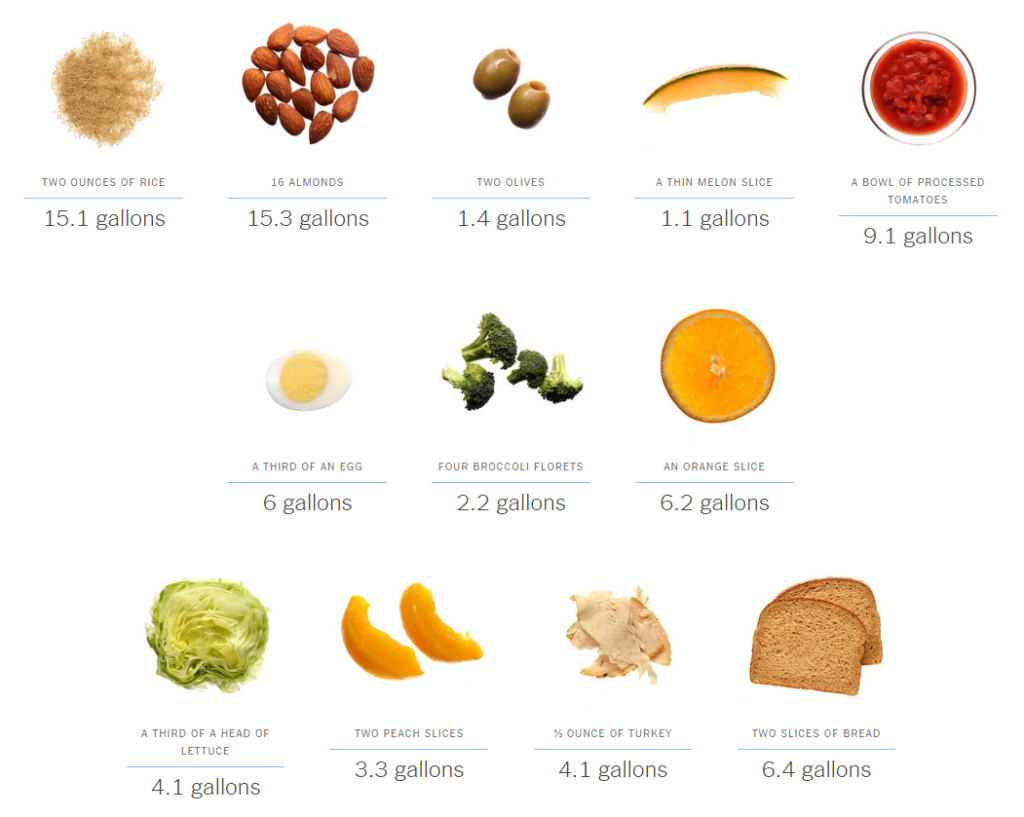

The New York Times tells you what food products not to eat if you want it to rain more in California.
The New York Times has an interactive feature (“interactive” in the sense that some of the graphics are videos that you have to click on to play) about California produce and water. Its headline:
Your Contribution to the California Drought
This headline comes straight out of the text (by Larry Buchanan, Josh Keller and Haeyoun Park):
The portions of foods shown here are grown in California and represent what average Americans, including non-Californians, eat in a week. We made an estimate of the amount of water it takes to grow each portion to give you a sense of your contribution to the California drought.
But the headline is just plain wrong.
People eating avocados don’t “contribute” to California’s drought—even if a sliver of it takes 4.1 gallons of water to produce, as the Times tells us. California’s drought is caused by lower-than-normal precipitation coupled with higher-than-normal temperatures, not by people eating too many grapes (24 gallons for a bunch) or mandarin oranges (42.5 gallons for three).
A drought is not the same thing as a water shortage. If your city was getting plenty of rain but decided to open up its fire hydrants 24/7 and re-landscape its parks with the lagoon look, it could have a water shortage—but it still wouldn’t have a drought.
Now, California’s drought has caused a water shortage—and California’s agriculture uses 80 percent of the state’s available water (Washington Post, 4/3/15). So would the feature be fixed with the admittedly less-catchy headline “Your Contribution to California’s Water Shortage”?
That would be more accurate—but still not very useful. For one thing, the feature is an awkward guide to buying low-water produce, since it’s based on both how much water crops use and how much people eat them on average. For example, a “thin melon slice” is a “water guzzler” at 1.1 gallons, whereas a “tiny pear wedge” is under “least water consumption” because it takes only 0.51 gallons. But is that because pears take less water to grow than melons, or because a thin slice is bigger than a tiny wedge? It’s impossible to say.
You can do the math and figure out that turkey actually does take less water to produce per ounce than beef—12.3 vs. 49.1 gallons—but this may not be immediately obvious from the 1/3 ounce and 1.75 ounce portion sizes that the Times uses for comparison purposes.
But the bigger question is whether blaming consumers for California’s water shortage, and then implying that they ought to selectively boycott (or just feel bad about?) California produce based on its water consumption, is actually a smart approach. It’s very common for corporate media, which are driven by commercial advertising, to emphasize the importance of purchasing choices, thus framing social and environmental problems as a matter of personal virtue or guilt.
But as Think Progress (5/5/15) noted in a piece on agriculture and California’s water crisis, it’s not consumer demand that has resulted in California growing so much of the United States’ fruits and vegetables—it’s government policy, including massive subsidies for corn (to be turned mainly into ethanol, corn syrup and animal feed) that have helped destroy once-substantial vegetable operations in the Midwest.
Shifting consumer preferences—assuming that the Times feature could steer eaters in a coherent direction—might encourage farmers to switch from one crop to another, redeploying their water allocations to whichever food products people are eating more of. But only a change in government policies can stop agribusiness from taking as much water as it can—and California Gov. Jerry Brown has so far shown no signs of interest in such a change (LA Times, 4/5/15). Absent collective action, the market has a powerful ability to adapt to—and thus negate—individual attempts to undo the damage it inflicts.
The same is true of your—and my—actual contribution to California’s drought, which is not eating almonds (even at 15.3 gallons of water per 16) but participating in an economy that injects vast amounts of greenhouse gases into the atmosphere, creating the changed climate that has led to the region’s worst drought in 1,200 years. Individuals can conserve energy, but without societal action to restrict the burning of fossil fuels, the reduced demand will just lower costs until someone is willing to make use of the supply. That’s what happens when “your contribution” is reduced to your consumption—as opposed to your participation in democratic action.
Jim Naureckas is the editor of FAIR.org.
You can send a message to the New York Times at letters@nytimes.com, or to public editor Margaret Sullivan at public@nytimes.com (Twitter: @NYTimes or @Sulliview). Please remember that respectful communication is the most effective.


Certainly the consumer cannot be faulted for consumption based on market prices. Market prices are depressed through government favors such as farm, water, and fossil fuel subsidies. It is the electorate that authorizes these market distortions that must share much of the blame. The electorate can claim they were mislead but that will not stand up in the court of real life. Of course, there are plenty of excuses such as forced attendance at government schools followed by mass media consumption of government and corporate propaganda. This may be why so many never seem to advance beyond adolescence. But there is always hope and always alternatives if we but grow in life-long learning.
A guilt trip to the wrong destination
Where are you FAIR? A couple of days ago I attended a Climate Rally in London. NOBODY mentioned Geoengineering, or ‘Chemtrails’. I had a megaphone, so at appropriate times I piped up, informing the ‘Sheeple’. But, like good ‘Sheeple’, they did not take a blind bit of notice. I was shocked, but not surprised.
And in California? Are you guys serious? I’m not going to give you a spiel; I’ll just say check ‘Geoengineering Watch’ and ‘California Skywatch’; and just in case you think that’s all ‘Conspiracy Theory’, get a load of this 20 minute video: ‘Geoengineering Whistleblower ~ Ex-Military ~ Kristen Meghan, Hauppauge, NY, January 18th, 2014’:
https://www.youtube.com/watch?v=jHm0XhtDyZA
Do you think this young lady is LYING?
Lively up yourselves; don’t be afraid to confront the admittedly frightening truth that the world is run by psychopathic, sociopathic, psychotic Banksters and War Criminals.
Candidate politics has diminishing returns, indicated by Congress’s “approval” ratings of as little as 8% recently. Direct democracy is working much better: the nation’s first renewable energy mandate was passed by ballot initiative in Colorado in 2000, Amendment 37. We also have the country’s first legal marijuana, Amendment 64, and the country’s strongest ethics in government law, Amendment 41, among other great things listed here: http://spryeye.blogspot.com/2012/01/case-for-ballot-initiatives-and.html?m=1
That’s why real leaders like Norman Solomon, Noam Chomsky, and Ralph Nader have endorsed national ballot initiatives: vote.org/endorsers See vote.org intro for big news about this!
I wonder why no one has responded to my previous post; maybe the ‘cat’s got their posting finger’ (or maybe, ‘Elephant in the room? What elephant?’. At least, ‘Tweedy Pie’ could see the ‘Puddy Cat’, creeping up on him. Alors, eh bien. California drought, or California dreaming? Check out ‘California Skywatch : The Chemtrail Cover-Up’: https://www.youtube.com/watch?v=Az8v54cwWTg
But hang on a minute, our Government’s would never lie to us, or put us in harms way, surely? That’s just ‘Conspiracy Theory’!!!