

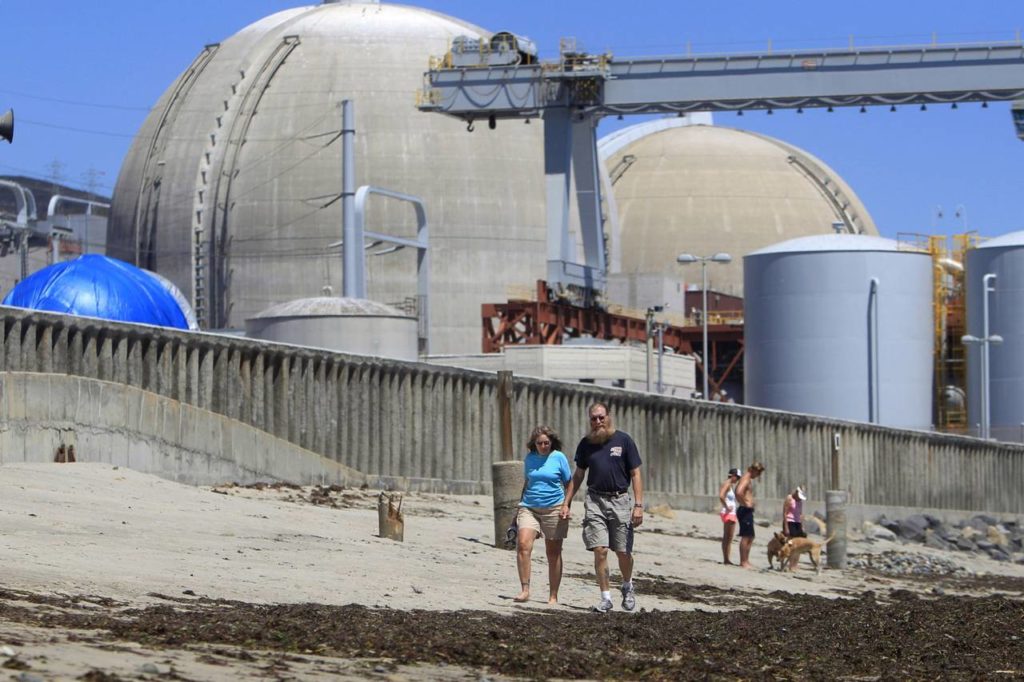
The Wall Street Journal (6/16/16) depicts nuclear power as as a walk on the beach. (photo: Lenny Ignelzi/AP)
The Wall Street Journal (6/16/16) published an article headlined “Environmental Groups Change Tune on Nuclear Power: Focus on Climate Change Has Raised Profile of Reactors, Now Viewed as Reliable, Carbon-Free Source of Energy.” Written by Amy Harder, the approximately 600-word piece appeared on the front page of the Journal’s B section.
Its dramatic lead-in:
Some of the nation’s most influential environmental groups are softening their longstanding opposition to nuclear power, marking a significant shift in the antinuclear movement as environmentalists’ priority shifts to climate change.
This shift, Harder wrote, “is lowering one of the biggest political hurdles facing the nuclear power industry in the US.”
What followed was framed by the story’s two quoted pro-nuclear sources, Joe Dominguez, an executive with Exelon Corp, the US’s largest electric holding company and operator of its largest fleet of nuclear plants, and Michael Shellenberger, co-founder of the quasi-neoliberal, pro-technology environmental think tank The Breakthrough Institute. According to Dominguez, the green groups’ “absence on the opposition front” is “’pretty significant’” and the “’shift in attitude…has a clear impact on companies’ bottom line.’”
The evidence of this shift? Vague assertions that the Sierra Club “is debating whether to halt its longtime position in support of shuttering all existing nuclear power plants” and that its “leaders see existing reactors as a bridge to renewable energy…as the group campaigns to shut down coal and natural gas plants.” Similarly, the story says, the Environmental Defense Fund is “deciding to what extent it should adjust its policy.”
Central to the story is the contention that prominent eco-advocacy groups, including Sierra, EDF and the Natural Resources Defense Council, are among those working with Exelon and state lawmakers on a legislative deal that would reverse a decision the company made in early June to close two money-losing nuclear reactors, Quad Cities and Clinton, and “ensure that the reactors remain in operation by providing financial recognition for the zero-carbon electricity they produce.”
But major assertions in the Journal article turn out to be either factually inaccurate, or to omit or spin important details. First, though Harder refers multiple times to nuclear power being “carbon-free” (echoing the websites of nuclear plant owners such as Exelon and Pacific Gas & Electric), that is not the case.
According to the Nuclear Energy Institute, an industry lobbying group:
Nuclear energy facilities do not emit criteria pollutants or greenhouse gases when they generate electricity, but certain processes used to build and fuel the plants do. This is true for all energy facilities. Nuclear energy’s life-cycle emissions include emissions associated with the construction of the plant, mining and processing the fuel, routine operation of the plant, disposal of used fuel and other waste byproducts, and decommissioning.
Nuclear energy’s greenhouse gas footprint is higher than renewables’, however. And as Greenpeace nuclear policy analyst Jim Riccio told the peer-reviewed journal Nature Climate Change in 2008, “The fact is, there’s no such thing as a carbon-free lunch for any energy source.” Riccio is also quoted in the Journal piece—against nuclear power: “Illinois should not be bailing out old and dangerous reactors because they can’t complete,” he said—hardly an endorsement. That sentiment is reflected on Greenpeace’s website, which states, “Nuclear power has no place in a safe, clean, sustainable future.”
Second, the notion that “the nation’s most influential” green groups are “changing their tune” is also untrue. The characterization of Illinois’ energy-policy debate, for example, is “over-the-top outrageous,” according to Dave Kraft, director of the Nuclear Energy Information Service, a 35-year-old safe-energy organization that calls itself “Illinois’ Nuclear Power Watchdog.”
NEIS is part of a coalition of environmental groups opposing SB 1585, a piece of legislation dubbed the Next Generation Energy Plan that is still in play. The bill was cobbled together from a proposal developed by Exelon with input from a variety of competing interests, including green groups. Kraft says these activists have been negotiating not “SO THAT the plants would be kept in operation, but WHETHER they will.… That’s a significant difference.” He says NEIS plans to write a letter of complaint to the Journal, asking for a correction and a retraction. (As this story went to press, Exelon notified the Nuclear Regulatory Commission that it intends to close the Quad Cities and Clinton reactors—WJBC, 6/23/16.)
Since the Journal story’s publication, other eco groups are rushing to clarify their positions. The NRDC, for one, published a blog post (6/19/16) debunking the piece, stating:
The story highlighted coalition negotiations underway in the Illinois General Assembly…. NRDC is engaged with allies in legislative negotiations on energy policy in Illinois. But the Journal is dead wrong on our goals, focus and motivation. Our effort to reform energy policy does not involve, or signal, a change in NRDC’s long-held concerns about the role of nuclear energy in the country’s generation mix. That is especially true in Illinois, the state with the greatest number of nuclear reactors and waste in the entire country. Our efforts to negotiate an agreement with Exelon involves a continuing dedication to transform the Illinois energy landscape and advance a new, clean energy economy.
The post went on to refute the Journal piece’s allegation that shuttered plants inevitably mean more carbon-spewing coal and gas in their place:
Current proposals by Exelon would bring financial assistance to the company’s two economically distressed nuclear facilities, as noted in the Wall Street Journal…. Our coalition is negotiating to ensure an orderly and just transition that will help ensure that when nuclear plants close (whether for financial reasons or reaching the end of their design life), efforts should be focused on how to replace them with energy efficiency gains and clean power from the wind and sun, not dirty fossil fuels. Without fixing the state’s flawed renewable energy policies, that cannot happen—so this is a conversation NRDC will continue to encourage in Illinois.
The Sierra Club, for its part, quickly answered the assertion that it’s reconsidering its position with a June 17 statement on the Club’s website by executive director Michael Brune:
Sierra Club remains opposed to dangerous nuclear power, and our efforts to make sure these plants shut down continue. Our successful work to stop and retire coal, oil, and gas operations has not precluded this important work, nor will it in the future. It’s imperative that we move toward an economy powered by 100 percent clean, renewable energy like wind and solar right away.
In addition, Sierra has publicly opposed the proposed bailout of the Exelon plants embodied in SB 1585, and has submitted a letter to the editor of the Journal, according to Club spokesperson Trey Pollard.
Even EDF, historically more industry-friendly, is not exactly a nuclear booster. The organization’s website recently featured a blog post (6/1/16) that listed key policies to “turn the corner” on carbon emissions: putting a price on carbon, implementing President Obama’s Clean Power Plan and developing a nationwide smart grid.
With this story, the Journal seems to be conflating the pro-nuke positions of prominent individuals in the scientific and policy community with the sentiments of major environmental organizations. As the Washington Post’s Chris Mooney reported in a fairly balanced (but misleadingly titled) article late last year, there has been a vocal group of academic scientists rethinking nukes. He wrote:
A new letter, signed by 71 ecologists and conservation researchers (at last count), may be…significant. Authored by ecologists Barry Brook of the University of Tasmania and Corey J.A. Bradshaw of the University of Adelaide—and based on a longer paper by the two just out in the journal Conservation Biology—it argues that greens must rethink their nuclear power resistance…. This is not the first time that a coterie of environmental scientists have stood up for nuclear energy. Last year, four top climate researchers—Ken Caldeira of the Carnegie Institution, Kerry Emanuel of MIT, Tom Wigley of the National Center for Atmospheric Research, and James Hansen of the Earth Institute of Columbia University—wrote a letter defending the deployment of what they described as newer, safer nuclear power technologies.
Frequently joining this latter group of pro-nuclear climate hawks has been TBI’s Michael Shellenberger, who told the Journal, “If anything gives me hope in these dark times, it’s that so many environmentalists are changing their minds about nuclear…. What was just a trickle of converters a few years ago has become a positive stampede.”
Who these converts are he did not say. But although the Journal describes TBI as “a progressive think tank,” the Institute and its new spinoff, Environmental Progress, have a history of separating themselves from, and even trashing, the environmental mainstream. The organization originally gained fame in the early 2000s with their essay “Death of Environmentalism: Global Warming Politics in a Post-Environmental World.” TBI advances a philosophy they call “ecomodernism,” a “manifesto to use humanity’s extraordinary powers in service of creating a good Anthropocene.” A strong pro-nuclear stance is part of TBI’s and EP’s platforms.
So perhaps it’s not surprising that Shellenberger, Hansen, Caldeira et al. signed a letter to Illinois legislators April 4 that repeatedly refers to nuclear power as “clean energy” and said that the two plants Exelon may close have saved lives that otherwise might have been harmed by coal plant emissions. The letter asserts that renewables like wind have an unfair market advantage over nuclear in terms of subsidies, and advocates that nukes be included in the state’s Renewable Portfolio Standard. (For the record, nuclear power is not a renewable energy source because it does not regenerate, according to the US Energy Information Administration—and nuclear power is heavily subsidized, not least through the Price Anderson Act, which caps liability for nuclear accidents at a tiny fraction of their potential cost.)
These scientists and policy wonks have also established a “win/win” pro-nuclear group called Save Diablo Canyon. In response to the Southern California plant’s impending closure, Save Diablo Canyon, Environmental Progress and something called Mothers for Nuclear (started by two women who work in the nuclear power industry) will lead a protest “March for Environmental Hope” from San Francisco to Sacramento beginning June 24 (Forbes, 6/21/16).
The Wall Street Journal has a long history of editorial page support for nuclear power (4/17/01; 8/5/09; 11/9/09; 4/6/11; 5/24/13, to cite but a few) and against wind power (5/22/06, 3/1/10, 8/24/10, 11/8/12, 5/18/14 and others). In publishing this piece as edited, perhaps it is telling a story it wishes were true. As Harder’s article itself acknowledges, nuclear power is in decline due to a combination of economics, displacement by renewables and opposition. The green groups’ supposed change of heart “comes at a critical time, as several financially struggling reactors are set to shut down” even as other reactors already have, due to the low price of natural gas and state policies “that favor renewables over nuclear power.” As if to prove that point, the story provided a list of a dozen reactors that have been or will soon be shut down.
Indeed, the anticipated closing of Diablo Canyon seems to show the opposite of the trend Harder describes. There, a coalition of environmentalists led by Friends of the Earth got industry and government to agree not only to phase out the plant, but also to replace the energy it generated with something other than fossil fuels. As Ivan Penn and Samantha Masunaga of the Los Angeles Times (6/21/16) reported, PG&E pledged that the “power produced by Diablo Canyon’s two nuclear reactors would be replaced with investment in a greenhouse-gas-free portfolio of energy efficiency, renewables and energy storage.” Their story notes that the move “runs counter to the nuclear industry’s arguments that curbing carbon emissions and combating climate change require use of nuclear power.”
So are there prominent climate scientists and self-described environmentalists advocating for nuclear power? To be sure. But their stance doesn’t necessarily define the larger movement of low-carbon, renewable energy advocates who hold a decidedly different position.
Miranda Spencer is a freelance writer and editor, and a longtime FAIR contributor.
You can send letters to the editor of the Wall Street Journal at wsj.ltrs@wsj.com. Please remember that respectful communication is the most effective.



Nuclear power generation, that which takes place within the reactor, is itself carbon free, but, yes, the overall process from the mining of ore, its transportation, enrichment, etc is not entirely carbon free. It might be good to give FAIR readers an idea of the amount of carbon generated per kW of energy produced via nuclear fission versus a coal-fired power plant, for example. I don’t know how they compare, but it might provide some perspective. There are other issues of course with nuclear power, for example, final disposition of rad waste. Question: Is there any relationship between the Breakthrough Institute and the Breakthrough Prize in physics?
The IPCC looks at this, and we posted a chart of carbon of different energy sources on our web site’s Key Questions page
http://www.environmentalprogress.org/key-questions/
Can you provide a link to the IPCC re this? You’re citing yourself here.
The IPCC citation is on the graph, as it is on all of our graphs.
Forget nuclear until safely sustained fusion has become a reality. When that is accomplishes nuclear will be able to compete with renewable energy in cost to users and safety.
And what of cost to planet?
Take a look at the differences between fission and fusion TeeJae- that should answer your question. I think the model now being looked at would involve many small fusion reactors all close to where the users are rather than one large fission reactor with power transmission lines delivering that power to a wide area. The trick is initiating fusion consistently and safely; once begun it is safe and outputs incredible amounts of energy. I am a long time green energy advocate and probably won’t live long enough to see fusion supplied energy but it will come if we don’t destroy this planet before then.
Why fusion as compared to fission only? Why not fusion as compared to solar, wind and/or hydro?
It’s interesting how you nuclear shills always seem to steer the conversation away from renewables.
I was not comparing fusion to fission. Fusion, if it is ever developed, would be superior to renewables since it does not depend on nature’s whims and has zero operating costs and zero pollution. It is the same principle upon which our sun operates. I would be quite surprised if anyone both concerned about out planet and knowledgeable about fusion would doubt fusion is ultimately where we will go for our source of energy- we are just not there yet. I am certainly not a shill for our present fission power plants. I am an old (over 70) White guy who tries to stay up with a world I’ve watched change for many years. I have solar shingles on my home- even my eyes are green so don’t mislabel me as a nuke shill to dismiss what I have said. Look into fusion and hope someday we’ll figure out how to initiate it.
The statement “Nuclear energy’s greenhouse gas footprint is higher than renewables” is factually wrong. You cite a news story that cites a single outlier study, when this matter has been assessed by the Intergovernmental Panel on Climate Change, which is typically considered an authoritative source as the reports are reviewed by many scientists and engineers, as well as governments from around the world. Figure 7.6 of the IPCC AR5 WG3 report (https://www.ipcc.ch/pdf/assessment-report/ar5/wg3/ipcc_wg3_ar5_chapter7.pdf) gives what is widely considered to be the most widely reviewed assessment of life cycle emissions. This assessment shows that I would hope that Fairness and Accuracy in Reporting would see fit to be accurate in this case, and not let your own biases influence the accuracy of your reporting. Why are you cherry-picking a single outlier estimate? Is it because it supports your ideological bias?
I assume your question is rhetorical, Dr Caldeira. The real issue, it seems to me, is misrepresenting nuclear as carbon free.
Thanks for pointing out the IPCC figures; I’m not sure how they debunk what we wrote. The IPCC report gives ranges of 7-56 gCO2eq / kWh for wind power, 9 – 63 CSP gCO2eq / kWh for concentrated solar power and 4-110 gCO2eq / kWh for nuclear power. In other words, the IPCC’s median estimated carbon footprint for nuclear is higher than for renewables. (Photo-voltaic solar power is somewhat higher, at 18-180 gCO2eq / kWh.)
I’m also not sure why you dismiss Benjamin Sovocal’s meta-analysis in Energy Policy an “outlier”; his estimate of 66 gCO2eq / kWh for nuclear is solidly within the IPCC’s range of estimates.
The point of our piece, I would reiterate, is that the Wall Street Journal’s claims that nuclear energy is “carbon-free,” and that environmental groups are “changing their tune,” are not true.
No. IPCC Median estimates:
Solar PV 48/41
Solar thermal 27
Nuclear 12
http://www.environmentalprogress.org/key-questions/
The median number for nuclear given by IPCC AR5 WG3 is 12 gCO2eq/kWh. The median number for concentrating solar is 27.3 gCO2eq/kWh. The median numbers for Solar PV are 40.9 and 48.1 gCO2eq/kWh (rooftop and utility). For wind, the median numbers are 10.9 and 12 gCO2eq/kWh (onshore and offshore). Median values for different types of bioenergy range from 272 to 475 gCO2eq/kWh. The median value for ocean wave and tidal is 17 gCO2eq/kWh. Thus, your statement that the median estimated carbon footprint for nuclear is higher than renewables is simply incorrect.
Further, if we look at the 75% maximum range (i.e., most studies, but eliminating some high-end outliers such as Sovacool’s study), nuclear emits 33 gCO2eq/kWh. This is lower than the value given for the 75th percentile of every form of biopower, geothermal, hydropower, and solar. Only wind and wave energy come in lower than this.
Sovacool averaged a bunch of studies without evaluating the underlying merits of each study and weighting them all evenly. The IPCC took a more considered approach and evaluated the merits of the studies that they included in their analysis. Note that the IPCC is not particularly friendly to nuclear power in other regards, so suggesting that the IPCC assessment in biased in favor of nuclear is not very credible.
If you say that nuclear power emits CO2 at rates that are comparable to the better renewables, that would be an accurate statement. However, your statement ‘Nuclear energy’s greenhouse gas footprint is higher than renewables’ is not supported by the IPCC AR5 analysis. You could perhaps defend saying ‘higher than wind’ or ‘comparable to the better renewables’, but not ‘higher than renewables’.
I find this disturbing because it is common for climate science deniers to cite one outlier study in favor of the IPCC consensus reports. It is sad to see FAIR, which is supposed to be committed to fairness and accuracy in reporting, to be promulgating misinformation, and not holding themselves up to the same standards that they ask of others. Please strive for fairness and accuracy in your own reporting.
I am no fan of Rupert Murdoch, but we should not be using the strategies employed by climate science deniers to attack Rupert Murdoch’s rag.
Dr. Caldeira:
This is all quite interesting, and I think it is clear that there is no such thing as a zero emissions energy supply. So I am somewhat confused by the letter that you signed to the Illinois State Legislature: http://epillinois.org/read-the-letter/ This letter seems to claim that nuclear power is zero emissions.
“Illinois generates more zero-emissions electricity than any other state. Most of it comes from the state’s six nuclear power plants, which produce about half of Illinois’ total generation and 90 percent of its low-carbon generation. ”
I understand political hype, but shouldn’t this really read somewhat differently.
There are zero direct emissions but of course there are non-zero life-cycle emissions. It has become standard jargon to talk about, for example, zero-emission vehicles to refer to electric cars, while acknowledging that there are non-zero life-cycle emissions. Nuclear is zero-emissions to a similar extent that solar and wind power are zero-emissions. That is, there are zero direct emissions but there are emissions associated with construction, maintenance, etc. I speak about nuclear using the same criteria and vocabulary that I use to speak about wind, solar, ZEVs, etc. Are you writing similar letters decrying the use of the “zero emission vehicle” terminology? Admittedly, zero-direct-emissions would be clearer because this is the meaning that is intended when people use the zero-emissions labeling.
Bob makes a good point, and you provide good context, Ken. I think we should just say low-carbon, which Ken you’ve advocating doing.
A technology with zero direct emissions will have zero life-cycle emissions if it is a component of an energy system that is otherwise completely decarbonized. That is, wind, solar, nuclear, and electric cars all have zero direct emissions and would have zero life-cycle emissions if the cement, steel, electricity generation, etc, were also decarbonized.
The fact that wind, solar, nuclear and electric cars have non-zero lifecycle emissions today is an indictment of the energy ecosystem in which these technologies find themselves today. These technologies could potentially be part of a future near-zero emission energy system.
The non-zero lifecycle emissions associated with these technologies is a critique of the energy system in which these technologies operate today, and are not a fundamental critique of these technologies.
—
On another issue, I remain disappointed that Fairness and Accuracy In Media (FAIR) responded so poorly when their own fairness and accuracy were questioned regarding their statement that “Nuclear energy’s greenhouse gas footprint is higher than renewables’”. Apparently, FAIR does not apply the standards it expects of others to itself; and thus appears to have enveloped itself in the fetid odor of hypocrisy.
“which is typically considered an authoritative source”
“what is widely considered to be”
Ken Caldeira’s use of weasel words – not to mention his belief that there is such a thing as “an authoritative source” – makes him a natural ally of the corporate media.
I cite an Intergovernmental Panel on Climate Change report to raise a question about quantitative claims and your response is to call me names.
Is that your idea of how to promote fairness and accuracy.?
Miranda,
If you guys are so committed to fairness and accuracy then how about covering the troubling financial facts showing strong ties between fossil fuel interests and anti-nuclear groups including NRDC?
The lead environmental organization that negotiated a proposal with Pacific Gas & Electric to close California’s last nuclear power plant could significantly benefit financially from its closure, as could the trustees that govern the organization, and its donors.
NRDC itself has significant, direct investments in natural gas and renewable energy companies.
The Proposal was negotiated by NRDC, PG&E and others is being proposed to the California Public Utilities Commission, which could allow it to become state policy.
The two highest-ranking members of NRDC’s Board of Trustees, its Chair and Vice Chair, as well as one of NRDC’s single largest donors, are all major investors in natural gas and renewables companies, could benefit significantly from Diablo’s closure.
A partial list of potential conflicts of interest.
A PARTIAL LIST OF POTENTIAL CONFLICTS OF INTEREST.
The Board of Trustees governs nonprofit organizations like NRDC, is responsible for hiring and firing the Executive Director, as well as making sure NRDC is avoiding conflicts of interest in its fundraising and advocacy.
NRDC as an organization has large investments in both renewables and natural gas. In 2015, the NRDC disclosed in a 2014 financial report that it had $7,710,276 million invested in four separate renewable energy private equity funds. The report said it had $7,852,229 invested in four funds in 2013.
Evidence of NRDC’s large stake in energy companies that could benefit from closing Diablo Canyon or other nuclear plants.
EVIDENCE OF NRDC’S LARGE STAKE IN ENERGY COMPANIES THAT COULD BENEFIT FROM CLOSING DIABLO CANYON OR OTHER NUCLEAR PLANTS.
Diablo Canyon contributes such a significant amount of power to the grid — about 8 percent of California’s electricity — that removing it could create profitable business opportunities for solar, wind, battery, bioenergy and natural gas companies.
NRDC’s Board Chair is Vice President at AECOM one of the world’s largest developers of natural gas power plants and pipelines — more of which could be needed if Diablon Canyon closes.
NRDC has three Vice Chairs, one of whom is Max Stone, a managing partner at D.E. Shaw, an investment firm that on June 16, 2016, bought a solar farm in California that has a power purchase agreement with PG&E. If Diablo Canyon closes, PG&E may make many more such deals with solar farm builders.
Ralph Cavanagh, lead negotiator for NRDC
RALPH CAVANAGH, LEAD NEGOTIATOR FOR NRDC
DE Shaw has large investments in natural gas, solar, wind and efficiency companies. DE Shaw reported having $37 billion in investments as of March 1, 2016, and a portfolio of 23 wind and solar projects whose capacity totals 1,100 MW. In 2013 D.E. Shaw settled a lawsuit for $75,000 for allegedly exceeding “position limits” in natural gas.
DE Shaw also invests in energy efficiency, more of which would be required under the NRDC proposal to close down Diablo Canyon.
NRDC justifies closing Diablo Canyon so it can make room for renewables. NRDC’s lead negotiator for the agreement, Ralph Cavanagh, told the New York Times that Diablo Canyon should be closed to accommodate renewables:
Giant baseload nuclear power plants like Diablo Canyon cannot easily be taken offline, or ramped up and down, as system needs change… This worsening problem is forcing the California grid operator to shut down low-cost renewable generation that could otherwise be used productively.
One of NRDC’s largest donors is Nat Simons, an investor in solar, wind, biofuels and other renewable energy companies.
Funding by Nat Simons’ Sea Change fund to NRDC.
Simons contributed $14,879,000 to NRDC from 2009 to 2013 (see chart below). and specified that the donations be used to change energy and climate policies. In a 2009 public meeting about climate change and clean energy, Simons said “role of philanthropy is really to facilitate that process” of changing policies to accelerate the transition to renewables.
The policies NRDC lobbies at state and federal levels directly benefit Simons’ companies. Those policies include federal subsidies for solar and wind (ITC & PTC), federal renewable energy procurement, and state Renewable Portfolio Standards (RPS). Several of Simons’ companies have won Department of Energy grants.
NRDC helped create and put $66 million in Black Rock “Ex-Fossil Fuels Index Fund” stock fund that invests heavily in natural gas and renewables companies, including pipeline companies. NRDC wrote
Natural gas stocks in Blackrock-NRDC fund.
NATURAL GAS STOCKS IN BLACKROCK-NRDC FUND.
IN FISCAL 2014, NRDC, BLACKROCK AND FTSE GROUP PARTNERED TO LAUNCH A EQUITY GLOBAL INDEX SERIES – FTSE DEVELOPED EX-FOSSIL FUELS INDEX SERIES – THAT EXCLUDES COMPANIES LINKED TO EXPLORATION, OWNERSHIP OR EXTRACTION OF CARBON-BASED FOSSIL FUEL RESERVES.
Black Rock’s investments in natural gas pipelines may not be a coincidence. NRDC worked closely with Black Rock to create the fund, and more natural gas pipelines will likely needed in California if Diablo Closes.
The lack of of natural gas pipeline capacity is one of the key factors state officials say is behind power outages in Southern California.
Last December, NRDC announced its participation in another investment fund it helped to create. In a blog post called “Invest in the Future, Not in Fossil Fuels,” NRDC’s Executive Director Rhea Suh described NRDC’s investment:
While NRDC derives no benefit from others’ participation, we made a significant investment in State Street’s new vehicle, because it supports our core mission.
….We can’t afford the damage, destruction, and hazard that come with producing, shipping, and burning the world’s coal, gas, and oil.
However, the fund invests significantly in natural gas companies, just like the BlackRock fund. The fund lists Eversource, Next Energy, Talen and Pacific Gas & Electric. While most of the fund is not directly invested in energy, the energy companies in the portfolio are almost entirely oil and gas companies
NRDC is the most influential environmental organizations among California policymakers. Mary Nichols of the Air Resources Board, Governor Jerry Brown’s top environment official, used to work at NRDC.
Rhea Suh, Executive Director, NRDC
RHEA SUH, EXECUTIVE DIRECTOR, NRDC
According to the National Council of Nonprofits, an organization’s “conflict of interest policy should (a) require those with a conflict (or who think they may have a conflict) to disclose the conflict/potential conflict, and (b) prohibit interested board members from voting on any matter in which there is a conflict.”
NRDC reported on its most recent IRS tax forms (990) that it has a conflict of interest policy that “may be provided at management’s discretion, if requested.” NRDC wrote:
EACH OFFICER, DIRECTOR, AND EMPLOYEE IS REQUIRED TO ANNUALLY DISCLOSE ANY CONFLICTS OF INTEREST THAT ARISE BY VIRTUE OF RELATIONSHIP TO THE ORGANIZATION, BOARD SERVICE, OR POSITION WITH EITHER NRDC ACTION FUND OR NRDC. NRDC ACTION FUND MONITORS COMPLIANCE WITH ITS CONFLICT OF INTEREST POLICY THROUGH AN ANNUAL QUESTIONNAIRE/DISCLOSURE STATEMENT THAT IS DISTRIBUTED TO THESE INDIVIDUALS. POTENTIAL CONFLICTS ARE INVESTIGATED IMMEDIATELY.
The point of my article was not to support NRDC or other enviro orgs but to clarify their actual official positions as misreported by the WSJ. Your attack on them strikes me as a digression. I’ll let NRDC themselves reply to your allegations.
Miranda,
What you’ve written here is not accurate. Your post was in fact a defense of NRDC’s anti-nuclear policies and agenda that repeated the inaccurate claim that nuclear is high carbon. In fact, IPCC finds it is lower-carbon than solar. Are you going to correct that?
My broader point is that you and FAIR are uncritically repeating anti-nuclear talking points without actually looking at the evidence with an open mind, as so many of us did. You didn’t once note that almost all of us used to be anti-nuclear and changed our minds.
In terms of “attack,” that’s all you did here. Amy Harder is an independent and fair-minded journalist on the *news* side not the editorial side of Wall Street Journal. She was lied to by the anti-nuclear groups, who are now having an internal civil war over the complete hypocrisy of claiming to care about climate and the environment and trying to shut down our largest source of clean energy.
That you would choose to attack a good journalist with such a biased piece speaks loudly of FAIR’s broader agenda which is to attack fair and accurate reporting that threatens your belief system.
Michael
Michael, I’m sure I can’t change your mind. But I know what my intentions were and they simply are: To correct the notion that the environmental movement is all getting behind nuclear. As I said correctly in the story, you and others have come to favor nuclear, as is your right. The big green groups have not changed their anti nuke positions. Others who once supported nukes now oppose them. It’s important for the Journal to get that story straight.
The Diablo settlement seems clear proof of the central thesis of your article, that major environmental groups are not shifting to favor nuclear power. At most, some of these groups recognize that scheduled phase-outs coupled with careful planning as to what happens next are preferable to the sudden shutdowns and demands for unlimited bailouts that have surrounded the troubled operating reactors in recent years.
Also, it seems sloppy of Shellenberger to ignore AECOM’s extensive involvement with nuclear power if he really believes the proposition that small potential deflections in the investments of NRDC and its board members could somehow have ensnared all of those parties in the Diablo Canyon settlement.
Not even Ralph Cavanagh is that persuasive.
Michael
Nice data. Can you disclose all funding for The Breakthrough Institute and Energy Progress, including speaking fees?
Bob Brulle
Yup! All on our web sites.
Warmly,
Michael
Wrong. Nothing on ‘The Breakthrough Institutes’ website about speaking fees. Same with your new ‘Environmental Progress’ org – nothing mentioned about any actual dollar figures. Is this your typical attention to detail?
Ever so warmly,
Eddie
Michael:
I can’t seem to find where you posted detailed financial information about either the Breakthrough Institute or Energy Progress. I do see a list of contributors to TBI here: http://thebreakthrough.org/about/funders/ but no amounts. Perhaps you could fill this information in. Also, I can’t seem to find information about speaking fees anywhere. Where is that posted?
If you are interested in my grant funding from NSF, it is all detailed on the NSF web site at the following addresses.
http://www.nsf.gov/awardsearch/showAward?AWD_ID=0455215
https://www.nsf.gov/awardsearch/showAward?AWD_ID=1558207&HistoricalAwards=false
Bob, your employer, which pays your salary, keeps its donors secret. That means your donors, the source of your salary for decades, could be fossil or other energy interests. In that sense Drexel is like NRDC, Sierra Club, and EDF who also keep their donors secret. By contrast we reveal our donors on our web sites. But instead of demanding your employer or the green groups whose anti-nuclear agendas you promote, reveal who their donors are, you start trolling for us to post how much they give? Tell you what: after Drexel, NRDC, EDF and Sierra Club reveal all of their donors and the amounts they give, we’ll do the same.
Michael
A quick look at their ‘About’ pages shows that EDF, Sierra Club and NDRC are quite transparent about where their funds come from:
https://www.edf.org/about
http://sierraclub.org/about
https://www.nrdc.org/about
LOL.
Thanks for re-affirming your propensity to seek out evidence that supports your prior beliefs.
Pages don’t list their funders.
I did more than a quick look:
http://www.environmentalprogress.org/big-news/2016/6/23/environmental-group-could-benefit-financially-from-closure-of-diablo-canyon
Setting aside the fact you cite yourself and your own pro-nuclear organization, you discuss Diablo’s closing being a boon for the renewables industry as a “bad” thing, when in fact it is a very GOOD thing and long overdue.
The nuclear plant closure is bad only for the nuclear industry, and your efforts to frame it as anything else are blatant pro-nuclear false propaganda.
Right because there aren’t any.
P.S. Please let me know when you get Sierra Club, NRDC, CAP and the other groups you support to disclose their donors. thanks!
Bob, I just looked at your web site and couldn’t find a list of your donors, or donors to Drexel. Can you direct me to a link where you publish them? Thanks!
Michael
I’m working on it. At least they file an IRS 990.
Bob
You think they list their donors on their IRS 990?
Can you please send me a list of your donors, donors to Drexel, and your speaking fees?
Thanks!
WTF, WSJ?! I do advocacy work for SEVERAL environmental organizations, and NONE of them are hyping nuclear. But ALL of them are pushing for renewables. God, I hate that Murdoch-owned rag.
Mike
I get a salary from Drexel for teaching 6-7 courses a year. No grants to me from Drexel. No speaking fees. My research is funded by the National Science Foundation.
Do you have any more data on green group funders? My project is to look at all funding of all NGOs involved in climate politics – NRDC to Heartland 1985 to 2015.
Bob
Thanks, Bob. So your salary is from Drexel. Who funds Drexel? Can you please send a list of donors? Thanks!
Michael
Drexel don’t disclose this. My salary comes mostly from tuition, as this is where
Most of Drexel’s funding comes from. . I’m not privy to how Drexel financed operate. What is your point? You might as well ask who funds Ken Calderia and Stanford? There is such a thing as not being funded by a vested interest.
This is way off topic. Point is that the WSJ assertion that major green groups are moving to support nuclear power is contradicted by these groups themselves. This is a critique of WSJ reporting.
Bob
No major green groups support nuclear power as a way to attack CO2 emissions, but they ought to. A goodly number of credible individual green activists, writers and scientists do support nuclear among them George Monbiot, Jim Hansen, Michael Mann.
I’m frankly getting tired of opposition to nuclear power being some kind of “litmus test” for whether one is is a “progressive” or not. The safety and health record of nuclear and its fuel cycle, compared to any method of generating electricity – even hydro – is superb. And yes I am including Chernobyl and Fukushimma.
Belatedly, there is no such litmus test for being progressive. Being pro or anti-nuke, or concerned about the environment, isn’t a partisan issue when it comes to the electorate. Rather, we see support and opposition to various forms of energy across the left-right spectrum. And again, this article is about accuracy, not about whether the “Big Green” groups are ideologically pure or what the “PC” position on nuclear is.
But nuclear power plants DO release CO2 during their working hours.
Every nuclear power plant releases large amounts of radioactive Carbon14 which is converted to CO2 in the atmosphere.
Repeat: Nuclear energy generation –> Carbon14 —> CO2
Therefore, nuclear power DOES contribute to “climate change” “global warming” whatever you want to call it.
>> “The carbon 14 produced reacts with oxygen atoms in the atmosphere to form carbon dioxide”
http://www.radiocarbon.com/carbon-dating-bomb-carbon.htm
>> Carbon 14 “is a radionuclide of considerable interest in nuclear power production. Carbon-14 is present in virtually all parts of nuclear reactor primary system and has a high production rate. It is released to the environment through gaseous and liquid discharges and through the disposal of solid radioactive waste. With its long half-life (5,730 years) and high mobility in the environment, 14C can be a nuclide of major concern after mixing with stable 12C 13C followed by the biological incorporation into biota, as carbon is the fabric of life.”
http://142.51.79.168/NR/rdonlyres/DC14CD43-913E-445E-AC5D-C129A78E03AC/0/sdarticle.pdf
Carbon-14 is also a health hazard to humans.
I couldn’t believe that anyone could still think this was true today (it’s not), so I followed that link back, and then to the article in Nature it got the claim from. As it happens, the source was Benjamin Sovacool, whose reputation for dishonesty on matters nuclear should preclude him or any paper he authored from being quoted. Among the falsehoods he pushes are that uranium enrichment is a major source of greenhouse gases (which comes from assumptions that uranium is enriched in gaseous-diffusion plants driven by coal-fired electric plants, of which none exist in the world any more… oh, and they also emit CFCs which are no longer produced). When you throw out the ridiculous assumptions of activists like Sovacool, you find that nuclear power has roughly the same carbon emissions as wind and much better than solar.
But nuclear is something that wind is not: a 24/7 source of energy. Wind requires backups for when it isn’t blowing. If those backups are nuclear, you don’t need the wind; if they’re not nuclear, they’re going to burn fossil fuel and dump many hundreds of grams of CO2 into the air for every kWh generated. No amount of wind and solar can stand alone as power for an electric grid. Nuclear can.
Shutting down Diablo Canyon is an environmental atrocity, as was the shutdown of San Onofre. The world has just years before it busts through the carbon limit for a 2°C warming. Any act which kills an emissions-free generator, for any reason, should be prosecuted as a crime against humanity. Killing a zero-emission generator that’s on-line 93% of the time to replace it with ones that are only on-line 29% of the time is insanity. Perhaps Greenpeace, the Sierra Club and NRDC can claim insanity at the trials where they should be defending themselves against those charges. But once it’s revealed that they are just doing the bidding of their donors, they cannot claim to be innocent. “Just following orders” never was good enough.
“No amount of wind and solar can stand alone as power for an electric grid. Nuclear can.”
More industry-driven false rhetoric. Recent studies have shown renewables absolutely can power 100% of the world, let alone just the US.
But BigNuclear sends out its shills to spread these lies in the name of profits over people and planet.
The chances that you’re a paid shill for some Green front for the gas lobby are pretty high. Guess who pushed to kill Vermont Yankee? Green Mountain Power, a wholly-owned subsidiary of Quebec’s Gaz Metro.
You have “studies” by the likes of Mark Z. Jacobson of Stanford’s Precourt Institute, financed by oil magnate Jay Precourt. Meanwhile, all your “Green” countries in Europe keep their lights on by burning huge amounts of coal; Germany is going to bulldoze a centuries-old village in order to expand a lignite mine. Your “studies” have nothing in the real world to back them up. Oh, you’ll point to Quebec or Norway… which are powered by lake-fed hydro, not fickle wind and solar. That’s called “the fallacy of ambiguity” unless it’s in sales, when it’s called “bait and switch”.
When San Onofre went off-line, it was not replaced by “renewables”; it was replaced by natural gas. This is one reason why the Aliso Canyon gas leak is going to cause blackouts in California this summer: California is destroying its energy security by specializing in ONE fuel.
You have fake studies, I’ve got proof. Decades of experience has proven that nuclear can power as much as 80% of any electric grid less than 20 years after starting the effort. This has been proven in France, in Sweden, and now in Ontario after the restart of the Bruce Point units. There are small cities that are 100% nuclear; they’re called nuclear aircraft carriers.
Anyone who believes the Green propaganda is a fool. The people pushing it are agents of the fossil-fuel lobby.
Projection. Nuclear is a small part of the US economy, and its profits have been destroyed lately. All the big money is in fossil fuels. It has to be this way; nuclear fuel is a fraction of a cent per kWh, compared to about 2.5¢/kWh to feed a gas turbine. A lot more money changes hands with fossil fuels even at current depressed prices.
The gas industry wants more money. Killing nuclear drives up demand for their product, and thus prices and profits. Whether or not you’re a paid shill for the gas industry, you’re a sorry excuse for a human being.
Your attempt to counter studies you’ve never seen is not only intellectually dishonest, it’s laughable. And your resorting to an ad hominem attack further destroys your credibility. If my desire to protect people and planet makes me a “sorry excuse for a human being” in your eyes, then what does your desire to protect corporate profits say about you?
Bringing fossil fuels into the discussion is another tell-tale sign of a pro-nuclear shill. Despite your best straw-man efforts, fossil fuels are irrelevant to this topic. So, enough with the natural gas argument. Proponents of renewables are smarter than to buy that nonsense.
Looks like FAIR won’t let me actually rebut you; my reply was posted 2 days ago but FAIR won’t let the public see it.