


The presence of two parents in Michael Brown’s life (Michael Brown, Sr., left, and Lesley McSpadden) did not shake the prevailing media assumption that what young black men need is a man in their lives.
Any effort to improve the lives of black men that meets with the hearty approval of Bill O’Reilly ought to set off a few alarm bells. But My Brother’s Keeper, an initiative announced by Barack Obama in February, was received benignly by the corporate press, with the closest thing to criticism being “Should he have acted earlier?” (ABC This Week, 3/2/14).
Reports displayed a telling vagueness. MBK was described as “a program aimed at giving young men of color a shot at success” (NBC Nightly News, 2/27/14), an effort “to reverse underachievement among young black and Hispanic males” (AP, 2/27/14) and as “commitments from foundations and businesses to help keep young minority men in the classroom and out of prison” (Washington Post, 2/28/14). ABC’s Diane Sawyer (2/27/14) called it “a plan to help kids succeed, even when they’re angry and have made mistakes.”
Serious sounds were made about the problem George Stephanopoulos (This Week, 3/2/14) presented as “the fact that young black men are more likely than other Americans to drop out of school, be sent to prison or end up murdered,” but with little interest in ascertaining just how MBK, with its focus on mentoring, or “high standards and up-close motivation” (CBS Evening News, 2/27/14), would address it.
Myriad deeper questions were left to big media’s margins. USA Today (3/3/14) ran Tavis Smiley’s critique that “what these young brothers really need is not so much to be ‘kept,’ but to have their humanity and dignity respected.” A Chicago Tribune source (2/28/14) likened the plan to “a band-aid on a gunshot wound.”
The New York Times (3/12/14) noted such core concerns as MBK’s exclusion of women and girls, its reinforcement of patriarchal norms and its reliance on philanthropic noblesse oblige over government action, but consigned them to its “Room for Debate” feature.
Independent media gave critics more space. The Nation’s Mychal Denzel Smith (2/28/14), for example, suggested that despite some admirable aspects, MBK
ignores the root problem. We can turn every black and brown boy into a “respectable” citizen. But the moment we do, the rules for what constitutes “respectable” will change. That’s how racism works.
At Salon (3/6/14), Brittney Cooper called out the proposal’s male-only focus, given that black women and girls fare as poorly and even worse in some ways, including the fact that “single black women have the lowest net wealth of any group, with research showing a median wealth of $100.”
But it’s not surprising that corporate reporters, in the main, saw little to question in the idea that entrenched socio-economic disparities could be meaningfully addressed without systemic change or even new resources, that the fundamental problem facing men of color is “broken” families in need of a dominant male, and that a proper point of emphasis is that, as Brian Williams (NBC Nightly News, 2/27/14) explained, “they cannot blame the circumstances of their birth.”
These media have a long, inglorious history of singling out black males as “superpredators” (Extra!, 1/98) and shiftless grifters, and in some ways the “uniquely endangered” black male is a variant rather than an antidote to that pathological depiction. The narrative may start by talking about “hurdles” black men face, but on examination it generally locates those obstacles within black men themselves, including those who, as Stephanopoulos put it, “end up murdered.”

“Suddenly we learned that US police forces are militarized! Some police disrespect black people! Different communities have different experiences!”
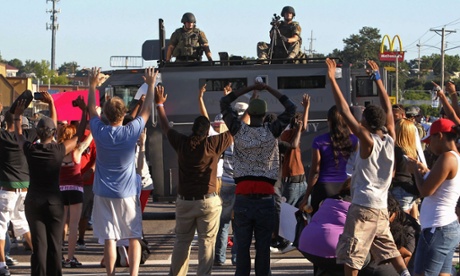
When Michael Brown—with a father in his life and accepted to college—was shot dead in the street in Ferguson, Missouri, by a white police officer, corporate media had a chance to revisit the assumption that what black men need most is a mentor. But rather than question the analysis they’d embraced, media instead found everything “new.” Suddenly we learned that US police forces are militarized! Some police disrespect black people! Different communities have different experiences!
That’s not to belittle media coverage, which was better than it might have been. There was the predictable culture-blaming, from the predictable quarters. (See MBK booster Bill O’Reilly—8/26/14—who dismissed protesters’ concerns because the idea of white privilege is a “big lie,” expounded by “race hustlers.”) But when you can find a column headlined “In Defense of Looting” in the Daily Mississippian (8/26/14), you know it’s not quite business as usual.
USA Today (8/15/14) reported on the incidence of killings by police (at least 400 a year) and decried the lack of reliable data. The Christian Science Monitor (8/21/14) explored the damage inflicted by St. Louis segregation and white flight. The New Republic (8/20/14) explained the particulars of “self defense” laws in Missouri and elsewhere that, combined with “entrenched racial and occupational biases” make homicide convictions of police officers like Ferguson’s Darren Wilson “basically impossible.” All of this helpfully moves the conversation from black people’s “feelings” to demonstrable facts.
But big media don’t really have themselves to credit for the elevation of Brown’s murder beyond lamentable anecdote. They were largely reacting to the vigorous public outcry, and to the Ferguson Police Department’s especially heavy-handed response, including assaults on reporters themselves. And they were struggling to keep up, as those following the story turned instead to Black Twitter and other online sources for news and perspective. (CounterSpin, 8/22/14)
Now mainstream media are asking whether Ferguson will be a “moment” or a “movement” for black activists, but they might more appropriately ask the same of their own engagement with the issues Ferguson puts on the table. As Salon’s Cooper (8/26/14) put it, real progress would entail
a real commitment to due process, protection of voting rights, a livable wage, the dissolution of the prison/industrial complex, funding of good public education at both K-12 and college levels, a serious commitment to affirmative action, food security and full reproductive justice for all women. Those are the kinds of conditions under which black communities, and all communities, could thrive.
A failure to see things on that scale, to treat what we’re now calling “Ferguson” not as aberrant but as reflective of US social systems and institutions, risks setting us back to appeals to individual betterment, the “pull up your pants” logic critics see in MBK.
And not insignificantly, a focus on the individual over the structural tells white people that racism is a personal thing they “just don’t understand” and therefore can’t fight, that progress is a zero-sum game in which there’s nothing people of conscience can do together. Recognition of the irreducibility (beyond class, culture, clothing or family structure) of anti-black racism is laudable and overdue. But it need not erase the non-black anti-racists who could be engaged in resisting policies and practices that overwhelmingly hurt people of color, like, for just one example, the practice of funding police departments with low-level warrants that target the poor—as spotlighted by the Daily Beast’s Michael Daly (8/22/14), who is white.
Ferguson could be a turning point for media coverage of racism. But should corporate media “forget” what they now suggest they are learning—as they have after previous “moments” (Extra!, 7/92, 8/06) the good news is that every day more people are talking around them, and moving forward without them.



A failure to see things on that scale, to treat what we’re now calling “Ferguson” not as aberrant but as reflective of US social systems and institutions, risks setting us back to appeals to individual betterment, the “pull up your pants” logic critics see in MBK.
It is amazing how difficult it is to get a person to see a point of view, when their paycheck is based on them not seeing that point of view.
When the black and brown men of America are the targets of institutional racism by schools, police and courts they have an arduous course to achieve success in life.
The picture painted of the lives of the blacks in Missouri reveals a twentieth century Jim Crow existence. Harassed by the police with constant infractions requiring fines which supported both the police and other civil programs.
It’s amazing to me how much of the behaviour that FAIR talks about as media bias shows up in this article.
The institutional racism the article speaks of has one common generic source–government. Government is the source of racism with its paternalistic attitude towards poor minorities and a government bureaucratic class and industry dependent upon keeping minorities in a perpetual state of trans-generational slavery. Government programs and voting and reproductive rights protection by government will do nothing the ameliorate the poverty, ignorance and dysfunctionality of minorities. Funding of educational institutions solve nothing. Schools continue to fail in spite of the fact that we keep throwing money at them. Successful schools are dependent upon functional families and a functional complementary cultural context. Affirmative Action and livable wages are meaningless if the disadvantaged are thoroughly unemployable. People already have food security and access to reproductive “rights”. These non-solutions proposed as solutions have been tried and tried again and they never do a damn thing to change things for the better. Same old Liberal bull based on the myth of “social engineering”.
In any event how can a government that desires the enslavement of blacks, do anything that will actually help them. Thats why Libs keep proposing non-solutions to giver the impression that they care. The only thing that government cares about is itself and maintaining its position of power and privilege. Government could care less about the lives they destroy and all of the suffering that they help to perpetuate. Get real!
What kind of “institutional bias” do young black men face in some urban cesspools like Detroit for example?
http://www.detroitmi.gov/Portals/0/images/legislative/home/members.png
Detroit has the highest per capita murder rate of any major US city, and a large amount of this is so-called “black on black crime”. Is that due to “institutional bias” from a city whose leadership is entirely made up of minorities?
i am a victem , i have two chips that was put in my ears , by people who are useing them to hurt me an my family an love one , it started off with money than once i didnt respond to them on than they try to use the chips to make me hurt myself an other . over the year i found out who was doing by listioning to them .also learn what i had in my body an where they was , my name is tyrone johnson , number is 917995-1727 , if wish to talk to me. i went to fed, they knew what they was an told me to report it to the cops ,an have them remove . also went to cop made a report , an also was told to have them remove .going to doctor tomorrow afternoon to see if i can have them remove an turn them over to cops. if wish to contract me best reach by number , thank you for any time you put into this matter.
I appreciate the occasional article on climate change, environmental issues, and corporate corruption but FAIR has a leftist bias not far from CNN, MSNBC, Huffington Post, PBS, Democracy Now and countless other news outlets. FAIR needs to tackle leftist hypocrisy and bias if ithe really has FAIR in mind