


 Reagan left office bolstered by the oft-repeated media myth that he had been far and away the most popular of any president since World War II. But bearing in mind Mark Twain’s observation that a lie gets half-way around the world before truth puts its boots on, the U.S. public deserves to know what the polling data actually says.
According to Gallup polls taken throughout his presidency, Reagan was not one of the more popular presidents in the post-Roosevelt pack. At various points during his presidency he rated lower than the other presidents during comparable periods of their terms in office. For instance, during the first two years of Reagan’s presidency, the public was giving President Reagan the lowest level of approval of all modern elected presidents. Reagan’s average first-year approval rating was 58%—lower than Dwight Eisenhower’s 69%, Jack Kennedy’s 75%, Richard Nixon’s 61% and Jimmy Carter’s 62%.
The post-Roosevelt presidents who assumed office through circumstances other than elections scored higher approval ratings during their first months in office than Reagan. In October 1945, six months after FDR died, President Harry Truman received an 82% approval rating, down from 87% the previous June. In December 1963, shortly after JFK’s assassination, Lyndon Johnson got a 79% public approval rating, and it stayed in the mid-to-low seventies until December 1964, when he scored 69%. Only Gerald Ford, who received a 71% approval rating in August 1974, declined below Reagan’s first-year level.
Nor did the U.S. public give Reagan higher marks in his second year than other post–World War II presidents. Reagan’s approval rating at the end of his second year in office was 41%, with an average for that year of 44%. Compare these statistics to Eisenhower, who notched a 69% approval rating at the end of his second year and a 65% year’s average; Kennedy’s were 76% and 72% respectively; Nixon’s 52% and 57%; and Carter’s at 51% and 47%.
President Reagan’s humdrum approval ratings continued throughout his first and second terms. Averaging 50% for his first term, Reagan fared slightly better than Ford at 47% and Carter at 47%, but with Gallup’s 3% margin of error even these differences are not statistically significant. On the other band, Reagan’s first term average was much lower than those of Presidents Kennedy (1961–63) who averaged a 70% approval rating, Eisenhower with a 69% average, and Nixon at 56%.
In May of the second year of his second term (1986), Reagan’s 68% approval rating surpassed the mid–sixth year figures for two-term presidents. But after the Iran/Contra scandal broke in the fall of 1986, Reagan’s approval rating plummeted to 46%, leaving him with an unimpressive average for that year.
Reagan finished strong with a December 1988 Gallup poll recording a 63% approval rating. But given the 3% margin of error, this statistic is not appreciably different than the final ratings of Eisenhower (59%) or Kennedy (58%). Polls showed FDR with a 66% favorable tally at the time of his death.
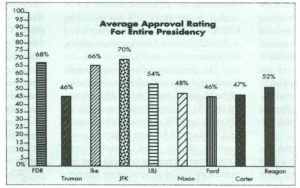
Reagan’s 52% average approval rating for his entire presidency was topped by Kennedy’s 70% average, Eisenhower’s 66%, Roosevelt’s 68%, and even by Johnson (54%), who eschewed running for reelection because of the unpopularity of his Vietnam policy. In short, about half—and sometimes more than half—of the U.S. public did not approve of Reagan’s presidential performance. His approval index was not much better than the lowest modern presidential averages: Truman’s and Ford’s, each at 46%; Carter’s at 47%; and 48% for Nixon.
Even the notion that the American public likes Ronald Reagan the man (as opposed to some of his policies) has been grossly exaggerated. Overall, his “likability” percentages have ranged in the low-to-mid seventies, reaching a high of 81% in November 1985, and a low of 50% in August 1983. No other modern president’s likability indexes has sunk as low as Reagan’s lowest; most have generally fluctuated in the mid-to-upper seventies for all of Reagan’s modern predecessors.
For example, 84% of Americans liked Ike in February 1956. In August 1964, 89% of Americans liked Johnson. Even in the summer months of Carter’s final, unpopular year as president (just before his defeat by Reagan in the 1980 election), Carter scored a higher Gallup personal likability index at 76% than Reagan’s 73% during the comparable period of his administration.
For anyone who cares to look at the actual polling data, the facts show that Reagan was definitely not the most popular post-war president, and during many comparable periods he was among the most unpopular.


