

Janine Jackson interviewed Carey Gillam about Hardeman v. Monsanto for the March 29, 2019, episode of CounterSpin. This is a lightly edited transcript.
[mp3-jplayer tracks=”CounterSpin Carey Gillam Interview @http://www.fair.org/audio/counterspin/CounterSpin190329Gillam.mp3″]

Whitewash, by Carey Gillam
Janine Jackson: The case is called Edwin Hardeman v. Monsanto, which sounds something like David v. Goliath. Hardeman is a 70-year-old man who says using Roundup, Monsanto’s weed killer, for nearly 30 years caused his non-Hodgkin’s lymphoma.
And Monsanto is, well, Monsanto. Recently acquired by German drug and crop chemicals company Bayer for some $66 billion, the corporate behemoth commands more than a quarter of the combined world market for seeds and pesticides, with a famously active PR machine.
And yet Goliath lost. The jury in US District Court in San Francisco returned the necessary unanimous decision, finding that Roundup caused, or was a substantial factor in causing, Hardeman’s cancer. And that Monsanto should be held liable, because the herbicide is not labeled to warn of that risk.
The company, naturally, is appealing. But with more than 11,000 other cases in the wings, this story isn’t going away anytime soon.
Our next guest has been following this case and others. A longtime food and agriculture journalist at Reuters, Carey Gillam is now research director at US Right to Know, and author of the book Whitewash: The Story of a Weed Killer, Cancer and the Corruption of Science, out from Island Press. She joins us now by phone from Kansas. Welcome back to CounterSpin, Carey Gillam.
Carey Gillam: Thanks for having me.
JJ: Listeners may remember the case last year in which a California jury found that the use of Roundup by a school groundskeeper, Dewayne “Lee” Johnson, was a substantial factor in his non-Hodgkin’s lymphoma. But that ruling didn’t make this one a sure thing, or even an expected thing.
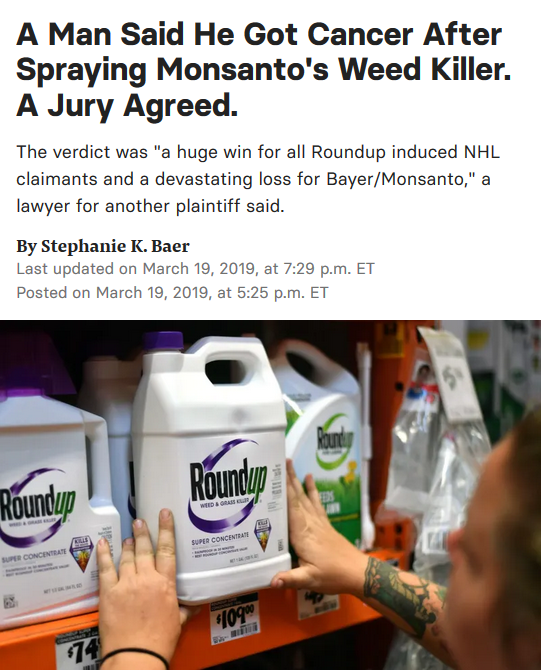
I’m noticing that some coverage seems to be taking a line that, as a former federal prosecutor was quoted on one news show, the verdict “proves that juries are being convinced that Roundup is causing cancer.” Another headline was, “A Man Said He Got Cancer After Spraying Monsanto’s Weed Killer. A Jury Agreed.” It makes it sound as though these court decisions are mainly the result of fancy lawyering, or maybe even deception. But Hardeman’s attorneys presented scientific data, just as Monsanto did; it wasn’t based on sympathy-mongering or something, right?
CG: Right. Of course, it is Bayer and Monsanto’s argument, or position, that the science is on their side, that the weight of scientific evidence shows no cancer risk, no carcinogenicity connection to its glyphosate-based herbicides like Roundup. But the evidence tells us otherwise.
And, of course, I’ve written a whole book about it, and talked about it many times. The weight of scientific evidence, published peer-reviewed epidemiology, toxicology, mechanistic data done over multiple years, multiple countries, does indeed show a cancer risk associated with these herbicides, with clear association to non-Hodgkin’s lymphoma. And that’s what caused the International Agency for Research on Cancer, in 2015, to classify glyphosate, the main ingredient in Monsanto’s Roundup, as a probable human carcinogen. So there’s a great deal of scientific evidence, and that’s what is convincing juries.
But the second leg of this, or the second part of it, is there’s also a great deal of evidence of Monsanto’s manipulation of the scientific record. So when Monsanto says it has all of this science on its side, well, we know now from internal Monsanto documents, that a lot of that science they point to is science that they paid for, that they wrote, that they ghostwrote, that they manipulated—that they essentially had a hand in creating a safety narrative that really was not true.
JJ: It’s interesting, because I think that was why some folks were surprised by the ruling in Hardeman, because the judge, Vince Chhabria, had taken a lot of issue, hadn’t he, with Hardeman’s attorneys presentation of the case? And what he seemed to take particular issue with was lead attorney Aimee Wagstaff’s effort to introduce evidence of just that, of Monsanto’s effort to manipulate regulators, including ghostwriting safety reviews. And I’m not sure, legally, whether that’s permissible, but it sure sounds relevant to me as a layperson, if the company is then going to rely on that data from those regulators.
CG: Right. Well, what Chhabria did—and this is the federal judge; the Johnson case was in state court—but what he did was really unusual. He threw Monsanto a bone. Monsanto said, “You know what? Let’s just let the jurors hear only about the scientific evidence.”
And so the judge divided the case into two phases. And the first phase was sharply limited to only discussion and presentation of scientific studies to the jurors. And Monsanto thought that they would win that. If the jurors couldn’t know about their ghostwriting and manipulation, they thought that they could win.
But, in fact, they did not. The jurors in that first phase said, after looking at all of the scientific evidence, that the weight of evidence was on the plaintiff’s side. And they found that, yes, it did cause his cancer.
In the second phase of the trial was when they considered damages, and that was when they looked at the manipulation of science, and came back with this $80 million verdict.
JJ: Let me just keep you on regulators for a second. When you’re reading press accounts, you see: Bayer/Monsanto flatly deny that glyphosate-based herbicides are carcinogenic, and they cite the Environmental Protection Agency. So in media stories, you get kind of disagreements between institutions, between the World Health Organization, EPA and different groups. What are we to make of the disagreements between various regulatory entities on this?
CG: Well, a couple of different elements to that. So No. 1 is that most of the regulatory agencies, including the Environmental Protection Agency, only require a large body of evidence about the active ingredients. So in the case of Monsanto’s products, the active ingredient is glyphosate. It is not the only ingredient, but it is the active ingredient. So their studies, that they were required to present to the EPA, was limited to glyphosate.
Now, the products on the store shelves are not glyphosate only; they include surfactants. And scientists around the world who have studied the actual formulated products have said that the way that these surfactants interact with glyphosate make it much more toxic than glyphosate by itself.
And Monsanto admits it has never done any long-term studies about these formulated products, and the EPA admits that it’s never required any long-term studies. So the actual products that we’re being exposed to, and that are being used out there, and that these plaintiffs [have] used, have never had any long-term regulatory requirements for carcinogenesis studies. And that is shocking to a lot of people. But that is the fact. So that’s one element.
The other element is, again, the regulators rely primarily on data and information that’s been given to them by the companies that sell the chemicals. And we know, from analysis that’s been done, that studies that are done by companies that profit from those products generally find those products to be safe. Whereas independent analysis and independent research is more likely to find risk, if risk is there. We have to take that into account when they point to the EPA as the all-knowing being that we should rely on.
JJ: Right. So it’s about carcinogenicity; it’s also about the right to know. I mean, capitalists talk a good game about choice. But what is choice without information? And the failure-to-warn, I’ve heard, is very important in these cases. But I have to say, I still wonder how much say a farmworker, for example, really has, even if there’s a label on the product. And given the ubiquity of these chemicals in our food, I certainly think the failure-to-warn is critical, but I wonder if there are some things that a label doesn’t cover, if you will.
CG: Yeah, that’s true. The failure-to-warn is a big issue. Now for the users of this who are exposed occupationally, a warning is a big deal. Because if you’re told, “Hey, this could cause cancer,” or, “This is particularly dangerous, you want to make sure that you don’t get it on your skin, and you don’t inhale it. And you wear gloves and long pants and a mask,” that’s going to provide a degree of protection.
And they didn’t do that with this product. They said it’s safe as table salt, safe enough to drink; people are out there in sandals, spraying it. You know, Mr. Hardeman was spraying a backpack sprayer around, with no protective gear. So that’s the deception.
When it’s in the food, you’re not voluntarily consuming food with pesticide residues in them—or maybe you are, most people don’t think about that! That’s a different animal.
But again, if this had been classified differently by our EPA, it would not be allowed to be sprayed directly onto food crops; we wouldn’t have the types of residues that we’re having in food if it had been judged differently by the EPA.
JJ: And then I would just note that I know that some of the work is around, not just farmworkers, but farmworkers’ children, who, of course, have different levels of susceptibility from damage from this. So you really have to look at who all is coming in contact with it, and it’s not just necessarily the person spraying it.
CG: Gosh, no, I mean, right. There have been studies where they find this in the urine of farmworkers’ children, even though the children are not out there working in the fields. And our government scientists have found that this chemical, because it’s so widely used, it’s in air samples; you see residues, traces of it, in rainfall; even it’s in the soil. It’s pretty ubiquitous, particularly in farm country.
JJ: Well, in the end, Vince Chhabria had some strong—or in the middle, I guess—he actually had some very strong language, in which he said:
There is strong evidence from which a jury could conclude that Monsanto does not particularly care whether its product is in fact giving people cancer, focusing instead on manipulating public opinion and undermining anyone who raises genuine and legitimate concerns about the issue.
That is some pretty strong language. And, I have to say, I read it as a heads-up to the press as well.
CG: Exactly. And he also did say, in that same ruling, that there are “large swaths of evidence,” the scientific evidence, showing that this product could be considered carcinogenic, and that Monsanto’s been trying to ignore those large swaths of evidence. So it’s not just the manipulation, it is also the scientific evidence that’s brought these juries, twice now, to these multi-million-dollar verdicts.
Carey Gillam: “We’re allowing these companies, a handful of very powerful companies, to really dominate the regulatory system, the political system, food policy matters, agricultural policy, in which we all are just exposed to pesticides and chemicals that can do harm to our health.”
JJ: Media coverage has taken some familiar turns, talking about the loss for Monsanto and Bayer, as though they were the harmed party here.
But then also, I think, just framing stories around lawsuits and trials affects how we hear them. So when you hear about how Dewayne Johnson was awarded $280 million in damages, and that was later reduced to about $80 million, and $80 million in Hardeman, you have to remember that Monsanto has almost endlessly deep pockets, and, you know, money doesn’t cure cancer. So just speaking of it in terms of, “Oh, they won,” doesn’t really give you an accurate picture of what’s happening here, I don’t think.
CG: Definitely. And I spoke with the plaintiffs attorneys, Aimee Wagstaff and Jennifer Moore, yesterday, and we talked about that. You know, it’s great to say, “We won,” and there’s money, and this cancer victim will get a few dollars.
But it’s really a larger picture and a larger problem in this world, where we’re allowing these companies, a handful of very powerful companies, to really dominate the regulatory system, the political system, food policy matters, agricultural policy, in which we all are just exposed to pesticides and chemicals that can do harm to our health.
And analysts are expecting that a global settlement from Bayer to put an end to all of this litigation might be between $2 and $5 billion. $2 to $5 billion is not going to cripple Bayer, Monsanto’s new owner.
So if people really want to see change, and we really want to have accurate information, to be informed, reporters and others need to start paying attention to the big picture here, and what’s happening to our environment, to our health, and how this company and these revelations in these jury trials, what they mean, what they really mean.
And that’s what I think is more important about these trials, is not who wins or who loses or how much money. I think what’s important is that it puts a spotlight on a really important public policy issue, and brings to light a lot of secret information. Internal Monsanto documents and regulatory documents and scientific studies that the general public has not heard about, 40 years of information that’s finally coming to light in these jury trials.
JJ: We’ve been speaking with Carey Gillam, research director at US Right to Know. You can find their work on this and other issues online at USRTK.org. The book is Whitewash: The Story of a Weed Killer, Cancer and the Corruption of Science, and it’s out now from Island Press. Carey Gillam, thank you so much for joining us this week on CounterSpin.
CG: Thank you for having me.



Janine, when are going to interview Robert F. Kennedy Jr. on the corrupt science and fraud that underpins vaccinations and the drug companies that make them? Do you think Monsanto, Dow, Dupont are the only companies that get away with inherently dangerous products harming people? Janine and Fair–are you afraid to know more?
Isn’t RFK Jr the fraud that’s been waging a longtime campaign against the liberalization of marijuana laws? He also believes vaccines cause cerebral palsy and spina bifada? Figures.
Robert F. Kennedy Jr. is a Kennedy that would make his father proud–seeing wrong and trying to right it fighting against the dirtiest, nastiest corrupt industry. Names like Merck, Glaxo Smith Kline, Sanofi and Pfizer who have been fined over $7 billion dollars since 2009 for bribery, failure to notify safety, false claims and criminal fraud. These are schmucks who manufacture the bulk of the vaccines mandated for our children. Kennedy recently spoke in Albany as democrat lawmakers throw children under the bus to the greedy vaccine manufacturers.
Here’s an excerpt of his speech:
KENNEDY: Thank you for coming on such a rainy day. The pharmacist walked by and I don’t blame him for being angry because this is the biggest threat to their business plan. The vaccine industry when I was a boy was $270 million dollars. I got three vaccines and was fully compliant. Today it is a $50 billion dollar industry and 20% of pharmaceutical revenues.
But that’s at the front end.
At the back end are all the chronic diseases that the FDA says they think are associated with vaccines. A hundred and fifty diseases are now listed on the product inserts. The reason they’re listed on the product inserts is because the FDA has made the determination that these injuries are more likely caused by a vaccine.
This is the chronic disease epidemic.
I have six kids. I had eleven brothers and sisters. I had over fifty cousins. I didn’t know a single person with a peanut allergy. Why do all my kids have food allergies? Because they were born after 1989.
If you were born prior to 1989, your chance of having a chronic disease, according to HHS (Health and Human Services) is 12.8%. If you are born after 1989, your chance of having a chronic disease is 54%. And the FDA has said to the vaccine companies, you need to take a look at these diseases.
And what are these diseases?
They’re the neuro-developmental diseases, ADD, ADHD, language delays, speech delays, tics, Tourette Syndrome, ASD, and autism. The auto-immune disorders, Guillan-Barre, multiple sclerosis, juvenile diabetes, and rheumatoid arthritis. The anyphylactic diseases, food allergies, rhinitis, asthma, and eczema. All of these exploded in 1989.
Great report Janine. All Americans— actually all human beings on the planet are being abused by pesticide makers who act as if things are fine. Things are not fine! Every living thing on this planet is affected by pesticides that Monsanto and Bayer and others choose to portray as “items” that they produce to make your laws and gardens look beautiful . NO, I think not! To deny complete information about the effects of these chemicals on human beings and animals is so inhumane and evil that maybe corporate people need to feel a real sting of the public’s horror. Although, if people had paid attention to Rachel Carson who wrote Silent Spring so many years ago—-maybe America could add another Roosevelt freedom. The freedom to eat clean food and drink non-polluted water. If we could do that, we probably would not have so many childhood cases of deadly diseases.
” Of course, it is Bayer and Monsanto’s argument, or position, that the science is on their side, that the weight of scientific evidence shows no cancer risk, no carcinogenicity connection to its glyphosate-based herbicides like Roundup. But the evidence tells us otherwise”……..”But the second leg of this, or the second part of it, is there’s also a great deal of evidence of Monsanto’s manipulation of the scientific record. So when Monsanto says it has all of this science on its side, well, we know now from internal Monsanto documents, that a lot of that science they point to is science that they paid for, that they wrote, that they ghostwrote, that they manipulated—that they essentially had a hand in creating a safety narrative that really was not true.”
HMMMMMM…..Sounds like what we’re hearing about vaccines, from all of the entities that profit from them (including the CDC, who holds vaccines patents in what should be a highly illegal conflict of interest, the FDA, also a massive conflict of interest, the MEDIA, medical schools and textbooks, which are funded by BIg Pharma, physicians, who recieve tens if not hundreds of thousands per dollars per year in bonuses for a high rate of fully vaccinated patients, CONGRESS and other legislators, researchers….the list goes on and on. And who on earth is it legal for vaccine manufacturers to do the safety testing on their own products??? And WHY, when people ask these questions, are THEY the ones who are demonized???
“There is strong evidence from which a jury could conclude that Monsanto does not particularly care whether its product is in fact giving people cancer, focusing instead on manipulating public opinion and undermining anyone who raises genuine and legitimate concerns about the issue.” Once again, this could be said for vaccine manufacturers, and the CDC, and the FDA….all who profit from vaccines.”
“And Monsanto admits it has never done any long-term studies about these formulated products, and the EPA admits that it’s never required any long-term studies. So the actual products that we’re being exposed to, and that are being used out there, and that these plaintiffs [have] used, have never had any long-term regulatory requirements for carcinogenesis studies. And that is shocking to a lot of people. But that is the fact. So that’s one element.” Yes, like how vaccines have NEVER been tested against an inert placebo, and no long-term studies have been conducted by a non-biased party (or any party that I know of, and in fact, as vaccines are classed as “biologics” unlike other pharmaceutical drugs, they are allowed to be “fast-tracked” and in fact only follow subjects for 4 – 30 DAYS rather that months or even years as other pharmaceutical drugs do.
“But it’s really a larger picture and a larger problem in this world, where we’re allowing these companies, a handful of very powerful companies, to really dominate the regulatory system, the political system, food policy matters, agricultural policy, in which we all are just exposed to pesticides and chemicals that can do harm to our health.” YES!!!!! Let’s question WHY we are allowing these corporations to have so much power over the health and even lives of the population. Let’s NOT villify people who are simply trying to POINT OUT THE PROBLEMS. Let’s NOT allow these products to be MANDATED, and let’s overturn the 1986 act that allows vaccine manufacturers complete immunity from liability from the deaths and injuries their products are causing. ONLY then might we see the full extent of the problem, and ONLY THEN might they actually start making a safer product.
“So if people really want to see change, and we really want to have accurate information, to be informed, reporters and others need to start paying attention to the big picture here, and what’s happening to our environment, to our health, and how this company and these revelations in these jury trials, what they mean, what they really mean.
And that’s what I think is more important about these trials, is not who wins or who loses or how much money. I think what’s important is that it puts a spotlight on a really important public policy issue, and brings to light a lot of secret information. Internal Monsanto documents and regulatory documents and scientific studies that the general public has not heard about, 40 years of information that’s finally coming to light in these jury trials.” YES. PEOPLE NEED TO START PAYING ATTENTION TO THE BIG PICTURE HERE and STOP trying to KILL THE MESSANGER. WE ARE TRYING TO PUT A SPOTLIGHT ON A REALLY IMPORTANT PUBLIC POLICY ISSUE AND BRING TO LIGHT A LOT OF SECRET INFORMATION, INTERNAL DOCUMENTS AND REGULATORY DOCUMENTS AND SCIENTIFIC STUDIES THAT THE GENERAL PUBLIC HAS NOT HEARD ABOUT (also decades worth of information). PLEASE RECOGNISE THE SIMILARITIES AND PUT YOUR MONEY WHERE YOUR MOUTH IS AND BE THE REPORTER WHO STARTS BRINGING TRUTH TO THIS ISSUE, BEFORE VACCINES ARE MANDATED FOR EVERYONE (IT WILL NOT JUST BE FOR CHILDREN, ADULTS ARE NEXT). Kids are dying. Every day. America has the highest rate of vaccination and the highest rate of child mortality in developed countries, and if you think that “correlation does not equal causation” on this, you need to dive down the rabbit hole and start looking at the thousands of INDEPENDANTLY RESEARCHED (not paid for by big pharma) that clearly show that it is, in fact, causation. Please, please get in touch with RFK Jr as Michael asked. Please choose to do right by our children, and be on the right side of history with this.
Ms. Gilliam, Ms. Jackson, thank you again for a superb interview! Here is a big joke on us: Rinse your greens in the sink, to wash off any residue. Since plants are made adapted to withstand pesticides, and herbicides they have pores just like us and those poisons are not just on the outside of the leaves but penetrate all the way into the heart of the plant, you cannot wash them off! I firmly believe that pesticides are responsible for the die-off of our insects. The world is awash in them and once sprayed they do not just magically disappear, they are in all of our water now. I wish we could build a case against their use and sue those companies bankrupt. My beloved swallows disappeared 5-6 years ago, I used to have nests everywhere. That evil GREED and LUST for Power is destroying life on our precious planet, I do not envy our children their non-future…..
Sounds familiar. My brother told me fifteen years ago that Round Up was a safe lawn chemical and I used it two or three times to kill poison ivy plants in our back yard. Since that time, my neighbor, who is and had always been, a profligate user of lawn and garden chemicals, told me that her husband died of pancreatic cancer thirty years ago. I looked it up and found that pancreatic cancer is associated with agricultural chemicals. The husband of a friend, also such a profligate user, developed lymphoma, was treated for it, but will probably die of it. I have not used Round Up in fourteen years.
Always the same story. I’m reading The HPV Vaccine on Trial now, and, predictably, every page is packed with scientific proof that the vaccine is much more likely to kill than cervical cancer is in East Africa, the area with the highest rates of cervical cancer in the world. And many many times more likely to cause permanent disability of many kinds. Study subjects were told that saline placebos were used in some of the participants, which turned out not to be true. None of them were given inert placebos. Some were given vaccines without the virus-like particles, but WITH aluminum, which all on its own has caused innumerable cases of severe disability, including autism and seizure disorders. And then those who got only aluminum were told at the end of the trial that they had gotten the (false) placebo, fauxcebo as the book calls it, were not told that they had gotten a ton of aluminum, but were told they needed to get the real vaccine and get tons more of aluminum. And in the meantime girls (and some boys) are dying or being disabled by the supposedly safe vaccine in large numbers.
All the same. Caveat emptor. Do not trust those who have money on the table.
This is much about ALEC and the gang that change laws to give Corporations all the power. I have been looking at this since 2011.
https://www.usatoday.com/in-depth/news/investigations/2019/04/03/abortion-gun-laws-stand-your-ground-model-bills-conservatives-liberal-corporate-influence-lobbyists/3162173002/?csp=chromepush
Always first-rate reporting Janine!
Its science because scientists have proven it to be true. Paid for or not you cant make this up and prove it in a court of law. So you expect us to believe a company that makes poison is getting a bums rush? Shame on you.
Gillam doesn’t have an honest bone in her body. https://www.acsh.org/news/2018/05/01/glyphosate-carey-gillam-keeps-lying-early-and-often-12910 and https://biofortified.org/2018/02/hogwash-review-whitewash-carey-gillam/
Oh, yeah, ‘ACSH’ is a ‘GREAT’ source, as sourcewatch.org analyzes below. (I’m not going to waste my time checking-out ‘biofortified.org’)
“The American Council on Science and Health (ACSH), was founded in 1978 by Elizabeth M Whelan, a demographer who turned herself into a nutritionist/publicist with the Nutrition Department at Harvard University, and her elder mentor/teacher Professor Frederick Stare. Stare had earned himself the reputation of being Doctor Sugar for his vocal advocacy of sugar and cereal interests through the Nutrition Department of Harvard’s School of Public Health.
Stare also mentored Dr Carl C Seltzer, a physical anthropologist from the Peabody Museum, who became one of the tobacco industry’s principle early scientific lobbyists by claiming to be a ‘heart specialist’.
Whelan (who was anti-smoking) obtained the backing of the American Chemical Association to create the ACSH, and Stare joined her at the top to give the new organisation some scientific authenticity. They described the ACSH as “a consumer education consortium concerned with issues related to food, nutrition, chemicals, pharmaceuticals, lifestyle, the environment and health.”
There are now many recent documents which confirm that ACSH actively solicits funding from corporations on specific issues — anti-GMO labeling, for example — that benefit from it taking positions favorable to those corporations.
Consumer advocate Ralph Nader once said of ACSH,
‘A consumer group is an organization which advocates the interests of unrepresented consumers and must either maintain its own intellectual independence or be directly accountable to its membership. In contrast, ACSH is a consumer front organization for its business backers. It has seized the language and style of the existing consumer organizations, but its real purpose, you might say, is to glove the hand that feeds it.’
Numerous ACSH publications (that do not disclose the corporations that have funded the organization) take positions attacking public concerns about various corporate products and practices, such as genetically modified foods (GMOs), pesticides, herbicides, and more, and have sought to downplay concerns raised by scientists and consumers. However, the tobacco industry has never been an ACSH client, and Whelan has very cleverly used her anti-tobacco stance to gain some credibility among health professionals and some activist groups. All of the tobacco connections were conducted by her partner, Fred Stare.
Some of the products ACSH has defended over the years include DDT, asbestos, and Agent Orange, as well as common pesticides. ACSH has often called environmentalists and consumer actvists “terrorists,” arguing that their criticisms and concerns about potential health and environmental risks are threats to society.[2]
ACSH has been funded by big agri-businesses and trade groups like Kellogg, General Mills, Pepsico, and the American Beverage Association, among others. See Funding below for more.”
Source: https://www.sourcewatch.org/index.php?title=American_Council_on_Science_and_Health