

On Sunday, ABC World News (9/8/13) had one of the more unusual takes on the Syrian conflict: how it would affect your retirement account.
Anchor David Muir explained:
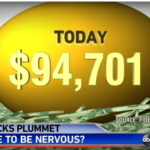
As the President prepares to make his case to the American people, Wall Street already revealing it is not convinced about a US strike. Millions of Americans and their 401 (k) s already feeling this, even before any possible action.
This seems to be a thing with ABC. Last year, the newscast constantly talked about how the Greek financial crisis might affect 401(k)s–or, as anchor Diane Sawyer once put it, a dip in the Dow Jones Industrial Average meant we should “blame it on the country of Greece, long criticized for being undisciplined, and now threatening American retirements.”
For starters, it’s important to remember that relatively few American workers have 401(k)s. And a drop in stock prices on a given day actually doesn’t really mean anything at all for a retirement account.
But for those who do have 401(k)s, what happened that had ABC take notice? Economics correspondent Rebecca Jarvis joined the show to say Syria “is issue No. 1 for the stock market,” and here’s the proof:
JARVIS: If you look at this, the stock market responding almost immediately, where you see on the left-hand side of your screen, the comments from Putin, that Russia would be backing Syria and not the United States, a 150-point drop in the Dow because of that.
So you can see, David, how pivotal this week will be as the US makes decisions about what its role will be in Syria. Wall Street will be watching.
MUIR: A huge drop with just word from Putin on Syria.
 Well OK. But look at that ABC graphic again. The Dow ended more or less where it started that day. If the Syria crisis is really “issue No. 1 for the stock market,” it sure has a funny way of showing it for very long.
There’s something inherently problematic about seeing world affairs–or anything else–through the lens of the U.S. stock market. It shouldn’t be taken as a scorecard on policy or the performance of a president. In this case, when the “huge drop” was followed by a recovery in a matter of hours, it’s hard to know why ABC thought this was news at all–unless you’re the kind of person who watches the twists and turns in the stock market all day long. That’s very few of us.


ABC is paid to look at the type of news, the corporations want their legions to be watching the numbers, not the reality. That way they control the past, as the electronic media is very ephemeral, indeed much like it’s old school name – the Ethernet – where what isn’t convenient is disappeared and becomes very hard to find. But the main issue is ‘when the numbers go up, everything is “BETTER”;. when the numbers go down everything is ‘Horrible’. Flipping between the “BETTER” and “horrible” is where the financial hokey pokey is played and the really big boys beat on the Market’s ups and downs itself. High rollers indeed.
I AGREE WITH YOU , BUT THE TRUTH IS THE FEW HOURS IS ALL THE TIME THAT THE US POPULATIONS CARED ABOUT SYRIA, , AND THEY FELT THE ADMINISTRATIONWAS JUST BLUFFING , WHEN TALKING ABOUT THE INTERVENTION