

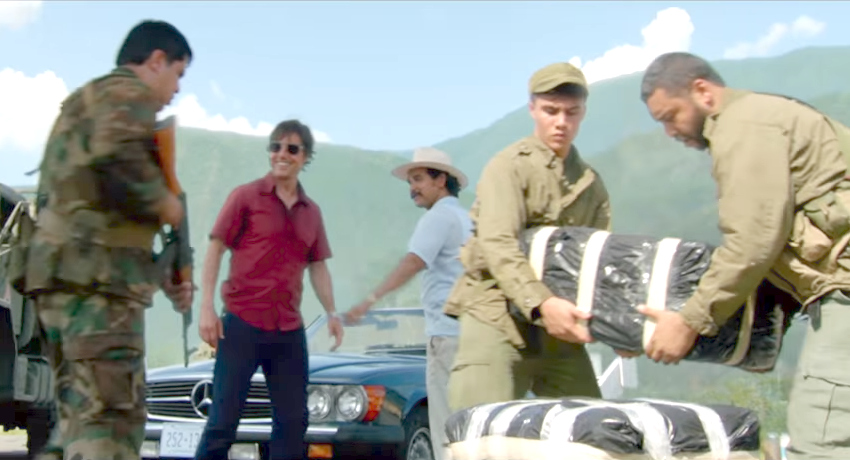

Tom Cruise as Barry Seal in American Made
Director Doug Liman (Writing Studio, 9/1/17) describes American Made, his film about real-life drug dealer Barry Seal, as “a fun lie based on a true story.” So it’s not like he’s holding himself to a high standard of historical accuracy.
For one thing, Seal (portrayed by Tom Cruise) did not meet Colombian druglords Jorge Ochoa and Pablo Escobar, whose psychopathic hijinks provide much of the incident in the movie, until 1984, when the narrative is almost over. And Seal never landed a plane on a suburban street and pedaled away on a child’s bike to evade the DEA, as Cruise does, I’m sorry to say. (American Made largely exists because the Oscar-winning Argo showed that CIA exploits could be turned into a commercial and critical success—if, as Argo did, you make up all the most exciting and cinematic parts.)
But as the movie covers a subject—the intersection of the 1980s’ drug trade with the covert wars in Central America—that was deliberately ignored by major media at the time, and has been little examined by historians subsequently (we’ll have to wait at least another decade for Ken Burns’ Iran/Contra), it’s worth looking at which parts of the script were fun lie and what was true story.

The real Barry Seal
It’s uncontroversial that Seal was a pilot for the Medellín cartel, and a much less reluctant one than portrayed in American Made. His ties to the CIA and the US-backed Nicaraguan Contra rebels are more often disputed but no less evident, given that the point of a covert operation is to be able to deny that your employees are working for you. Seal’s tiny airport in Mena, Arkansas, through which he was smuggling multi-millions in Colombian cocaine, did indeed also double as a Contra training camp, as depicted in the film. As investigative journalist Gary Webb wrote in his book Dark Alliance:
While denying that the CIA was involved in any illegal activities at Mena during the time Seal’s drug-smuggling operation was based there, the CIA’s Inspector General’s Office confirmed in 1996 that the CIA ran a “joint training operation with another federal agency at Mena Intermountain Airport.”… The CIA also used the Mena airport for “routine aviation related services” on CIA-owned planes, according to a declassified summary of the report.
One of Seal’s planes actually did end up being shot down over Nicaragua while ferrying US arms to the Contras, thus kicking off the Iran/Contra scandal. And Seal did have friends in high places, as the film suggests; John Kerry’s 1989 Senate subcommittee report on Contras and drugs reported:
Associates of Seal who operated aircraft service businesses at the Mena, Arkansas, airport were also the targets of grand jury probes into narcotics trafficking. Despite the availability of evidence sufficient for an indictment on money laundering charges, and over the strong protests of state and federal law enforcement officials, the cases were dropped. The apparent reason was that the prosecution might have revealed national security information.
In their book Whiteout, Alexander Cockburn and Jeffrey St. Clair quote a Customs official’s memo explaining that a drug investigation into a pilot had to be dropped because he “works for Seal and cannot be touched because Seal works for the CIA.”
More dubious are the film’s depictions of the Medellin cartel as having a close working relationship with the revolutionary Sandinista government in Nicaragua. Charges of Nicaraguan involvement in “narcoterrorism” were a staple of 1980s Cold War propaganda, but despite its best efforts, the Reagan administration was never able to come up with any evidence. As Webb quotes the CIA telling the Senate Select Committee on Intelligence in 1984:
Although uncorroborated reports indicating Nicaraguan involvement in the shipping of cocaine to the United States had been received, CIA was unable to confirm reports implicating high-level Sandinistas in drug trafficking.

The low-res image of Frederico Vaughn (in the striped shirt) that Ronald Reagan offered as proof of Sandinista drug trafficking
In fact, the best-documented part of Seal’s covert life was his involvement with the DEA and Oliver North’s National Security Council in a sting operation that was supposed to provide the proof of Sandinista drug-dealing. While in the film, Seal flies to Nicaragua and gets absurdly incriminating photos of Escobar and Ochoa themselves loading sacks of cocaine onto his plane, in reality what Seal brought back were grainy images that were supposed to represent Frederico Vaughn, who both the Reagan White House and Liman’s film maintain was a top aide to a major Sandinista official (Interior Minister Tomas Borge, though his name doesn’t come up in the film).
Vaughn was really a minor player in the Sandinista bureaucracy, the deputy director of a government import/export company. Though it’s pretty clear that that was just his day job, his real employer seems to have been somewhere north of the border. As FAIR (Extra!, 7–8/88) reported back in the ’80s:
Federico Vaughn, the supposed Sandinista official…appears to have been a US spy all along. An AP dispatch (Omaha World-Herald, 7/29/88) disclosed that subcommittee staffers called Vaughn’s phone number in Managua and spoke to a “domestic employee” who said the house had been “continuously rented” by a US embassy official since 1981.
The unnamed embassy official, according to Hughes, was among the group of US officials recently expelled by the Nicaraguan government after a violent political demonstration in July.
Webb points out that the CIA said in 1985 that Vaughn “was said to be an associate of Nicaraguan narcotics trafficker Norwing [sic] Meneses Cantarero”—Norwin Meneses being a Contra-connected drug dealer (and DEA informant) who figured prominently in Webb’s San Jose Mercury News Contra/crack expose. Webb also notes that “Oliver North’s daily diaries for that period contained several references to ‘Freddy Vaughn,’ including a July 6, 1984, entry that said, ‘Freddy coming in late July.’”
More broadly, the film depicts Central America as a Cold War battleground—the politics are succinctly explained with a cartoon of a Russian bear fighting an American eagle—with no mention of the fact that hundreds of thousands of civilians were being murdered by US-backed governments (and the US-backed Contras). But bringing up that part of the history would definitely put a feel-bad spin on what was meant to be an entertaining romp with a lovable rogue.

Iran/Contra committee counsel Arthur Liman (image: Vimeo)
The strangest twist in the film comes at the very end, when it’s dedicated “To Arthur”—that is, Arthur Liman, the director’s late father, who served as the Senate’s lead counsel for the Joint Iran/Contra Committee. Under the elder Liman’s direction, of course, the committee steered well clear of the Reagan administration’s ties to Barry Seal and his ilk. The Nation‘s David Corn (3/23/15) long after recalled the subject coming up when the committee’s final report was released:
In the midst of the questioning, a journalist from an alternative weekly asked, “Did the committees investigate the allegations of Contra drug-dealing?” Before Arthur Liman, the chief counsel of the Senate Iran/Contra committee, could reply, a reporter from the New York Times loudly sneered, “C’mon, ask a serious question.” And Liman, perhaps taking his cue from the Times reporter, moved on.
I protested: Why not answer the question? But no other reporter joined in.
It’s disquieting to see ugly realities that were buried by the father with the help of the New York Times turned by his son into entertainment product for Comcast (the parent company of Universal). But how entertaining is it? The actual story of how drugs and counter-revolution intersected in Central America was told to more dramatic effect—and much greater regard for factual accuracy—in Kill the Messenger, the 2014 biopic of Gary Webb (In These Times, 11/20/14). If you’re looking for a charming good ol’ boy carrying out improbable capers in a Southern milieu, Channing Tatum did it better in Steven Soderbergh’s Logan Lucky, released earlier this year—and without the historical distortions.



A funny thing about terrorism
Stunning that such crucial events in US history can be lied about or construed as “conspiracy theory” to this day. Meanwhile, people who covered the crimes the US helped commit in Central America were driven from the news business.
People should look for Robert Parry and Gary Webb interviews on YouTube for the real stories instead of these Hollywood lies.
Thank you for this! Hollywood has a long, vile history of red-baiting, both at home and abroad, and the fact that the studios which brought us Red Dawn have made yet another film demonizing the Nicaraguans and the Sandinistas is, sadly, no surprise. Stay tuned for a thriller featuring brave Senator Ron Wyden daring to visit and comfort dissident oligarchs in Venezuela, only to have his trip turned into a PR nightmare when Vladimir Putin’s secret intelligence agency, Wikileaks, reveals what he is up to!
I saw the film and I could’ve sworn they made the point that the Nicaraguans and the Sandinistas were being framed by the Reagan Administration, for what the CIA were actually doing with the Medellín Cartel.
I was so afraid when I read the headline that we were going to get the usual St. Ronnie of Dementia white wash! Thanks for this.
I wonder when they will make the movie of Ronnie;s War…..when even the citizens of Grenada didn’t know there was even a war. Weirdly, the Margaret Thatcher person and the Ronald Regan one, seemed to suffer from the same, plague of a need for war, but with not much of a brain from either one. Did people think the Falklands was any kind of win? Did America win the Grenada war?, or maybe it didn’t count, since it was an embarassment, although some American soldiers died anyway, for the hubris of stupidity. Since we have fake news, I guess that no one should be surprised that Hollywood makes movies about real wars, but with fake incidents.
Hollywood once again being a bedfellow to State department propaganda and then acting as a faux resistance and controlled opposition to which ever party is the jerkwad of the day. Good to know this is another distorted film I can skip.