

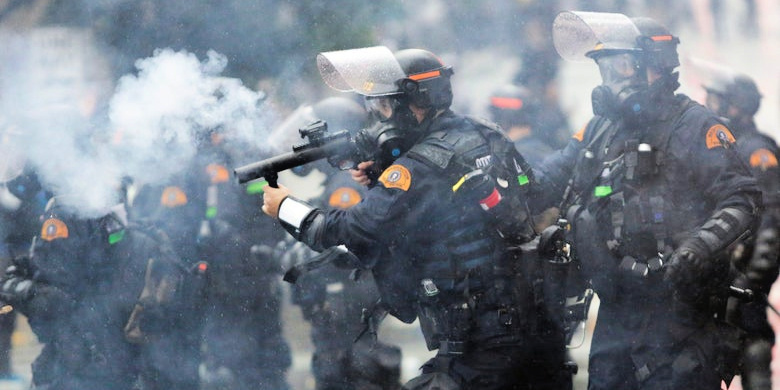
As protests against police violence erupted around the nation, Twitter and Facebook were filled with videos of heavily armored police forces indiscriminately pepper-spraying marchers, firing flashbangs at crowds containing children and the elderly, and shooting projectiles at people standing outside their own homes. To most of those immersed in the social media environment, looted or burning buildings must have seemed relatively unimportant compared to the state violence meted out to the population.
Initial media coverage lacked much serious analysis of the abusive police conduct. Media coverage not only demonized legitimate outrage at a broken system, it whitewashed the role police played in spreading violence and chaos. In a USA Today piece (5/31/20) about how “Peaceful Protesters Lament Violence at George Floyd Demonstrations,” the only violence discussed at length was the vandalism, looting and fires set during protests. The piece briefly mentioned tear gas and arrests, but did not include them in its examination of how police “overreact” to peaceful protesters.
The Washington Post (6/1/20) and Reuters (5/29/20) followed similar patterns, as did a USA Today video (5/30/20), titled “George Floyd Death Protesters Spread Violence, Destruction Across US Cities.”
A major New York Times article (5/28/20) described “skirmishes” with police, language that implied parity between unarmed protesters and armored, militarized police. One of the most common terms used to describe police violent incursions into protesters’ space was the benign word “clashes.”
Even when outlets described the rampant police violence against protesters, the language used still protected police from scrutiny. A Media Matters study (6/2/20) noted headlines using the passive voice to avoid ascribing agency to police. For example, instead of declaring that police were targeting journalists, Reuters (5/31/20) merely wrote, “Journalists Targeted in Attacks.”
Outlets also described inanimate objects committing violence instead of attributing actions to officers, as in the Independent headline (5/31/20), “NYPD Vehicle Rams Crowd of Demonstrators in Brooklyn.” Reuters (6/1/20) had “Tear Gas Fired on Protesters Near White House as Trump Speaks.”
Even coverage of police abuses sometimes attempted to falsely equate these abuses to protesters’ actions. For example, a USA Today (5/31/20) story that showcased police attacks on journalists tried to implicate protesters in attacks on journalists, writing, “Members of the news media appeared to be targeted, by police and protesters alike.”
The only case presented involving demonstrators was when protesters outside of the White House chased away and yelled obscenities at a Fox News camera crew. This minor incident was included in a long list of police using rubber-jacketed bullets and arbitrary arrest to subdue reporters.
A piece in the Intercept (6/4/20) noted that assaults on journalists have come overwhelmingly from police–83% of the time, according to numbers from the Freedom of the Press Foundation, not counting dozens of arrests of journalists by police. At least some of the remaining assaults were not by protesters, the Foundation’s Trevor Timm noted, citing an attack on Philadelphia TV reporter Jon Ehrens by “what appear to be police-aligned white nationalists.”
Perhaps the increasingly overt abuses of journalists prompted outlets to be more critical of police. In one high-profile incident, CNN reporter Omar Jimenez and his crew were arrested on live TV despite clearly identifying themselves as press. Another incident saw a local news crew clearly and deliberately targeted with pepper balls by police. These incidents, along with days of massive social media backlash against police violence, likely contributed to a broader refocus on law enforcement abuses over the course of several days.
By mid-week, outlets were starting to bring serious attention to police violence. The New York Times (6/4/20) published an editorial headlined “Mayor de Blasio, Open Your Eyes. The Police Are Out of Control,” with a subhead reading, “This Is Not What Serving and Protecting Should Look Like.” Newsweek (6/4/20) ran a piece headlined “Protest Leaders Largely Calm Amid Unrest as Police Violence Tests Mayors and Governors.”
Critical coverage of police tactics has an enormous effect on how elected officials and police officers view violence by their forces. The threat of negative representation in the media puts pressure on them to seriously address abuses—at least the obvious abuses caught on camera. Only sustained media attention to such brutality will create the conditions for ongoing calls for justice to be answered.
Bryce Greene is a student at Indiana University/Bloomington.



