


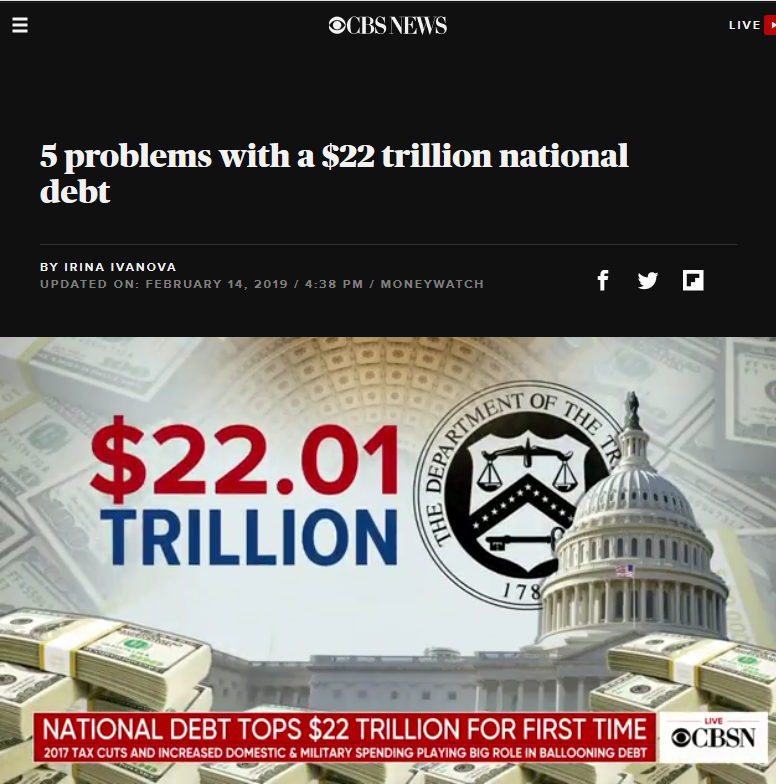
CBS News had a piece warning its audience about the problems of large government debt. It noted projections of rising US government debt, commenting:
The only countries with a higher debt load than the US are Portugal, Italy, Greece and Japan. The first three have become synonymous with profligate spending and economic woes post–Great Recession, while Japan’s “lost decade” of economic stagnation is a mainstay of economic textbooks.
The first three countries are all in the euro zone. They do not have their own currency, but rather must adhere to rules set by the European Central Bank and the European Commission. Their situation is comparable to that of a state in the United States. No one disputes that it would be a big problem for Utah or California to run up very large debts.
Japan is the country most comparable, but the textbooks CBS refers to seem not to be very reliable. According to the IMF, Japan’s per capita GDP has increased by an average rate of 0.9 percent annually between 1990 and 2018; while this is somewhat less than the 1.5 percent rate in the United States, it is hardly a disaster. In addition, average hours per worker fell 15.8 percent in Japan over this period, compared to a decline of just 2.9 percent in the United States.
In spite of having a debt to GDP ratio that is more than twice as large as the US, Japan does not provide evidence to support the warnings CBS gives about large deficits. Its long-term interest rates are near zero, meaning the debt is not crowding out investment. Its interest payments on its debt are roughly 0.5 percent of GDP ($100 billion in the United States), indicating that they are not crowding out other spending priorities. And its inflation rate is just over 1.0 percent, indicating that profligate spending has not led to a problem with inflation.
Dean Baker is a senior economist at the Center for Economic and Policy Research in Washington, DC. A version of this post originally appeared on CEPR’s blog Beat the Press (2/14/19).
Messages to CBS may be sent here (or via Twitter @CBSMoneyWatch). Please remember that respectful communication is the most effective.



A more serious problem than public (government) debt may be private debt. The average credit card debt in this country is over $14,000 for those who owe- and if you include credit card holders (like ourselves) who pay off every month, it is still about $7000. Also student debt, mortgage debt, and a major cause of bankruptcy – debt related to medical issues. On top of that, a feverish prodding to create artificial needs and consumption by big business media has built a nation of debt slaves. Private debt in the US is about twice that of public debt, yet politicians of all stripes never seem to wish to discuss this frankly. Encouraging private debt is the system’s way of forestalling the problem of glut.
Mr. Ecklein, well said! The solution to all of our problems is to research and find a cure for the deadly, communicable disease called: GREED and the LUST FOR POWER. Until a cure is found nothing at all will change. Do what we will as long as there is one quart of oil to pump, one ounce of gold to mine or one poor person with a buck left in his/her pocket the rich man must have it in his/her pocket.This disease I speak of blinds humans to anything but the sight of the Great Almighty American Dollar. Even when the rich man has already gotten 85 billion in the bank and he’s 85 years old, he will still be after that next billion. When the rich man stands at The pearly gates St. Peter tells them the price of admission is to give up their fortune or no entry, they will always choose the option where they get to keep their money, which, of course, is Hell….An excellent book I found is called:The Experience, A Celebration of Being. By Sirio Esteve, Random House 1974. It is available from used book stores for as little as .05 cents + 3.99 mail. I have bought 40 copies to give away. Read the chapter on Slavery First. He sort of sounds like you……
“Private debt in the US is about twice that of public debt, yet politicians of all stripes never seem to wish to discuss this frankly.”
Politicians, most of whom are in the 1 percent economic class, work for the .001 percent.
Private debt fuels wealth accumulation at that top economic hierarchy (via fractional reserve banking & interest).
Fractional reserve banking is sadly about the only way the true ruling elite know how to make money.
We’re at a point where profit for a few can most only come from the debt of many others.
This seems to me the cause of our constant cyclical economic crises.
Private debt goes up to allow the few at the top to accumulate more, the debt eventually becomes unsustainable leading to a crash.
Those at the top are the mainbenefactors of both stages (profiting off the debt of others, then reclaiming assets used to secure that debt after the crash, leading to more wealth concentration by a few),
Consumers are bombarded with constant propaganda encouraging them to buy during that debt stage (via methods like regular consistent iPhone or Android or Windows upgrades, for example).
Politicians don’t discuss it because their handlers (the .001 percent) don’t want them to, as it would open a huge can of worms & lead to concern among the mass of consumers.
For when your entire economy is run like a huge ponzi scheme (money from new “investors”/stakeholders being used to enrich the current), more consumers and greater debt from those consumers is a requirement.
Interestingly, with the current record pace of corporate consolidations (either directly or indirectly, with a few institutional shareholders owning most of the “competing” corporations, in most every single industry, via large stock holdings, and those few institutional shareholders being largely owned by the .001 percent), consumers are essentially buying from the same owning/controlling firms they work for.
Those at the top are “double-dipping”, making profit on both ends.
They’re also now mastering the art of profiting off increasing social-welfare programs (like EBT administration, EBT sales, investments in subsidized housing, etc.), necessary for the increasing number of their workers whom are being paid poverty rates.
Triple-dipping?
It’s neo-feudalism. It’s one of the constructs of the neo-feudal, new American Planned Market Economy (that is, state-capitalism/crony-capitalism for only the .001 percent).
Those at the top, and their political puppets (of ALL parties) won’t bite the hands that continue to feed them their caviar.
Let’s see there is about 60-70 Trillion bucks floating around the world financial markets everyday, The actual US debt is 71 Trillion, 500 billion according to the US debt clock, but this includes Home loans, student debt, car loans, etc. Of course our Fed. Reserve can always print up another ten or twenty trillion Ben Franklin’s and use that to buy up treasury notes like they did to save the banks in 2008-09. Inflation will then cure that debt problem. P.S. A .005 cents tax on all financial transactions would almost do the same thing, but of course you can’t tax the rich, that’s a big no-no…..
I guess I don’t fully understand the context of this article.
That rising U.S. debt isn’t that much of a problem because it isn’t a huge problem for Japan?
Or that CBS News stinks in it’s attempted use of evidence?
For starters, the debt situation between Japan & the U.S. is not as similar as seems to be presented in this article.
Most of Japan’s debt is held by Japanese nationals, thus interest can be held down.
Thus, repayment values stay low relative to the overall debt level.
This isn’t true of the U.S.
It’s the U.S. interest on their debt that becoming a major concern to many.
Yet even in the case of Japan, by 2041, assuming tax revenue remains constant and there won’t be any economic shocks, Japan’s interest repayments will exceed tax income (assuming interest rates stay at 1.1%).
Japanese debt is possibly also one of the main true reasons for increasing tensions with China.
There’s much more detailed info on the debt problems of Japan here:
http://www.eastasiaforum.org/2018/08/06/is-japans-mountain-of-public-debt-a-threat-to-financial-stability/
So, I don’t really understand the purpose of this article.
I’d be careful about using Japan as an example. Its an export country with debts in local savings and a very stable society. I’m not sure others can ride things out like they have.