


Janine Jackson interviewed Sarah Anderson about corporate tax cuts for the September 1, 2017, episode of CounterSpin. This is a lightly edited transcript.
[mp3-jplayer tracks=”CounterSpin Sarah Anderson Interview @https://eadn-wc04-3257648.nxedge.io/audio/counterspin/CounterSpin170901Anderson.mp3″]
Janine Jackson: In some cases, powerful interests are so invested in telling a certain story, tell it so often and so insistently, that you’d be hard-pressed to guess from media coverage that it’s disputed, or simply false.
Such is the case with a certain line about the relationship between corporate taxes and job creation. CEOs complain about the taxes they have to pay, and make claims about what they’d do if they were taxed less. And corporate journalists aren’t generally in the business of challenging CEOs. But are we seeing some fissures in that argument, now that it’s Donald Trump talking about how his plan for a “competitive tax code”—common parlance for cutting corporate taxes—will lead to “millions of people” earning a “big, fat, beautiful paycheck”?
Sarah Anderson directs the Global Economy project at the Institute for Policy Studies, and is a co-editor of the IPS website Inequality.org. She’s also lead author of the annual Executive Excess Reports on CEO pay. She joins us now by phone from Washington, DC. Welcome back to Counterspin, Sarah Anderson.
Sarah Anderson: Thanks so much for having me, Janine.

IPS (8/30/17)
JJ: The claim that media consumers could recite in their sleep is that if you reduce corporate taxes, companies will use that money to invest, to expand and, as a consequence, to hire more workers. Sarah, how did you, at IPS, go about testing that for this new report, and what did you find?
SA: We’re not the first people to look at this question, but we did come up with a new methodology, which is that we looked at the US companies that have already been paying next to nothing in taxes. Our official corporate tax rate is 35 percent, but many companies don’t pay anywhere near that. So we looked at all the ones that paid less than a 20 percent effective tax rate, during the period of 2008 to 2015, that had been profitable every year, so they had no excuse for not paying taxes. And what we found was that these companies had not been using their tax savings to create jobs. In fact, their record on job creation was much worse than private companies throughout the economy as a whole. The tax-dodging companies had median job growth of -1 percent, whereas for the rest of the economy, it was positive 6 percent growth.
And so that was step one in our task, so we looked a little bit further: If they aren’t spending their tax savings to create jobs, where is all of that money going? And, surprise, surprise, we found out that a lot of it was winding up in the pockets of their top executives. The companies that were dodging taxes and slashing jobs were paying their CEOs, on average, about $15 million dollars last year, whereas the average, which is already pretty obscene, for big company CEOs is quite a bit lower, at just $13 million.
JJ: It’s interesting; this report is actually part of the Executive Excess series, so that connection between tax-dodging and CEO pay is really important. Well, what is this stuff about companies buying back their own stock?

Sarah Anderson: “If they aren’t spending their tax savings to create jobs, where is all of that money going? And, surprise, surprise, we found out that a lot of it was winding up in the pockets of their top executives.” (photo: IPS)
SA: That has been a big trend, growing over the last decade, where if companies want to make themselves look stronger without actually becoming stronger, they can take profits and use them to repurchase their own company stock on the open market. You’re reducing the availability of stock, so that drives up their share price. It’s a way to artificially increase the value of your shares. And one thing that it does is it expands the paycheck of the top executives, because most CEO pay these days is in the form of stock-based compensation. So they have a personal, vested interest in spending money on these stock buybacks instead of putting it into things like research and development, or investing in new facilities or technologies that might help create jobs over the long term.
JJ: It seems to me, just going bigger picture, that many people have internalized this idea of “makers and takers,” you know; corporations are the drivers of the economy. It’s as though they’re in charge, so if we just give them what they want, maybe they’ll be nice and they’ll let us have some jobs. It just seems like a weird way for a government, or a society, to think.
SA: And there is just no evidence to back it up. So one thing that is really important to look at is in 2004, the US government offered companies that were stashing their profits overseas, and avoiding US taxes, they allowed them to bring the money back to the US at a 0 percent tax rate. The way it normally is, they don’t have to pay US taxes on these foreign earnings unless they bring the money back here, and then they would pay the full 35 percent tax rate. But in 2004, they decided to give companies an incentive to bring the money back by giving them this 0 percent tax rate. And they were sure, they claimed, that these companies then would create oodles and oodles of new jobs in the US. And instead, the companies that got the most benefit out of this just turned around and cut jobs. So we have the evidence there, that’s just an extreme example, of how companies that got huge tax breaks didn’t create a single job; they cut jobs.
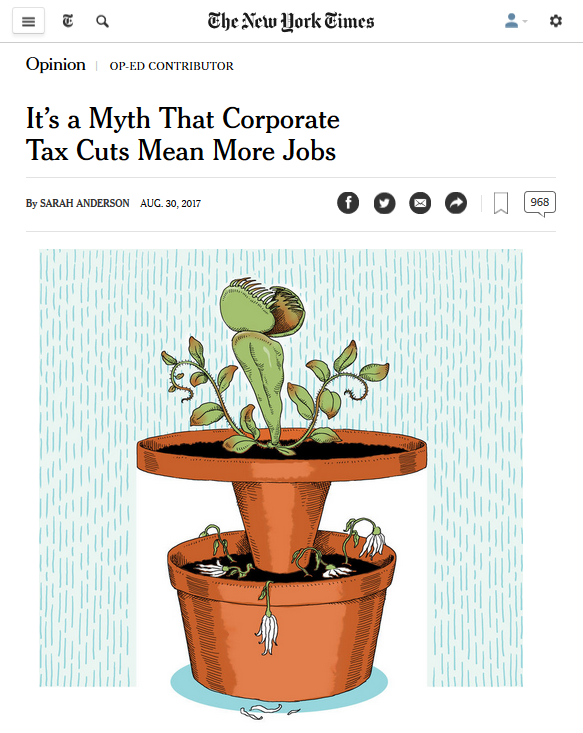
Sarah Anderson’s op-ed in the New York Times (8/30/17)
JJ: And yet we’re hearing those same ideas get circulated again, and we’re supposed to believe them—this time.
You have an op-ed in the New York Times, “It’s a Myth That Corporate Tax Cuts Mean More Jobs,” and it has gotten a really good deal of pickup, which is terrific. But besides hoping to drive a stake into this particular zombie idea, what else would you like to see come out of this moment? Obviously, we’re talking about it because Congress is going to be considering tax policy soon, but you have some other ideas in that piece about things that we might look at doing.
SA: Absolutely, and people really should buckle up and get ready for a very intense fight over taxes. I know that this issue makes a lot of people’s eyes glaze over, but this is a huge and important fight. If the Republicans get their tax plan through, it would mean losing trillions of dollars because of tax breaks for the wealthy and big corporations, and that would just mean huge cutbacks on things that mean a lot to working people, like education and Medicare and so forth.
So this is really important. And what we should be pushing policymakers to focus on is, instead of more tax breaks for people that don’t need them, and companies that don’t need them, we should be focused on closing up the loopholes that have allowed our system to get so perverse and unfair. And one of the big ones is the one that I just mentioned, where companies can stash profits overseas, often in tax havens, and not pay any US taxes on those profits indefinitely. And if we ended that loophole, we could generate enormous amounts of money in a very fair way, that could go for the urgent needs we’re facing in this country, around infrastructure and jobs and so forth.
So that’s one thing we should be looking at, is closing the loopholes. We should also be looking at new forms of taxation that would also make our system more fair. One I love to talk about is putting a tax on Wall Street speculation. So as it is now, when ordinary folks go out and buy something like a winter coat or put gas in their car, they pay a sales tax on that. But these extremely wealthy hedge fund investors and other traders on Wall Street, who are buying millions and millions of dollars worth of stocks and derivatives all day long, they pay no tax on that. Even a very small tax on each trade would add up to a lot for these big high-flyers in the financial system. So we need to be going on offense here, rejecting the false claims that cutting corporate tax rates will create jobs, and really insisting on making the system more fair.
JJ: We’ve been speaking with Sarah Anderson, director of the Global Economy project at the Institute of Policy Studies. They’re online at IPS-dc.org, and that’s where you’ll find the new report, Corporate Tax Cuts Boost CEO Pay, Not Jobs. Sarah Anderson, thank you so much for joining us this week on Counterspin.
SA: My pleasure.



We have known supply side economics was ineffective since before the 1980 presidential election. Reagan’s eight years confirmed our worst fears. But somehow the political right continues to cling to this fantasy.
And as long as those at the top stand to gain from fooling the people with nonsense like “trickle down,” that fantasy will continue.
This is a myopic claim, that others have evaluated before her, which she could have just copied and pasted — and to drive her point home (no doubt, it’s the view she held before she began the article) she could have restricted her focus… to the top 10% (sheer coincidence, that).
http://bit.ly/2wU7U46