

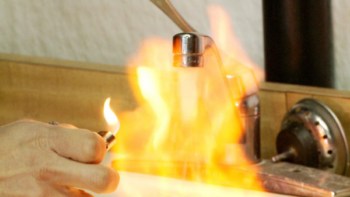
Is your water flammable? Corporate media don’t want you to blame fracking.
A new study shows that gas leaks from wells associated with the controversial drilling technique known as fracking are responsible for water contamination. Over at Think Progress (9/15/14), the study was summarized under the headline “Study Links Water Contamination to Fracking Operations in Texas and Pennsylvania.”
But other media accounts tell a different story–one that seems designed to send the message that fracking isn’t causing these problems.
“Well Leaks, Not Fracking, Are Linked to Fouled Water” was how the New York Times (9/15/14) put it. At the USA Today website (9/15/14): “Study: Faulty Gas Wells, Not Fracking, Pollute Water.”
Confusing, right?
The Times story begins:
A study of tainted drinking water in areas where natural gas is produced from shale shows that the contamination is most likely caused by leaky wells rather than the process of hydraulic fracturing used to release the gas from the rock.
The Times is trying to stress that fracking critics’ claims have been challenged. As the Times‘ Henry Fountain reports, “Some environmental groups have suggested that hydraulic fracturing, or fracking, could cause the gas to migrate into drinking water aquifers.” But this study, it’s explained, says otherwise:
The researchers found no evidence that fractured shale led to water contamination. Instead, they said cement used to seal the outside of the vertical wells, or steel tubing used to line them, was at fault, leading to gas leaking up the wells and into aquifers.
But does this finding justify the “don’t blame fracking” headlines? It’s hard to follow the logic. These wells exist only because of fracking. If polluted water is linked with the fracking wells and not the actual cracks in the earth caused by fracking, that’s important to know. But it still seems clear that fracking is to blame.
It’s not like critics of fracking were previously unfamiliar with the dangers of faulty casings. In 2011, CNN (5/10/11) reported on a Duke University study that found high levels of methane in drinking wells near natural gas wells, and noted that study author Robert Jackson suspected faulty casings were involved. But that didn’t mean fracking was off the hook:
The gas, which is usually located thousands of feet below the water table, appears to be entering the water wells either through cracks in the bedrock or, more likely, the casing in natural gas wells, said Jackson. Casings are steel and concrete barriers natural gas companies use to line a well where it passes through the water table.
Jackson suspects hydraulic fracturing may be to blame…. Jackson thinks the sand and high pressure used in the fracking process may be weakening the well’s casing, allowing the gas to seep out.
The environmentalist Desmog Blog (5/10/11) cited CNN‘s report under the headline “Scientists Confirm Fracking Link to Flammable Drinking Water.”
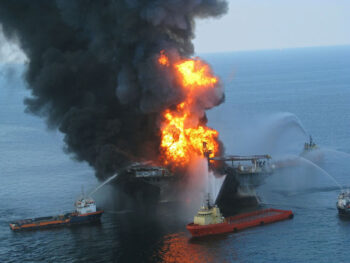
The Deepwater Horizon spill: not a disaster involving offshore drilling, just a cement issue? (photo: US Coast Guard)
Problems with well cement were also involved in the greatest single oil disaster in US history; as the Times notes, “The BP oil spill in the Gulf of Mexico four years ago was related in part to problems with cement that was supposed to act as a gas barrier in the well.” So would anyone say the BP disaster is not really about undersea oil drilling? I don’t think so. But in this case, readers are told that it’s not fracking’s fault that faulty fracking wells are polluting your drinking water.
The Washington Post did a better job with its headline (9/15/14): “Study: Bad Fracking Techniques Let Methane Flow Into Drinking Water.” And then there’s the larger issue of fracking-linked water pollution. As Katie Valentine of Think Progress pointed out:
But anti-fracking activists say that cementing and casing are only part of fracking’s contamination problem. For one, there’s the issue of fracking waste: In 2012 alone, fracking wells in the US created 280 billion gallons of toxic wastewater, according to a 2013 report from Environment America. That wastewater often contains carcinogens and even radioactive materials, and the deep pits that the wastewater gets stored in are not foolproof. In New Mexico alone, the report states, chemicals from oil and gas waste pits have contaminated water sources at least 421 times.
And whether it’s the act of drilling itself or failures in casing or waste storage, contamination from fracking operations is a major problem in natural gas-heavy parts of the country. Last month, Pennsylvania made 243 cases of contamination of private drinking wells from oil and gas drilling operations public for the first time. West Virginia, too, has linked cases of well water contamination to oil and gas drilling. And this month, researchers at the University of Texas found that levels of arsenic, selenium and strontium were higher than the EPA’s limits in some private wells located within about 1.8 miles of natural gas wells.
Not exactly the picture you get from the don’t-blame-fracking coverage in the New York Times and USA Today.



But does this finding justify the “don’t blame fracking” headlines? No
It’s the same ‘twisted logic’ that the uber-right have tried to use for years with Guns (Yes, it is the people who pull the trigger, on the other hand, it isn’t the person who took the piece of shaped lead and tossed with sufficient force to kill another person) or drunk Drivers (it wasn’t the drivers fault, he was just having a party). But, your not going to have advertisers pay you billions in advert money if you blame them (even when it is their fault) for screwing up the water.
In all honesty, the real culprit of all this is neither the “Fracking” nor the “Faulty Well” per se, as neither happened by accident, or is a work of nature. It was the greed of Big Oil, wanting more and more, Faster and Faster at any cost, even your life, who used the cheapest materials and did as fast as possible, hoping that by the time everyone figured out what was happening, they would be gone and done, counting their Trillions in profit while the rest of us count our dead and dying.
Not “confusing.”
HOW MANY TIMES do we have to tell them
it’s not the “fugitive methane contamination”
itself that is a problem, but the fact that:
If methane can leak around and infuse the water,
SO CAN -ALL- THE CHEMICALS IN THE PROCESS-
frack fluid, disturbed deep radioactives, heavy metals, etc.
A PATH IS A PATH !
Especially when purposely opened by explosions
and propped open by ‘proppants’-
AND WILL BE TAKEN EVENTUALLY
BY ALL THOSE TOXIC CHEMICALS,
ESPECIALLY AT FRACKING’S TWENTY THOUSAND P.S.I. !
They are left down there FOREVER to find those paths,
not just for the 18 months in the study!
I thought the “wells” in the Times article were the drinking water wells that are contaminated. That is, I thought they were saying that if the wells were better lined, then the drinking water would be ok, because fracking isn’t actually contaminating the aquifer.
(I am not arguing the merits of this; I’m just saying your critique may be based on misreading the article.)
@David G. No sir, the article is pretty clear about the wells they are speaking of:
Well integrity is a widespread problem in the oil and gas industry, with one often-quoted statistic suggesting that 15 percent of all cement sealing of wells may be imperfect, said Scott Anderson, who studies energy production issues for the Environmental Defense Fund. The BP oil spill in the Gulf of Mexico four years ago was related in part to problems with cement that was supposed to act as a gas barrier in the well.
Mr. Anderson said there were many steps that producers could take to eliminate leaks, including basic ones like making sure the proper cement or steel tubing was used, and monitoring pressures both during well construction and later while gas is flowing. Companies should also be more aware of any gas pockets in the formations they are drilling through, he said.
So if you read the article, this should make it clear they are referring to the wells drilled in order to commit the Frac’ ing Process.
@Padremellyrn: You’re right. I read the article in the print edition a few days ago, and now that I reread it on-line I see I misunderstood. It’s confusingly written, though, since it talks about drinking-water “wells” as well as gas-drilling “wells”, and sometimes just refers to “wells”, leaving it to dim readers such as I to get it wrong.
In my defense, the reason I misread it was precisely for the reason FAIR finds fault with it: it didn’t make sense to me that the article would hold fracking blameless for contaminating drinking water, while also saying that fracking wells were a source of the problem. But apparently that is the weird case it is trying to make.
Thanks for pointing out my error, Padremellyrn.
I suppose that all the earthquake swarms reported in association with fracking have been caused by faulty cement too?
Are they seriously trying to mince words on this issue?! I’m highly offended that they think we’re that stupid.
@DavidG – FAIR article, paragraph 4: “Confusing, right?”
It seems you agree with FAIR that it is indeed quite confusing. Which is the point FAIR is making; that pro-industry outlets like USA Today and NYT are *intentionally* trying to confuse readers in order to muddy the waters. (or in this case, contaminate the waters). ;)