

This piece originally appeared at Let’s Try Democracy (10/27/16).

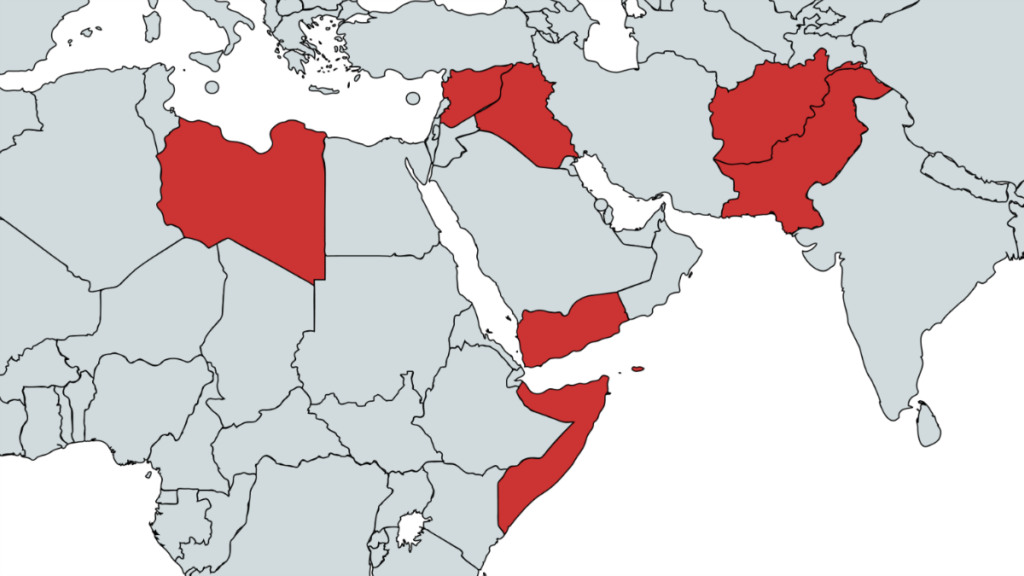
US wars in these countries over the last 15 years haven’t left Americans feeling safer. (image: mapchart)
A new poll from an unlikely source suggests that the US public and the US media have very little in common when it comes to matters of war and peace.
This poll was commissioned by that notorious left-wing hotbed of peaceniks, the Charles Koch Institute, along with the Center for the National Interest (previously the Nixon Center, and before that the humorously named Nixon Center for Peace and Freedom). The poll was conducted by Survey Sampling International.
They polled 1,000 registered voters from across the US and across the political spectrum, but slanted slightly toward older age groups. They asked:
Over the last 15 years, do you think US foreign policy has made Americans more or less safe?
What, dear reader, do you say?
If you say less safe, you not only agree with dozens of top US officials the week after they retire, but you agree with 53 of the people polled. Those who said “more safe” add up to 14 percent, while 25 percent said “about the same” and 8 percent just didn’t know.
Well, at least all these humanitarian wars to spread democracy and eliminate weapons and destroy terror have benefited the rest of the world, right?
Not according to the statistics that show terrorism on the rise during the war on terrorism, and not according to 51 percent of poll respondents who said US foreign policy has made the world less safe. Meanwhile, 13 percent said “more safe,” while 24 percent said it was about the same and 13 percent didn’t know.
Asked about four wars in particular, registered US voters said each of them had made the US less secure, by a margin of 50 percent to 21 percent on Iraq, 42 percent to 19 percent on Libya, 42 percent to 24 percent on Afghanistan, and 41 percent to 32 percent on bombing ISIS in Syria.
These answers should not immediately be taken to prove that the US public is universally wise and well-informed and (not coincidentally) at odds with US media. Not only is that margin pretty slim on ISIS, but 43 percent of those polled said ISIS was the greatest threat the United States faces. Meanwhile 14 percent named Russia, 9 percent North Korea, 8 percent the national debt, 8 percent domestic terrorists, and bringing up the rear with the correct answer of global warming as the greatest threat were a grand total of 5 percent of those polled.
A survey of US news reports would certainly suggest a point of agreement here between the public and the media. But here is where it gets interesting. Although the public believes the hype about danger emanating from these foreign forces, it does not favor the solution it is endlessly offered by the media and the US government. When asked if, compared to last 15 years, the next president should use the US military abroad less, 51 percent agreed, while 24 percent said it should be used more. And 80 percent said that any president should be required to get congressional authorization before committing the US to military action, while 10 percent rejected that radical idea that’s been in the US Constitution since day 1.
The US public may look quite depressingly ignorant in a quick survey of YouTube videos, but check this out: Asked if the US government should deploy US troops on the ground in Syria, 51 percent said no, compared to 24 percent who said yes. Only 10 percent said yes on Yemen, while 23 percent said no; however, 41 percent said the US government should keep “supporting” Saudi Arabia in that war.
Good majorities also oppose Japan acquiring nuclear weapons, Germany acquiring nuclear weapons or the US defending Taiwan against a Chinese attack. (Who invents these scenarios?)
This moderately encouraging survey of public sentiment stands in stark contrast to US media coverage of wars in general and Syria in particular. The New York Times’ Nicholas Kristof is ready for a bigger war, as are columnists in the Washington Post and USA Today, as well as, of course, Chuck Todd and other televised talking heads. Meanwhile, Hillary Clinton’s comment to Goldman Sachs that a “no-fly zone” would require “killing a lot of Syrians” has received dramatically less press than her brave calls for creating a humanitarian no-fly zone, and the steady depiction of that proposal as “doing something”—in contrast to the only other option: “doing nothing.”
The public, however, rejects the only “something” that’s on offer, and just might leap at the opportunity to try something else, if anyone ever proposed anything else.
David Swanson is an author, activist, journalist and radio host. He is director of WorldBeyondWar.org and campaign coordinator for RootsAction.org. Swanson’s books include War Is A Lie. He blogs at DavidSwanson.org and WarIsACrime.org. He hosts Talk Nation Radio. You can follow him on Twitter (@davidcnswanson) and FaceBook.



http://nymag.com/daily/intelligencer/2016/10/clinton-adviser-lets-attack-iran-to-aid-saudis-in-yemen.html
Neocon irrationality is behind the loss of trust.
When the Nobel Peace Prize laureate President, Hope and Change Obama, goes on a seven year killing spree, while Congress complacently continues to vote funds for these illegal adventures and none of the candidates for President in either of the two official, corporate, parties, even questions this “legacy” or promises to investigate the war crimes committed by this and the previous administration, the utility of public opinion polls in the “democratic process” eludes me.
I learned the history of Vietnam, in 1965, at a Teach-In at City College, San Francisco; while it didn’t keep me out of the draft and out of the Army, I knew, intellectually, that it was a war of imperialism and that the only reason we didn’t allow the reunification of the country in 1956, per the 1954 Geneva Accords, was due to our certainty that the far and away most popular person was Ho Chi Minh and we weren’t going to allow fair and free elections if THAT was going to be the result.
Where are the Teach-Ins for Libya, Syria, North Korea, Yemen, Eritrea, etc.?
Whether the fault for our current situation is due more to the overall ignorance of the public or the machinations of the upper class and its power elite is academic. We are Imperial Rome, reborn, but with nuclear weapons; our bread and circuses are provided by TV, smartphones, computers and video games. The silence of academia, the religious community and the legal profession is deafening.
As Walt Kelly wrote, years ago, “We have met the enemy and he is us.”
I think you missed a word in the 5th paragraph. ’53 percent of the people polled’ not ’53 of the people polled’, i imagine it ought to read.
So why do they go on with this state of permanent wars? Simple, plain old imperialism to grab natural resources on foreign lands to satisfy an ever growing and wasteful demand!
I would really love to speak my mind regarding such an inane question as “Are wars good for us?”
Hominoids may have an impressive intuitive toolkit but beneath the skin they are murderers, liars and thieves. How’s that?