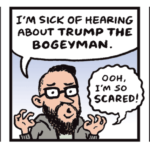
Trump Briefings? News. Biden Briefings? Not News.
Nowadays, corporate media would have you believe they are appalled by Donald Trump: They had to cover the liar and cheat because he was president, but they held their nose the whole time, and now they can’t wait to get back to serious reporting on policy.
The only trouble is, if you have a memory longer than a minute, you’ll recall that CBS head Les Moonves (Extra!, 4/16) declared flatly that the ad money and ratings Trump brought the network mattered much more than any harm giving him a platform might incur. “It’s a terrible thing to say. But bring it on, Donald. Keep going.” Or maybe you remember the time that CNN, Fox and MSNBC (FAIR.org, 3/16/16) all aired an empty podium where Trump was scheduled to speak instead of Bernie Sanders actually speaking.
Or maybe you’re just paying attention. As Press Run critic Eric Boehlert (2/22/21) noted, just a month into Joe Biden’s term, CNN unceremoniously stopped airing daily White House press briefings. They didn’t cover Barack Obama’s much; in the last six months of his presidency, just 3% of daily briefings aired live (Media Matters, 5/30/17). But in early 2017, the DC press corps collectively decided that every Trump utterance had to be broadcast live, even if the briefings were “built on deceits [and] designed to foil honest inquiries,” as Boehlert said. So the upshot: Obama briefings? Not news. Trump briefings? Always news. Biden briefings? Not news again.
Whatever you make of the fact that a news network’s rule of “Everybody stop what you’re doing, the White House is about to make a statement!” only seemed to hold when they could expect that statement to be akin to a flaming car wreck…just remember that those are the “journalistic” criteria they’re working with all the time.
Heroes and Villains
Eager to find Republican heroes to help prove that their own escalating criticism of Trump wasn’t partisan, corporate media fawned over Georgia Secretary of State Brad Raffensperger, who jumped on the Trump bandwagon early and was only kicked off it when he rebuffed Trump’s infamous demand to “find” 11,780 votes in order to overturn the state’s election result. Reuters (1/3/21) emphasized his “reputation as a ‘straight shooter,’” while New York Times columnist Maureen Dowd called him “brave” (2/12/21). Mika Brzezinski (MSNBC, 1/4/21) raved, “He’ll end up being the American hero out of all of this, and that’s amazing, and he’s amazing.”
But while Raffensperger rejected Trump’s Big Lie, his support of the little lies of ongoing electoral fraud helped make the Big Lie possible. Raffensberger repeatedly suggested that he was investigating “over 250” election fraud cases related to the presidential election. In fact, according to the Atlanta Journal-Constitution (12/17/20), there were only 132, and the vast majority concerned procedural errors rather than claims of fraud.
Raffensperger also launched vote fraud investigations into four progressive voter registration groups, including Abrams’ New Georgia Project (AJC, 11/30/20). And he oversaw the illegal purge of 198,000 voters—mostly people of color—from the Georgia voting rolls before the 2020 election (Democracy Now!, 1/5/21).
Sure, media will fret about voter suppression as Republican-held states around the country drastically curtail voting rights. But their own credulous coverage of vote fraud claims, which went on for decades (Extra!, 11–12/08, 10/12), and their willingness to lionize purveyors of those lies to this day, have played no small role in allowing it to happen.
Power Analysis Failure
Texans have paid a steep price, not just in electric bills, but in suffering and lives lost, as a direct conse-quence of the market dogmatism that undergirds their energy system. But the way the New York Times covered the crisis obscured rather than illuminated that.
FAIR looked at 45 articles the Times posted from February 15 to February 23. Articles on the crisis that detailed the suffering and losses avoided analysis of the causes, and articles explaining the systemic failure didn’t delve into the human cost—and tended to exculpate energy companies and their allies in the Texas government.
For instance, it was not until a week after the storm that the New York Times (2/21/21) ran a piece on the grid failure itself, “How Texas’ Drive for Energy Independence Set It Up for Disaster,” wherein “energy independence” should really be spelled “market fundamentalism.” The piece traced the current problems back to the 1999 decision to radically deregulate the Texas energy market: “The energy industry wanted it. The people wanted it. Both parties supported it,” the Times said about that decision. It said that the “prediction of lower-cost power generally came true.”
Only it’s not true. A Wall Street Journal investigation (2/24/21) demonstrated that deregulation raised prices, not lowered them—by $28 billion.
Do Words Matter to NYT?
The New York Times (2/24/21) published an article about how “words matter,” explaining how Joe Biden is reviving words censored by the Trump administration (such as “LGBTQ” and “climate change”) and changing others (like from “illegal alien” to “noncitizen”). The piece noted that language has “symbolic power” and “can help usher in new policies.” So surely the paper ought to think twice about characterizing—in the very same article!—the Center for Immigration Studies, founded by a white nationalist (FAIR.org, 9/4/15) and named by the Southern Poverty Law Center as a hate group, with the anodyne language “which favors limits on immigration.”
Bad Countries Ban Media Outlets;
Good Countries Have ‘Licences Withdrawn’
“BBC News Banned in China, One Week After CGTN’s License Withdrawn in the UK”
—CNN headline (2/14/21)