

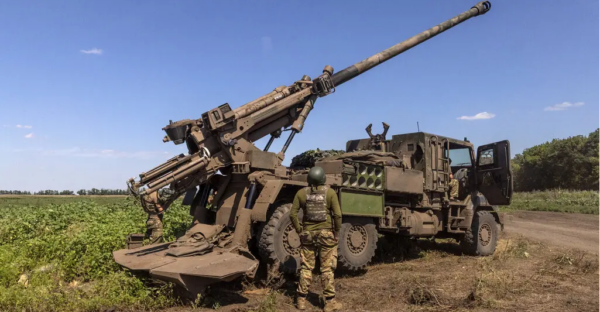
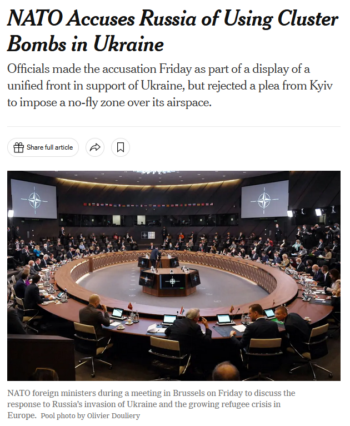
Before the US started sending cluster bombs to Ukraine, the use of such weapons was seen by the New York Times (3/5/22) as something you would “accuse” another country of doing.
For the New York Times news department, cluster munitions fall into two categories—clearly wrong or complexly controversial—depending on who uses them.
There was no ambiguity when Russia apparently started using cluster weapons during the invasion of Ukraine. Five days after the invasion began, the Times (3/1/22) front-paged a story that described them in the second paragraph as “internationally banned” and went on to report:
Neither Russia nor Ukraine is a member of the treaty that bans cluster munitions, which can be a variety of weapons—rockets, bombs, missiles and artillery projectiles—that disperse lethal bomblets in midair over a wide area, hitting military targets and civilians alike.
Given that the Times is a US-based outlet, the long article unduly detoured around some basic facts—notably, that the United States is also not “a member of the treaty that bans cluster munitions.” And the 1,570-word piece failed to mention anything about the US military’s firing of cluster munitions during its own invasions and other military interventions, including Yugoslavia in 1999, Afghanistan in 2001 and Iraq in 2003. The Congressional Research Service has noted that “US and British forces used almost 13,000 cluster munitions containing an estimated 1.8 to 2 million submunitions during the first three weeks of combat in Iraq in 2003.”
When the Times (3/5/22) followed up a few days later with a piece headlined “NATO Accuses Russia of Using Cluster Bombs in Ukraine,” the ostensible paper of record still did not mention Washington’s refusal to sign the treaty banning cluster munitions. As for US use of those weapons, the piece buried a single sentence with a deficient summary at the end of the 24-paragraph article, telling readers:
NATO forces used cluster bombs during the Kosovo war in 1999, and the United States dropped more than 1,000 cluster bombs in Afghanistan from October 2001 to March 2002, according to a Human Rights Watch report.
The Pentagon’s massive use of cluster munitions during the invasion of Iraq went unmentioned. So did a Tomahawk missile attack with a cluster bomb, launched from a US Navy warship, that killed 14 women and 21 children in Yemen a week before Christmas in 2009.
A ‘most vexing question’
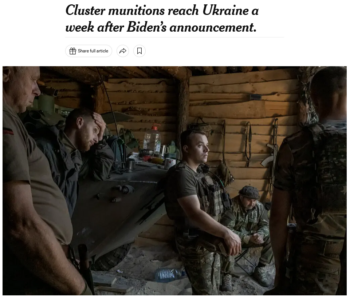
Based on its url, the original headline of this July 14 New York Times story was “Widely Banned Cluster Munitions From the US Arrive in Ukraine.”
Appropriately, the New York Times reporting on Russia’s use of cluster munitions was unequivocally negative in tone and content, devoid of justifications or rationales. But when President Joe Biden decided in early July of this year that the United States should supply cluster munitions to Ukraine, it was a different story. A frequent theme was the urgent need to replenish dwindling Ukrainian supplies of weaponry, while the United States possessed enormous quantities of cluster munitions.
In some coverage—“Here’s What Cluster Munitions Do and Why They Are So Controversial” (7/6/23), “Democrats Denounce Biden’s Decision to Send Ukraine Cluster Munitions” (7/7/23) and “Cluster Weapons US Is Sending Ukraine Often Fail to Detonate” (7/7/23)—Times reporting explained that those weapons are especially inhumane time bombs. Their shrapnel tears into the bodies of civilians who encounter duds that explode months or years later.
But such concerns were soon overshadowed by emphasis on a knotty American dilemma, which the Times (7/11/23) described as “vexing.” For months, the newspaper explained in a written introduction to its Daily podcast:
President Biden has been wrestling with one of the most vexing questions in the war in Ukraine: whether to risk letting Ukrainian forces run out of artillery rounds they desperately need to fight Russia, or agree to ship them cluster munitions — widely banned weapons known to cause grievous injury to civilians, especially children.
Shift to ‘impact on battlefield’
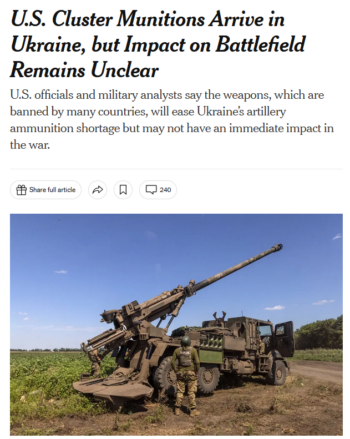
The New York Times (7/14/23) reports that the effect of arming Ukraine with cluster bombs will be “modest,” but will “make the Ukrainian artillery a little more lethal.”
As the reportorial focus shifted, military concerns became dominant. “US Cluster Munitions Arrive in Ukraine, but Impact on Battlefield Remains Unclear” (7/14/23) was the headline over a story that fretted about insufficient impact:
US officials and military analysts warn that American-made cluster munitions probably will not immediately help Ukraine in its flagging counteroffensive against Russian defenses as hundreds of thousands of the weapons arrived in the country from US military depots in Europe, according to Pentagon officials.
From there, the Times tracked the progress and potential effectiveness of the newly shipped US weaponry, with stories like “Cluster Munitions Reach Ukraine a Week After Biden’s Announcement” (7/14/23), “Ukraine Starts Using American-Made Cluster Munitions in Its Counteroffensive, US Officials Say” (7/20/23) and “Ukrainians Embrace Cluster Munitions, but Are They Helping?” (9/7/23).
Notably absent from the newspaper’s coverage of US cluster munitions were names or photos of anyone who’d been maimed or killed by them—except for a long piece about US servicemembers who were accidental victims of those US weapons in Iraq, “Three American Lives Forever Changed by a Weapon Now Being Sent to Ukraine” (9/3/23).
As for the Iraqi lives forever changed by those weapons, there was no space for their names or pictures. In fact, Iraqi victims weren’t mentioned at all.
ACTION ALERT: You can send a message to the New York Times at letters@nytimes.com (Twitter: @NYTimes). Please remember that respectful communication is the most effective. Feel free to leave a copy of your communication in the comments thread.




It has long seemed odd to me that there is little or no stigma attached to people who work in the weapons industries, even though those workers are often well aware of the enormous and long-lasting harms that their daily job creates. Those many people who self-righteously excoriate others who cause harm – such as sex offenders or drugs dealers – appear entirely comfortable that middle-class Americans, well-respected in their communities, are every working day being paid well to help kill and maim children, women and men. But of course, the reason is that those victims aren’t Americans.
https://www.theguardian.com/world/2018/aug/19/us-supplied-bomb-that-killed-40-children-school-bus-yemen
https://www.middleeasteye.net/news/made-britain-tested-yemenis-reality-working-bombmakers
What? So sex offenders, drugs dealers, rapists, etc, equate to people that work for defense and weapons industries ?? You left out people who served in the armed forces. Not buying what your selling. Sometimes there is just no reasoning with levels of ignorance that occasionally present themselves on FAIR.
We blame weapon manufacturers for selling guns used in school shootings.
You were serving the corporate class of the USA, not its working class. The USA’s horrific history of invading, bombing and devastating much poorer nations has no justification whatsoever, which you attempt to do. The recent catastrophe of a broken dam in Libya is a direct consequence of the imperialist, US-dominated NATO bombing of that country in 2011.
Weapons workers themselves know their job means more children will be killed or maimed. There ought to just as much stigma for building these devices as for directly assaulting children. Are you seriously justifying the manufacture and use of cluster bombs which will, for possibly decades, be destroying Ukrainian children?
Take the words of men who laboured to build the weapons used against Yemeni children: “”It’s really weird and there is no way to describe it, because you are in essence building a weapon of mass destruction.”
So why don’t they quit? “Good pay and job security,” Jack responds, taking another sip of his beer. “If the military contracts go, 7,000 people go with them.”
Jack is like thousands of others who works at the BAE Systems factory in nearby Samlesbury, outside Preston in Lancashire, making parts that will be assembled in nearby Warton to create Typhoons, the most advanced jet fighters operated by the Saudis over Yemen.
There, the Saudis have contributed to a civil war with the most terrible violence: bombing civilians, blowing up hospitals and imposing a siege that has condemned millions of Yemenis to slow starvation and poverty.
And Britain, in its wisdom, has sold the Saudis the hardware to do it. Since the war began in 2015, the UK has approved arms sales to Riyadh worth more than $3.3bn. Many of those weapons have come from BAE factories like Samlesbury, built by workers like Jack.”
https://www.middleeasteye.net/news/made-britain-tested-yemenis-reality-working-bombmakers
Wow, left to their own devices folks like Rebecca would have us dealing with people like Stalin running the world. One always needs to review the alternatives and its funny how dogmatic ideologues seem to leave out the death and destruction people that Putin is causing currently with his invasion. I have never read her call out the Iranian religious autocrats / mullahs who killed thousands of female citizens just last year after Mahsa Amini had been charged (then killed) with not wearing a hijab, properly. According to several Middle East media outlets, the country’s so-called morality police are back at it again currently, as Iranian protests (and the round ups occur) spread once again. Very, very selective criticisms beyond her own ideology.
Great story Norm, andi h needed.
Who invaded whom? Ukrainians are defending their lives against an unprovoked invasion. They need all available forms of defense.