

New York City’s 2016 budget proposed by Mayor Bill de Blasio on Tuesday called for $3.2 million for the NYPD to fight “frivolous lawsuits.” Exhibit A as to why these additional funds were needed was a case of cartoon tort abuse that was reported by the Rupert Murdoch–owned New York Post (1/29/15)—and since repeated uncritically in several other outlets, including the New York Observer (1/29/15):
De Blasio Promises Policy Change After ‘Wrong’ Machete Settlement
Mayor Bill de Blasio promised to stop settling “frivolous” lawsuits with the NYPD after the city paid out $5,000 to a man shot by cops while threatening them with a machete.
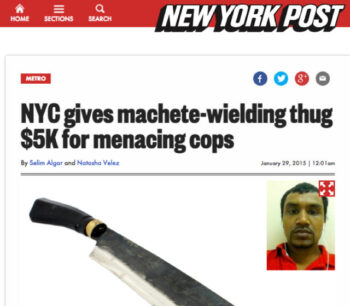 The Post‘s Selim Algar and Natasha Velez originally described the case :
Ruhim Ullah, 24, had pleaded guilty to menacing a police officer after the 2010 confrontation, in which he was shot once in the leg by a cop trying to stop him from attacking officers with the machete, according to his lawyer.
Despite his admission of guilt, Ullah still filed a $3 million lawsuit, accusing the officers of wrongdoing. But despite witnesses who described him as armed, the city offered a $5,000 settlement to get rid of the flimsy suit, despite the message their action sends—that crime, and potentially deadly force against cops, can pay.
It was the NYPD’s very own “Hot Coffee” case—a sign of a supposedly hyper-litigious system spiraling out of control. A “machete-wielding mad man” attacks the cops, gets shot in the leg, and then sues the NYPD for damages.
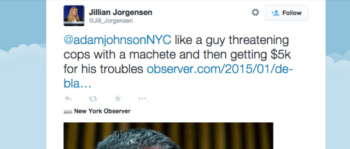 For city officials — and their loyal local press — it was a perfect example of why the NYPD needed an additional $3.2 million. When New York Observer senior political editor Jillian Jorgensen needed an illustration of a frivolous lawsuit, she could tweet: “like a guy threatening cops with a machete and then getting $5k for his troubles.”
But there’s a problem: One of the key details of the report—that even Ullah’s lawyer agreed the shooting was justified — appears to have been made up out of whole cloth. The Post would claim:
After the payout, even Ullah’s lawyer admitted he thought the officer may have done the right thing. “This may have been a justified shooting,” said attorney Scott Cerbin.
I reached out to Cerbin, a Brooklyn lawyer who was more than happy to correct the record: “I’m glad you called…. I don’t know where Selim [Algar] got the idea that I thought the shooting was justified. I never said that to him.”
I asked, “So, did he just made it up?”
“Yes, he just made it up.”
And this is just one of many parts of the New York Post report that are either misleading or factually incorrect. Court documents from Rahim Ullah’s civilian and criminal case provided by Cerbin paint the picture of a mentally unstable man and an incident full of much uncertainty. The Post would claim that Ullah
was shot once in the leg by a cop trying to stop him from attacking officers with the machete, according to his lawyer.
But this isn’t what Cerbin said, he explained:
Every witness to the incident claims the knife had been set down by Mr. Ullah before the police shot him. Because they were friends and relatives of Mr. Ullah, they were not considered “independent” witnesses, but that Mr. Ullah was “attacking” the officers is not something I ever claimed or believe to be true.
Whether or not Rahim Ullah was “attacking” the police officers in question is uncertain, but what appears to be certain is that the Post has put words in Ullah’s lawyer’s mouth to bolster its narrative. Cerbin insists he never depicted the incident this way, and has no idea where the Post‘s Algar is getting these quotes from.
Another important fact that’s overlooked, Cerbin said, is that a defendant pleading guilty to a crime—in this case “menacing a police officer”—is entirely separate from whether the police used excessive force in their apprehension. There exists a division between the two, he insisted over email, for a very good reason:
I think it was a reasonable strategy by defense counsel to avoid a trial and potentially lengthy prison sentence. I would also note that an excessive force claim against the police survives a guilty plea. In other words, his plea of guilty to menacing had no legal effect on his claim for excessive force against the police. The Post article completely ignores this fact.
That Ullah was acting erratically and could have, in some eventuality, posed a threat to the NYPD officers does not in itself justify shooting—and potentially killing—the subject in question. This is especially the case if Ullah’s claim that he had surrendered the knife is indeed accurate. This is why the guilty plea—which Cerbin says was offered to get a reduced sentence in the Kings County Mental Health Court — is not, in and of itself, a concession that the police officer’s actions were justified.
All of this was either left out or distorted by the New York Post, and thus all subsequent coverage of the case. While these new facts don’t necessarily disprove the claim that Ullah’s suit was “frivolous”—an inherently subjective question—they do show that the Post‘s telling of the story left the reader wildly misinformed on a politically potent story.
I reached out to the article’s co-author Natasha Velez on Twitter. (The New York Post does not list emails of its writers.) She has not returned my inquiry.
As for the Post‘s Algar, he has a dicey record on embellishing key facts. The New York Times was forced to issue an unusually long correction in 2005 after it ran Algar’s article falsely accusing four Turkish men of an assortment of charges that had already been dropped by the police. As Gawker (2/10/05) explained at the time:
NYT: One or Two (or Three) Little Mistakes
A reader just called our attention to the best correction ever in Sunday’s New York Times, for an article by Selim Algar that ran January 30 in the paper’s Long Island section. The correction comes in at 933 words, making it almost half the length of the original article and longer than just about anything we’ve ever written.
The New York Times‘ correction explained:
The article also reported incorrectly that the four men—Turhan Ak, Sukru Akkaya, Mustafa Catalbas and Ahmet Cayan—had been charged with evading taxes and bootlegging gasoline. It also implied incorrectly that they were charged with smuggling illegal aliens into the United States. The Times article contained a number of errors and was marred by journalistic lapses. The most serious lapse was the failure of the newspaper to contact the four men or their lawyers.
In the case of Rahim Ullah, Algar may have done one better. While he did bother to reach out to Cerbin, Ullah’s lawyer, according to Cerbin he would go on to invent quotes attributed to him out of thin air.
Algar—and the New York Post in general—have a record of reducing those on the “wrong side” of law enforcement to two-dimensional “thugs” in urgent need of our disdain. That they would do so to help their ideological confederates in the NYPD push through additional funds is predictable. That they go one step further and make up quotes out of whole cloth is a new low even for the long-discredited tabloid.
Adam Johnson is a freelance journalist; formerly he was a founder of the hardware startup Brightbox. You can follow him on Twitter at @adamjohnsonnyc. A version of this post appeared on his blog Citations Needed (2/12/15).



Taking a hatchet to the facts
Make that a machete
Great post. Thanks, Adam.
As repugnant a concept as it might be, the use of criminal libel against these liars would brighten this civil libertarian’s day.
I like this guy
Rupert Murdoch, making the planet a worse place for humankind his entire life.
~
Reminds me of the Saturday Night Live skit they do periodically, of a Fox broadcast where they have to scroll a long list of corrections every time they go to a commercial break. If you pause it, they’re hilarious. But this is supposed to be real news…
Nice Post.We are also in same field.For more information contact us at our website.http://bit.ly/1JG8EwU