


 Throughout this election cycle, FAIR has documented how corporate media view it as their mission to protect the status quo and corporate profits by lauding centrist and right-wing Democrats like Joe Biden, as well as serving as an anti-Bernie Sanders attack machine. It seems the latest tactic in corporate media’s crusade to undermine the Sanders campaign—and the progressive movement supporting him—is to bleed them dry with disingenuous “factchecks,” serving as a form of death by a thousand nuances.
At the start of the Democratic primaries, the Sanders campaign utilized Biden’s long history of supporting cuts to popular entitlement programs like Medicare and Social Security to devastating effect, so it’s no surprise that corporate media worked overtime to nullify one of the Sanders campaign’s strongest arguments. On the campaign trail and in the latest CNN debate, Biden himself used these corporate media “factchecks” to discredit Sanders’ accurate attacks on his record:
My Lord, Bernie. You’re running an ad saying I’m opposed to Social Security that PolitiFact said is a flat lie and that the Washington Post said is a flat lie.
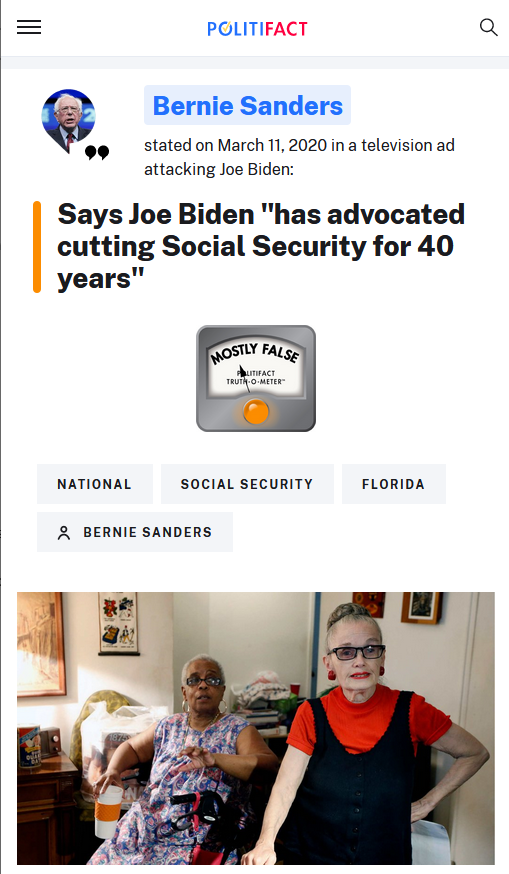
PolitiFact stands out for its extreme parsing of details to distort reality. Before the March 15 debate, Politifact (3/12/20) rated Sanders’ claim that Biden “has supported cutting Social Security for 40 years” as “Mostly False,” because the “record is much more nuanced than that,” stating that it’s more accurate to describe Biden’s position as having “changed over time.”
As part of its denial of Sanders’ claim, Politifact itself listed numerous instances in the past 40 years when Biden has advocated cuts to Social Security:
- “In 1984, Biden co-sponsored a proposal with two GOP senators to broadly freeze federal spending. The proposal would have meant no Social Security cost-of-living adjustments for one year.”
- “In 1996, Biden suggested cutting the cost-of-living adjustment by one percentage point.”
- “When he ran for president in 2007, in an interview with NBC, Biden said the retirement age and cost-of-living adjustments had to ‘be on the table’ in negotiations on stabilizing Social Security.”
Politifact seemed to be disputing Sanders’ claim because it doesn’t reflect Biden’s current position, as though there would be any point running ads pointing out Biden’s former stances on Social Security if they weren’t inconsistent with what he espouses now.
Politifact’s rating also neglects how language is conventionally used. For example, no one would find it unreasonable for me to claim that I lived at a certain address for ten years, even if I also spent several weeks away from home on vacation at multiple points during that time period. Likewise, just because Biden frequently changes his positions, and has occasionally expressed opposition to cutting a highly popular social program when it suited him, doesn’t mean that a “plain reading” of Sanders’ claim about Biden having supported Social Security cuts over 40 years isn’t true.
After the CNN debate, Politifact continued its role as a PR surrogate for the Biden campaign with its latest factcheck (3/15/20) holding that Sanders’ statements were not only wrong, but also dishonest. Politifact criticized Sanders’ remarks for leaving out “context,” and ignoring “Biden’s subsequent positions in opposition to such cuts.”
Astonishingly, Politifact asserted that “Biden’s focus has changed to protecting Social Security from cuts since he became vice president in 2009.” That would be news to anyone who remembers the Obama administration famously pursuing a bipartisan “grand bargain” with Republicans to cut Social Security under the pretext of “deficit reduction,” most notoriously through the Simpson/Bowles Commission (Intercept, 1/25/20; FAIR.org, 5/21/12; Extra!, 6/1/16).
I earlier (FAIR.org, 1/22/20) criticized Politifact’s obtuse attempt (1/9/20) to echo the Biden campaign’s dismissal of his 2018 praise for Paul Ryan’s attempts to cut Social Security as “sarcastic,” thus rendering Sanders’ criticism “False,” and for failing to highlight Biden’s very next words claiming that Social Security/Medicare needed “adjustments”:
FAIR (2/4/15, 6/25/19) has noted that euphemisms like “solution” and “adjustments” are frequently used to describe what are more accurately called cuts to Social Security. As Ryan Grim noted on Twitter (1/9/20), “‘Adjustment,’ in Washington, is a euphemism for ‘cuts.’ That’s just a basic fact of congressional lingo that can’t be disputed.” Particularly when Biden says of the retirement programs, “It still needs adjustment, but can stay,” it’s hard to see how you can read it other than as a call to “save” the programs by cutting them.
Jacobin’s Branko Marcetic (1/22/20) pointed out the absurdity of corporate media’s attempts to spin away the straightforward interpretation of Biden’s remarks:
Watch the video for yourself, read the transcript, or read any of the fine journalists who have taken on the tedious task of explaining Biden’s 2018 words for those mysteriously struggling with basic reading comprehension. If Biden was truly being “sarcastic” about agreeing with Paul Ryan, why would his next sentence hint at the desirability of means-testing Social Security (“I don’t know a whole lot of people in the top one-tenth of 1% or the top 1% relying on Social Security when they retire”)? Why would he repeat, moments later, in a tone that cannot remotely be construed as “mocking” or “sarcastic,” that these major entitlements “still needs [sic] adjustments” to “stay”?
The Washington Post‘s Glenn Kessler (3/8/20) says it’s “misleading” for Sanders to criticize Biden for supporting an increase in the retirement age because “this was not a controversial position at the time.”
You’ll remember the Washington Post’s Glenn Kessler as the “factchecker” who claimed that Sanders’ saying three oligarchs had more wealth than the bottom half of the US was wrong because “people in the bottom half have essentially no wealth, as debts cancel out whatever assets they might have” (The Nation, 9/3/19). Kessler (3/8/20) continued in that vein by asserting that Sanders “offers a misleading portrayal” and is “missing important context,” because Biden’s attempts to cut Social Security through the “raising the retirement age” scam in the 1980s was “not a controversial position at the time.” It’s “misleading” to claim that Biden wanted to cut Social Security since both Democrats and Republicans wanted to cut Social Security, as both parties bought into the austerity mindset during the Reagan era (as they still do). Makes sense.
Kessler also lambasted Sanders’ criticism of Biden’s attempts to cut Social Security by freezing all government spending as misleading because it “was not aimed at Social Security specifically.” This resembles the obtuse logic behind corporate media’s euphemistic descriptions of racist actions and policies as “racially charged” or “race-related” if perpetrators don’t explicitly announce they’re trying to harm people of color: So long as deficit scolds like Biden don’t specifically target and denounce Social Security when they try to cut it, it’s “misleading” to say they tried to cut it.
Kessler also treated Sanders’ accurate description of the “chained CPI” scam as a way to cut Social Security as a he-said, she-said situation, even though Kessler admitted that calculating increases in the costs of living through chained CPI would result in benefits for Social Security growing at “a slower rate” than the traditional CPI. That would be more clearly and concisely described as a “cut.”
Setting aside the ridiculous logic of arguing that it’s inaccurate to claim Biden was trying to cut Social Security because he was merely supporting austerity in general, it’s simply silly to pretend Social Security has anything to do with the deficit, or that there are no alternatives to “saving” Social Security besides cutting it. Not only are there simple solutions to increase Social Security’s solvency that don’t require reducing benefits (like scrapping the payroll cap), but as Dean Baker pointed out, Social Security is a self-financed program, which would draw on its trust fund if it’s unable to pay out full benefits collected through payroll taxes, and would reduce benefits—rather than contribute to the national debt—if the trust fund were allowed to run out. In this, Kessler not only misses the forest, but also the trees.
AP (1/29/20) painted Sanders as a hypocrite because he too had said Social Security may need “adjustments”—without mentioning that he offered as an example “making the tax system more progressive.”
Epitomizing false balance, Kessler’s factcheck also echoed the Associated Press’s earlier factcheck (1/29/20) that tried to paint Sanders as a hypocrite by noting Sanders’ use of the term “adjustments” in a 1996 op-ed that ran in the Burlington Free Press (10/23/96). Although CNN also borrowed from the AP’s factcheck when it asked Sanders about his 1996 op-ed during the most recent debate (3/15/20), even CNN’s problematic factcheck (3/15/20) acknowledged that the op-ed explicitly “opposed proposed cuts by the Republican-led Congress to entitlement programs,” and that 1997 op-eds and press releases made clear that Sanders “opposed any cuts to Social Security,” and that the “adjustment” Sanders had in mind was “making the tax system more progressive.”
Although Kessler derided Sanders for criticizing Biden for “supporting a deal that Sanders himself had praised” during a 1999 press conference referencing bipartisan Social Security cuts in 1983, the executive director of Social Security Works, Alex Lawson, argued that any attempt to frame Biden and Sanders’ record on Social Security as similar is misleading. While it was a mistake for Sanders to have used the ambiguous term “adjustments” in 1996, in 1997, Sanders called for “adjusting” the “artificial ceiling” on the payroll cap so that the wealthy could contribute more towards the program, and sponsored bills to block cuts and expand benefits throughout the ’90s and his entire career.
The Post’s post-debate “factcheck” (3/15/20) of Sanders’ criticisms continued its hand-wringing over details by claiming that “Sanders’s point rests on how one defines a ‘cut.’” If the Post acknowledged that freezing spending would make those funds “worth less” because of inflation, why not just call them “cuts” to Social Security, rather than offering pedantic quibbles like “Technically that’s not a reduction”?
Whatever clever dodges politicians propose for cutting Social Security, whether through “raising the retirement age,” “chained CPI” or “freezing” spending, it’s important for media outlets to cut through the jargon and inform citizens by accurately labeling what they want to impose on the US’s most successful anti-poverty program: cuts. Otherwise, these “guides” to Social Security debates should be understood by readers as apologies for austerity (Extra!, 5/99).





Seeding the clouds for Joe’s snow
‘You’ll remember the Washington Post’s Glenn Kessler as the “factchecker” who claimed that Sanders’ saying three oligarchs had more wealth than the bottom half of the US was wrong because “people in the bottom half have essentially no wealth, as debts cancel out whatever assets they might have”’
Good Grief!
Define “wealth”, fool!
“Any fool can delude the speciously oblivious with base falsehood; while the CHAMPION liar adheres scrupulously to incontivertible fact.”
Aethalides, hearld of the Argonauts
Factcheck also relied on the AP article, “Sanders’ Social Security ‘adjustments’ undercut Biden attack”, written by Barrow and Slodysko, both of whom are considered primarily “Business and Finance” (re: corporate) journalists. Slodysko has written a number of articles about Sanders, most of which can be categorized as ‘hit pieces’. According to their AP article, “Sanders’ allies have specifically highlighted Biden’s past use of the term “adjustments” — a word they say was deployed as a euphemism for cuts. Yet Sanders himself used the word in an election-year opinion article about Social Security that ran in The Burlington Free Press in 1996. As our population ages,” Sanders wrote, “it is clear that we will have to make incremental adjustments in Social Security taxes and benefits — as Congress has done in the past.””
– The quote from the Burlington Free Press article was taken way out of context. That would have been easy to determine had the quote been linked like many other citations within the AP article or like most reputable articles. Searching for the BFP article revealed almost nothing other than dozens of media sources that cited the AP article. Multiple searches yielded a solitary result of any significance: “Fact Check: There’s No Comparing Bernie Sanders to Joe Biden on Social Security” by Walker Bragman in Paste Magazine. Bragman revealed, “Published in October 1996, it is not an “opinion article” at all, as the AP asserted. Rather, it was a submitted answer to a reader question for an election-year Q&A column… Although the AP did not outright misquote Sanders, it changed the tenor of his statement. Immediately preceding his discussion of Social Security, Sanders wrote, “It is absurd for anyone to be talking about slashing important entitlement programs for the elderly and the sick while leaving alone an unfair tax system which enables millionaires to become richer at the expense of almost everyone else. In terms of Social Security, our largest entitlement program, we should be aware that the Social Security Trust Fund is projected to be solvent for the next 34 years, until 2030.”
In order to get a copy of the BFP article to see for myself, I ended up having to tweet Bragman. Not even he could provide a link and only was able to send this screen shot of the BFP article. I’m hoping for a better copy.
Due to this meanness and stupidity of you—- BIG MEDIA—-no one wants to pay for your ridiculous newspapers—even for a $1 price. Apparently in the 21st century, Free Press means that major media is FREE to lie and dissemble. FREEDOM of speech does not mean the power to lie about other candidates———when the press is suspect a person can be sure that the government has that same failing.
It is not an entitlement program like Medicare and Social Security I paid for it while working for 44 years and now I am paying for Medicare every month they deduct from my Social Security for Medicare