


Trigger warning: discussion of suicide and its depictions.
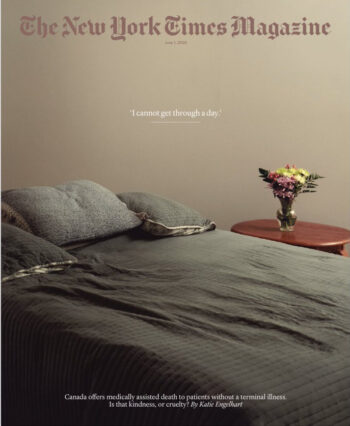
The New York Times Magazine (6/1/25) ignored ethical guidelines designed to keep reporting from encouraging suicide.
The New York Times Magazine recently published a cover story (6/1/25) that gave in-depth representation to the challenges faced by a chronically sick, disabled woman named Paula Ritchie, age 52. Ritchie dealt with underdiagnosed illnesses and pain, as well as challenges in supporting herself and managing her mental health.
The Times then told the story of Ritchie ending her own life out of despair over her situation. The journalist, Katie Engelhart, observed and documented her suicide, up until the last breath left her body. “I was with Ritchie until the very end,” she posted on X (6/1/25). Engelhart gave lengthy justifications for Ritchie’s choice to end her life, and described several people who supported her in that decision.
Articles like this aren’t common in the media. Suicide prevention is typically regarded as both a social good and an ethical responsibility. In the US and Canada (where the article takes place), suicidal people are involuntarily detained to prevent their deaths. It has long been illegal in Canada (and many US states) to assist or even “counsel” a person to commit suicide.
There are also ethical standards that guide media outlets in reporting on suicide, in order to minimize the risk of glamorizing or idealizing it. These guidelines are based on research showing that the media has an outsized influence when it comes to suicide. Graphic, detailed and sensationalized coverage has been shown to increase the “risk of contagion,” according to one guide. AP News specifically tries to avoid detailing the “methods used” in stories that reference suicide, based on this research.
The Times violated almost all of the published guidelines by personalizing, detailing, dramatizing, justifying and sentimentalizing Ritchie’s suicide, as well as by making it a cover story. The story featured close-up images of the method of Ritchie’s death and what appears to be her post-mortem body.
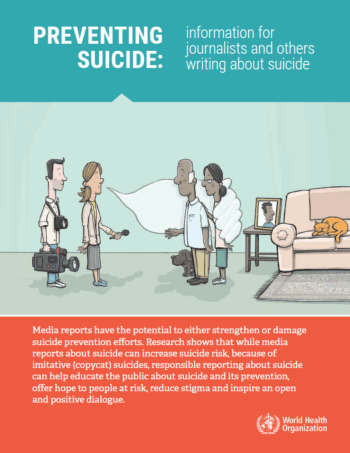
The World Health Organization urges journalists covering suicide not to “explicitly describe the method used” or “use photographs, video footage or social media links that relate to the circumstances of the suicide,” among other guidelines.
So why wasn’t there generalized outrage or pushback from other media? The only significant outcry came from thousands of disabled people on social media.
The simplest answer is that Ritchie’s suicide was administered by a doctor, and legal in Canada. Media tend to be more accepting of the unacceptable when it is government-sanctioned. In 2021, the country expanded its Medical Assistance in Dying (MAiD) law to permit physician-assisted suicide for disabled people who aren’t suffering terminal illnesses. The law and its implementation have been extremely controversial, as the article noted. Similar laws have been passed or introduced across Europe.
The Times article reinforced a popular belief that disability is a fate worse than death. The disabled author Imani Barbarin sums it up in the title of her forthcoming book: If I Were You, I’d Kill Myself. It’s a refrain disabled people are accustomed to hearing, the frightful implication of which is that accommodations aren’t worth the bother, and death is for their own good.
The media has a tendency to reinforce this idea in stories about disability. As I previously wrote about for FAIR (1/20/21), the New York Times (4/10/20, 12/24/20) published stories early in the Covid-19 pandemic suggesting that disability should be considered in determining who had a right to Covid ventilators, based on unproven myths of “quality of life.” The articles cited literal eugenicists as experts, and didn’t invite disabled people to the conversation.
Both sides, and propaganda
In Engelhart’s Times article, she appeared to offer a sensitive and balanced view on the debates around MAiD expansion. Yet the article was laden with ableist rhetoric, medical misinformation and subtle propaganda from the well-funded “right to die” movement. It also left out prominent critical facts about MAiD.
Engelhart omitted that the United Nations Convention on the Rights of Persons with Disabilities (3/11/25) issued a report in March that condemned Canada’s MAiD, and recommended that the country “repeal” the expanded law and halt plans for future expansion. The report outlined how benefits and healthcare for disabled people are inadequate in Canada, resulting in coercion around MAiD, especially for women and marginalized groups. People have been sharing stories of coercive MAiD practices since it was expanded (e.g., Independent, 6/23/23; New York Post, 11/8/22; X, 6/4/25).
It’s significant that the most powerful international body issued such a strong condemnation of MAiD; it’s something that anyone following the issue should know about, and Engelhart has published a book on MAiD and speaks about it constantly, yet she left it out of her article.

Dying With Dignity Canada’s goals include, according to the Walrus (1/12/24) “making MAiD available to people whose sole condition is a mental disorder” and “expanding MAID to ‘mature minors’ age twelve and older.”
Engelhart did discuss some of the issues exposed by the UN, but she cited “disability rights advocates,” “critics” and “opponents,” not the UN. She also didn’t name or quote these opponents, aside from a few uneasy doctors. None of the many disability rights, human rights and religious organizations that have condemned MAiD expansion were named, and only some of their arguments were discussed. Missing, for instance, was the fact that a promised expansion of disability benefits was tabled just after MAiD expansion was approved, suggesting the government saw the suicide program as another solution, of sorts, to the disability problem.
Also missing from the article was the role of a powerful lobbying group known as Dying with Dignity Canada (DwD), which has raised millions of dollars from corporate and wealthy donors (Walrus, 1/12/24). DwD has had an enormous influence on the Canadian government and media conversations on MAiD. The organization isn’t named in the Times Magazine piece, but its propaganda is subtly woven throughout.
Engelhart has been more explicit about her pro-MAiD leanings in other writings and statements (e.g., Neiman Storyboard, 3/3/21; NPR, 3/9/21), as well as in online responses to comments on her Times Magazine piece.
In search of euphemism
As evidence of her bias, look at the way Engelhart introduced the terminology in the Times article: “Canada’s Medical Assistance in Dying (MAiD) program—what critics call physician-assisted suicide.” It’s a curious attribution. Is there a more direct, factual way to describe what happened to Ritchie than suicide? It’s a subtle nod to DwD, which seeks to remove the “suicide” from assisted suicide. From the organization’s website:
We do not use the terms assisted suicide or euthanasia because they stigmatize people who are suffering intolerably and want to access their right to a peaceful death. Suicide is a desperate act of self-harm, while medical assistance in dying is a legal, federally regulated end-of-life choice, driven by hope and autonomy.
The Merriam-Webster definition of suicide is “the act or an instance of ending one’s own life voluntarily and intentionally.” DwD seems to be attempting to redefine the word to soften what happens with MAiD.
On Twitter, Engelhart has argued that “assisted death” is a less “politically loaded” term than “assisted suicide.” She has also taken issue with the AP for referring to MAiD recipients as “killed.” It’s not propaganda to state that when someone dies, they are “killed” by the cause of death. People are killed by cancer, accidents and self-inflicted wounds as much as by murder.
Engelhart’s efforts to soften the language of assisted suicide calls to mind crime reporters using “police-involved shooting” to say that police have shot someone. The common norms for speaking about suicide and shootings can apply without harm or distortion of the facts.
The Times Magazine article reflected some of the contradictions inherent to DwD ideology that appear throughout Engelhart’s work. For instance, she often compares assisted suicide rights to abortion rights, a DwD talking point. But she also compares it to the merciful “euthanizing” of “beloved pets.” Unlike people who elect abortions, animals do not get to choose their fates, or even express their wishes. Humans project our assumptions onto pets, including that their suffering must be a fate worse than death.
Despite Engelhart’s seeming alignment with the “dying with dignity” movement, to her credit, she did expose that there wasn’t absolute “dignity” in Ritchie’s death. The article ends with a gruesome description of Ritchie’s last moments, including her expression of “horrible” discomfort.
A ‘difficult case’

Dr. Matt Wonnacott, the doctor who approved euthanasia for Paula Ritchie: “If you tell me that you’re suffering, who am I to question that?” he told Engelhart.
Engelhart provided a lot of detail about Ritchie’s medical conditions, but relied on outdated, vaguely sourced and ableist ways of describing chronic illness. Here and elsewhere, her work is mostly sourced to doctors, especially MAiD providers, and patients who want to die, but not the many people who live with and manage complex chronic disease.
As a disabled journalist, I see Ritchie’s story through a different lens than Engelhart. I have many of her conditions, deal with ongoing suffering, sometimes severe, and was suicidal at one point.
Engelhart described Ritchie as if she were too difficult to diagnose sufficiently beyond a collection of symptoms, including head injury, migraine, fatigue, dizziness, long-standing depression and PTSD from childhood trauma. Yet I know that it can take ten or more years for a person to get properly diagnosed with most chronic illnesses, if they are lucky. I also know that chronic illness patients deal with doctors who gaslight, misdiagnose and psychologize symptoms.
The doctor who authorized Ritchie’s suicide, Matt Wonnacott, appears to be one of those. He was a primary source in the story. Engelhart did leave it open for readers to feel uncomfortable with Wonnacott’s approach. Although he acknowledged that Ritchie still had treatment options, he admitted to making decisions to approve assisted suicide based on “gestalt” and “patient choice” more than medicine. On the other hand, Engelhart seemed to take the doctor’s medical assessments at face value, not interrogating his knowledge or biases.
At one point, Engelhart referred to a category of MAiD patients with “functional disorders…that are poorly understood within medicine, and disputed within medicine, and that some clinicians believe have a significant psychological component.” Who are these clinicians? She did not say, but then listed a series of conditions that are not considered, by official diagnostic criteria, to be psychological: “fibromyalgia, chronic fatigue, irritable-bowel syndrome, some kinds of chronic headaches.” “Functional” has a history, like “hysteria” before it, of being used as a catch-all for misunderstood women’s illnesses.
As for “chronic fatigue,” it is more properly known as Myalgic Encephalomyelitis, or ME. There is an epidemic of it lately, as it is commonly caused by Covid-19. As such, there are countless recent studies proving its physiological causes. At one point, Engelhart discussed how Ritchie’s muscles work one minute, then “suddenly buckle” the next, writing: “This suggested that the buckling was due to psychological causes or a lack of effort.” Yet Ritchie seemed to be demonstrating a hallmark symptom of ME known as “post-exertional malaise.”
Engelhart included a lot of detail about Ritchie’s care and medications, with the effect of seeming like every option was exhausted. Yet I am surprised by what is missing. There is no mention of dysautonomia or its treatments, even though Ritchie has difficulty bathing herself and getting out of the bath, both common in that illness. There is no mention of cutting-edge treatments for ME, like antivirals for reactivated viruses, or naltrexone. And there is no mention of the new class of CGRP migraine drugs, which have rescued millions of people from horrible constant pain.
In place of medical investigation, Engelhart uses rhetoric and sentiment to portray Ritchie as a lost cause. She supports this portrait with classist and ableist imagery, like mentioning Ritchie’s “old TV and a window that looked out on a row of garbage bins,” her “stained” floors, her trouble bathing and long history of depression. She quotes people in Ritchie’s life who liked her, but also found her difficult, “vicious,” and “loud and excessive.”
I have a different perspective on Ritchie. She comes across to me as resourceful in pursuing help, a strong person who has survived tremendous suffering, and compassionate to others. She is surrounded by friends when she dies. She has common illnesses that have been under-researched due to medical misogyny. And she has been denied cutting-edge treatments due to the profound gulf between research and practice, as well as long-established bigotry in medical care. In my perception, if she had been properly diagnosed and treated, she may or may not have felt differently about ending her life.
Fly on the wall
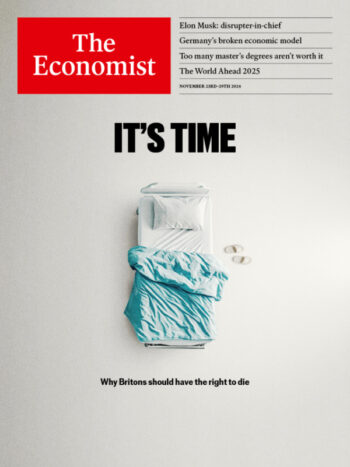
The Economist‘s cover story (11/21/24) seemed to encourage not just legalizing suicide, but suicide itself.
Engelhart did a skillful job of portraying her own role in Ritchie’s suicide as if she were a passive observer. In a separate interview she gave with the Times about writing the piece, she said she “was trying to be as small a presence as possible in the room.” Yet she also admitted that Ritchie reached for her hand just before she died, so she couldn’t have been that small. Engelhart didn’t reflect, in the interview, on the role she may have played in Ritchie’s fate, or the ethics of her project.
The article emphasized that Ritchie knew she was being interviewed by a writer for the New York Times Magazine. She knew that her story would be amplified worldwide, but especially if she continued to end her life. Engelhart’s body of work on MAiD is mostly about people who elect and complete the act of suicide. That validation, alone, could have been a form of encouragement, especially for someone who felt isolated and unheard.
Best practices in suicide prevention are based on studies showing that suicidal people are uniquely and extremely vulnerable to suggestion, and that suicidality is usually temporary. According to a journalism guide from the Trevor Project, which aims to prevent suicide in LGBTQ youth, “More than 50 research studies worldwide have found that certain types of news coverage can increase the likelihood of suicide in vulnerable individuals.”
With the Times’ story, the worst-case scenario almost happened. One reader, a patient with Long Covid, responded on social media that the article caused him to consider that maybe assisted suicide would be a good option for him. After reading the responses of disabled people, he had more context and changed his mind. (I am protecting his identity.)
There is growing support for the expansion of assisted suicide across the world and in the media (e.g., Economist, 11/13/21, 11/21/24). The pandemic has eased people’s discomfort with preventable death, especially of elderly and disabled people. Engelhart’s book got a lot of attention around the height of Covid-19’s Omicron wave. Meanwhile, the current US administration is suggesting that worthiness for healthcare should be tied to social value.
It’s a key time for news organizations to recall their ethical obligations around reporting on suicide. At the very least, the news shouldn’t stop calling it “suicide” just because those who die have been approved for MAiD due to disability.
Stories of chronically sick people who resist MAiD and/or survive suicide attempts are rarely given as much in-depth treatment or column inches in the media. But those stories might give readers more context in considering how to feel about these policies. The New York Times even gave a flattering interview (11/16/24) to a doctor who has elsewhere been condemned for her unethical and too-eager MAiD practices and has been restricted from practicing everywhere (London Times, 7/19/24; Globe and Mail, 3/9/16).
News outlets should also consider hiring disabled journalists and editors to work on stories like this, or at least journalists who are curious enough to investigate medicine critically. Mainstream writing about health and disability has long ignored the insights of chronic illness patients, unless to use individual cases to speak over collective concerns. We need stories about disability and illness that don’t rely mostly on the medical establishment for expertise, especially given its long history of aligning with eugenics.




Suicide is most often the outcome of the failures of society
I do believe we have the right to decide if we wish to continue living
But in a truly just world, far fewer of us would feel compelled to wrestle with that wrought choice.
“…disability should be considered in determining who had a right to Covid ventilators, based on unproven myths of “’quality of life.'”
The irony of that statement is that being denied ventilation may have saved the lives of some of those disabled folk.
The reality that’s still being carefully suppressed is that ventilation of the kind mandated by the Covid treatment protocols was the opposite of the standard protocol for its use, and was combined with giving the patient a cocktail of medications that actively suppressed respiration. That’s not a “conspiracy theory”; it’s been thoroughly documented by health care professionals, including veteran nursing staff. Look it up.
Look it up where, exactly? My suspicions are always roused by commenters who demand that readers research evidence to support the claims of the commenter. If you cannot provide links to high quality evidence, then your comment is pure BS.
Ew. Go play Qanon somewhere else.
I totally disagree with your description of the story, as one who read it when it first appeared. the woman in question was not merely ‘despairing,’ as you put it, but in physical misery for years after trauma to her head. And, after seeking help from numerous doctors in Canada , with no help with her crippling problems of not being able to sleep or eat, or stand without dizziness, she appealed for Assisted suicide from Canada. i have had depression and am against suicide merely for that, but when a head injury makes sleep eating and physical activity impossible, normal function is no longer possible.
And though I mourn this woman’s decision, it is a story that very much merits being told. Shame on you for merely attacking the New York Times ( which is far from infallible) for this story. Count me as unsubscribed.
She wrote an extremely important article about ethics and you’re pissed because she pointed out how a disabled person might be pressured into dying? Interesting.
It’s always valid to criticize the NYT. They are the paper of record and they can certainly handle it. In a related note, the author was offering another perspective. Nothing wrong with that. If you are unswayed, nothing wrong with that either.
Then why bother having a Comments section if it’s just to pat the author on the back? I was always under the impression that Comments = Discussion.
I agree with Maureen. This article strongly shows ITS bias – not so much against unethical reporting but assisted suicide in general. It reads as though the author has a bigger problem with MAiD and is using “journalistic ethics” as a cloak to decry the entire practice.
I consider myself an informed, curious, educated person with a journalism degree and finished the NYT article and thought, that was extraordinarily well written. Especially because I too have no particular love for The Times. But Justine Barron surely knows that a magazine article has to be edited for clarity and readability, so including every last detail of Richie’s exhaustive medical history would be excessive in a lay article, and that terms like “chronic fatigue” are still very much in the public lexicon. This article seems like an emotionally reactive nitpicking to a topic the author clearly has some discomfort with.
You claim that the author of the NYT article is biased but I found your article totally biased. The fact is NOBODY, including the State has the right to interfere in a person’s decision of whether they want to continue living or not. That is a personal decision only the person whose life it is has the right to make.
Thank you.
I’m 80 dealing with disability and oncoming dementia. My life is my own and the state is not welcome to butt in. Neither are writers who can opine from a space of good health.
Except the reporter did interfere, and you’re arguing against suicide hotlines and for suicide stations.
Why?
Chris, Do you know people who are disabled? Do you realize that people (I should know) who are disabled are choosing MAiD because they are destitute? Do you believe in survival of the fittest? Do you believe in disability benefits that are at least meet needs for food, housing, safety, medical needs addressed? Why would people who are disabled (and who have mental illness) offered suicide by state?
I do know people who are disabled.
I am well aware of the fact that destitution pushes people towards death and not enough assistance is given to help people live.
I believe that people who apply the term “survival of the fittest” to human beings are Nazis.
I believe that everyone should have their means of living guaranteed and supported.
So you agree that publicly-funded health care workers should not be paid by the state to kill people in publicly-funded health care facilities then? Because that’s what MAiD is in Canada.
Exactly.
Suicide is legal in Canada gary. Maid didn’t make suicide legal. It made it so the state can sanction your suicide and then a doctor can come in and do it.
The author here does a lot of hand wringing about the ethics of reporting on suicide, but fails to contemplate the ethics of forcing someone to be alive who is in terrible suffering, does not consent to continue living, and for whom she doesn’t have a solution to the suffering.
That’s because it’s an article about the ethics of reporting in an outlet that focuses on reporting. It’s not about the ethics of a law.
The reason that the author takes issue with the ethics of the reporting is because she takes it as a given that individuals should never have the right to end their life. She believes that the idea of a right to die should be off limits and that exposing the public to any viewpoint which contradicts or challenges paternalistic suicide prevention narratives is an act of reckless endangerment of the “vulnerable” who must be told what to think and what’s in their best interests.
This magazine is called FAIR and claims to challenge media bias, but your article is full of exactly that. Who are you to decide if others get to end their lives or not? You walk only in your shoes, no one else’s. Don’t you dare tell someone else they have to live because the option to stop upsets you.
Should the disability community have been consulted about the TIMES piece? Sure. But does it get to speak for every person on Earth? No. Quit trying to deny Ritchie her autonomy just because you would have made a different choice.
Fight for representation without taking away the rights of others.
You’re saying it’s fine to kill people when we don’t give them medical care or help them live?
People should have the right to decide whether or not they want to live based on their actual circumstances. They shouldn’t be used as political pawns to make a statement about the funding of disability benefits, or about capitalism. They shouldn’t be held hostage in a life that is intolerable to them until society reaches the sunlit uplands of the socialist utopia that you are envisaging.
People do have the right to decide that already. Non-disabled people get suicide prevention when they talk about ending their own lives. Disabled people are offered lethal injection even after declining, repeatedly, even BY suicide hotlines, instead of what we actually need. Nobody has a right to demand that publicly-funded health care workers in publicly-funded health care facilities be granted a specific exemption from the law against murder in order to provide death on demand specifically to disabled people only, with no oversight.
If you were actually paying attention to this issue you would know that we disabled people are speaking up for ourselves, against MAiD, we’re not being used as pawns. We are being held hostage in government-enforced poverty, without access to the things we actually need to make our lives livable. Do you know it can take months to get a simple wheelchair repair done? Years to get in to see specialist doctors? Yet we can get approved for MAiD and be dead the same day by just telling the assessors “I’m going to stop eating” – all paid for by the same government that refuses to give us enough money for rent and food. The NYT article was eugenicist propaganda, reinforcing the false beliefs of people who think all of us disabled people are better off dead. Complete lack of journalistic ethics.
Having the right to end one’s life must include the right not to be obstructed in doing so. In Canada, MAiD is the only avenue for legal access to a reliable method of ending one’s life. The intention of that is to keep them trapped in their suffering, either by causing suicide attempts to fail, or by deterring the attempts by being able to threaten people with the consequences of a failed attempt. Voluntary suicide prevention is available to all, including those who qualify for MAiD. Having paternalistic and coercive suicide prevention forced on one against one’s will isn’t an additional right to which those who don’t qualify for MAiD receive. It’s a barrier to exercising autonomy.
Disability benefits are another issue, but one that won’t be solved by forcing people to live, and it is unjust to use that as an excuse to force anyone to live. Especially as you want to give the same government failing to fund disability supports the power to trap disabled people in the poverty that results from their funding. The fact that disabled people don’t have what you would consider to be adequate access to positive rights (I. E. support provided to them by the state) isn’t a justification for depriving them of negative liberty rights (the right not to be forced to live).
I think the author simply painted a picture that conflicted with the one-sided view offered by NYT. Originally article should have offered various points of view but did not. People are free to read both articles (and others) and reflect of the different perspectives.
The NY Magazine article wasn’t just a “one sided” piece, it was possibly the most egregious example of Inspo Porn that I’ve seen in the entire time I’ve been speaking up and speaking out about the flaws and failings of MAiD T2.
NY Magazine isn’t infallible, and this article should be recognized as a low point created by a writer who made herself the story on the back of a woman who suffered traumas no one should experience.
This article isn’t unbiased, but the biases skew toward the people who would prefer to not have to die “with dignity” because they’re being denied the right to live with dignity.
Great article Justine
I lost my best friend to suicide when I was in Boy Scouts. It was 4 years later that I learned the details of why he did in health class in high school. In my personal opinion he was an idiot for the reason given. While I do not condone suicide, I am not so naive to think that suicide is never a viable option. This latter is the problem I have with this FAIR article. Speaking as a physically disabled person (I survived a hemorrhagic stroke), I am fully cognizant of the fact that everyone has their breaking point. Keeping someone alive when they are in constant debilitating pain and/or they are fighting a disease that it is known beyond any shadow of doubt that their quality of life is going to vastly deteriorate physically and/or mentally is frankly torturing the patient. I am referring to the same reasoning that can cause a family to euthanize a beloved pet, only the patient is the one requesting it for themself.
As for instances that are doctor assisted, doctors with any scruples will be exploring every avenue with assisted suicide as an absolute last resort. It is never a decision that is taken lightly.
Just as in the case of abortion, while I might personally disagree with the individual reasoning behind it, I nevertheless support the individual’s right to bodily autonomy and the individual’s right, with the consultation of a licensed medical professional, to do what is best for that individual.
The other thing to keep in mind is that stories about suicide are not necessarily trying to romanticize it but to humanize the people and the extreme circumstances they find themselves in.
I do not have to agree with something to recognize there may be things that I am not aware of that might potentially cause me to change my mind, regardless of how unlikely that might be.
A timely and well-argued piece. Here in the UK, leftist media has largely promoted what it labels ‘assisted dying’ as a solution to the profound societal and personal problems that are in reality the effects of our capitalist regime. Of course people should be free to organise their own deaths how they wish; but examples from around the world – particularly in Canada – show how assisted suicide can become normalised and extended to many situations that are far from life-threatening and would be solved in a well-planned socialist society. But such a solution would demand an end to the appropriation of all the wealth created by the working class, and that is far beyond the imagination of journalists.
If you believe that people should be free to organise their own deaths, then what are your views on paternalistic laws which bar access to reliable and humane methods, forcing people to risk a botched attempt and the consequences that go with that? What are your views on locking people up in psychiatric units because they have expressed a wish to end their life? Get rid of those permanent barriers (or at least make them temporary barriers) and perhaps MAiD wouldn’t be needed. But most opponents of MAiD want those suicide prevention measures as well, and are being dishonest by ignoring the existence of these barriers when they claim that people can just kill themselves.
“far beyond the imagination of journalists”
Journalists are not science-fiction writers. And while I agree that in a well-planned socialist society none of these issues would arise, that is unfortunately not the world we live in right now. Even the doctor in the article admits he would have liked to help the Richie of two years ago but must face reality and deal with the patient that is right in front of him right now.
Also people seem to be forgetting that longform magazine journalism always tends to have a slant, even though I do feel like The Times author did her best to be as objective as possible. I certainly came away with a new understanding of MAiD Track 2 without thinking it was the best plan on earth. It’s almost like Barron and I read two entirely different articles.
I’m a great longtime fan of FAIR and share FAIR’s posts regularly. This article should not be on FAIR’s website. This article is what FAIR fights against, in my opinion. The writer is completely biased. Her credits involving disability could seem to make her an expert with welcome information but instead betrays her advocacy for a cause instead of her looking at this complex issue with clarity. The woman who chose assisted suicide was disabled. One of many examples in the article: it’s one thing to articulate the fight for language, it’s another to reject one argument that explores a way not to use the term suicide and instead as a writer demand the use of the word suicide and killed in describing people choosing to die with dignity. That spills into advocacy that could be termed propaganda. The rejection of psychosomatic conditions is bizarre. The idea that assisted suicide spreads like a contagion is disproved by The Netherlands. And on and on. It’s unfortunate that such a lazy article has been published on this site.
You have a pro-death agenda.
Advocacy is fine, especially when the other side has already been given a large platform. If the NYT piece had been well-rounded and presented the perspectives of disabled people, this article would not have been necessary. It was necessary. Now we see more data and learn that there are multiple perspectives.
I think the nurses at my doctor’s office have seen that article and they’ve decided that it’s my time whether I like it or not.
Simply trying to get medication refills from them makes me think I will die before they get it done it’s so frustrating, and I suspect it it’s because they want me to just go die.
It’s a shame we can’t simply get medical care instead of being pushed to suicide.
“ Media tend to be more accepting of the unacceptable when it is government-sanctioned.”
Truly. This needs to be called out.
Thank you for doing so.
I believe everyone should have the right to choose when to die, but I also believe everyone’s needs should be met. MAiD addresses the former, but it shouldn’t be a substitute for the latter. No one should have to choose MAiD because of societal or systemic failure.
Your article doesn’t sit well with me because it carries a moral judgment on the choice to end one’s life. I think it’s rooted in a white, Western perspective, often rooted in a fear of death, which often overlooks the importance of community support in how we approach death.
People should be able to choose to die, to die with dignity, surrounded by loved ones, not isolated or forgotten. Without that, at best, we die alone in our sleep.
I’d recommend watching this related piece from APTN:
https://youtu.be/V0BylJe38Js?si=utgust5stbD5XHpo
Author here: just want to clarify that I have no moral judgment on the choice to end one’s life, nor would I ever express that. I don’t feel it, never thought it, and never have made such a statement.
The critique is of the journalism, of ethics and facts
Hi Justine,
I’m glad to hear that you support a person’s choice to end their life.
I could have worded my comment above differently to better convey that the moral judgment I see in your article is an undercurrent that I think permeates many articles on this topic.
For example, one instance where I see this moralizing emerge in your article is in the terminology used for suicide. You rightly problematize the catchphrases and dogwhistles used by groups to soften MAiD’s potential as a tool for eugenics (I unintentionally used one in my previous comment—”die with dignity”). However, your argument relies in part on dictionary definitions. This approach mirrors tactics used by those who resist change—like transphobes, who invoke the dictionary to argue against a more expansive understanding of sex and gender.
I believe that white and western relationships to death often reinforce eugenics. We fear death, and the disabled remind us of it, so we ignore, hide, banish, and murder them. To develop a more holistic relationship with death, we need to shift both our understanding—and our language—around it. Just as many northern Indigenous Peoples have an extensive vocabulary for snow, I believe we should have a broader vocabulary for suicide.
As a disabled and Indigenous Person, I see both positive and negative aspects of MAiD. I’m deeply concerned about its potential use in eugenics, and I’m also troubled by white and western objections to its use in all circumstances.
(As I can no longer see my comments on your Substack, nor your account, I’m guessing that you may have deleted my comments and blocked me. If that’s the case, I’m guessing I may have upset you, and for that, I’m sorry. Please know that my comments were made in good faith.)
If you don’t morally judge the person who ends their life, it seems to be because you ostensibly don’t believe that anyone who would make such a choice has any agency over their choices (and therefore cannot be blamed for their actions) . Or at least, that is the conclusion that I draw from your article, due to your paternalistic concern with allowing people to be exposed to both sides of the MAiD debate.
Your ethical view seems to be that suicide should be a closed topic, and only one narrative should be permitted in the media.
This is an excellent well-sourced piece! It is essential as other jurisdictions look to follow in Canada’s footsteps.
Engelhart’s omissions of the UN CRPD report, the heavy lobbying of Dying with Dignity are tantamount to journalistic malpractice. Dying with Dignity in particular has engaged in lobbying with the members of the parliamentary MAiD committee while legitimate disability groups don’t have equivalent resources or funding.
Thank you for doing journalism based on reality and lived experience rather than unexamined predudices or the impulse to bypass truths that might challenge them.
I can’t claim to know another person’s experience. But, for years, I had the same symptoms as the article’s subject. They were soul-destroying. For several years, it was dark times. But it turns out that, while difficult to treat, these symptoms are not only diagnosable but very` treatable. With time and thorough medical care via my country’s universal healthcare (which is constantly and rightfully criticized, but overall pretty good), my symptoms diminished to minimal and manageable. My quality of life is great, where for a prolonged period it was very poor. I was able to reach this point through a) luck b) resources that not everyone has, like supportive loved ones and a safe, secure home c) self-advocacy borne of being a child, niece, and cousin of nurses.
EVERYONE is entitled to every chance possible to recover from or manage illness or iinjury and regain quality of life. I am 100% an advocate of bodily autonomy, but there is no freedom or choice when coercive factors such as poverty or inadequate medical care are determinants of that choice. Misery or death is not a free choice when there is a path toward health that is being actively denied.
Excellent analysis showing the NYTs extreme ableist bias, numerous factual errors, and failure to follow ethical reporting on suicide guidelines – the NYT, Katie Engelhart, and her editor must retract this story and apologize.
Many in the comments here seem more interested in supporting the eugenics propaganda of the original piece than actually dealing this the clear bias and errors in good faith. Justine’s analysis was greatly appreciated by many people with disabilities and chronic illnesses on social media. And for good reason. It centered a perspective the NYT intentionally overlooked.
Stories like this NYT piece manufacture consent to strip disabled people of supports to help them live with dignity. No surprise there, it’s a publication that also manufactures consent for the genocide in Palestine, war, and pandemic erasure.