

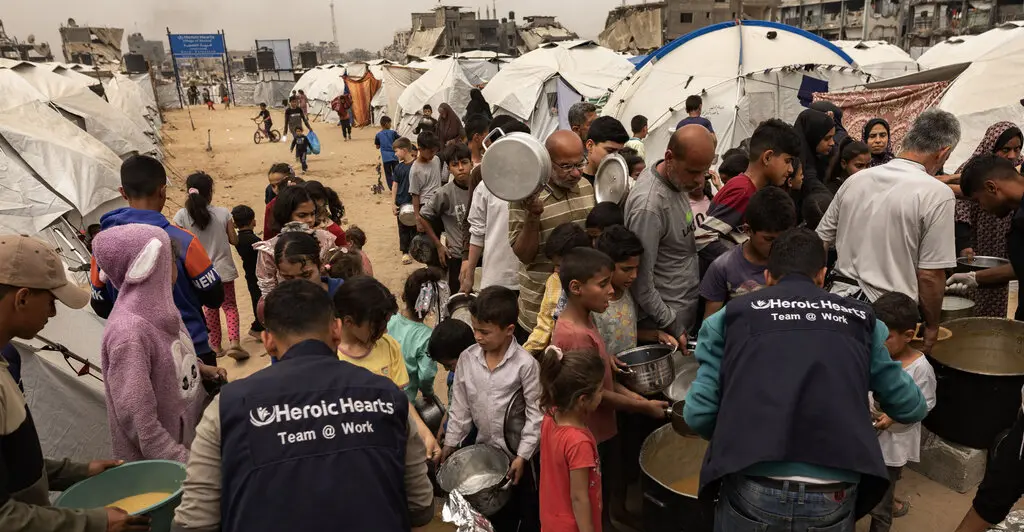
The World Health Organization (5/12/25) “calls for the protection of health care and for an immediate end to the aid blockade, which is starving people, obstructing their right to health, and robbing them of dignity and hope.”
More than two months ago, Israeli Prime Minister Benjamin Netanyahu announced a complete blockade of aid—including food, water and medical supplies—from entering the besieged Gaza strip. It’s a severe escalation of Israel’s now 19-month genocide against Palestinians in Gaza—and what the World Health Organization (5/12/25) has described as “one of the world’s worst hunger crises, unfolding in real time.”
With no replenishing stock, aid groups have begun running out of supplies to distribute to families in need.
The UN Relief and Works Agency (5/16/25) reports that their “flour and food parcels have run out,” and that “one third of essential medical supplies are already out of stock.” More than a week ago, World Central Kitchen reported that they no longer have supplies to cook hot meals and bake bread for starving families—they’ve since repurposed their pots to distribute filtered water.
With Gaza’s entire population experiencing crisis-level food insecurity, and with three-quarters facing “emergency” or “catastrophic” levels of deprivation, the famine has been recognized by Human Rights Watch interim executive director Federico Borello as “a tool of extermination.”
‘To pressure Hamas’
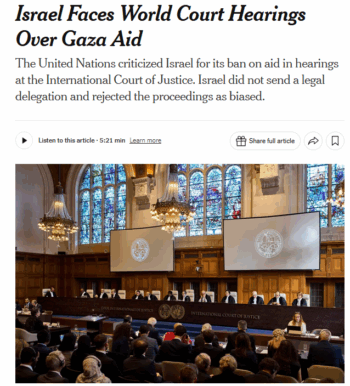
The New York Times‘ online headline (4/28/25) reduces the prospect of mass starvation to the innocuous phrase “Gaza aid.”
At first glance, the April 29 New York Times offered what many would call an objective account with the headline: “UN Faults Israel Over Blockade of Aid for Gaza” (web version here: 4/28/25).
A closer look at the piece however, reveals the Times’ usual spinelessness in its Gaza coverage, unquestioningly accepting Israeli framing in its supposed right to carry out its ongoing genocide.
Reporter Aaron Boxerman writes up top:
For more than a month and a half, Israel has blocked food, medicine and other relief from entering the devastated Gaza Strip in an attempt to pressure Hamas to free the dozens of remaining Israeli hostages there. It argues that its blockade is lawful and that Gaza has enough provisions despite the restrictions.
That frame looks like a simple sentence, but note that it tacitly requires you to accept that Israel determines whether people in the Gaza Strip can receive the basics for human life—asking why Israel is in charge of Palestinians’ food and medicine is beyond this conversation’s walls.
Then, without even a comma, we are told that the denial of life to all Gazans is “an attempt to pressure Hamas”—Boxerman makes a silent skip over the acceptability of collective punishment there, and a frictionless transmission of Israel’s rationale for its actions. That Israel has itself deprioritized the release of the hostages vis-à-vis the reoccupation of Gaza is off the page. But that Israel “argues” the blockade is lawful and that Gaza has what we’re told to accept as “enough provisions”? Those are statements that the Times suggests can stand alone.
Who you choose to believe
The New York Times (4/28/25) describes the relationship between Israel, which has announced a policy of starving millions of people, and the UN, which is trying to force Israel to allow food aid into Gaza, as “fraught with mutual recrimination.”
But aha, you say, here comes another view—though it’s already set up by being in the responsive, “others differ” position:
The United Nations and aid groups say the blockade has further harmed Palestinians already reeling from more than a year and a half of war in Gaza, which has killed tens of thousands of people, displaced well over a million and leveled large swaths of the enclave’s cities.
While true, and ostensibly sympathetic, what with the reeling and the leveling, notice how this is not a direct response to the claims in the lead: that the blockade is lawful, and that Gaza has all it needs. It’s just a statement that the people of Gaza have suffered tremendously. And that even that is just a thing the UN and aid groups “say.”
You could tighten this all to the NBC News headline (4/17/25) Belén Fernández clocked in her piece on coverage of Israel’s starvation of Gaza (FAIR.org, 4/25/25): “Aid Groups Describe Dire Conditions in Gaza as Israel Says There Is No Shortage of Aid.”
All of this depends on who you choose to believe, seems to be elite media’s message—with a few winky-wink tips on who to believe.
Boxerman goes on to report:
Ordinary Gazans have lamented the rising price of basic commodities under the pressure of the blockade. In some cases, the restrictions have turned the quest for getting enough nutritious food into a daily struggle.
It’s like an unfunny game of “find the qualifier”: What’s an “ordinary” Gazan, and who are the extraordinary ones who deserve to starve? What defines the “some cases”? Is un-nutritious food freely available? When does a “quest” become a “struggle”?
It’s a perverse way to describe a situation where widespread starvation is not looming or imminent, but well underway. But it’s an excellent way to tell people they don’t necessarily, if you look at it a certain way, need to give a damn.
ACTION ALERT: You can send a message to the New York Times at letters@nytimes.com or via Bluesky: @NYTimes.com. Please remember that respectful communication is the most effective. Feel free to leave a copy of your message in the comments thread here.
Research assistance: Wilson Korik



What bothers me about all these exposes about the mainstream media (which ARE all basically correct) is the complete disregard for what’s going on in Sudan. I just searched FAIR’s website for “Sudan” and the first thing that came up was an article about what was omitted from Pope Francis’s obituary.
Why can’t the media (in general) walk and chew gum at the same time?
Approximately 24.6 million Sudanese are facing acute hunger, representing roughly half of the population. This crisis is driven by conflict and limited humanitarian access, with famine confirmed in at least 10 locations and 17 additional areas at risk. Over 638,000 people are facing catastrophic levels of hunger, the highest in the world.
And yet, despite the ENORMOUS difference in actual numbers, THIS is what constantly leads the news:
Approximately 500,000 people, or one in five Gazans, are facing starvation. This represents a “catastrophic” situation of hunger, acute malnutrition, and risk of death. Nearly 71,000 children under the age of five are expected to be acutely malnourished over the next 11 months.
Why does the NYT coverage of one lead the news on your website when the NYT is BARELY covering the other?
I just don’t get it. Unless. One side of the conflict is Jewish.
No, Seth. The difference between Sudan and Gaza is that you are funding and fully supporting the genocide in Gaza. Add contempt to damage with the perpetrators’ disgusting claims to be the victims.
Enough of your whataboutery.
Or the proxy war in Ukraine. It’s as if that’s the “good war” because Putin is the designated monster even by FAIR and poor Ukraine is merely “defending itself” while the glorious US has come to its aid as always, bringing democracy. And weapons.
They’re repeating Afghanistan, it’s obvious the media can’t say that without upsetting bipartisan washington political elites.
And large labor unionization efforts are being blocked every week now. Is the pressure exerted by Yemeni pirates and FAIR’s friendship bracelet organizing advice going to kick in soon?