


New York City news channel NY1 (7/20/17) aired a segment on a parolee from a narcotics conviction who was “seen committing some type of violation, although it’s not clear exactly what.” Nevertheless, the segment urged viewers to call into the Crime Stoppers hotline with tips.
To say that the criminal justice system is a huge, dehumanizing conveyor belt of punishment and surveillance might be an understatement. As the role of cops and prosecutors in America has been under increasing scrutiny over the last few years since the growth of the Black Lives Matter movement, we’ve been made privy to all sorts of interesting tidbits: the transfer of military surplus equipment to local police, the rise of “predictive policing” and Stingray technology that cops use to spy on us, to name a few.
However, another questionable police tool has developed in plain sight—and is being dutifully pushed forward by some in the press. Crime Stoppers USA is a national organization, founded by a cop, whose local affiliates provide rewards for tips that lead to arrests. If you live in an urban city, chances are you’ve seen ads for Crime Stoppers, or similar programs, at bus stops or in the street. You’ve also likely seen Crime Stoppers in the media, because that’s one of its main goals, as stated on the website:
Crime Stoppers is publicized on a regular basis by all media outlets including print, broadcast and web-based partners. Special attention is given to unsolved crime re-enactments, “Crimes of the Week,” cold cases, narcotics activity, wanted fugitives, and suspected terrorist and gang activity.
The practice of encouraging people to provide incriminating information for money, however, raises questions. The Justice Department’s inspector general released a report last year that called into question the Drug Enforcement Agency’s use of paid informants, because “poor oversight” led to “an unacceptably increased potential for waste, fraud and abuse.” Lawyers and advocates against the drug war told the Washington Post (9/30/16) that “paying informants creates incentives to lie or fabricate evidence.”
With those concerns being raised about a federal agency, which can be audited, what kind of protections or protocols do local, private nonprofits use when they dangle money in front of us in exchange for crime tips?
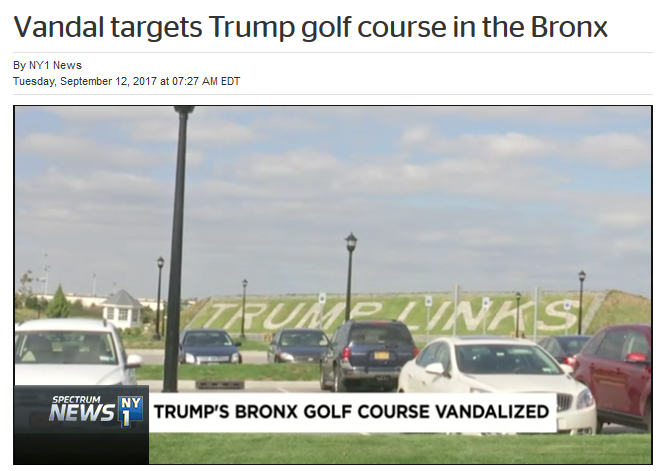
NY1 (9/12/17) urged viewers to call Crime Stoppers with tips about protesters who “spray-painted a poem about immigration onto the grass” at a Trump golf course.
The New York City iteration of Crime Stoppers is likely the most developed of these types of programs in the country. And while it doesn’t seem to be connected to the national Crime Stoppers program, it’s run by a controversial organization for the same purposes of making informants out of us.
Established in the 1970s to raise private money for the NYPD, the New York City Police Foundation provides technology and other resources for police, but operates somewhat inconspicuously in the shadows. The Foundation’s financials, for example, aren’t very transparent, raising concerns about how money is spent and whether donors—which include CIA-linked Palantir (founded by controversial Gawker-slaying tech mogul Peter Thiel)—are given questionable access to the police department.
But the New York City Police Foundation doesn’t operate completely off the radar, either. With a propensity for throwing lavish gala fundraisers, its central purpose seems to be direct money from wealthy donors, like billionaire investor Carl Icahn and mega-developer Bill Rudin, to fund a public/private piggy bank for the NYPD.
The Foundation’s board of trustees is chaired by a real estate developer and reads like a who’s who of developers and financiers. At its 2014 fundraiser, Rudin, former police commissioner Bill Bratton and other attendees received keepsake bullets from the Foundation. New York City Mayor Bill de Blasio was also there and rejoiced over rising property values in Brooklyn that he suggested were the result of declining crime rates.
Clearly, New York’s elite have a vested interest in the police department, but what, some may ask, does their money get them?
Former CBS anchor Dan Rather, a foundation donor, has been rewarded for his generosity with ride-alongs and even the chance to join a “search for a robber at a housing project.” The “charity” has funded studies buttressing zero-tolerance policing of squeegee men (aka the Broken Windows theory of policing), and even perks and political consulting work for former NYPD leader Ray Kelly, who once considered a run for mayor. There have also long been questions of cronyism, as Foundation money has been used to pay consulting fees to friends of ex–NYPD chief Bratton.

The most well-known Police Foundation project, however, might be NYC Crime Stoppers, which offers rewards of up to $2,500 to anonymous tipsters. NY1 News, a popular 24-hour local news channel in the city, has for years extensively featured Crime Stoppers features in its everyday programming.
A search of NY1‘s coverage shows hundreds of segments this year, thousands over the past few years, that encourage viewers to send tips to the Police Foundation’s Crime Stoppers hotline. Segments air footage showing not only people who’ve been accused of violent crimes, but also those accused of things like stealing five bucks and tossing coffee on someone, robbing toothbrushes and vandalizing a Trump golf course. Most, if not all, of NY1‘s Crime Stoppers stories finish with these exact instructions:
Anyone with information on the case should contact the Crime Stoppers hotline at 1-800-577-TIPS, or text CRIMES and then enter TIP577, or visit www.nypdcrimestoppers.com.

NY1 reporter Clodagh McGowan (6/7/17) accepts an award from New York Police Commissioner James O’Neill.
This past summer, NY1 was honored by the Police Foundation and NYPD Commissioner James O’Neill for featuring Crime Stoppers coverage. Local reporter Clodagh McGowan accepted the “Chief of Detectives” award from O’Neill on behalf of NY1 News and its parent company, Spectrum. Said McGowan:
I think it’s so important that we have this partnership with the NYPD where they can impart, share with us, some of the media, of the videos, the pictures that they collect, and we can turn it around, get the information and get it on the air.
This cozy arrangement between NY1, Crime Stoppers and the NYPD means that the lines between law enforcement and journalism are significantly, if not completely, blurred. What are the ethical questions and privacy concerns raised when identities of alleged criminals are put on thousands of television screens before anyone has even been charged? What are the details of NY1‘s apparent arrangement with the Police Foundation and the NYPD? Do NY1‘s producers have any research-based evidence that paid informants actually help solve crimes—without leading to wrongful convictions? What are the effects of inundating the viewing public with images of alleged crimes?
The most compelling question may be whether aiding police investigations by publishing Crime Stoppers information on a daily basis conflicts with NY1’s journalistic mission. (When FAIR attempted to ask these questions of NY1, PR manager Nikia Redhead’s response was, “We’ve chosen to decline the request to participate in this story.”)
Just as local prosecutor’s reliance on police makes it difficult to convict or even indict violent cops, local news channels that become appendages to a police department will find it difficult to report independently on brutality or corruption. Perhaps NY1 and its reporters are comfortable sacrificing their independence to catch criminals—even golf course vandals—but many others may not be. The very least that NY1 can do is be clear and transparent about its collaboration with the NYPD, and tell the public why it’s working with the controversial, billionaire-funded Police Foundation.
If you have any tips about NY1 or the Police Foundation, tweet Josmar Truillo at @Josmar_Trujillo.
You can send a message to NY1 here (or via Twitter: @NY1). Remember that respectful communication is the most effective.




Thanks, Josmar, for this piece.
I don’t think it is realistic or, I would say, even desirable, that local media should abstain from circulating information about unsolved crimes or wanted suspects, but the kind of cozy collaboration outlined here raises all sorts of questions, some of which are posed by Josmar.
As a long-time NYC resident, I know nothing about the NYC Police Foundation. It seems to merit scrutiny.