


Since October 7, the day the escalation in Israel/Palestine began (FAIR.org, 10/13/23), American media outlets have persistently described the fighting as an “Israel-Hamas war.” From October 7 through midday on December 1, the New York Times, Wall Street Journal and Washington Post have combined to run 565 pieces that use the phrase “Israel-Hamas war.”
This paradigm has been a dominant way of covering the violence, even though Israel has been clear from the start that its assault has not been narrowly aimed at Hamas. At the outset of the Israeli onslaught, Israeli Defense Minister Yoav Gallant (Times of Israel, 10/9/23) said: “I have ordered a complete siege on the Gaza Strip. There will be no electricity, no food, no fuel, everything is closed.” Oxfam later said that such restrictions on Palestinians’ ability to eat—which left 2.2 million people “in urgent need of food”—mean that Israel is deploying a policy wherein “starvation is being used as a weapon of war against Gaza civilians.”
A day later, Israeli military spokesperson Adm. Daniel Hagari (Guardian, 10/10/23) said that “hundreds of tons of bombs” had already been dropped on the Gaza Strip, and admitted that “the emphasis is on damage and not on accuracy.”

The New York Times‘ label (12/2/23) encourages readers to view Israel’s attacks on a population as really being aimed at a distinct group.
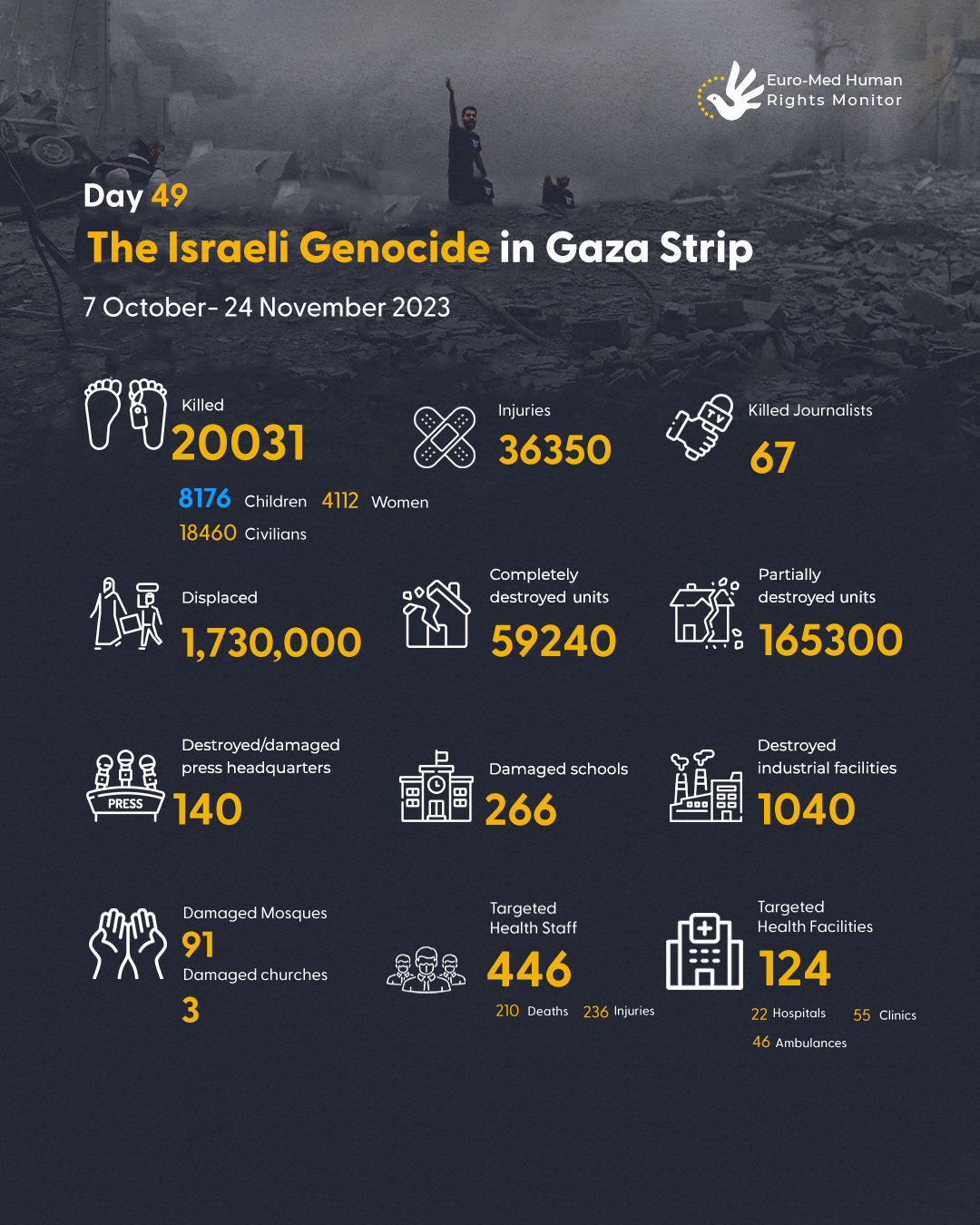
The indiscriminate nature of Israel’s assault is clear. The United Nations Office for the Coordination of Humanitarian Affairs reported on November 24 that “over 1.7 million people in Gaza, or nearly 80% of the population, are estimated to be internally displaced.” On November 25, the Swiss-based Euro-Mediterranean Human Rights Monitor reported that Israel had killed 20,031 Palestinians in Gaza, 18,460 of whom (or 92%) were civilians, since October 7.
Thus, while Israel has openly acknowledged that it is carrying out indiscriminate violence against Palestinians, US media outlets do Israel the favor of presenting its campaign as if it were only aimed at combatants. “Israel-Gaza war” comes closer to capturing the reality that Israel’s offensive is effectively against everyone living in Gaza. Yet “Israel-Gaza war” appears in 265 pieces in the three papers, exactly 300 fewer than the obfuscatory “Israel-Hamas war.”
Consider also the Euro-Mediterranean Human Rights Monitor finding that Israel has slaughtered 8,176 children. If 41% of all the Palestinians Israel has killed in the first seven weeks of its rampage have been children, and 8% have been combatants, then it is less an “Israel-Hamas war” than an Israeli war on Palestinian children.
Characterizing what has happened since October 7 as an “Israel-Hamas war” fails to adequately capture the scope and the character of Israel’s violence. Describing the bloodbath in Palestine this way obscures that grave violence is being visited upon virtually all Palestinians, whatever their political allegiances and whatever their relation to the fighting.
Cognitive dissonance

Contrary to the implication of NBC‘s headline (12/2/23), the divide in Hollywood is not between supporters of Israel and Hamas, but over the issue of Palestinian human rights.
Corporate media have often stuck to the “Israel-Hamas war” approach even when the information the outlets are reporting shows how inadequate it is to conceive of Israel’s attacks in that way. For instance, the New York Times (10/20/23) ran a story about Israel ordering 1.2 million Gaza residents to evacuate their homes, and still classified the evacuation as part of the “Israel-Hamas war.” The Izz ad-Din al-Qassam Brigades, Hamas’ armed wing, is estimated to have 30,000–40,000 fighters (Axios, 10/21/23).
The Wall Street Journal published a short piece (11/6/23) that noted:
The United Nations said that the Israel-Hamas war has killed the highest number of UN workers in any single conflict. The UN said that over 88 workers in its Relief and Works Agency [UNRWA], the largest humanitarian organization in the Gaza Strip, have been killed since October 7.
But UNRWA did not itself use the “Israel-Hamas war” narrative in the report to which the Journal referred, instead opting for “escalation in the Gaza Strip.” Indeed, Israel killing UN workers at a rate of almost three each day would seem to fall outside the bounds of an “Israel-Hamas war,” but that’s how the paper categorizes the violence. (“Israel’s war on the UN” falls well outside the bounds of the ideologically permissible in the corporate media.)
A Washington Post article (11/7/23) titled “Israel’s War in Gaza and the Specter of ‘Genocide'” quoted several experts and political leaders making a credible case that, in the words of Craig Mokhiber, former director of the United Nations’ New York office on human rights, “the term ‘genocide’ needs to be applied” to what Israel is doing in Gaza.
Nevertheless, the article’s author, Ishaan Tharoor, attributed such statements to “critics of Israel’s offensive against the Islamist group Hamas,” and described the violence as “Israel’s overwhelming campaign against Hamas.” Genocide as defined by the UN requires “the intent to destroy a national, ethnic, racial or religious group, in whole or in part.” So saying that Israel’s attacks are directed “against Hamas” twice in an article pointing to authorities on genocide invoking the term with reference to Israel’s actions in Gaza ought to generate cognitive dissonance.
Violence on the West Bank

In the first two weeks of fighting, the BBC (10/22/23) reported, Israel killed 89 Palestinians on the West Bank.
Another problem with classifying the bloodshed of the last seven weeks as an “Israel-Hamas war” is that Israel has also enacted brutal violence and repression on the West Bank, which is governed by the Palestinian Authority, Hamas’ arch rivals; Hamas is mostly confined to Gaza (Electronic Intifada, 10/28/23).
Between October 7 and November 26, Israeli forces killed 222 Palestinians in the West Bank, and Israel’s government-backed settlers killed eight more. In that period, Israel has also repeatedly carried out airstrikes in the West Bank, hitting such targets as the Balata refugee camp (Reuters, 11/18/23) and a mosque in the Jenin refugee camp (BBC, 10/22/23).
Israel has also arrested hundreds of West Bank Palestinians since October 7 (AP, 11/26/23) and attacked a hospital in Jenin, shooting a paramedic while they were inside an ambulance and using military vehicles to block ambulances from entering hospitals.
It would therefore make more sense to speak of an “Israel-Palestine war” than an “Israel-Hamas war,” but the former has been used in just two articles in my dataset.
What the media presents as a war between Israel and an armed Palestinian resistance group is in reality an Israeli war on Palestinians’ physical survival, on their food and clean water supplies, on their homes, healthcare, schools, children and places of worship—a war, in other words, on the Palestinians as a people.




This is a #MustRead article. “Israel-Hamas War” is a misnomer not only because it is inaccurate, but also because it facilitates the false labeling of anyone who criticizes Israel as being pro-Hamas. Apparently the nomenclature comes from AP guidelines which everyone else seems to blindly follow. Has AP ever changed their reporting guidelines mid-way and by what process?
I think we must now start to think about that even our own criticism is following wrong perspectives.
The postmodern German daily “TAZ”, for example, a paper that started as a kind of “ecologist Left liberal” in the late 1970s goes far beyond even the NYT or Washington Post. The paper is now, like a lot of former Leftist papers, a postmodern liberal capitalist paper, but people stay with the wrong label “Left leaning”.
The Taz’ 100/0 position against all people of Gaza cannot only be explained by the German past (I come from a Jewish family and made that mistake in my youth myself). If a paper decides to do journalism, it cannot simply take 100/0 positions, while the reputation of the same paper relies on post-structuralist “diversity” and “we only ask questions, we never have answers” ideologies, which filled all of our US European universities in the cultural sciences since 30 years at least. The TAZ started, after October 7, with horribly one-sided reports, claiming the main problem was “German antisemitism”. While we all know about antisemitism, this was simply a total distortion of what is going on in the world. London had 100 000 people-rallies for Palestine. Germany didn’t, and that was not only so because the right to demonstrated was not given, in parts. (another topic).
These are heavily distorted media, the former Left-leaning TAZ is just an especially bizarre example. But you can’t find criticism of this heavily distorted view anywhere.
If you cover what goes on in the world, you must at least see the biggest mistakes you make, yourself. Berlin TAZ does not.
The “TAZ” is just a very bad example – praise yourself to be so post-colonial, diverse, cool, and then hammer on, 100/0 style. The problem is not only the horrible paper: the problem is the majority who believes this was a good newspaper.
On the other hand it has to be said that far Left media – what is left of them^^ – can also be totally off track. On “counterpunch” the editor, October 13, in his “roaming charges” took, while belonging to the same post-structuralist camp than hundreds of papers and the Berlin TAZ, the opposite direction. In his article you found 0, zero, words of condemnation about the Hamas atrocities which started this horrible war. 1200 innocent people dancing and just living in a Kibbuz slaughtered. Not a word about it. And this is – are we really in need of stating what was obvious before our intellectual fragmentation – also wrong. What on earth Hamas thought to achieve with killing 1200 innocent people is never asked. Why?
This horrible also shows what went wrong with the Left during the last 30 postmodern years. While attacking the enlightenment and universalism, it was forgotten that NO enlightenment and universalism, “a good life for all on earth”, can be used to excuse racism, killing of the climate as the USA and Europe, male, female and diverse, are doing. Universalism cannot be used to excuse horrible wars. Self declared “enlightenment” people who tried to do so were – by definition – NO universalists.
By throwing out the baby with the bathwater, following postmodern “GODS” instead of thinking and feeling ourselves, we end up in a fragmented, bizarre world view. We must find a way back to real universalism – the only way which could get us nearer of what the Left once dreamed about, and what was never achieved on earth: peace for all, a planet which is not destroyed by 800 millions of people residing in USA, Europe and other capitalist countries. Destroyed also by posh millions who pretend to be so “post-colonial”. Mere lies to “in-scene themselves new”, to feel good and cool. And, again, innocent people are dying by the thousands.