


Malcolm Gladwell (New Yorker, 12/19/16): “Ellsberg was an insider—and that fact puts him in stark contrast with the man who has come to be seen as his heir, Edward Snowden.”
Glenn Greenwald noted the class bias of Malcolm Gladwell’s New Yorker piece (12/19/16) that compared Edward Snowden unfavorably to Daniel Ellsberg—in part because, as Gladwell wrote, Ellsberg went to better schools:
Snowden did not study under a Nobel Prize winner, or give career advice to the likes of Henry Kissinger. He was a community-college dropout, a member of the murky hacking counterculture.
But maybe more surprising than the class bias of the New Yorker’s resident deep-thinker is his take on the role of anonymous leaks. In a properly functioning media system, Gladwell argues, the purpose of leaks is to fool people into accepting government indoctrination—and it would be a shame if that system were to break down.
Gladwell borrows (of course) this argument from Columbia law professor David Pozen (Harvard Law Review, 12/20/13), writing, “Pozen argues that governments look the other way when it comes to leaks because it is in their interest to do so.” Pozen makes a distinction between unauthorized “leaks” and “plants”—the latter being “a leak made with the full authorization of the White House.” (This is a distinction that FAIR has made for years—see Extra!, 5–6/90, 5–6/06.) The article cites as an example of a plant an anonymously sourced story about CIA drone strikes in Yemen:
Letting the facts slip out served a purpose for the Obama Administration. A plant like that, Pozen writes, “keeps the American people minimally informed of its pursuits [and] characterizes them in a manner designed to build support.”…
But if you want to reserve your right to plant an authorized leak, Pozen argues, you have to allow unauthorized leaks as well:
For a strategy of planting to work, it is critical that relevant audiences not immediately assume that every unattributed disclosure they encounter reflects a concerted White House effort to manipulate the information environment….
In a world where every stealthy disclosure is a plant, the journalist is a stooge [and] the administration’s motives are transparent…. But, when the origin of the disclosure is uncertain, all parties save face.
Note that for Gladwell here, for the government’s motives to be “transparent” is a bad thing: If readers spot the “effort to manipulate the information environment,” then the government attempt to “build support” through deception will fail. Likewise, being recognized as a journalistic “stooge” is a bad thing; an undetected stooge is not a problem.
Even unauthorized leaks bolster the executive branch, in this account, by helping “to justify to the public the extraordinary power it wields.” Writes Gladwell:
The White House allows leaks—even if those leaks hamper and embarrass it in the short run—because they help it maintain its power in the long run. In short, the relationship between the government and the press—between the source of leaks and the beneficiary of leaks—is symbiotic.
But this symbiosis depends on “a degree of discretion and judgment,” a recognition that “leaking…is a ritual that obliges its participants to play by certain rules”: Governments have to prosecute leakers, but not too much; journalists can’t publish too many leaks—and must pretend that authorized disclosures are really unauthorized: the press must “preserve the ambiguity of plants, in order to preserve its access to leaks.”
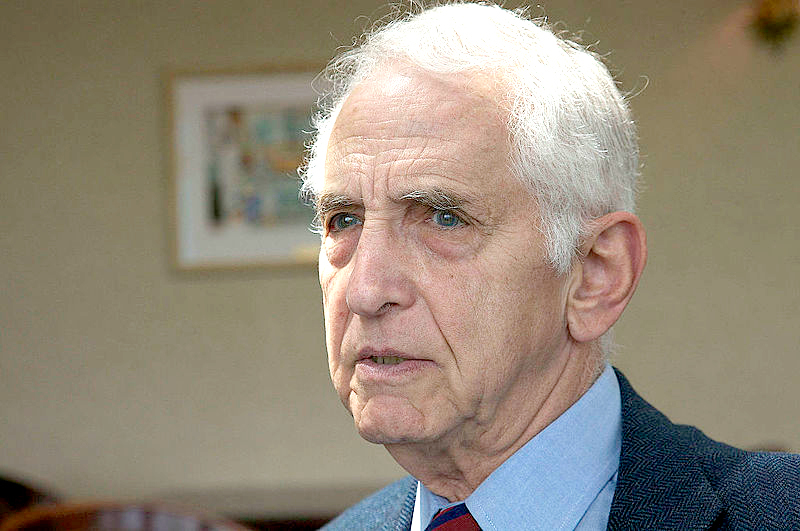
Daniel Ellsberg, whom Henry Kissinger called “the most dangerous man in America.” (cc photo: Christopher Michel/Wikimedia)
In Gladwell’s view, Daniel Ellsberg leaking the Pentagon Papers was an example of this kind of symbiotic relationship between the government and the press. After recounting how the disillusioned Pentagon official came to give the secret history of the Vietnam War to the New York Times, Gladwell summarizes:
A studious political-science Ph.D. wishes to instruct the upper echelon of American leadership in the benefits of reading several thousand pages of history, and, after his initial efforts prove unavailing, assigns a carefully curated set of course materials to the most august institution in American journalism. This isn’t the behavior of a dissident.
Funny, though—neither Nixon nor Ellsberg seemed to think the relationship was so symbiotic. Nixon rails against Ellsberg as a “radical” and part of a “conspiracy” against him in the Watergate tapes (6/15/71):
So he takes out papers and does it—now goddamn it [pounding desk], somebody’s got to go to jail on that. Somebody’s got to go to jail for it. That’s all there is to it.
In a conversation later the same day (6/15/71), Nixon condemns the Pentagon Papers leak in much the same terms that Gladwell sees Snowden:
It really involves the ability to conduct government. How the hell can a president or a secretary of Defense or anybody do anything?… And how can they make a contingency plan if it’s going to be taken out in a trunk and given to a goddamn newspaper?
Gladwell mentions the Nixon White House burglarizing Ellsberg’s psychiatrist’s office (as part of what Gladwell refers to as the “farcical denouement” of the Ellsberg case), but doesn’t note that Nixon had discussed “firebombing” the Brookings think tank in order to steal files related to the Pentagon Papers—not the kind of action typically associated with symbiosis.
For his part, Ellsberg expressed no interest in getting the “upper echelons of American leadership” to read the Pentagon Papers via his leak, but rather said he wanted to get them into the hands of the public. In an interview with Reason magazine headlined “Why I Did It!” (6/73), Ellsberg explained:
The only thing that I could personally hope to achieve by my own efforts was to make these documents available to the American public for them to read and to learn from…. What the Pentagon Papers told me when I read them was that the executive branch was determined not to learn lessons from its experience in Vietnam…. The history in the Pentagon Papers told me that if others were to learn a different lesson, it would have to be people outside the Executive Branch, and they would have to have the physical capability to read the papers.
Despite Ellsberg’s avowed interest in bringing the actual history of the Vietnam War to the people, Gladwell presents him as the quintessential leaker: “Leakers…are interested in using and exploiting secrecy: they believe that secrecy, by its preservation and strategic violation, serves an essential purpose.” Gladwell presents Snowden as engaged in an entirely different sort of activity:
Snowden didn’t leak, in the traditional sense. He flooded, and in that difference of degree is a difference in kind…. A much-needed national conversation about the NSA’s encroachment on civil liberties became sidetracked by debates about his own motivations.

Goofus exposes secrets because he thinks the public has a right to know them, not because he wants to spark a conversation among elites.
Gladwell imagines a character named “Daniel Snowberg,” essentially a Ellsbergian Gallant (“He has a doctorate in international relations”!) to Snowden’s Goofus. The imaginary Snowberg leaks only what he has to in order to get a narrow court ruling on privacy rights:
Daniel Snowberg, the insider, would have sparked a national debate that focused on the question of what access the NSA should have to the private data of ordinary American citizens…. Snowberg would have stood as someone who restored the legitimacy of the national-intelligence apparatus: who…embarrassed the executive branch in the short term in order to preserve the prerogatives of the executive branch in the long term.
If only Snowden had been an overeducated insider who valued the preservation of secrecy and wanted only to use and exploit secrets in order to preserve government power. Then we could have had a real debate about civil liberties!
Instead, having tried to expose the secrets of an abusive government to the public—just like Ellsberg did—he’ll have to wait 45 years for the inheritors of Malcolm Gladwell’s style of establishment journalism to fantasize that he was an insider all along.
Jim Naureckas is the editor of FAIR.org. You can find him on Twitter at @JNaureckas.
Messages to the New Yorker can be sent to themail@newyorker.com (or via Twitter: @NewYorker). Please remember that respectful communication is the most effective.




Very funny that Gladwell would be belittling Snowden’s schooling and/or intelligence.
Here’s Gladwell’s wikipedia writeup:
“Gladwell’s grades were not good enough for graduate school (as Gladwell puts it, “college was not an… intellectually fruitful time for me”), so he decided to go into advertising. After being rejected by every advertising agency he applied to, he accepted a journalism [sic] position at The American Spectator and moved to Indiana”
Well, let’s everyone pile on Gladwell. How dumb.
Or it could that FAIR or the writer is the unbalanced one here,
because sooner or later everyone who is a Jew or says positive
things about Jews or Israel, including Bernie Sanders eventually
comes under the fire of FIAR.
B Kline
Your incisive analysis of this article, FAIR and its readership as demonstrated by your assertion that FAIR eventually attacks, “sooner or later everyone who is a Jew or says positive things about Jews or Israel,” strongly suggests that you are Gladwell’s ideal and intended audience. Your playfulness with the acronym FAIR and the radical side of the aisle, “letf ” are simply side-splitting. Perhaps there’s an empty desk at the New Yorker, where you can continue to amuse?
You seem to imply that Gladwell is Jewish and a victim of antisemitism. In fact, he’s a Christian. I was able to learn this in a couple of minutes, and it wasn’t even the object of my search. Care to comment?
If Gladwell’s a “deep thinker”
There’s a distinctly odiferous quality to what it is he’s so deep into
Malcolm Gladwell: court stenographer, court flunkey, or court jester?
Ugh, I gave up taking Gladwell seriously quite a few years ago when it became obvious his “reasoned opinions” are often not based on reason so much as on the desire to appear counterintuitive and an outside-the-box thinker.
Why take any single person seriously, why not look at each word anyone writes critically?
Shirley
If Gladwell actually is “outside-the-box,” is there any way we can talk him back in? With Big Thinkers of this calibre writing for them, the cartoons remain the best reason for reading the New Yorker.
I’m not sure we want to talk him back in.
Let him continue to wander around aimlessly outside where he can’t do any real damage.
I used to respect Gladwell, but became disillusioned with him a few years ago when I realized he’s just another Washington stooge toeing the Establishment line. Sad to see nothing’s changed.
It gives bad taste when Gladwell talks about Snowden talks about his poor academic achievement & his the prowess of his intellect. He was not appearing in a corporate sector interview. H e did with avowed commitment what he thought appropriate &a truth worth disseminating. It is up to us to see it with objective.
Safdar Ali safdarali1948@hotmail.com
And was Malcolm Gladwell interviewed or asked about this story?
This is a good example of the “letf” eating itself.
Malcolm has to write about something on a regular basis. Everything
he pens cannot be brilliant or Earthshattering, even his books are a
bit uneven in that.
I think this is kind of an unfair hit piece on Gladwell, and for what
point? To show that he is of a certain class elite … I thought that
was obvious because he is a writer for the New Yorker.
People,including me, are upset with Gladwell’s comparison of Daniel Ellsberg (the leaker who did it the right way) and Edward Snowden (hacker) who did it the wrong way, because the information Snowden provided to journalists, having studied the actions of Wikileaks, Chelsea Manning, William Binney, and Thomas Drake thoroughly, he concluded his best chances were to get the NSA info (which a young person last night told me “who cares”) about privacy, The Constitution, the internet out to the public. If Gladwell has to write “something on a regular basis”, he’d be better off not wasting so many words on the difference between a hacker and a leaker. At first it seemed like good research. Then it fell apart. Gladwell is probably envious of the courage it to for Snowden, who had nothing to gain financiallylet alone being accused of espionage for his knowledge of what the NSA was doing. So no, it’s not an unfair hit piece on Gladwell. I was hoping more would come out about the nastiness of his article on the difference between what Ellsberg did and what Snowden did. Surely, he must know how much Ellsberg admires Snowden as well.
Gladwell has too many facets to be summed up in a single label. Some of his facets hit home more than others. I would resist the idea that Gladwell can be summed up in anybody’s single phrase. Who among the commenters would want to be summed up in just a word or two? All of us have strong points, all of us have weak points. Over-simplification is a vice of the blogosphere; the real world is more complicated.
For a much more progressive take on these issues than Gladwell’s and Pozen’s (if you’ve got the time–70 pages) see Margaret B. Kwoka’s “Leaking and Legitimacy” in the UC Davis Law Review
https://lawreview.law.ucdavis.edu/issues/48/4/Articles/48-4_Kwoka.pdf
e.g.
Gladwell’s work can, in fact, be summed up in one word: Shtick. He’s perfected this “I’m a super-smart non-expert who looks at things from a fresh, commonsense perspective that the experts ignore, and I render complicated subjects simple” act. It’s compelling. And it’s pure bullshit.
i’ve read two articles by him on two subjects that I actually know something about – health care and basketball. the first was a dull recitation of Washington conventional wisdom, (patients need skin in the game!), and the second was so laughably ahistorical that I haven’t read a word by the jackass since (a piece on how teams that are in good shape can win by pressing full court and running, complete with head-scratching about why coaches have almost never done it — without mentioning that UCLA won 10 national titles in 12 years doing exactly that).
Gladwell’s a well-paid dipshit who earns a good living reassuring people in power, especially neoliberals, that none of the world’s problems are their fault, and any problem can be fixed with a simple, common sense solution that somehow miraculously involves no sacrifice whatsoever by American elites.
Nice work if you can get it and sleep at night.
amen to maysondeck
Well put maysondeck.