


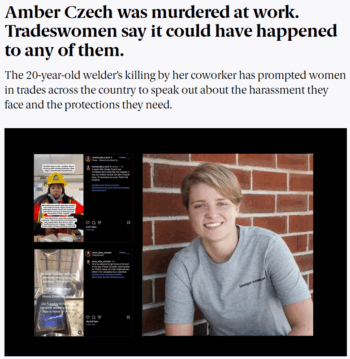
Jessica Kutz (19th, 11/21/25): “At the same time that tradeswomen are urging more to be done to address gender-based violence in the workplace, the Trump administration has curtailed resources.”
Media coverage focuses on violence: “If it bleeds, it leads.” Yeah, but only some violence, sometimes. How much have you read, for example, about Amber Czech?
She was a 20-year-old welder in Minnesota, and as the 19th’s Jessica Kutz (11/21/25) notes, in one of the rare media acknowledgements, “Women make up just 6% of welders in the country, and, as with other male-dominated occupations, it came with the risk of isolation and bullying.”
In Czech’s case, that bullying ended with a male coworker allegedly bludgeoning her to death, because, as he told law enforcement, he didn’t like her, and had been planning to murder her for some time.
I saw reports on this from tradeswomen outlets, social media and some local outlets. But it seemed to barely rate as a national story; that coverage came largely from outlets that lean heavily on crime coverage (e.g., New York Post, 11/13/25; New York Daily News, 11/13/25; People, 11/14/25).
It has nothing to tell us, evidently, about broader trends or influences. In this case, it seems, it’s just an errant individual. Nothing to see here.
The 19th reported:
Last fall, the Tradeswomen Taskforce and Equal Rights Advocates, a nonprofit focused on gender justice in workplaces, won a $350,000 grant to address gender-based violence in the workplace.
The Trump administration canceled that program.
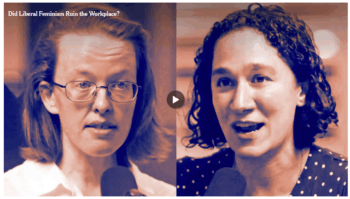
The New York Times‘ Ross Douthat (11/6/25) hosted a debate between two conservative women over exactly how feminism had been bad for the workplace.
Meanwhile in Italy, parliament passed a law recognizing the crime of femicide, or gender-based violence against women, becoming the 30th country to do so. It’s far from a panacea—difficult to prosecute, and reliant on a carceral solution—but it acknowledges the problem and creates a way to clearly track it. In the United States, femicide rates are estimated to be more than seven times higher than in Italy, yet it prompts little media attention or outrage (Ms., 4/17/25).
The New York Times apparently didn’t have space to cover Czech’s murder, but they did have room for Ross Douthat to host a debate (11/6/25) on “Did Women Ruin the Workplace”—later changed to “Did Liberal Feminism Ruin the Workplace?”—and for David French (10/23/25) to muse on “How Women Destroyed the West.”



Is there a specific crime of gender-based violence against men? Because men get murdered at a much higher rate than women. Seems weird to focus on one gender, when it’s the other gender that actually gets murdered in much larger numbers. When men are victims, they are just invisible, I guess. “Nothing to see here,” as the headline says.
You miss the point entirely. The issue is who is the murderer. The answer, of course, is tremendously disproportionately men. Moreover, men are rarely killed “because of their gender.” Not so rarely is the case for women. I do hope that alleviates your sense of “weirdness.”
Is the motive for a crime as important as the fact that it is committed? I doubt that the families of murdered men are consoled by knowing that it wasn’t his maleness that resulted in his death. If FAIR is honest about media reporting of violent killings, it would tell us that they are far more prominently reported if the victim is a woman or a child, which tells us something about society’s equivalence of the two categories.
You’re also missing the point entirely.
The point being that some people’s deaths are more newsworthy than others, based on their gender. You didn’t explain, so I will presume that’s your meaning.
So your position is that it’s perfectly reasonable that this woman’s murder – at work, and specifically due to her gender – should not be reported? How do you feel about the fact that women’s apparent ruining of the workplace and Western civilization did make the cut? That’ll show the ladies, eh lads?
As my comments made abundantly clear, my position is that the media treats men as disposable – so their deaths are less reportable – and women as if they are as frail and vulnerable as children. I’m asking why, for example, reports of a mass death might be headlined “Fifteen women and children among hundred killed”. Men’s violent killings are largely anonymised; women and children are more humanised. If there are attacks on immigrants, it is female and child victims that are highlighted by migrant organisations in order to gain public sympathy.
Had she reported issues with the man who killed her to her supervisors, shop steward, owner?
If so, and even if she didn’t, she has a very solid lawsuit that can be brought against the employer, and possibly the union as well.
The team that was going to do the study could propose to her family that they would do all the heavy lifting on the lawsuit if they could publicize the trial.
That could both get the family help in winning restitution, and give the team a way to publicize the issue and raise visibility for their now unfunded project.
May she rest in peace and justice be done.
There should be a lot more discussion about the important stories that the media ignores. Femicide and maternal mortality have been largely been off there radar. The fact that a leading cause of death for pregnant women is their partner should be a top story.
There are a lot of other stories the media chooses to bury. Just today I was complaining about the fact that the media has largely ignored the fact that the Epstein emails show Steve Bannon frequently communicated with him long after his Florida conviction. I guess the fact that Epstein was advising Bannon on his project to MAGAfy Europe isn’t as interesting to our callow media because there is no sex in the story just advice on how to spread facism. Or maybe they’re ignoring it just because it doesn’t tarnish a Democrat. The pathetic Olivia Nuzzi story is getting far more coverage.