

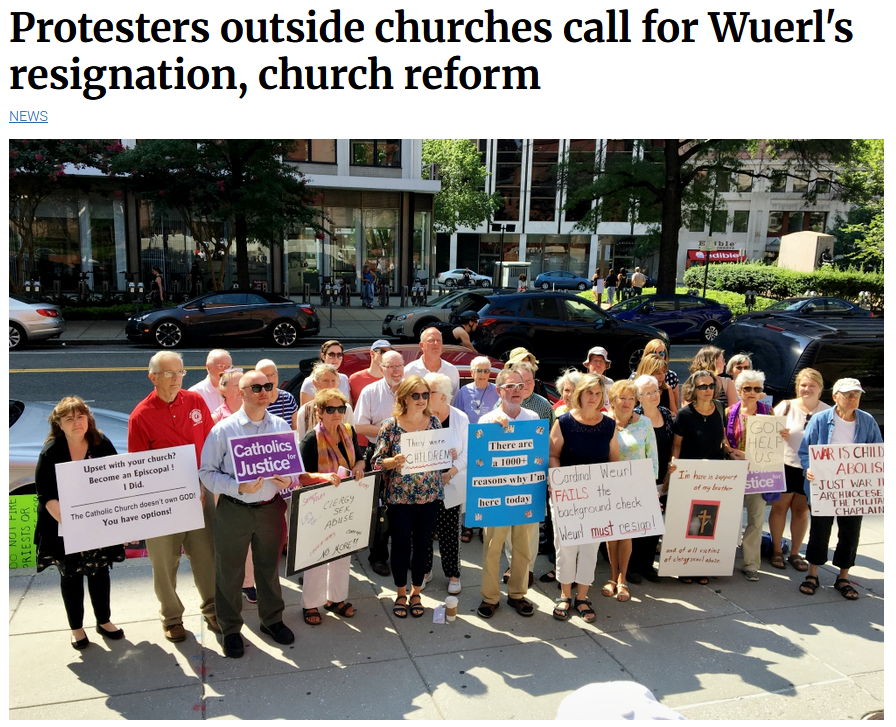
You did not have to be anti-Catholic to protest sexual abuse cover-ups outside Catholic churches (National Catholic Reporter, 8/26/18.) (These particular protests were successful; Pope Francis accepted Cardinal Donald Wuerl’s resignation two months later.)
As revelations about the Catholic Church abuse scandals emerged in the early 2000s, protests at churches grew. In Los Angeles, protesters “defiantly entered” a “church with a wooden cross covered with photographs of abuse victims,” according to the LA Times (6/2/03). An AP report (9/23/02) covered what was then “the largest protest” in response to the sex abuse scandal at “the cathedral, the seat of the Archdiocese of Boston, in months.”
The protests continued for years; in 2018, the National Catholic Reporter (8/26/18) recounted, about “30 protesters, including survivors of clergy sex abuse, stood outside the Cathedral of St. Matthew the Apostle in Washington, DC,” to call for an “end to cover-ups.”
The widespread molestation of children by priests who had the protection of the church hierarchy angered Catholics and non-Catholics alike. And at no point did any reasonable observer misinterpret these protests as attempts to intimidate Catholic mass goers or spread anti-Catholicism.
Fanning misconceptions
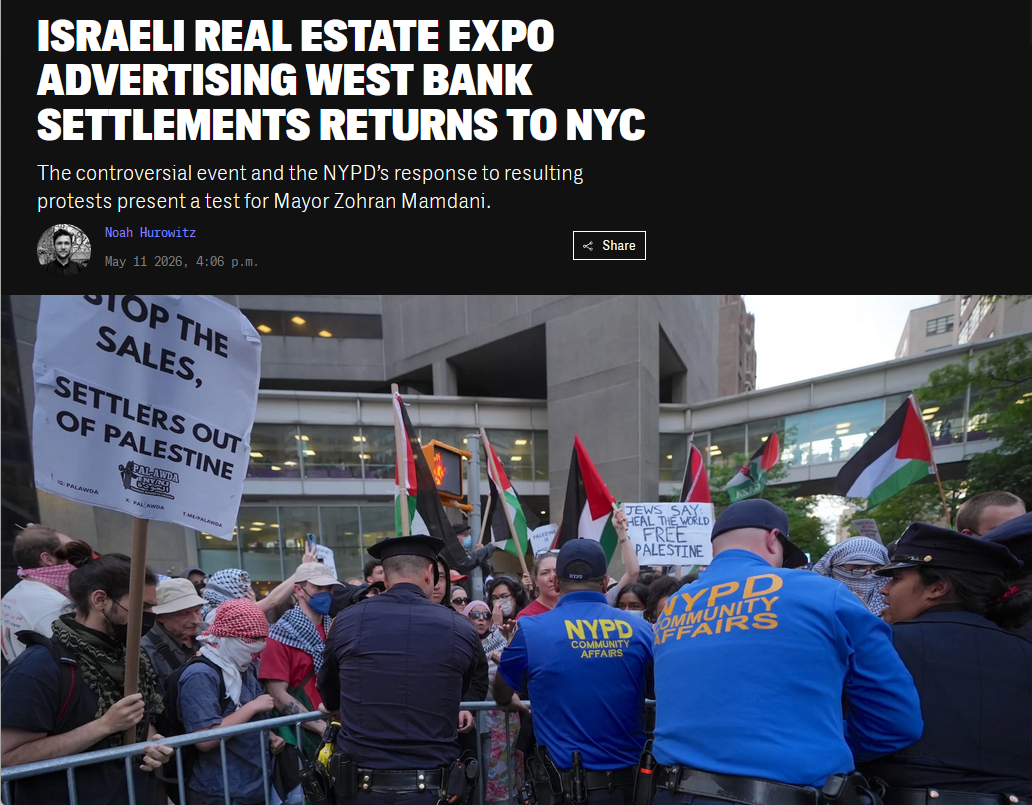
Intercept (5/11/26): “The ‘Great Israeli Real Estate Event’…is co-sponsored by several real estate companies with ties to Israel…advertising land sales in Kfar Eldad, Karnei Shomron and other Israeli settlements in the occupied territories.”
Today in New York City, the press is focusing on a series of protests against real estate events that promote “properties for sale in the occupied Palestinian territories” (Intercept, 5/11/26), settlements that are widely recognized as illegal under international law (Amnesty International, 1/30/19). Several such events have taken place at synagogues; the first protest against these illegal land sales, at the Park East Synagogue on Manhattan’s Upper East Side in November 2025, sparked so much outcry it inspired a new law giving police authority to restrict demonstrations near houses of worship (Politico, 4/24/26).
The local media have fanned the misconception that these are anti-Jewish protests, meant to intimidate Jewish worshippers attending synagogue, when in fact they are pro-Palestine protests against illegal land sales that are strategically held inside a house of worship.
In the Catholic sex scandal case, it was easy for most people to see that the protests were not about religion or bigotry, but about an injustice committed within a religious order. In the occupied land sales case, the press entertained the notion that any condemnation of Israel that happens within earshot of a synagogue must be rooted in anti-Jewish sentiment.
‘An expression of a religious desire’
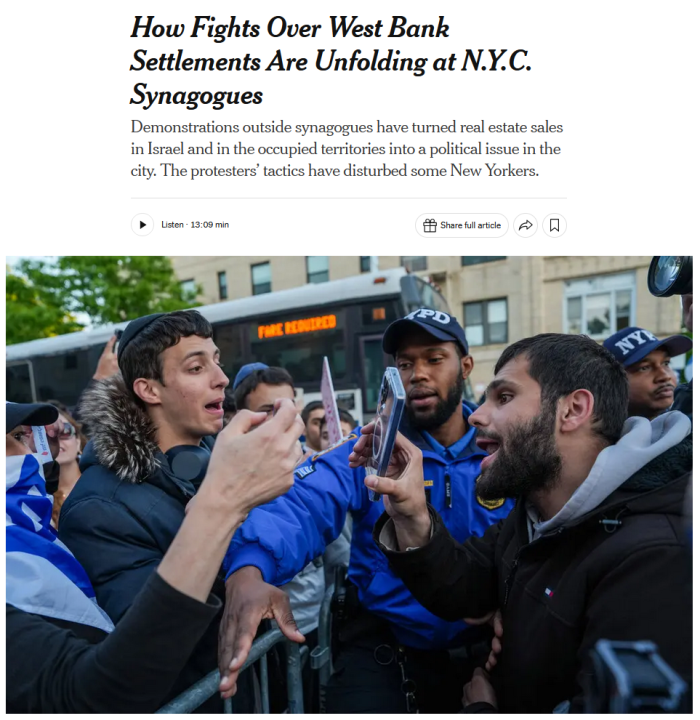
The New York Times‘ subhead (5/15/26) reads: “The protesters’ tactics have disturbed some New Yorkers.” The New Yorkers disturbed by the sale of stolen land didn’t make the headline.
The New York Times (5/15/26) wrote:
The protests have also unnerved many New Yorkers and aggravated the uneasy relationship between Mayor Zohran Mamdani, who has vocally opposed the real estate events, and some Jewish residents. They are dismayed by the raucous scenes outside synagogues at a time of rising antisemitism, and want the mayor to speak out more forcefully when protesters cross into menacing territory.
The Times‘ Liam Stack went on:
Mark Treyger, the chief executive of the Jewish Community Relations Council of New York, a nonprofit umbrella group, said Jewish residents he had spoken to in recent weeks were experiencing “a chilling effect from these numerous ongoing protests that really are spilling into intimidation, hate and harassment.” He added that he wanted Mr. Mamdani to more assertively speak out against demonstrations that cross into darker territory.
The paper reported that, while “some legal experts” agree with critics’ view that synagogues shouldn’t host the fairs “because they promote the acquisition of occupied land in violation of international law,” Treyger said that “supporters of the fairs view them as an expression of a religious desire to reconnect with Israel,” and that “the right to hold such events is protected by the First Amendment.”
The piece concluded by quoting an attendee: “I visited a few contested areas. But to me, it’s not contested, because to me it’s part of our home.”
Presumably the Times would not offer such a “both sides” framework to people who claimed a “religious desire” for racial segregation, or for executing LGBTQ people. It’s not clear why people who claim God told them to steal land from other ethnic groups should be treated differently.
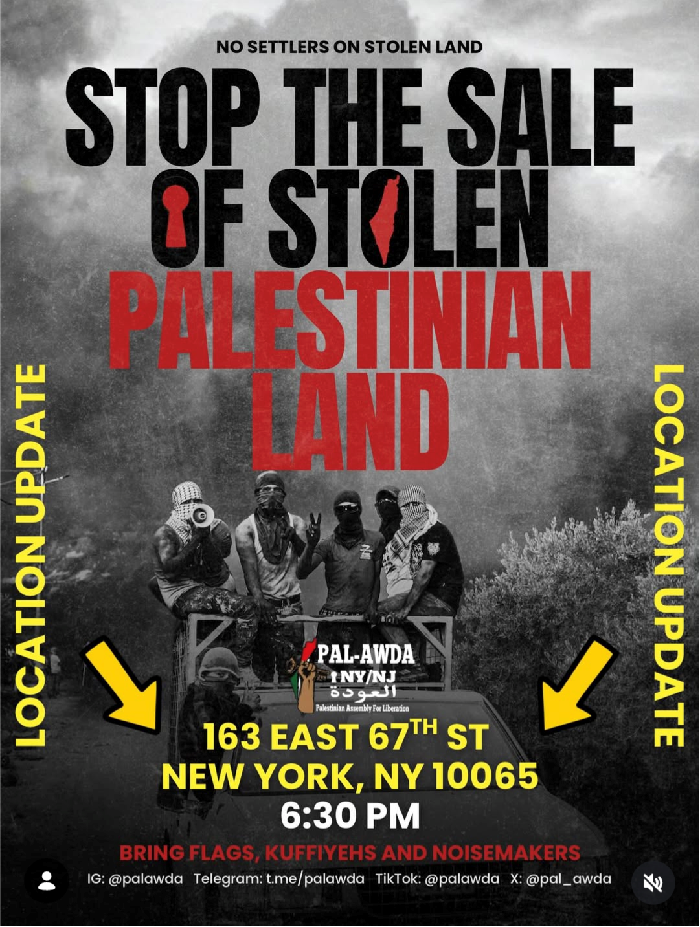
Pal-AWDA’s protest flyers are not aimed at Jews, Judaism or synagogues—but at the sale of stolen Palestinian land.
The Palestinian Assembly for Liberation–Awda, the group organizing these protests, is protesting land sale events, not Shabbos services. A spokesperson for the group pointed out to FAIR:
Reports like the Times that characterize these protests using a narrative of conflict between Palestine supporters and Jews fail to cite the presence of Jewish contingents, including Neturei Karta rabbis, that make up a key part of our protests, and who agree that houses of worship should not be used for the illegal sale of stolen Palestinian land.
Such coverage creates the idea that if someone perceives a protest to be against a certain religion, even when it’s about a certain political activity, that justifies rethinking the First Amendment right to assemble.
‘Violent thugs with keffiyeh rags’
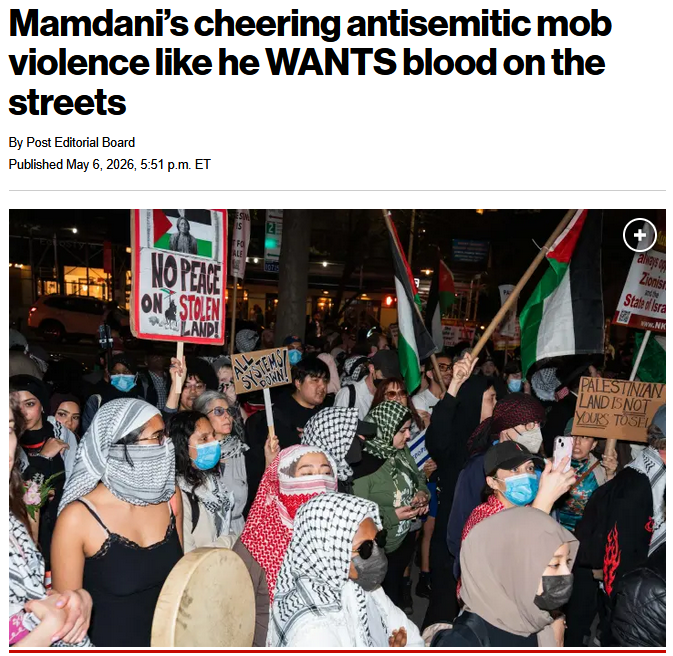
When Mayor Zohran Mamdani says we need to ensure that “all protesters are able to exercise their First Amendment rights,” the New York Post (5/5/26) says that means he’s “ignorant of US law.”
The right-wing media are predictably running wild with the story. In its trademark racist style, the New York Post (5/5/26) called the demonstrators “a hateful mob of keffiyeh-clad anti-Israel protesters.” The Post editorial board (5/6/26) went further:
Don’t let them call it a “protest”: It was a riot outside Park East Synagogue on Tuesday night, as a hundred violent thugs with keffiyeh rags tied around their faces battled with the NYPD for hours. They claimed to be protesting a meeting to promote the sale of West Bank land to Jews; in reality it was purely about moving to Israel—with [a] few brochures that had photos of Israeli settlements in the West Bank.
Protesters in fact don’t claim to be objecting to “the sale of West Bank land to Jews”; the emphasis in their material is that the land is stolen, and that selling it is illegal. But the Post‘s preferred formulation is absurd: It wasn’t about settlements…except, well, maybe a little bit.



In California they’re trying to ban these protests (AB 2664).
https://mondoweiss.net/2026/05/synagogues-that-sell-stolen-palestinian-land-should-of-course-be-protested/