


 Blaming health risks due to the Covid-19 pandemic, the New York State Board of Elections announced last week that the state would simply cancel its Democratic presidential primary, leaving former Vice President Joe Biden to be proclaimed the victor without a vote. The response from the country’s two most prominent newspapers? Meh.
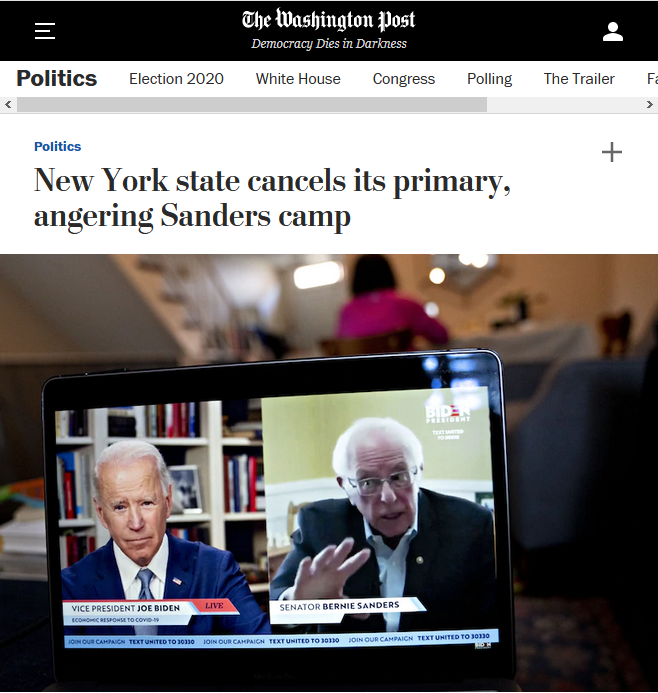
The Washington Post (4/27/20) frames the cancellation of democratic elections for New York State’s leading party as a matter of concern for the “Sanders camp.”
Under the headline “New York State Cancels Its Primary, Angering Sanders Camp,” the Washington Post‘s Sean Sullivan (4/27/20) framed the story as simply a battle between the Sanders campaign (and its allies) and state election officials, offering back-and-forth quotes from both sides. Sullivan did include one quote from an outside expert—but only to dismiss a Sanders adviser’s suggestion that the move offered a “precedent” to Trump to “use the current crisis as an excuse to postpone the November election.”
“Not so, an elections expert said,” retorted the Post, quoting the director of voting and elections at the nonpartisan group Common Cause: “You’re comparing apples to oranges.”
As we’ve written before (FAIR.org, 5/4/20, 3/23/20), many journalists seem fixated on reassuring the public that Trump can’t postpone or cancel the November presidential election, while ignoring the frighteningly real threats to our democratic elections generally (though see the New York Times‘ Emily Bazelon—5/5/20—for a vital recent exception to this trend). Could Sullivan have asked any voting rights experts about the threat to democracy posed by canceling a primary election, rather than just looking for reassurance about November?
The New York Times‘ Stephanie Saul and Nick Corasaniti (4/27/20) similarly framed the story as a dispute between the Board of Elections and “Bernie Sanders and his legion of progressive supporters.”
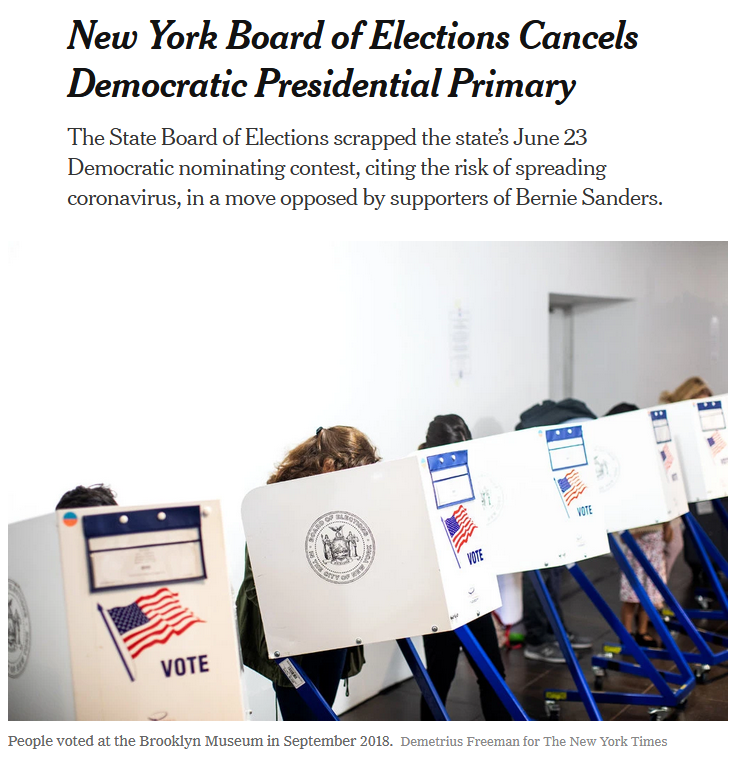
The New York Times (4/27/20) likewise presents the cancellation of the Democratic primary as something that affects “supporters of Bernie Sanders.”
It’s worth noting that the Sanders camp wasn’t the only incensed party. Candidate Andrew Yang sued the Board of Elections over the move, a development the Times didn’t run a story on until Yang’s lawsuit—joined by Sanders delegates—was ruled on by a federal judge (New York Times, 5/5/20). Judge Analisa Torres wrote in her ruling (Law360.com, 5/5/20):
The removal of presidential contenders from the primary ballot not only deprived those candidates of the chance to garner votes for the Democratic Party’s nomination, but also deprived their pledged delegates of the opportunity to run for a position where they could influence the party platform. And it deprived Democratic voters of the opportunity to elect delegates who could push their point of view in that forum.
The Times didn’t quote a single outside expert on the dangers of the move, nor did they question the state’s motives, which it presented as being based entirely on the health and safety of voters and poll workers. (The Sanders camp was not arguing for people to turn out at polls during a pandemic, but for a switch to a vote-by-mail system—Washington Post, 4/27/20.) The fact that it would help reduce the influence of progressive Democrats at the Democratic National Convention, and probably suppress the progressive vote in down-ballot elections, it seems, is immaterial. The article closed with words from state Democratic Party chair Jay Jacobs:
“We’re not being unfair, we’re just reacting to a global pandemic which happens to be centered in New York at the time.” He added: “In a situation like this, lives have to trump politics, no pun intended.”
While Saul and Corasaniti mentioned the role of New York Gov. Andrew Cuomo—who endorsed Biden long before the former vice president announced he was running (Democrat & Chronicle, 1/2/19)—they simply repeated his claim that the decision lay with the board, and that “I don’t even understand the issue, to tell you the truth.”
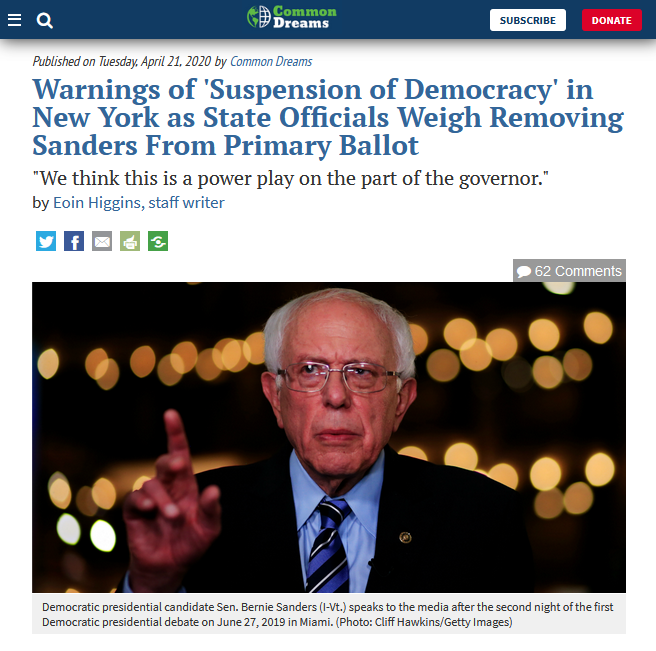
But it’s not hard to see through his feigned ignorance: It was Cuomo’s 2020 state budget that included a provision that gave the Board of Elections the unusual power to remove candidates from the ballot (Common Dreams, 4/21/20), along with provisions that would weaken third parties—like the Working Families Party, which frequently runs progressive challengers against state Democrats (Gotham Gazette, 4/13/20), much to Cuomo’s displeasure (New York, 6/7/18).
As one-time Cuomo challenger Zephyr Teachout pointed out in the Nation (5/6/20), suspending a campaign is different from terminating it; multiple presidential candidates in recent history have returned days or even months after suspending their campaigns. Giving a two-person unelected board the discretion to cancel an election when candidates have not terminated their campaigns is something you would think the home paper of record would take a bit more seriously.
At least on the editorial side of the Post, columnist Henry Olson (4/28/20)—no Sanders fan—gave voice to the deep problems with New York’s move. At the Times, FAIR could find not a single editorial voice speaking out against the Board’s move.
CORRECTION: An earlier version of this story said that the New York Times had not reported on Andrew Yang’s lawsuit opposing cancellation of the New York State primary. The lawsuit was mentioned in the 14th and 15th paragraphs of a Times story (4/29/20) about Yang’s political future.



And so New York State Dems—how long before only property owners, and they have to be male property owners too—–how long before women and those without land property are not allowed to vote anymore?
The is not a frivolous question New York—- because YOU just tried to eliminate the voice of the PEOPLE,———– ALL the People! Of course, the electoral college already does that, don’t they. It doesn’t matter what, we the voters decide–the party can decide to let the electors overrule our votes. The Popular Vote needs to rule—otherwise America moves ever closer to being the world’s biggest HYPOCRISY!
Well… I’m guessing, those affluent Creative Class folks, watching Steven Colbert sheltering in place, could vote FOR our essential working-class heros; stocking, preparing and delivering our phyto-polyphenol, antioxidant rich food? Whilst our ill-equipped, overwhelmed and lethally exposed medical professionals, first responders and sacrificial transit providers are simply too distracted, to take in the big picrure, too trapped in their gallant life and death struggle to think long term? So we could alleviate their burden by appointing our best and brighest, entrepreneurial geniuses to lead us into a brave new world and dispel the adverserial divisiveness of the past…
Correct me if I’m wrong…
1) Did NY claim they were cancelling the Democratic presidential primary because of the epidemic.
2) Were other NY state elections to be held on THE SAME DAY, so these other elections were going to happen still?
If the answer to these two statements is yes, I think most of us can read the tea leaves.
Yes – voting for everyone else is taking place.
So did no one that recommended that NY state cancel its primary not realize that there were numerous other candidates running for office outside of the presidential primary? This was the corrupt NY democratic party that just tried to silence every primary challenger to establishment democratic seats. Thankfully a judge realized what they tried to do and stopped it from happening. The NY state democratic party is by far one of the most corrupt state party’s in the country.
The district attorney of NYC just appealed the decision- the brazenness is really remarkable especially as New Yorkers don’t care forCuomo.
This is interesting. During an interview Andrew’s brother,Chris Cuomo, asked him about this ruling & Andrew basically said Bernie Sanders is on the ballot “for now”. It didn’t sit well with me and this article contains evidence that “my gut”, usually accurate more than 90% percent of the time, is correct.
FYI, I feel that Sanders on the ballot became more important BECAUSE of this pandemic.
If you are going to criticize other media reporting, you should make sure your own is correct! This story is not. It gets it horribly wrong.
This reporter says: “ It’s worth noting that the Sanders camp wasn’t the only incensed party. Candidate Andrew Yang sued the Board of Elections over the move, as the Times failed to report until Yang’s lawsuit—joined by Sanders delegates—was ruled on by a federal judge (New York Times, 5/5/20). Judge Analisa Torres wrote in her ruling
In fact, the NYT did run a story on Yang’s lawsuit shortly after it was filed. Here’s what they printed: “ Mr. Yang has endorsed Joseph R. Biden Jr. in the race, but on Tuesday night he sued the New York State Board of Elections for having canceled June’s Democratic presidential primary, according to court documents.
He argued in the documents that losing delegates and losing the right to vote in New York was “quite simply an outrage that is illegal” and that it would cause him to lose influence at the party’s convention.” NYT April 29. Matt Stephens on Yang.
You should apology to your readers and the Times. This is truly horrible.
The district attorney of NYC just appealed the decision- the brazenness is really remarkable especially as New Yorkers don’t care forCuomo. What’s horrible is that rather Democrat party has appealed the judges ruling. A grade school child would know this is illegal. the point of the article is that the Times didn’t even blink at the Democrats closing g down New Yorkers right to vote. As the hometown paper whose side or for whom do they speak?
Again you claim to know that other people’s nefarious motives are behind a plot to strengthen Joe Biden, the establishment’s candidate. You probably should in passing mention their stated motive: to prevent the spread of Co-vid 19.
From FAIR’s Mission Statement it is clear that this organization has pre-ordained that all large media corporations have one motive and that is to protect the corporate status quo. i think that is too narrow. I would argue that their motives are more diverse since they depend on maintaining a large subscription base and to do that they need to appeal to a large, diverse cross section of the population. (That diverse group contains a lot of status quo types reflective of our society.)
Welp. Turns out “Democracy dies in Darkness” really was a mission statement after all.