


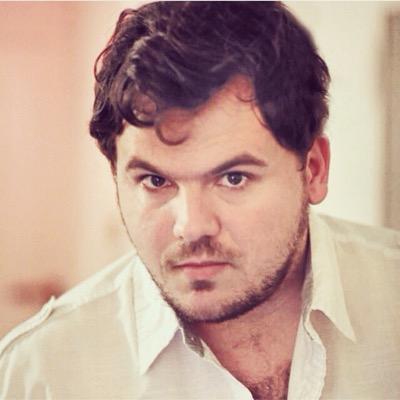
Photo of the “unkempt and impatient, often angry” Bernie Sanders accompanying a New York Times editorial (photo: Sam Hodgson/NYT)
In the latter stages of the primaries, as Bernie Sanders’ chances of actually winning the Democratic nomination went from remote to virtually nonexistent, his remaining in the race has had less to do with winning the presidency and more to do with promoting his campaign’s core ideas. Would issues like single-payer healthcare, free public college and regulating Wall Street stay on the front burner, or be left behind as a primary-season ideological fling?
And as his candidacy’s political purpose became clearer, corporate media criticism of his intention to stay in the race has become sharper. After the June 7 primaries, when it became mathematically impossible for Sanders to win a majority of the pledged delegates, much of the media circled the wagons, insisting Sanders drop out in the interest of “party unity” and “stopping Trump”—something Sanders himself has pledged to work toward.
But for establishment outlets like the New York Times, more important than Sanders dropping out of the race is that his core policy goals be dismissed as fantasy. In its editorial look back at the Sanders campaign, the Times (6/11/16) did some ideological policing:
Mr. Sanders offered prescriptions that too often consisted of facile calls for “revolution,” for feel-good but economically unsustainable proposals for universal healthcare and free tuition to public colleges.
With this one sentence, the New York Times not only embraced a right-wing canard that’s been peddled by everyone from the Wall Street Journal to the neoliberal Urban Institute, it also contradicted its previous editorial stance on the issue. In 2013, the Times (9/29/13) presented universal healthcare as a widespread standard that the US ought to meet:
After decades of debate and bitter political battles, millions of uninsured Americans will soon be able to get health coverage they can afford, a right that has long been universal in other advanced nations.
And later that November (11/18/13):
The report found that by virtually all measures of cost, access to care and ease of dealing with insurance problems, Americans fared poorly compared with people in other advanced countries. The survey covered 20,000 adults in the United States and 10 other industrial nations — Australia, Canada, France, Germany, the Netherlands, New Zealand, Norway, Sweden, Switzerland and Britain, all of which put in place universal or near-universal health coverage decades ago. The United States spends far more than any of these countries on a per capita basis and as a percent of the national economy.
But now universal healthcare is “feel-good,” “economically unsustainable” claptrap? Sanders’ proposal is based largely on the single-payer model of Canada—a model the Times editorial board venerated less than three years ago. What changed?
One major change was in the official policy position of the Democratic Party. While universal healthcare was once a broad goal of putative liberals, the Democrats’ soon-to-be leader, Hillary Clinton, says that single-payer healthcare will “never, ever happen.” New York Times Clinton partisan and leading center-left economist Paul Krugman insisted in January that single-payer was “a distraction.” Adam Gaffney of the New Republic wrote in March, “Republicans are no longer afraid of the menace of single-payer, for a perfectly good reason: The mainstream of the Democratic Party has largely abandoned it.”
One could argue that the New York Times’ problem is with Sanders’ specific proposals, and not the goal of single payer in the abstract, but such a position has never been proffered by the Gray Lady since the beginning of the Clinton/Sanders debate. The Times’ dismissal of free public college—again, also routine in several countries—is also telling: Large social programs are “unsustainable,” despite being entirely unexceptional throughout the developed world.
Conversely, the Times editorial board, which supported US wars in Afghanistan, Iraq and Libya, rarely if ever discusses the “economic sustainability” of these ventures. The urgency of these long-term budgetary commitments (over $4 trillion and counting) was put in purely moral and life-and-death terms, cost be damned.
Such conviction is entirely absent when it comes to overhauling America’s healthcare system, despite the fact that one 2009 Harvard study found that 45,000 Americans die a year due to lack of healthcare coverage. And while the ACA has mitigated this crisis somewhat, almost 10 percent—or 33 million—Americans remain without coverage.
Any attempt to radically address this shortfall—and the deaths inevitably resulting from it — is not seen as something worthy of consideration, much less endorsement. Instead, what is normal in most rich countries is dismissed by the paper or record as the “unsustainable,” “feel-good” posturing of an “unkempt,” “impatient” and “angry” socialist.
Adam Johnson is a contributing analyst for FAIR.org. Follow him on Twitter at @AdamJohnsonNYC.
You can send a message to the New York Times at letters@nytimes.com (Twitter:@NYTimes). Please remember that respectful communication is the most effective.



I don’t think you get it FAIR – what works routinely well in other parts of the world are not only unsustainable, but absolutely repugnant in the USA – this, because the USA is special, built on a history of gross exploitation, inhumanity, slavery and oppression – and still at work today – it’s the state constitution.
I’m afraid NYTs is right and FAIR wrong – I think Adam Johnson, you think you can adopt an inkling of normality like merely maturing and developing or making “change” – like putting on a new outfit. But the corpse is long past flexibility – you’d have to break it and even then it’s still a nuclear time bomb of death and addiction.
You as well must shread the USA and sever from all its past – throw it out and beg mercy and help from these other parts of the world you refer to.
Drug addicts must run their course – many are mentally disturbed, armed and dangerous- they don’t make it and take as many others as their weapons will allow, with them.
Economically unsustainable = anything that doesn’t pad the bottom line of the corporate elite.
Not to mention that “pledged” isn’t the same as “Committed”…
Hillary will NOT arrive at the convention with enough Committed Delegates to “win” the nomination so, by definition, Bernie’s not “mathematically eliminated” until and if the first vote affirms that situation…
The New York Times lied outright in an editorial last January saying the a 0.1% tax on the financial exchanges was $66 billion. The trading volume is $660 trillion so the correct answer to their own question is $660 billion. Bernie’s bill S1371 has a tax of 0.5% on stocks and lesser rates on the most toxic exchange traded assets like the CDOs popularized by “The Big Crash” but enough to easily pay everyones college tuition at least in all public institutions.