

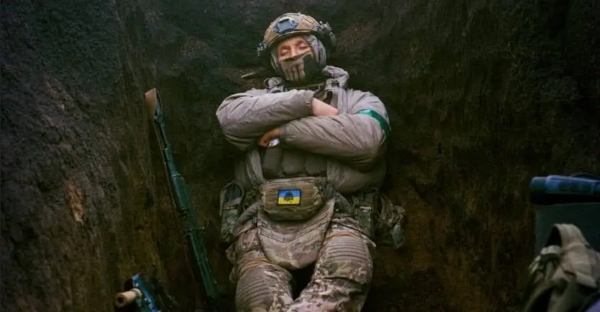
The New York Times continued its line of downplaying—or even celebrating—Nazis in Ukraine with a piece (6/5/23) that sought to explain away the frequency of Nazi symbols in photographs of the Ukrainian military. The Times commented that such imagery put “Western journalists” in a “difficult position,” noting that a Ukrainian press officer said journalists had asked Ukrainian soldiers to remove Nazi insignia before being photographed.
The headline read: “Nazi Symbols on Ukraine’s Front Lines Highlight Thorny Issues of History.” The chief concern, per the Times subhead, was the worry that evidence of Nazism in Ukraine “risks fueling Russian propaganda.”
‘Complicated relationship’

For the New York Times (6/5/23), Ukrainian use of Nazi imagery raises fears that it will help “Russian propaganda.”
At issue was “the Ukrainian military’s complicated relationship with Nazi imagery, a relationship forged under both Soviet and German occupation during World War II.” The relationship is “delicate,” the Times says, because of Putin’s stated war aims of de-Nazification.
Times reporter Thomas Gibbons-Neff dismisses the idea that Ukraine needed de-Nazification on the grounds that, despite its “acceptance” of Nazi symbols in many cases, current President Volodymyr Zelenskyy is Jewish. This weak argument is made weaker, given that, regardless of his heritage, it is well-documented that Zelenskyy sits at the center of a power structure in which far-right, neo-Nazi forces are a key constituency.
Igor Kolomoisky, one of Zelenskyy’s key supporters, was even a backer of the Azov Battalion—a group, once described by the Times (3/15/19) as a “neo-Nazi paramilitary organization,” that has been integrated into the Ukrainian military.
None of this justifies an illegal invasion. But it is clear that important facts have been deliberately suppressed or omitted within the US press (FAIR.org, 1/15/22), impairing readers’ understanding of the conflicts’ sources and possible resolutions.
The relentless threat of being labeled “Putin apologists” has created a chilling effect at even the highest liberal establishment organizations. Per the Times:
Even Jewish groups and anti-hate organizations that have traditionally called out hateful symbols have stayed largely silent. Privately, some leaders have worried about being seen as embracing Russian propaganda talking points.
The Times story acknowledged that journalists are worried about reporting reality, noting that at one point, according to a Ukrainian press officer, journalists from an unnamed outlet had soldiers remove Nazi symbols before they were photographed. This is a serious allegation of journalists knowingly distorting their portrayal of reality for explicitly political reasons.
Pioneering the Holocaust

As the Azov Battalion (center) became Ukraine’s Azov Regiment (right), it preserved its insignia’s evocation of the Nazi SS’s wolfsangel symbol (left).
The Times did find someone credentialed to legitimize running cover for Nazis:
Ihor Kozlovskyi, a Ukrainian historian and religious scholar, said that the symbols had meanings that were unique to Ukraine and should be interpreted by how Ukrainians viewed them, not by how they had been used elsewhere.
“The symbol can live in any community or any history independently of how it is used in other parts of Earth.”
The distinction drawn between how Nazi symbols were used in Ukraine as opposed to “other parts of Earth” suggests that Nazism in Ukraine was somehow more benign than in other places. To the contrary, Ukraine was where the mass slaughter of Jews was pioneered, with an estimated 1.5 million people killed there, or one in every four Jewish victims of the Holocaust. These killings were largely carried out by Ukrainian nationalist militias; survivors of these units that participated in the Holocaust were granted veteran status by Ukraine in 2019, making them eligible for government benefits (Kyiv Post, 3/26/19).
The CIA’s Nazis

As part of his defense, Kozlovskyi references the postwar anti-Soviet struggles of these Ukrainian nationalists:
Today, as a new generation fights against Russian occupation, many Ukrainians see the war as a continuation of the struggle for independence during and immediately after World War II.
Kozlovskyi and the Times omit the fascist character of this “struggle for independence.” Though it is rarely acknowledged today, the United States had a robust policy of training and equipping former Nazis in Western and Eastern Europe—by no means “unique to Ukraine”—to act as anti-Communist paramilitaries.
Ukraine saw former SS and Nazi intelligence units receive support from the CIA as part of the nationalist movement against Communism. The Nazis we see in Ukraine today are direct descendents of these networks and organizations. Even if the Times refuses to reference this history, these symbols have their roots explicitly in US-backed Nazi movements, making their defense of the current Nazis all the more egregious.
Like many facts in this war, the Ukrainian Nazi problem and its origins have been relegated to the memory hole by US corporate media (FAIR.org, 2/23/22). What’s striking is just how common it was for establishment press to acknowledge Ukraine’s Nazi problem before the war began—with the issue even recognized by the US Congress.
However, as the Times reporting has reinforced, US journalists have decided that being on the right team in this war is more important than presenting an accurate picture of events to their audience. This latest Times piece underscores the role journalists play in manufacturing consent for US policy on this and many other fronts, even if it means rehabilitating Nazi paramilitaries.
ACTION ALERT: You can send a message to the New York Times at letters@nytimes.com (Twitter: @NYTimes). Please remember that respectful communication is the most effective. Feel free to leave a copy of your communication in the comments thread.
FEATURED IMAGE: New York Times photograph of a Ukrainian soldier wearing a patch that incorporates the Nazi Totenkopf symbol.




They’ve had some prior downplaying experience – CIA in NYT.
And it works.
l’m continually astonished at my “liberal” friends’ adoption of the NPR/NYT “liberal” line that Putin is evil, the Ukrainians are valiant underdogs, and any other observation or analysis – not even contrary, just other – is verboten.
Well you shouldn’t be as it’s a bipolar country we live in and neither side will even listen to the other
I think the U.S. proxy war in Ukraine is getting a solid, media-wide endorsement that tests the historic, 24/7 anti-communism (anti-Russian) indoctrination of the American people. What is of particular interest in this current “tolerance” of Nazi Ukrainians, is that it fundamentally challenges the afore stated indoctrination. If WWII was not a united stand for liberal democracy, but an Allied victory over Nazi Germany that was only possible because of the devastating Soviet defense that no other western military could mount, then it invites Americans to look at that history with new eyes.
While the American government was unmoved by German aggression, at least sufficiently unmoved to remain uninvolved, American industrial barons and bankers were sending their considerable financial contributions to the Germans. So if we were eventually pulled into the war to stop “the hun,” that was a rhetorical pretext that shrouded our systemic compatibility with fascists.
It is not an “illegal invasion” if the people of the Donbass had been begging Russia to intervene for 8 years. It is not an illegal invasion if the Ukraine government had been attacking and shelling the people of the Donbass for 8 years. It is not an illegal invasion in the same sense that the invasions of Vietnam, Iraq, Afghanistan, Syria and Libya were illegal.
I realize that everyone is supposed to genuflect and say “Putin’s evil, illegal invasion” or they are attacked mercilessly for being a Putin puppet. It hurts every article where the author parrots the “illegal invasion” talking point.
Hey, at least FAIR doesn’t say UNPROVOKED, amirite?
Indeed, and RF repeatedly refused to incorporate the relevant oblasts into Russia, insisting that they puraue diplomatic options leading to the the Minsk Accord which the Ukrainos signed into in bad faith. None of these facts are known to the public in the west by design, since our media is as deeply dishonest as our fascism enabling governments.
Reply to John R. Moffett;
I agree with you. Maybe people forgot how, when Ukraine was part of Russia, that Kruschev and Kennedy seemed able to work together to solve their problems. I also read how Russia in WW 2 was suppose to take down Japan—-and that while Japanese were discussing the ending of war in D.C. —- Truman decided to forget about the Russians and went for nuking the Japanese in Hiroshima and Nagasaki, neither of which were war bases either.
I agree with you about how easily and how quickly Russia becomes the worst enemy ever. I guess that many in the US believe there are certain nations to be the evil ones, while the US neglects its own negative actions upon so many nations. Yes, who can forget the disgusting Victoria Nuland and her “F**k the EU comment. Or the brain dead and dead pan expressions of Blinken as Americans are murdered in Israel by Israelis.
I do despair.
Sometimes I wonder if the elected ones will ever sit down and read that short little Preamble——I would love to see America truly become that “more perfect union.'”
Checking your supposition with more facts: The “Polish” rule of Ukraine was actually the rule of the Polish-Lithuanian commonwealth, which sought, in the 17th century, to perpetrate cultural genocide upon the inhabitants of Ukraine by preventing them to worship in their traditional manner according to the rites of the Orthodox church. Russia freed the Ukrainian peasants from the Polish yoke and put an end to the proselytizing efforts of the corrupt regime in Rome.
Thank you. I’m getting very tired of that obligatory line.
It is worth noting that Zelensky’s billionaire oligarch sugar daddy and financial backer of the decidedly Nazi Azov Battalion, Igor Kolomoysky is also Jewish.
Really complicated:
Thank you again for your consistently excellent reporting about the problems with Ukraine.
Although I agree that the invasion was illegal and should have been stopped, I am endlessly frustrated with reports from the NYT and other mainstream sources that imply that to criticise Kiev in any way is to defend Putin. Putin is a reactionary right-wing autocrat. But we’re perfectly fine to negotiate with other right-wing autocrats like MBS as long as they serve American national interests.
I want the Ukrainian people to have self-determination. That is their right. I’m not opposed to our sending Ukraine weaponry, but the US and NATO (as well as allied countries like Australia and Japan) must put pressure on Zelensky to disavow the Nazis, remove them from the ranks of the Ukrainian military, and stop conflating Russian language and culture with the Putin regime.
By all means, help Kiev. But be more judicious about it.
Bryce Greene has become a treasure of a writer, I always enjoy his research and articles, good job
The fact that the United States was knowingly arming and training Nazis to kill is absolutely a justifiable obligation for Russia to invade
It helps to study history. The “Holodomor” occurred during much of the the early 1900’s until WWII, though much was during 1930-32 when Russia starved milions of people. Ukrainians, who were very successful farmers, did not want to be ‘collectivized’ so Stalin imposed Communism by torturing and starving–in many many ways—anyone who would not give up their land, farm equipment, cattle, etc. Many more details to this, but basically, in WWII when Russian troops were marching west and Germans east, the Nazi’s were forced to retreat. Perhaps you can imagine why many Ukrainians were saved by retreating with them and saw the Nazi’s as heroes. Those who couldn’t and who had to remain under Russian rule, did not forget and have never accepted the Russians and decades their brutality. History is filled with many of these kinds of things. What looks obvious is not always the truth.
Yes, because Europe, and Ukraine have never experienced a drought during any period of time in the 20th century, and *certainly not in the immediate years after the civil war* which by no means disrupted agriculture at all.
/s
Also: Deliberate starvation never troubled the so-called “consciences” of any of the Anglo-Americans when it came to supporting the British empire that deliberately starved 4 million Irish and countless tens of millions of Inhabitants of the Indian subcontinent.
Your “concerns” are noted however, Karen.
It helps to study history. The “Holodomor” occurred during much of the the early 1900’s until WWII, though much was during 1930-32 when Russia starved milions of people. Ukrainians, who were very successful farmers, did not want to be ‘collectivized’ so Stalin imposed Communism by torturing and starving–in many many ways—anyone who would not give up their land, farm equipment, cattle, etc. Many more details to this, but basically, in WWII when Russian troops were marching west and Germans east, the Nazi’s were forced to retreat. Perhaps you can imagine why many Ukrainians were saved by retreating with them and saw the Nazi’s as heroes. Those who couldn’t and who had to remain under Russian rule, did not forget and have never accepted the Russians and decades their brutality. History is filled with many of these kinds of things. What looks obvious is not always the truth.
Good work exposing the hypocrisy of our government with the support of the Ukrainian military .. obviously most US citizens did not and do not support the aggressive actions of the Russian military .. so I guess l, as history points out, war makes for strange bedfellows ..