


The Supreme Court heard oral arguments this week in Chiles v. Salazar, a challenge on free speech grounds to Colorado’s ban on LGBTQ “conversion therapy” for children under 18.
Kaley Chiles is a Colorado therapist and evangelical Christian who argues the state’s 2019 law that bans this discredited and dangerous treatment, which seeks to change a person’s sexual orientation or gender identity, is a violation of her First Amendment rights.
The other side of the case is the state of Colorado, represented by regulator Patty Salazar. The state argues that it is regulating healthcare and protecting children from a practice that every major medical and mental health organization in the US, including the American Medical Association, the American Psychological Association the American Psychiatric Association and the National Association of Social Workers, has linked to increased suicidality, depression and other serious mental health issues.
The fundamental question before the Court is whether talk therapy is protected speech or medical activity. Chiles argues that it’s speech, and that Colorado’s law unlawfully regulates the content of her speech; Colorado argues that it’s medical conduct, which is not protected by the First Amendment—states are permitted to regulate such conduct to protect patients from harmful or substandard care.
The Supreme Court’s decision will affect the fates of queer youth in more than two dozen states that ban or restrict this “therapy.” The Trump administration is backing Chiles, with lawyers from the far-right Christian group Alliance Defending Freedom (ADF) representing her.
Such a consequential case should be given careful framing and context from the media. Unfortunately, in their coverage previewing the October 7 hearing, the New York Times—and, to a lesser degree, the Washington Post and USA Today—failed in striking ways.
These three articles from three major papers were significant because they set the framework for readers to understand the case. They were also placed prominently in the papers, with the Times (10/6/25) and Post (10/7/25) articles both appearing on page A1, and the USA Today (10/7/25) piece on A4. (The stories appeared online a day or two earlier.)
The Times‘ framing skewed heavily toward Chiles’ perspective. While the Post and USA Today presented more thoroughly the experiences of LGBTQ people and the arguments of the respondents, all three pieces left out scientific and legal information that are necessary for a complete understanding of the case—and what’s at stake for LGBTQ youth.
‘Free speech test’
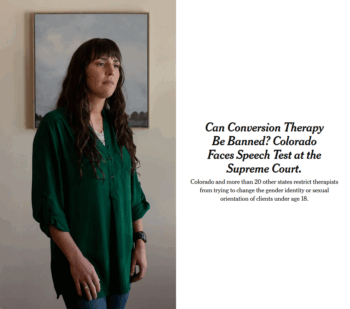
Who wants to lose a “free speech test”? The New York Times (10/5/25) put the emphasis on the rights of the therapist, rather on protecting at-risk youth from demonstrable harms.
Supreme Court reporter Ann E. Marimow previewed the hearing for the New York Times (10/5/25) under the headline, “Can Conversion Therapy Be Banned? Colorado Faces Speech Test at the Supreme Court.”
By describing the case as a “free speech test” that Colorado is facing, the Times headline frames the case exactly the way Chiles and the ADF are asking the Supreme Court to interpret it: as a question of speech, as opposed to a medical regulation issue.
The lead image is of Chiles gazing thoughtfully into the distance, and the article begins with a description of her “tranquil” Colorado Springs office and offerings of “loose leaf tea.” It paints Chiles as a well-meaning professional who, under Colorado’s ban, is unable to perform her job properly because her speech is limited:
Mrs. Chiles, an evangelical Christian with a master’s degree in clinical mental health from Denver Seminary, says the law violates her First Amendment rights, constraining what she is allowed to say in therapy sessions with young people who have sought out her care.
The article acknowledges that major medical groups disavow the conversion therapy as ineffective and potentially harmful, before returning to Chiles’ argument that “it seemed like an invasion for the state to kind of be peering into our private counseling sessions.”
Marimow goes on to lay out the legal arguments on both sides, but returns again to Chiles’ claim that these children are “voluntarily” seeking this treatment. The article notes that both sides cite last year’s decision in U.S. v. Skrmetti, which allows states to ban gender-affirming treatments for youth that they consider harmful. But it glides silently over the contradiction of anti-LGBTQ activists’ claims: On the one hand, youth under 18 are unable to consent to gender-affirming care—which has been shown to save lives—and therefore in need of protection from the state to avoid coercive pressure from medical professionals. At the same time, they are fully capable of “voluntarily” engaging in conversion therapy, which has been shown to put them at risk. (A 2024 Trevor Project survey found that 13% of LGBTQ youth report being threatened with or subjected to conversion therapy.)
The Times also lets the “free speech” perspective have the last word. The piece mentions a similar case brought in Washington State that the Court refused to hear two years ago, and quotes the objection from Justice Clarence Thomas, who said he would have heard the case “because it ‘silenced one side of this debate’ by restricting the First Amendment rights of medical professionals.”
Sidelining survivors
The New York Times only includes one quote from someone impacted by conversion therapy: Matthew Shurka, who is featured in only three short paragraphs in the nearly 2,000 word article. In contrast, Chiles, whose photo is featured at the top of the piece and whose argument weaves the narrative together, is directly quoted three times and mentioned by name in 15 paragraphs.
Shurka has testified about the trauma he experienced during five years of conversion therapy, and is an activist against the practice. “I knew I wasn’t changing and I blamed myself for my failures; it didn’t occur to me that the therapist was harming me,” Shurka is quoted as saying.
A beat later, the reader is back in Chiles’ office, with “a photo of a sunset with a biblical verse about the power of counsel and understanding,” while the Times lists her experience and credentials.
Marimow’s piece fits into the pattern that FAIR has long documented and quantified of the Times sidelining trans and queer perspectives on issues that impact their lives (FAIR.org, 7/14/25, 5/30/25, 5/28/24, 8/30/23, 5/19/23, 5/11/23).
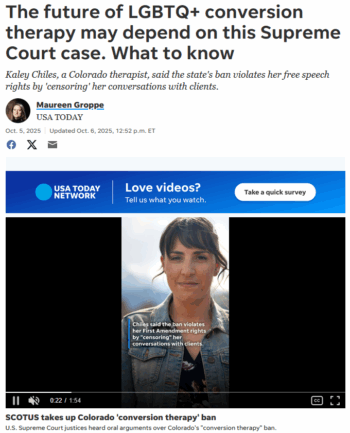
Rather than leading with the therapist’s perspective, USA Today (10/5/25) opened with a gay man recalling that through conversion therapy, he “absorbed the therapist’s message that something was deeply wrong with him.”
In contrast, other major papers spent more time centering former conversion therapy patients. USA Today (10/5/25) began its preview of the case with the story of Matt R. Salmon, a gay survivor of conversion therapy, which he refers to as a form of “psychological abuse.” Salmon is now a psychiatrist and counselor himself.
“Licensed professionals don’t have free speech,” he argues. “You don’t just get to say whatever you want.”
USA Today also cited the testimony of Francis Lyon, a trans man who testified to the Colorado legislative committee in 2019 that conversion therapy blamed his parents for not instilling “femininity” by encouraging him to wear skirts, hose, heels and cosmetics.
Like the New York Times, the Washington Post (10/6/25) led its piece with a profile of Chiles. But unlike the Times’ Marimow, Post reporter Justin Jouvenal spent significant space on the testimony of a conversion therapy survivor. Silas Musick, a transgender man from Colorado Springs nearly ended his own life in 2010 as a result of the conversion therapy he underwent. He testified to the Colorado state legislature in 2019 to support the law that is now in question.
“There was no amount of thinking or praying or wishing or trying to change daily behaviors,” Musick told the Post. “It led to the deepest, darkest depression of my life.”
“Musick eventually concluded that he couldn’t live his life as his family and religion wanted, so he would end it,” Jouvenal wrote.
Not a mental illness
The Times also presents Chiles’ case as one of not being able to provide sufficient mental health care.
“If clients under 18 tell her that their same-sex attractions are causing them stress, as a licensed therapist, she is forbidden from counseling them to change their sexual orientation,” the piece explains.
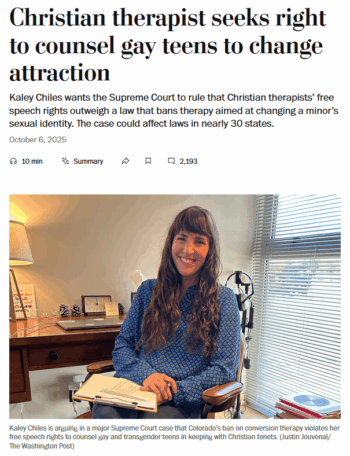
The Washington Post (10/6/25) leads with Kaley Chiles’ claim that a ban on conversion therapy “silences her.”
The Washington Post further quotes Chiles’ argument that sexual orientation and gender are being “treated differently than literally every other topic in counseling…. It’s not the way we would operate with addictions and eating disorders and with depression.”
There’s a good reason for that that the Post should have pointed out: Same-sex attraction and transgender identities are not mental illnesses.
As the APA and other professional societies have made clear, this is the underlying problem with conversion therapy:
While many might identify as questioning, queer or a variety of other identities, “reparative” or conversion therapy is based on the a priori assumption that diverse sexual orientations and gender identities are mentally ill and should change.
The American Psychiatric Association removed homosexuality from its Diagnostic and Statistical Manual of Mental Disorders (DSM) in 1973, and “gender identity disorder” in 2013. Studies show real mental illnesses LGBTQ youth face are a result of social stigmatization—not their identities themselves (Trevor Project, 12/15/21).
Both pieces fail to make this critical point about mental illness and conversion therapy, allowing LGBTQ experiences to be quietly pathologized and stigmatized.
Meanwhile, there are treatments that are shown to improve the mental health outcomes of queer youth. A 2022 JAMA study found that gender-affirming care for trans youth cuts their suicide risk by 73%. And the Trevor Project’s 2024 survey of LGBTQ youth’s mental health found that queer-affirming schools, families and communities greatly reduce children’s suicide risk.
Misrepresented evidence
The Times also left readers uninformed on the evidence behind the harms and ineffectiveness of conversion therapy. “In her filings, Mrs. Chiles also rejected the state’s reliance on a medical consensus, saying there is insufficient evidence that voluntary talk therapy that seeks to change a minor’s gender identity or sexual orientation causes harm,” the Times piece stated, without offering any analysis of that evidence.
Those filings from Chiles and the ADF cite—in addition to such “evidence” as testimonials from “detransitioners” and people who profess to having successfully changed their sexual orientation, as well as the Wall Street Journal editorial board, the Daily Wire and a Reddit thread—a very small handful of studies that it claims show that conversion therapy is not actually harmful, and that people’s gender expression and sexual orientations can be changed.
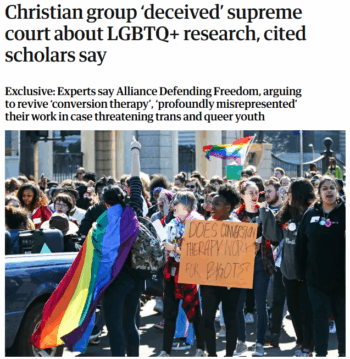
A researcher whose work was cited by advocates for conversion therapy actually described such therapy as “not only ineffective in changing sexual orientation but … psychologically damaging, often resulting in elevated rates of depression, anxiety and suicidality” (Guardian, 10/6/25).
But as the Guardian (10/6/25) reported, two of the scholars cited said the ADF “profoundly” misrepresented their work in ways that threatened the safety of queer youth.
The ADF cites a study by Clifford Rosky and Dr. Lisa Diamond, claiming that their work suggests sexuality is subject to change. In reality, the study discusses the fluidity of sexuality for some people, independent of conversion therapy, and condemns the practice as potentially lethal.
“They claim our work supports conversion therapy when our work clearly and specifically condemns conversion therapy on the same page they’re citing,” Rosky told the Guardian.
The ADF and Chiles further cite a 2009 APA study in their argument that noted a lack of research on the effects of conversion therapy on youth specifically. USA Today points out that this is because of the ethical problem of subjecting children to conversion therapy, which the APA asserts in studies (2009, 2015, 2020), and reiterates in their brief to the Supreme Court, is ineffective and harmful.
The New York Times and Washington Post pieces do not mention the ADF’s misuse of these studies as “evidence,” even though they clearly undermine their support for conversion therapy. Nor do they cite or link to any of the peer-reviewed studies provided by Colorado to support its position.
In reality, lesbian, gay and bisexual people who have undergone conversion therapy are nearly twice as likely to attempt suicide. Transgender and nonbinary youth who have been subject to it are more than twice as likely to attempt suicide (NBC News, 9/11/19). That risk jumps to four times as likely if they’ve undergone conversion efforts before age 10.
Even though Chiles is framing her argument as one of free speech, the lack of scientific evidence for her claims as a health professional is critical, because Colorado’s argument centers on the state’s ban protecting children from substandard care.
False equivalence
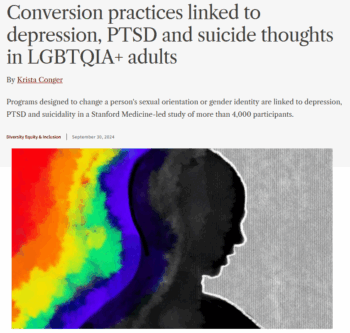
Coverage that was centered around the mental health needs of LGBTQ youth, and not a therapist’s interest in self-expression, would look very different (Stanford Medicine, 9/30/25).
One of the few things the Times does point out (if late in the piece), that the Post and USA Today fail to, is that one of the main legal challenges that Chiles faces, and one of Colorado’s central arguments, is that the law has never actually been enforced in the state, and would not be applied to any therapy she has claimed to have engaged in. As Justice Sonia Sotomayor argued in the hearing, the Court requires “credible threat of prosecution” for Chiles to have standing to even bring the case, and none is demonstrated.
But the Times‘ clarification is not made before the paper first paints a picture of the Colorado law constantly impacting Chiles’ practice, rather than simply being a hypothetical:
Under a 2019 Colorado law, if clients under 18 tell her that their same-sex attractions are causing them stress, as a licensed therapist, she is forbidden from counseling them to change their sexual orientation. If they want to talk about their gender identity, she cannot advise them to change it.
When the Times asked her if she has ever practiced conversion therapy, Chiles responded that she “has worked with young people struggling with gender dysphoria and unwanted sexual desires.”
“I’ll just have to let everyone else decide what that is as a label,” she said.
Meanwhile, queer people who have undergone conversion therapy face very real and well-documented risks.
The absurdity of pitting a hypothetical “chilling” effect on Chiles’ speech, versus the litany of studies and real lived experiences that prove conversion therapy is not only ineffective but dangerous for the mental health of LGBTQ people, is lost in all three of these pieces.
It is certainly journalists’ job to present both sides of important Supreme Court cases. But it is also their duty to clarify the medical consensus, the context, and the potential impacts of the case. While it’s true that the professional practice of Kaley Chiles and others like her might be impacted—despite her failure to demonstrate that—it’s hard to argue, given the evidence, that the people most impacted by this case will be anyone other than queer youth. It’s their lives and perspectives that therefore ought to be centered in the coverage.





This is an excellent take down of a well-documented therapy practice that hurts patients. Thanks for highlighting it!
The Roberts Court hates State’s Rights if those States aren’t beholden to far right ideology or MAGA brain worm skepticism of science and modern medicine. All 6 of the court’s conservatives keep using a shell game where they leave it up to future legal scholars to wonder how Roberts is for States’ rights but keeps overruling the will of the People of the State of Colorado twice now.
When the GOP loses control of Congress soon, the number one task of the opposition to the GOP should be to strip these charlatans on the SCOTUS of the appellate jurisdiction they’ve profoundly abused, it would effectively squash their ability to exploit the shadow docket as a rubber stamp for new law making, unbelievable that this has not gotten more scrutiny and attention. No thanks to the corporations who benefitted from shadow docket rubber stamping.
How these unelected 6 keep overruling lower more salient courts is a scandal, especially when anyone can see those 6 unelected activists are abusing their authority to strip transgender and anti queer folks of protections and rights.
The word “anti” in the last paragraph / run on sentence was a typo.
I agree that conversion therapy is quackery, but there is one fundamental fact that FAIR (deliberately?) left out: conversion therapy is rooted in Dialectical Behavioral Therapy (DBT), which is championed by mainstream psychiatry, despite its torturous nature. DBT as a one-size-fits-all therapy has been criticized many times and places, especially its slightly more legitimate cousin CBT (cognitive behavioral therapy), which is often deployed to victims in war zones and other societal calamities mostly because it teaches the client/victim that their own emotions are always wrong. CBT is noteworthy for blaming victims of social unrest for their emotions, making it a tool of neoliberalism, reflected in its celebration and investment amongst Western states. DBT is rife with grifters in the therapy space, usually peddling phony quick-fixes to BPD and other mental issues. But since modern left-wing culture is gung-ho for “mental health,” its many problems are swept under the rug, and only addressed in more extreme cases like homo/transphobic conversion therapy.
DBT is routinely foisted on the LGBT+ community sans the conversion part—“It’s okay to be gay or non binary, but all your OTHER emotions are wrong”— and it seems strange that FAIR would ignore this. (Maybe the word ‘dialectical’ is a branding trick to sucker progressives?) After all, the LGBT movement came from the anti-psychiatry movement, something that seems completely forgotten as queer people are constantly being told they have “anxiety,” “depression,” attachment issues,” and recently “autism,” all real conditions that nevertheless are used by well-organized bigots to malign mentally healthy people who don’t conform to societal norms and expectations—oddly those expectations are never examined for mental unwellness. The result is that while mental health culture allegedly is about affirming and “helping” LGBT people, in practice is serves to pathologize queer people by putting their emotions through means testing, much as that practice used to deny social welfare benefits isn’t directly racist but still serves a racist purpose. One would think FAIR would catch this.
Perhaps most disturbing is the MAGA drumbeat of re-opening asylums, which dovetails with CBT/DBT extremely well. The long and ugly legacy of poorly run asylums is legion. CBT/DBT and other pseudoscientific “therapies” derived from them will continue to plague mental healthcare for the foreseeable future. It would be nice if FAIR provided a nuanced perspective on this—after all, the anti-psychiatry movement also gave rise to the notoriously queerphobic Church of Scientology, so a one-size-fits-all rebuttal is just as problematic—but that also does not seem to be likely to happen anytime soon.
Who told you this? Who told you that conversion therapy is “rooted in DBT?” Dialectical Behavioral Therapy is antithetical to conversion therapy whose roots are religious puritanical ideology and a discredited hypothesis that being gay is wrong or unnatural.
Nothing about DBT or CBT has ever been tied to conversion therapy, which isn’t the same as saying that conversion therapy clinicians aren’t lying and claiming their methods come from DBT. You do realize right that these fake clinics have a motive to lie about the origins of their conversion methods, no?
Of course conversion clinics are going to lie to obfuscate the fact that their clinic is based on far right wing conservative religious morality policing.
Before you take the word of anyone online, including me, use credible sources for anything you attempt to claim about topics you are unfamiliar with. DBT and CBT are based on mindfulness, and are used to treat addiction, some OCD, to treat eating disorders and phobias, but has never been credibly linked to conversion therapy.
Again, take the following quote as a starting point not an absolute or ultimate truth claim:
“The claim that conversion therapy is rooted in Dialectical Behavioral Therapy (DBT) is a persistent online myth. The two are distinct and antithetical: DBT is an evidence-based therapy that emphasizes acceptance and emotional regulation, while conversion therapy is a discredited and harmful practice that attempts to forcibly change a person’s sexual orientation or gender identity.”
The above quote came from Google’s A.I. Overview so please take it with a grain of salt and do better than relying on bullcrap you’ve read on a Reddit or Discord forum.
I use Google or other search engines as a starting point, not a primary source.
DBT is based on empiricism, that means evidence based science or medicine, not pseudo religious puritanism which conversion therapy is rooted in.
No offense but I knew your comment was problematic for two reasons, one is because you cite no credible sources for your primary claim (asserting conversion therapy “is rooted in” DBT/CBT, probably because there are none), and second because you are probably going off what some conversion therapist has claimed, do not do that.
Conversion therapists lie. And no matter what some conversion clinic’s website says, or its therapist’s claim, conversion therapy techniques are not rooted in DBT. Do not trust deceptive discredited sources, especially these fake religious clinics whose sole enterprise is misleading people, and to lull people into their religious ideologies.
DBT can also be misused by clinicians but this does not mean the problem is necessarily with DBT, hopefully you understand that as well.
Watch out for therapists who claim conversion therapy is based on DBT, it is not. Conversion therapy is 100% discredited, psychotic, and dangerous nonsense that causes grave harm. DBT is a neutral methodology that when used correctly is successful to treat people suffering from a wide range of self destructive behaviors, being gay is not self destructive in its own, right? Self destructive is like substance use addictions, unhealthy compulsions like gambling or shopaholic, and eating disorders like anorexia or bulimia.
I knew someone who went through a four year research study that used DBT/CBT in one of the study’s trials. The person who was in the study worked with psychiatrist Marsha Linehan, and they knew her personally. Look her up, she’s one of the founding psychiatrists who developed DBT, which comes from Buddhism, not evangelical pseudo Christianity, or far right wing obsession with controlling others.
Extreme contempt of psychiatry and psychology as a whole, is unreasonable hysteria that is unhelpful. Especially when it’s been leading psychiatric, psychological, and other institutions who have refuted the validity of conversion therapy, check this out:
Virtually every accredited medical, psychiatric, and psychological authority opposes conversion therapy, due to its lack of scientific validity and documented harm. These practices are based on the false assumption that being LGBTQ+ is a mental illness that can or should be “cured”.
The consensus among health professionals is overwhelming, with global and national organizations from various fields all rejecting conversion therapy.
Major psychiatric and psychological organizations
American Psychiatric Association: Opposes any psychiatric treatment that assumes homosexuality or gender diversity is a mental disorder. It advises therapists to respect and affirm individuals’ identities.
American Psychological Association (APA): Found insufficient evidence that conversion therapy can reliably change sexual orientation or gender identity and noted it poses risks of harm. It advises against sexual orientation change efforts (SOCE) and gender identity change efforts (GICE).
World Psychiatric Association (WPA): Declared conversion therapy unethical, unscientific, and harmful, stating there is no sound scientific evidence that innate sexual orientation can be changed.
American Academy of Child and Adolescent Psychiatry (AACAP): Finds no evidence to support any “therapeutic intervention” that assumes a specific sexual orientation or gender identity is pathological.
American Psychoanalytic Association: Considers directed efforts to change sexual orientation or gender identity to be against the fundamental principles of psychoanalytic treatment and often resulting in substantial psychological pain.
American Association for Marriage and Family Therapy: Condemns conversion therapy, aligning with the consensus of other major medical and mental health organizations.
National Association of Social Workers (NASW): Considers conversion therapy an infringement of social work ethics and values.
To Olivia Riggio, thank you, your article hit the nail on the head. Between your piece and one by Elie Mystal covering Clarence Thomas wanting the court to use its Republican Super Majority to reverse rulings conservatives don’t like, it’s now becoming clear that standing or not the vengeful six are salivating to be let off their leash.