

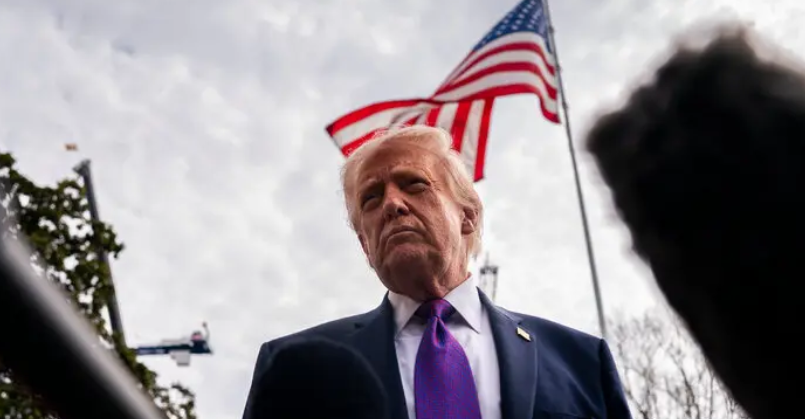
According to the New York Times (4/7/26), US intelligence officials assured Trump that “crippling Iran’s capacity to project power and threaten its neighbors” was “achievable with American intelligence and military power.”
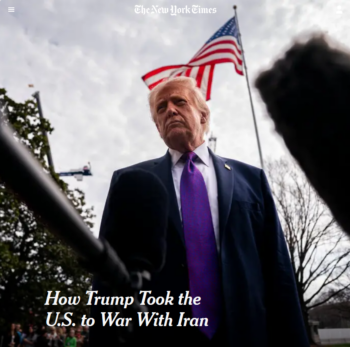
A New York Times exposé (4/7/26) detailed a presentation by Israeli Prime Minister Benjamin Netanyahu to President Donald Trump in the White House Situation Room—meant to sell the president on a war with Iran roughly two weeks before the US’s initial attack—and Trump’s subsequent discussions with his inner circle.
The Times report, headlined “How Trump Took the US to War in Iran,” is sparking renewed corporate media attention to how this conflict began. But that discussion has been clouded by the report’s fixation on Netanyahu’s sway over Trump and alleged divisions among his advisers.
That Trump was narcissistic and gullible enough to believe lies Netanyahu told him, as the report lays out, was undoubtedly an important factor in the time and manner of a US/Israeli assault that has killed thousands and effectively widened the scope of the Gaza genocide.
But buried within the report is an interesting detail indicating more structural forces were also at work: The Times‘ Jonathan Swan and Maggie Haberman reported that the US intelligence community determined that, while the prospect of regime change was “farcical,” “crippling Iran’s capacity to project power and threaten its neighbors” was “achievable with American intelligence and military power.” Iran’s continued capacity to close the Strait of Hormuz and exact a heavy toll on US bases in the region demonstrates this was a faulty assessment.
Whether it was by groupthink, incompetence or the influence of neoconservatives and the Israel lobby, the fact that the national security state came to such an erroneous determination is going criminally underdiscussed.
Military/industrial megaphone
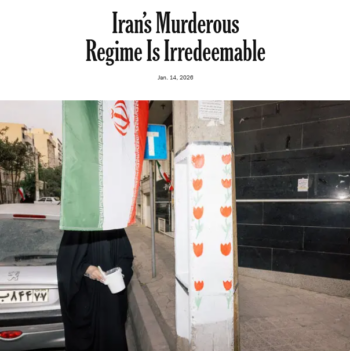
Despite Mossad openly bragging that its agents had directly participated in an armed uprising against the Iranian government, the New York Times (1/14/26) held that Tehran’s depictions of “protesters as puppets of foreign enemies” were “smears” that “should not intimidate the world into inaction.” This was the paper’s last Iran editorial before Trump and Netanyahu launched the war.
A full accounting of how this disaster came about must grapple with the US military/industrial complex and its push for war. No less important is reckoning with that complex’s megaphone: the compliant US corporate media. And juicy scoops on palace intrigue concerning the leaders in the White House and Tel Aviv won’t wash away the Times’ participation in that push.
The Times’ streak of failing to challenge, or even actively encouraging, major US wars (FAIR.org, 10/23/17) remains unbroken during this latest misadventure. Their approach this time was more disjointed than in the past: First, the usual bluster. But then, an all-too-conspicuous silence.
When war with Iran—a heavily armed nation of 90 million people with eminent geographic advantages—was just theoretical, the New York Times’ editorial board was as hawkish as usual. That included cynically deploying humanitarian concerns in Iran to advocate for regime change just 12 days before the armada’s arrival in the gulf (FAIR.org, 2/10/26).
In that January editorial (1/14/26), headlined “Iran’s Murderous Regime Is Irredeemable,” the Times pulled out arguments from the old regime-change playbook. The Iranian government, the Times said, is “among the world’s most nefarious regimes, and the people who bear the biggest cost are the citizens of Iran.”
Having neatly packaged their argument urging empathy for the Iranian people, the Times then offered a familiar sleight-of-hand for its readers: It is possible—natural even—for coercive US power to be utilized to help the Iranian people “achieve liberty.” Offering the considerations it thought Trump should be taking into account, the Times wrote:
The crucial question is what measures—diplomatic, economic and potentially militarily—have the best chance to strengthen the protest movement and sow division among elites allied with the Khamenei government.
Never mind that US policy has been to the detriment of Iranians’ “liberty” for the better part of a century. The papers’ editors advised Trump that, if he chooses the military option, he should do so “much more judiciously than he typically does.”
Suddenly silent
As war became increasingly likely—that is, once Trump began amassing his “armada” in the Persian Gulf—the editorial board went silent. No more calls for coercive force. No more discussion of Iran at all.
From January 26 to February 27—the 32-day period of military buildup, during which Trump was weighing one of the most consequential US foreign policy decisions of this century—the Times’ editorial board had nothing to say.
That is unprecedented, given the page’s historic role in promoting US adventurism. In the 32 days preceding the US invasion of Iraq, for instance, the New York Times published 13 editorials perpetuating the weapons of mass destruction myth, which to them was sufficient justification for a war against Iraq.
The public debate over whether or not to go to war with Iraq was so ubiquitous leading up to the invasion that one of the Times’ pro-war editorials (2/23/03) acknowledged that “the debate over Iraq has exhausted everyone.”
That voluminous public debate, replete with fabrication and misinformation as it was, manifested in broad public support for the war. In the first days of the conflict, 76% of the US public favored military intervention in Iraq.
The Iran War, on the other hand, is only the second major US war (after the 2011 Libyan intervention) in the era of modern polling to start with more Americans opposed than supportive of it. Any propaganda campaign in favor of war with Iran would have a steep hill to climb after two decades of experience with Middle East interventions.
Mirroring Democratic silence
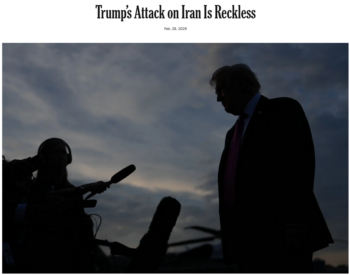
While quibbling about how Trump went about attacking Iran, the New York Times (2/28/26) agreed that Iran’s government was a “distinct threat” that combines “murderous ideology with nuclear ambitions.” It counseled readers that “recent history demonstrates that military action, for all its awful costs, can have positive consequences.”
In the last two weeks before Trump launched his attack, details of his military deployment, like the inclusion of E-3 Sentry Airborne Warning and Control System (AWACS) aircraft, indicated that the potential for war was serious.
Still, the Times editorial board found no reason for comment. Given that the editors were advocating for regime change mere days before Trump took up their suggestion by ramping up its forces in West Asia, it is highly doubtful that they learned from their history of mistakes and had a change of heart. In any case, if they did, they didn’t voice it.
What can be said is that the Times’ silence mirrors that of Democratic leaders in Congress, who also barely let out a peep during this period. For their part, it is clear that they aimed to conceal their support for the war from their base, who overwhelmingly oppose it. Within that dynamic, congressional Democrats waited until after the war began to propose a war powers resolution—demonstrating their issues, if any, were about process, not substance.
The Times likewise saved its feckless criticism until after the war began, penning an editorial (2/28/26) the day Trump launched the war (proving their capacity to move quickly when convenient) voicing process concerns: Trump lacked clear achievable objectives, threatened to mire the US in another “endless war,” and failed to consult Congress. Like Democratic leaders, the Times failed to reject—and indeed reiterated—the logic of the war itself: that article of faith that Iran is an intolerably evil and belligerent state (FAIR.org, 3/13/26).
Just like Democratic leaders, the New York Times failed to use its outsized influence to challenge this monstrous war. Instead, it participated in its genesis, through cowardice as much as through sanctimony.



Leave a Reply