

The New York Times for many years had a transgender contributing opinion writer, Jennifer Finney Boylan. Part of a less exclusive club than that of columnists, who appear more frequently, Boylan nevertheless offered a rare, recurring trans perspective in one of the most prominent opinion sections in the country.
But in April, a seismic shift quietly occurred in that opinion section: Boylan departed, and just two weeks later, the paper debuted Pamela Paul as a new columnist—one who regularly engages in anti-trans politics.
Paul, the former Book Review editor at the Times, never directly attacks trans people; that wouldn’t fly in the New York Times opinion section, as she surely knows. But her repeated returns to anti-trans themes and anti-trans sources reveals a clear agenda that has more in common with Marjorie Taylor Greene than Paul, or the Times, would ever care to admit.
Free to be—not you
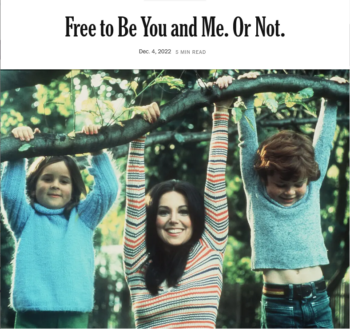
It takes some ingenuity to turn Free to Be…You and Me into an argument (New York Times, 12/4/22) for further marginalizing an oppressed minority.
In what by my count is now her fifth column to vilify trans people or the trans movement, subtly or directly, Paul (12/4/22) took the 50th anniversary of the popular ’70s album/book, Free to Be…You and Me, as an opportunity to argue that the movement toward letting people define their own gender is in fact eroding the progress on gender equality that album promised and symbolized.
Free to Be, Paul writes, challenged gender stereotypes and embraced the idea that “it didn’t matter whether you were a boy or a girl because neither could limit your choices.”
But rather than celebrating continued progress on gender freedom, much of which has come about as a result of the LGBTQ movement pushing against restrictive notions of gender identity, or lament the recent backlash against such freedoms by the right, Paul pines for a 1970s-style gender binary, and finds her modern villains in trans people and their allies.
Yes, she dutifully notes that “conservative backlash” is having an effect on gender freedom, and even spends a few paragraphs on the role of marketers who try to squeeze more money out of parents by gender-segregating clothes and toys. But her real purpose here is to highlight “a strain of progressivism that has repurposed some of the very stereotypes women and men worked so hard to sweep away.”
You see, as a result of the lessons of Free to Be, Paul “accepted the reality of biological science that I was a girl.” However:
Now we risk losing those advances. In lieu of liberating children from gender, some educators have doubled down, offering children a smorgasbord of labels—gender identity, gender role, gender performance and gender expression—to affix to themselves from a young age. Some go so far as to suggest that not only is gender “assigned” to people at birth but that sex in humans is a spectrum (even though accepted science holds that sex in humans is fundamentally binary, with a tiny number of people having intersex traits). The effect of all this is that today we are defining people—especially children—by gender more than ever before, rather than trying to free both sexes from gender stereotypes.
Though she positions herself as a free speech liberal, Paul’s position reads remarkably like that of QAnon Congressmember Marjorie Taylor Greene, who proudly displayed a large sign outside her office announcing, “There are TWO genders: MALE & FEMALE. ‘Trust The Science!’” (Greene reportedly did this to taunt her fellow representative Marie Newman, whose office is across the hall and who had hung a flag in support of her transgender child.)
Espousing the same biological determinism that forms the core of the anti-trans movement, Paul asserts (falsely) that “the reality of biological science” dictates our gender, dismisses intersex people (a “tiny” 1 out of every 50 people) as irrelevant, and paints as extremists those who suggest one’s gender might not always match one’s sex—while framing the whole thing as purportedly being about children’s liberation or well-being.
Unlike Marjorie Taylor Greene, Paul will occasionally suggest she has nothing against a vague notion of “transgender rights,” without specifying what those might entail. In this column, it comes in the form of a parenthetical: “(It’s worth noting that [Marlo] Thomas, when asked in 2015 if Free to Be fit in with transgender rights, said its message encompasses everyone.)” And Paul herself argues it’s actually her position that allows people to be “gender non-conforming”—by which she really means not conforming to gender stereotypes, while strictly conforming to one’s assigned gender. In this way she tries to paint herself as an open-minded liberal, rather than the reactionary she actually is.
Remember how Paul initially said the problem is that “a strain of progressivism” has “repurposed” gender stereotypes? Did you perhaps wonder what that means? She never explains it; she simply lets readers connect the dots on their own, with the obvious implication being that trans and non-binary people, by embracing a gender identity different from the one tied to their “biological reality,” are failing to challenge stereotypes and instead reinforcing them.
Paul writes that she learned from Free to Be that just because someone with a penis is “afraid of mice and wants to be a cocktail waitress” doesn’t mean he’s a girl. Great! Paul is happy to grant that person the freedom to break gender stereotypes. But what if that person experiences gender dysphoria and identifies as female? Tough luck, suggests Paul—you shouldn’t have that freedom, because that would reinforce gender stereotypes.
Paul refuses to recognize that that is its own straightjacket. Unlike Paul, trans and non-binary people are not trying to dictate how anyone else identifies or how anyone else expresses their gender. And trans and non-binary identities span a glorious spectrum of gender expression; some conform to gender stereotypes, some blast them wide open, some do both depending on the day. Where Free to Be helped break open gender roles and stereotypes that constricted people 50 years ago, the transgender movement is helping to break open a biological determinism that constricts people to this day.
The problem with Paul’s argument isn’t just that it does the opposite of what it claims to do, aiming to restrict people’s gender freedom. By pretending to be a rights-loving liberal while peddling this conservative position, Paul—and the Times—normalizes the backlash against trans people and their rights.
‘What people are afraid to say’
Having a “keen desire to write about what people really think and believe but are often too afraid to say” (New York Times, 3/7/22) is another way of saying that she wants to give people permission to express the prejudices they’re ashamed to have.
The Times got exactly what it wanted when it hired Paul, who had been the paper’s book review editor for nine years. In their announcement (3/7/22) about the new hire, the Opinion editors wrote:
Pamela impressed us in our conversations with her keen desire to write about what people really think and believe but are often too afraid to say. She made clear to us that she has little patience for groupthink on the right or left but rather wants her column to help people question what has often become the received point of view.
This is exactly the sort of language used to decry so-called “cancel culture” by those whose opinions meet with criticism. Indeed, less than two weeks after that announcement, the Times editorial board (3/18/22) published one of its most appalling editorials in recent memory, “America Has a Free Speech Problem,” which cast “fear of being shamed or shunned” for one’s public opinion as a greater danger than the government censorship that is taking place across the country.
In other words, to the Times, it’s a more worrying development that those with a platform, like the Times editors, are forced to deal with being criticized on Twitter than that state and local governments across the country are banning books and speech—overwhelmingly books and speech about gender identity and sexual orientation. Hiring Paul was clearly a decision to bring on a hired gun to take the Times‘ side in this “culture war.”
And straight out of the gate, Paul (4/24/22) made clear she would be speaking for the growing cohort of widely platformed pundits who, while generally identifying as liberals, attack those who suggest that marginalized people ought to be able to tell their own stories as people “who wish to regulate our culture.” “Am I,” Paul rhetorically asked, “as a new columnist for the Times, allowed to weigh in on anything other than a narrow sliver of Gen X white woman concerns?” She denounced this unattributed perspective as “miserly”:
Surely human beings are capable of empathizing with those whose ethnicity or country of origin differ from their own. Surely storytellers have the ability to faithfully imagine the experiences of “the other.” If we followed the solipsistic credo of always “centering” identity when greenlighting a project, we’d lose out on much of journalism, history and fiction….
That is what art is meant to do—cross boundaries, engender empathy with other people, bridge the differences between author and reader, one human and another.
Of course, it’s a straw man argument, as no reasonable person suggests people can only weigh in on their own experience; the actual argument Paul takes issue with is that marginalized voices should be centered, considered and respected. But it’s Paul’s way of trying to inoculate herself against the inevitable criticism that perhaps a straight, cisgender woman is not the best person for the Times to pick to write repeatedly about the LGBTQ issues she is bizarrely obsessed with.
It’s instructive that she includes “school curriculum dictators” in her list of “those who wish to regulate our culture,” alongside “docents of academia…aspiring Gen Z storytellers and, increasingly, establishment gatekeepers in Hollywood, book publishing and the arts.” As is common in Paul’s columns, it’s a smear she doesn’t elaborate on, but casually drops in to allow readers to connect the dots so she doesn’t have to. You can be sure that, like the Times editors, she isn’t referring to those banning books and speech in schools. In fact, Paul makes that perfectly clear in a column purportedly about book banning. And, once again, trans people are at the center of Paul’s complaint.
A duty to support hate speech

Under the headline, “There’s More Than One Way to Ban a Book” (7/24/22), Paul offers her own version of the Times editorial board’s “anti-woke” argument that supposed threats to free expression emanating from the left are more troublesome than those from the literally book-banning right. Like the rest of these “cancel culture” arguments, Paul confuses criticism and accountability with censorship.
One of her central examples is the criticism of the American Booksellers Association for promoting a book full of dangerous anti-trans disinformation (for example, the false claim that most cases of gender dysphoria “resolve”—Psychology Today, 12/6/20). The ABA responded, to Paul’s dismay, by “issu[ing] a lengthy apology” and “back[ing] away from its traditional support of free expression, emphasizing the importance of avoiding ‘harmful speech.’”
The ABA (2/24/22) took pains to affirm its commitment to free expression in the wake of the incident and to explain that, as a non-government entity, it was nevertheless “free to condemn hate speech as a matter of organizational policy.” Obviously in this case no speech was censored and no books were banned; a book was deemed not worthy of being singled out for promotion, because it spread harmful misinformation about a marginalized community that is currently under political (and physical) attack.
Paul acknowledges that some books might not even be deemed worthy of publishing, but argues that such decisions “should be based on the quality of a book as judged by editors and publishers, not in response to a threatened, perceived or real political litmus test.”
Ah, to live in a world where books were published based solely on quality. As the former book review editor, surely Paul knows that decisions about what to publish and promote are driven by the market, and that any “political litmus test” can only be understood in relation to that market.
The book in question was published by Regnery Publishing, the right-wing outfit that churns out conspiracy-theory and disinformation-laden books like Dinesh D’Souza’s election conspiracy-mongering 2000 Mules (based on his movie of the same title) and climate denialist Marc Morano’s The Politically Incorrect Guide to Climate Change. Regnery published Unfit for Command, the attack on John Kerry’s Vietnam record that made “Swift Boat” a verb (Extra!, 11–12/05); it’s also specialized in Islamophobia, as with Robert Spencer‘s The Politically Incorrect Guide to Islam (and the Crusades). It’s clear how decisions are made at Regnery about what to publish—and it scarcely needs explaining that notions of quality grounded in truth, accuracy or democratic discourse have nothing to do with it.
Far from being silenced, anti-trans (and other anti-“woke”) ideas that are centered on disinformation and dehumanization of marginalized groups enjoy a huge right-wing media ecosystem that publishes and promotes them, which “free expression” warriors like Paul never mention.
Inclusion is exclusion

Paul even more directly attacks trans people in the column “Let’s Say Gay” (10/23/22). There, Paul—again, by all accounts a straight, cisgender woman—decries what she perceives as a problematic shift in language from the specific words “gay,” “lesbian” and “bisexual” to the umbrella terms “queer” and “LGBTQ.”
The problem, as she frames it, is that because of this linguistic shift, “gays and lesbians can feel crowded out.” And that matters, she argues, “because the gay rights movement’s successes have historically hinged on efforts at inclusion.”
That’s right; just like in her Free to Be column, Paul argues that up is down and down is up—or, in this case, exclusion is inclusion and inclusion is exclusion. To support her analysis, Paul offers data (in the form of New York Times mentions) showing that “queer” and “LGBTQ” appear far more often than they did 10 years ago, and “gay” less often.
“Gay” still outpaces the other two combined; the Times is hardly entering Don’t Say Gay territory. But the data is really just a diversion from the absurdity of the argument. “Gay” is not an inclusive term; the whole reason the acronym was invented (and the “L” placed before the “G”) was to push back against the way the dominance of the word “gay” had been making lesbians and bisexuals less visible.
So if we’re going to count mentions, let’s count Paul’s. She uses the term “gay” 28 times (29 if you count the headline). “Lesbian” appears nine times, while the ever-neglected “bisexual” only appears twice. Paul’s own use of language makes clear the exclusionary tendencies of “gay.”
Indeed, Paul’s entire argument is grounded in exclusion—of trans and non-binary people. She admits that some “lesbians and gay people” prefer the umbrella terms “because they include people who identify according to gender expression or identity as well as sexual orientation.” But, Paul cautions, “let’s consider those who do not, and why.” The main trouble seems to be that “queer” and “LGBTQ” are “about gender as much as—and perhaps more so than—sexual orientation.” And there lies Paul’s bone to pick. She breaks it down further:
But this is important: Not all gay people see themselves as queer. Many lesbian and gay people define themselves in terms of sexual orientation, not gender. There are gay men, for example, who grew up desperately needing reassurance that they were just as much a boy as any hypermanly heterosexual. They had to push back hard against those who tried to tell them their sexual orientation called their masculinity into question.
It’s that person with a penis who’s afraid of mice, again! And again he’s being used to suggest that trans people are the villains, reversing the progress he’s made against gender stereotyping.
Paul wants to separate the struggles around gender identity and sexual orientation. This isn’t a new tactic—some gays and lesbians have been trying to exclude trans people from their movement since the movement’s beginning. But a basic understanding of the history of discrimination against LGBTQ people in this country gives the lie to the idea that they can be easily separated. Most arrests at raids on gay and lesbian bars were based on violations of gender norms, not sexuality: Laws required people to wear at least three articles of clothing “appropriate” to their assigned gender, so that arrests were made based on gender nonconformity—a much easier thing to prove than who you are attracted to.
‘Radical gender ideology’
James Kirchick defended the imprisonment of Chelsea Manning in a New York Times op-ed (8/29/17) headlined “When Transgender Trumps Treachery.”
Paul’s transphobia is also made clear by her sources. The only people she cited to support her “Let’s Say Gay” argument were Julia Diana Robertson, James Kirchick and David Sedaris. Robertson founded the Velvet Chronicle, an online publication, linked to by Paul, created to oppose “gender ideology” (a central and poorly defined buzzword for the anti-trans movement) and the ability of trans youth to access gender-affirming medical care.
Kirchick has argued that the gay rights movement should “declare unilateral victory” and stop “prolonging a culture war that no longer needs to be fought,” attacks on trans rights be damned. In case you’re wondering what exactly that “culture war” entails, he also published a long tirade against the belated recognition of trans women of color activism at Stonewall, complaining that
the intersectional left—perpetually in need of an adversarial posture against society, and for whom “trans women of color” is now a slogan—has settled on radical gender ideology as its next front in the culture war.
The Sedaris quip that Paul cites, in which he declared himself straight because he’s done “fighting the word ‘queer,'” was one that was also quickly praised by an anti-trans lobby group. (Sedaris himself, unlike Paul’s other sources, does not appear to have an anti-trans agenda.)
Stoking moral panic about “radical gender ideology” is exactly where the authoritarian backlash politics of the right intersect with those who would consider themselves liberals and feminists yet cannot abide self-determination and bodily autonomy for trans people. It’s where J.K. Rowling awkwardly finds an unexpected ally in Vladimir Putin, and the media of the liberal elite overlap with Marjorie Taylor Greene and Ben Shapiro.
‘Shoving women to the side’
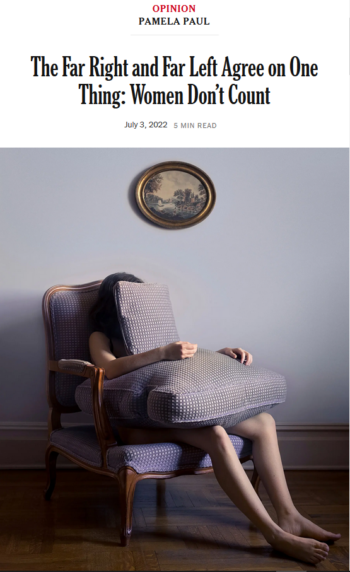
Yes, for New York Times opinion editors (7/3/22), Planned Parenthood and the ACLU are the “far left.”
Paul’s argument about the word “queer” echoes her argument about the word “women” from just a few months earlier: “The Far Right and Far Left Agree on One Thing: Women Don’t Count” (7/3/22). There she accuses a “fringe left” group, including “uber-progressives” and “transgender activists,” of working “to deny women their humanity, reducing them to a mix of body parts and gender stereotypes.”
Yes, it’s the tired argument (that nevertheless repeatedly finds a welcoming home in elite news outlets) that using terms like “pregnant people,” which acknowledge that trans men and nonbinary and intersex people can get pregnant and suffer the same—if not greater—harms from attacks on reproductive rights as cisgender women, means “shov[ing] women to the side.” Paul writes angrily:
Women didn’t fight this long and this hard only to be told we couldn’t call ourselves women anymore. This isn’t just a semantic issue; it’s also a question of moral harm, an affront to our very sense of ourselves.
Same argument, different bottle. Of course women can still call themselves women, and gay people can still call themselves gay—those terms are in no danger or disappearing from our discourse. But using language like “pregnant people” and “queer” expands our language to be more inclusive, not less, and to try to stop erasing those who have historically been most marginalized and often suffer the most from attacks on autonomy and self-determination (FAIR.org, 11/12/21).
A ‘dystopian’ world of negative reviews
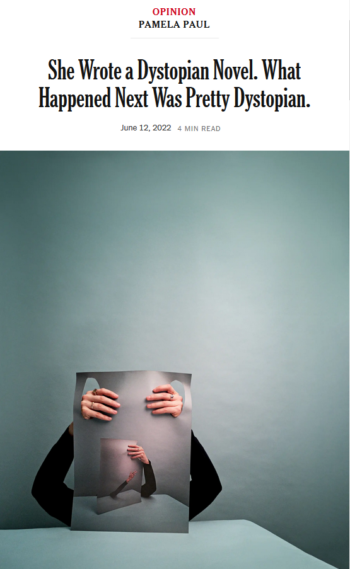
In Paul’s nightmare vision of society (New York Times, 6/12/22), people say negative things about books they don’t like.
In “She Wrote a Dystopian Novel. What Happened Next Was Pretty Dystopian” (6/12/22), Paul denounces the trans critics of a science fiction book about gendercide while pretending the issue can be separated from transphobia: “We can set aside contentious questions around gender identity and transgender politics,” she argues, because a fiction writer “ought to be free to imagine her own universe.”
But in the next paragraph, she jumps right into those contentious questions:
This is in no way a transphobic novel. It neither denies the existence of transgender people, who are woven into the narrative in several places, nor maligns them.
Paul—who is, remember, a cisgender woman—appears to make this definitive judgment based on her own assessment of the novel—Sandra Newman’s The Men—as she cites no trans people supporting that judgment. Nor does she quote any trans critics of the novel in order to present their side of the story—for example, Ada Mardoll (Ramblings, 3/11/22), who argues that the premise of the book is that “no cis woman is evil and no trans woman is good.”
Instead, she falsely suggests that trans critics haven’t even read the book, and reduces their complaints to an inability to accept the idea “that a fictional world would assert the salience of biological sex, however fanciful the context.”
Trans people are the villains in Paul’s depiction of a “nightmare” come to life:
What a sour irony that a dystopian fantasy brought a dark reality one step closer. In this frightful new world, books are maligned in hasty tweets, without even having been read, because of perceived thought crimes on the part of the author. Small but determined interest groups can gather gale force online and unleash scurrilous attacks on ideas they disapprove of or fear, and condemn as too dangerous even to explore.
What happened to the book in question, in the end? It wasn’t banned; it wasn’t taken out of print, or pulled from bookstores. It was criticized by a marginalized group on Goodreads and Twitter. Meanwhile, books affirming trans and nonbinary identities (and discussions of transphobia, and homophobia, and racism) are literally being banned in schools and libraries across the country. As in her other columns, Paul uses the power of her platform to whip up moral panic about the marginalized criticizing the status quo, distracting from the real threat of the powerful silencing those marginalized voices.
A thumb on the scale
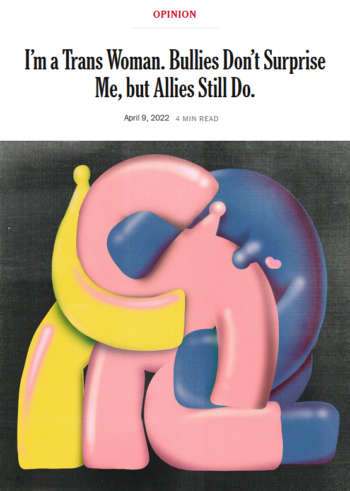
Former New York Times writer Jennifer Finney Boylan (4/9/22) won’t be surprised by very many of Pamela Paul’s columns.
Paul’s arguments deserve attention because they’re downright dangerous. Like the rest of the anti–”cancel culture” warriors, she claims to fight for free expression (“Let’s Say Gay!”) by implicitly urging censorship: Don’t say queer or trans.
By giving Paul a platform, the Times is feeding a grievance-based ideology that directly harms trans and other marginalized people (FAIR.org, 11/23/22). It’s the GOP that is pushing a breathtaking number of anti-trans laws across the country that threaten trans people’s very lives. But it’s the supposedly liberal pundits claiming to fight for free speech and feminism, of which the Times and other elite news media consider themselves a part, that blunt opposition to such moves and make them politically possible.
It was only six years ago that North Carolina faced widespread backlash against its so-called “bathroom bill,” which banned legal protections for transgender and nonbinary people. At the time, Pew Research Center (9/28/16) found that Americans believed trans people should be allowed to use the bathroom of the gender they identify with by a 5 percentage point margin. This year, that support has flipped dramatically (Pew, 9/15/22), with people in favor of requiring people to use the bathroom of the gender they were assigned at birth by 10 percentage points.
Opinion page editor Kathleen Kingsbury (4/26/21) once wrote of the Times Opinion team, “We have our thumb on our scale in the name of progress, fairness and shared humanity.” In this political moment, when control over trans lives has become an increasingly central political and legal debate, and with no trans writers among their stable of columnists or contributing writers, the Paper of Record is paying a cisgender white woman to regularly voice anti-trans arguments. Their thumb is on the scale, all right—but not in the way Kingsbury would like us to believe.
In Jennifer Finney Boylan’s parting missive, “I’m a Trans Woman. Bullies Don’t Surprise Me, but Allies Still Do” (4/9/22), she lamented the high-profile anti-trans rants of people like J.K. Rowling, but found hope in those who spoke out against them. She probably never dreamed that the columnist coming on as she left would use the platform to be one of the bullies, with no trans voice left to counter her.





BREAKING 12-16-22 KYIV, Ukraine — Russia launched another ferocious barrage of missiles at Ukraine on Friday, again pummeling critical infrastructure. At least three people were killed and more than a dozen were injured when a residential building was hit in Kryvyi Rih, one of seven cities targeted in the attack.
Damaged cities — including Kharkiv and Sumy in the northeast, Poltava, Dnipro and Kyiv, the capital — reported power outages after the strikes, even though Ukrainian officials said that their bolstered air defenses had succeeded in intercepting and destroying 60 of 76 missiles fired by the Russians.
And this connects with the above story how, exactly?
Duhhhh. It’s informative, significant and of importance.
So are many things, but why post it here?
I’ve been a FAIR supporter since the beginning of the 90s but you’re losing me on this.
An incredibly long article to defend a fallacy, that gender is in the mind.
Sexuality might be in the mind but gender is determined by testicles or ovaries. Except for the tiny, fraction of a percentage, that are truly intersex/hermaphrodite.
Yes, this article is absurdly long; I gave up about one-third of the way through. Julie Hollar is a fine journalist, but I part ways with her on this one. To begin with, I couldn’t care less about the NYT, which for the most part degenerated into an MSM right-wing mouthpiece many years ago. And though I strongly support the right of any human to follow their own sexual path, it’s a fact that gender is biologically determined, no matter what band of the “masculine/feminine spectrum” you fall into.
When Ralph Nader first ran for POTUS, he infuriated many Gays by saying he was not interested in “genital politics”. I concur. Our world is trembling on the brink of multiple economic and environmental catastrophes. I wish FAIR would spend more time on those issues.
“gender is biologically determined” is utterly untrue and always has been. What do you mean by gender? Is it what we wear, how we communicate, which roles we are permitted to perform, which jobs we can take? The anti-transgender campaign, which is not supported by many of the general public here in the UK (the Women’s Institute, for example, welcomes trans women) is a far-Right campaign in its beginnings and its essence.
Enough with the right or left nonsense thing. Indeed, what flavor Kool Aid do you regularly drink? Gender is determined by testicles/a dick or ovaries/a vagina. There is a very tiny fraction (less than 0.1%) that are truly hermaphrodite (aka they have both) and/or intersexual. Honestly, it’s not very complex and the controversies are more about the dynamic of what’s commonly called self ID or self-identification which often has male-bodied people presenting themselves as women, who live as women, compete with women, with varying degrees of medical intervention and in some cases, or no medical intervention. Sure, it could be ephemeral or even permanent. However and regardless, it’s often a slap in the face to women for a host of very reasonable and sensible reasons. Stop canceling and lecturing people here who have reasonable positions or concerns on complex topics just because – you may – not agree. One size rarely fits all, you know.
Oh boy,,, you are in trouble Ed as stating the the quiet part out loud isn’t allowed here. Bulls eye nevertheless. Personally, its been over just ten days since I read something so incredibly long, but pointless, yet had a clear underlining agenda in mind. This ‘woke’ stuff eventually is gonna tip this country over. Sad.
“Many who oppose transgender rights believe that gender is determined solely by biological sex. But, biological sex isn’t as straightforward as they likely think, and there is no one parameter that makes a person biologically male or female. In fact, many conditions make assigning a biological sex quite difficult.
Despite the complexities, biological sex is often discussed as if it were obvious how to assign male or female sex… The biology of sex is real, but it’s extremely complicated, and there is sometimes no easy way to draw a line between the biologically male and female… “What’s amazed me the most is that there is such a continuum from the male to the female, and it’s really hard to draw a line somewhere neatly in the middle.””
https://www.forbes.com/sites/kimelsesser/2020/06/15/the-myth-of-biological-sex/
This article is making a number of serious mistakes.
(1) “Despite the complexities, biological sex is often discussed as if it were obvious how to assign male or female sex.” This is basically the thesis statement of the article. It seems to imply something it doesn’t want to say, i.e. it is not obvious how to assign sex. But this is patently absurd. In well over 99% of the cases it’s exceedingly obvious how to assign sex.
(2) The article conflates Differences in Sexual Development (DSDs) with intersex. They are not the same. Intersex is a misleading and unhelpful term. A woman born without a uterus is not more of a man or less of a woman. A man with a misshapen penis is not more of a woman or less of a man. They do not exist at an intersection of the sexes like some mythic figure. They are men and women with uncommon bodies.
(3) The article cites chromosomal disorder known as Androgen insensitivity syndrome as an example of sexual ambiguity. According to Wikipedia, AIS occurs in 1 in 20,000 to 64,000 XY (karyotypically male) births. While this syndrome raising some interesting scientific questions, it extremely rare.
(4) “Some individuals are born with ambiguous genitalia and are not clearly male or female in genital appearance at birth. In fact, research indicates that about 2% of the population is born with these ambiguous traits.” This is an astounding claim. It uses the same crappy Fausto-Sterling paper cited in this very article by Julie Hollar. However, where Julie used the paper to falsely claim 1 in 50 people are “intersex,” this Forbes article stunningly uses the same paper to claim 1 in 50 people are born with “not clearly male or female genital appearance at birth.” That is some serious inflation of the numbers. A study from the Endocrine Society puts the number at 1.3 in 1000 (https://www.endocrine.org/news-and-advocacy/news-room/2019/disorders-of-sexual-development-may-be-more-common-in-newborns-than-previously-thought).
(5) “Studies of testosterone levels in elite athletes show overlap between men and women, so it’s tough to use testosterone as criteria for who is biologically male and who is biologically female.” Okay. Who is determining sex based on testosterone levels? I understand this question is relevant to sports, but it has nothing to do with assigning sex.
(6) “It seems biological sex would once again be left to the subjective decision of a doctor.” Over 99% of the population in unambiguously male or female. You can not declare sex subjective based on a 0.13% of the population.
(7) However, the real underlying issue remains… The existence of ambiguous sex does not tell us anything about the existence of transgender people. Most transgender people (as far as I know) have unambiguous genitalia. They simply desire to live as the opposite gender by occupying spaces designated for the opposite sex. I don’t understand what that has to do with DSDs. Please explain.
According to this author, any disinclination to accept the entirety of the latest in gender dogma as promulgated by a fraction of one percent of the population amounts to vilifying trans persons or the trans movement.
The American left isn’t quite impotent enough for Fair?
Another (way, way too long bridge to nowhere) on ‘if so facto’ pronouncements regarding gender theories as if there was demonstrable facts on ‘actual truth’. You have a right to your religion but how about leaving the unconverted alone until you have far better arguments other than what’s hurtful and trying to induce shame for opinion. Also, as someone above alluded too, please write and report on something more meaningful and consequential that affects broad based topics that are destroying human kind. Lose the repeated narrow focus on legitimately contested issues or topics. as its becoming more and more difficult to read – never mind support – FAIR as they become a one trick horse and pony show.
I looked at Ms Paul and thought she was a guy. The big teeth and the weird hair was what made me think of that. Plus, only a guy would wear such ugly earrings. In my mind I gave her a crew cut—-VIOLA! A match!
BUT, really does it matter what gender people are? Seeing more he than she—is this worth discussing. NO, but hopefully Ms Paul finds another occupation , because this one does not seem a good fit.
Okay, weighing in here as a lesbian and feminist. Telling any or all gay people they might actually be a girl or guy (aka; as in actual penis/virginal) throws a wrench into their overall – point in time – development, adding confusion, possible generating bodily mutilation in a worst case scenario. Cool it and let it play out organically (no pun intended). This push by teachers, schools and so-called advocates is becoming disturbing. Frankly the notion that all children can choose their freaken pronouns or dysphoria is sorta nuts. They are just kids you know. But it’s also nuts because it’s based on critical theory whose overall goal is the dismantling of all norms and deconstruction of objective reality often by calling it a function of a new reality. Kinda crazy to my way of thinking.
Transgender rights are not at all based on critical theory. They are based on the reality of transgender people who have been part of every human society. The hatred, contempt and plain ignorance expressed by commenters here, and whenever trans rights are written about by FAIR, are signs of the success of the far Right in pursuing its goal of removing the rights-based progress made in the West over the last century. The removal of reproductive rights is closely linked with attacks against the rights of LGBT+ people to live as ordinary people.
I had teachers-to-be last term forcing middle school kids to choose pronouns, and proudly told me they’d chastised a boy who jokingly said “she/her”, and later I heard thought I was “transphobic” for saying that perhaps not all middle-schoolers are ready to choose their gender identity? (I remember Virginia Uribe, an early developer of an LA school gay support group – “Project 10”, who when criticized for not having gay/lesbian proudly in the title, said it took her until she was a 60 year old grandma to admit she was lesbian.) Using student preferred names and pronouns is respectful of differences, but forcing pronoun choice is wrong to me.
This is so similar to what I just read about a libertarian/conservative hedge fund man named Ramaswamy profiled in the current NYer. He wrote a piece called Woke, Inc. He’s so bothered by liberalism, bc it’s just groupthink. He won’t say, “I just don’t care about these victims, actually.” I’ll quote him here: “The murder of George Floyd was tragic, but it was also tragic that thousands of people of all races died of diseases every day that could be better treated by a broken health-care system.” Such sad content yet I laughed pretty heartily. Why not come out and say “I dont’ care.” Or, “sure the Democrats care about this stuff but I don’t.”
Why can’t Pamela Paul say, “I think these trans people are weird!”
I guess they want to check every box. Years from now perhaps they’ll claim they were abused and had tomatoes thrown at them because of their Right Wing opinions.
I’m not sure what “liberalism” has to do with Woke, Inc., but what would be an acceptable marker for “caring” about George Floyd, at this distance? An appropriate t-shirt? The usual social justice pieties? Would it be enough for the applicant to express dismay at casual police brutality, or would she have to insist on an explicit racial animus as well — because all good people, who are also clairvoyant, do?
Perhaps you’d rather that we distinguish the good people from the bad, those who “care” and those who don’t, by a much simpler means? Say, those who offer, unsolicited, “their” pronouns, and those who don’t?
Would that satisfy the doctrinal requirements of the cargo cult sometimes referred to as “social justice”? Would it go far enough to destroy progressive policy by alienating as many people (sometimes called “voters”) as possible?
Time was, the right was unwilling to talk about class — positively unAmerican! Now look who’s doing it. Compared to consigning the world to genital preoccupations, lulling the lumpen with consumer products is positively inspiring. At least individual thought was still possible.
Major “Pale Horse” Greene — and the Pale Horse Republicans rode in on a pale horse — And what happened? During the “Great Let Down” AKA the Great Plague of Republican Pestilence.
Is Pamela Paul also a member of the pale society, but secretly?
What I mean to say is, Marjorie Turdlore Greene, took photo’s with a KKK Klansman. And the pale people have often been found to be duplicitous. But I don’t know much about her.
Republicanism in 2023:
Join the new GOP “come party with the horse we rode in on”.
Hopefully she is not a part of all that.
The real story – nobody has “it” right yet. About these issues (in the story). I do. But I’ll wait for everyone else to catch up. There is something missing from any and all debates on the issue (at least in the public sphere). From a theological perspective too. I could debate all them into the ground.
How many times have I been right before? Too many and counting. I predicted Trump years before it happened, and the double impeachment. Most of what happened I predicted in 2010 including the far right revolt. Occupy, I predicted in 2002.
For the people who want to see a nicer humanity; the real arguments will be as difficult, but they are as powerful, in support for a universal declaration of human and cognitive rights.
And yes I wanted to call their party the Pale Horse Party when I started writing this.
Why? No other name fits so well.
“Most arrests at raids on gay and lesbian bars were based on violations of gender norms, not sexuality: Laws required people to wear at least three articles of clothing “appropriate” to their assigned gender, so that arrests were made based on gender nonconformity—a much easier thing to prove than who you are attracted to.” – that was an interesting point!
Of course as this writer sees things, the only opinion that matters is hers. anyone who disagrees with anything that she or other trans activists says is a spewing transphobic hate. Women who don’t want to pay sports with trans women are bigots. Women prisoners who don’t want to share a prison cell with a trans women an are bigots. Women who say that only women, or females, as with all mammals, can get pregnant and give birth are bigots. No discussion is allowed. It is what they say it is. That’s it.
I’ve read Pamela Paul as I used to read Jennifer Boylan. I liked Boyla fotbthe most part I til she became so dogmatic and contradictory about anything regarding trans. In one column she said that only trans can play trans characters in movies etc.Fine. But then she failed to say that only biological women or men can play biological women or men. So by her logic only trans can do both. Why do they have that right no on else has. Paul writes about many issues, but because she wrote about how she thinks some of the trans movement is based on old gender stereotypes, she is in the same league as Marjorie Taylor Greene. That is insane. But according to this writer, if you don’t agree, either shut up or admit that you are in the same despicable league as the likes of Greene. Talk about censorship. Opposing view are forbidden, Chase Dtangio, ACKU lawyer, demanded that the book Irreversible Damage not even be allowed in bookstores. This the same organization that once argued that Nazis could March in Skokie ILL, a largely Jewish community with many Holocaust survivors, but a book with info about the harms of puberty blockers and hormones on trans youth should be banned. I used to give money to ACLU but never again. I used to like Fair.organic, but the over the top unfair provacative reporting on this topic, makes me doubt just how fair they are on these reporting on other issues.
Miriam,
You started off with an empty rhetorical statement that applies to everything you said too…hilariously (or sadly) you seem so blinded by your burning desire to be right that you fail to see how saying –
“Of course as this writer sees things, the only opinion that matters is hers.”
applies to all of your claptrap too! Lol lmao….
You illustrate my points exactly. You don’t give any examples of how everything I saw is empty rhetorical claptrap. How exactly are you right and I’m wrong? Only your opinion, not actual facts, matter.
Ms Hollar this is the best thing you’ve written for FAIR. A very thorough and well-argued dismantling of this Times writer and others who share those views. Excellent work!
>Espousing the same biological determinism that forms the core of the anti-trans movement, Paul asserts (falsely) that “the reality of biological science” dictates our gender, dismisses intersex people (a “tiny” 1 out of every 50 people) as irrelevant, and paints as extremists those who suggest one’s gender might not always match one’s sex—while framing the whole thing as purportedly being about children’s liberation or well-being.
(1) I’m not sure what you mean by “biological determinism” here, but biology is overwhelmingly an indicator of gender identity.
(2) Differences in sexual development in a small population don’t refute the sex binary. You don’t develop theories based on outliers.
(3) The research you cite uses an inflated definition of intersex as anyone who deviates from the “platonic ideal that for each sex there is a single, universally correct developmental pathway and outcome.” As argued here (https://www.leonardsax.com/how-common-is-intersex-a-response-to-anne-fausto-sterling/), deviation from the plantonic ideal is not an effective clinical definition of intersex. The vast majority of people within that definition conform to a phenotypic understanding of sex with slight variations (some conditions may even remain unknown until adulthood). The occurrence of truly ambiguous sex is probably closer to around .02%
(4) The existence of differences in sexual development tells us nothing about the existence of trans-identity. It’s a wishy-washy claim that implies there might be some unknown biological source of trans-identity but never says anything of substance.
(5) I wouldn’t call you an extremist, but you did just misrepresent and exaggerate data to make your point.
I would appreciate a response to these points. What am I missing? Because I don’t understand what FAIR is attempting to accomplish by writing smear pieces.
Critical Reader,
You said
“I’m not sure what you mean by “biological determinism” here, but biology is overwhelmingly an indicator of gender identity.”
Which is it? Are you ignorant of what people in the article are talking about? Or are you a genuine critical reader? You seem to lack even basic reading. comprehension skills…lol…this totally begs the question of how you can be critical of something you yourself have now admitted you do not understand? Wow bro-ham.
Again, I’m really not sure what you mean. It seems uncontroversial that upwards of 98% of people have a biology which aligns with their gender identity. If we attempted to predict gender identity based solely on biology, we would be overwhelmingly correct. Keep in mind, I only use the term “gender identity” because the idea is central to the transgender position. I’m not even sure that “gender identity” is a coherent concept. If you can point me towards some solid research on this topic, I would appreciate it. It is really a shame that this topic has short-circuited FAIR, it makes me really question their integrity. Again, if I’m getting something wrong here, please someone point me to some actual evidence.
That’s what i wanted to say.
Oh my god, even comments on an article about the anti-trans panic/genocide are full of anti-trans bullshit. I think I speak for all trans people when I say I’m terrified. I’m going to the range and encourage all queer and trans people to do the same, because our allies aren’t gonna show up for us.
Old science with the 1-2% intersex (from Ann Fausto-Sterling ’00 and ’03) and I over-taught the incident of intersex by 100% during the week on Gender in Intro SOC for years until this year I looked up recent science that adds a zero: .081! Our social desire for trans rights encourages the anti-science view that intersex is common. (Intersex and transgender people generally have nothing to do with each other, but are constantly conflated.) I’ve long taught “two sexes with variation” but attacked by a trans activist for not admitting there are “multiple sexes”, which belies 99.5% of what biologists believe. See “why evolution is true” but how sex reality may be the new Scopes Trial. (At least it was science teachers who teach the required “intelligent design” lessons many BIO textbooks had to assert to appease the right-wing – but non-science teachers are preaching many sexes (not genders) exist! This term a student in my Intro to Women and Gender Studies student asserted she’s learned “her HS biology teacher lied to her”.